For one hundred and sixty million years—an incomprehensible epoch dwarfing the entirety of human existence by more than five hundred fold—the surface of planet Earth was governed by a spectacular dynasty of terrestrial giants: the Dinosauria. Rising from the ash-choked desolation of the Permian-Triassic extinction, archosaurian lineages reorganized vertebrate biomechanics, perfected respiratory efficiency through pulmonary air sacs, developed endothermic metabolisms, and ultimately took flight on feathered wings. Yet quietly in the shadowed understory of this reptilian paradise, tiny, nocturnal synapsid survivors were re-engineering the vertebrate ear, expanding the neocortex, and nursing their young—waiting for the extraterrestrial thunderbolt that would remake the biosphere in a single terrifying day.
1. The Rise of the Archosaurs and the Carnian Pluvial Event (~252 to 201 Ma)
Following the Permian cataclysm, the supercontinent of Pangaea was an arid, monsoonal furnace. Two reptilian clades competed for continental hegemony:
- Pseudosuchia: The crocodile-line archosaurs, featuring sprawling or semi-erect stances, heavy dermal armor, and predatory power (exemplified by giant rauisuchians like Postosuchus).
- Avemetatarsalia (Ornithodira): The bird-line archosaurs, featuring erect, pillar-erect parasagittal limb postures, lightweight skulls, and digitigrade foot mechanics.
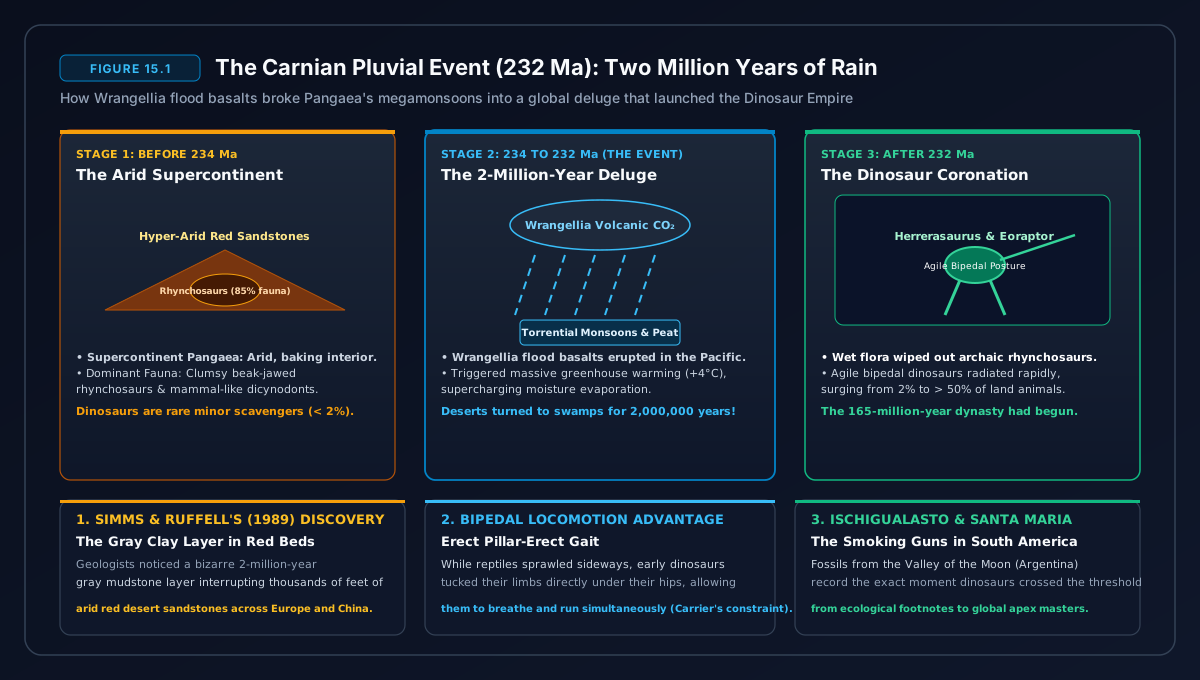
The decisive ecological tipping point occurred approximately 234 to 232 million years ago during the Carnian Pluvial Event (CPE). Massive basaltic volcanism in the Wrangellia oceanic plateau triggered an abrupt surge in greenhouse gases, transforming the global interior from a parched desert into two million years of torrential monsoon rains and humid heat.
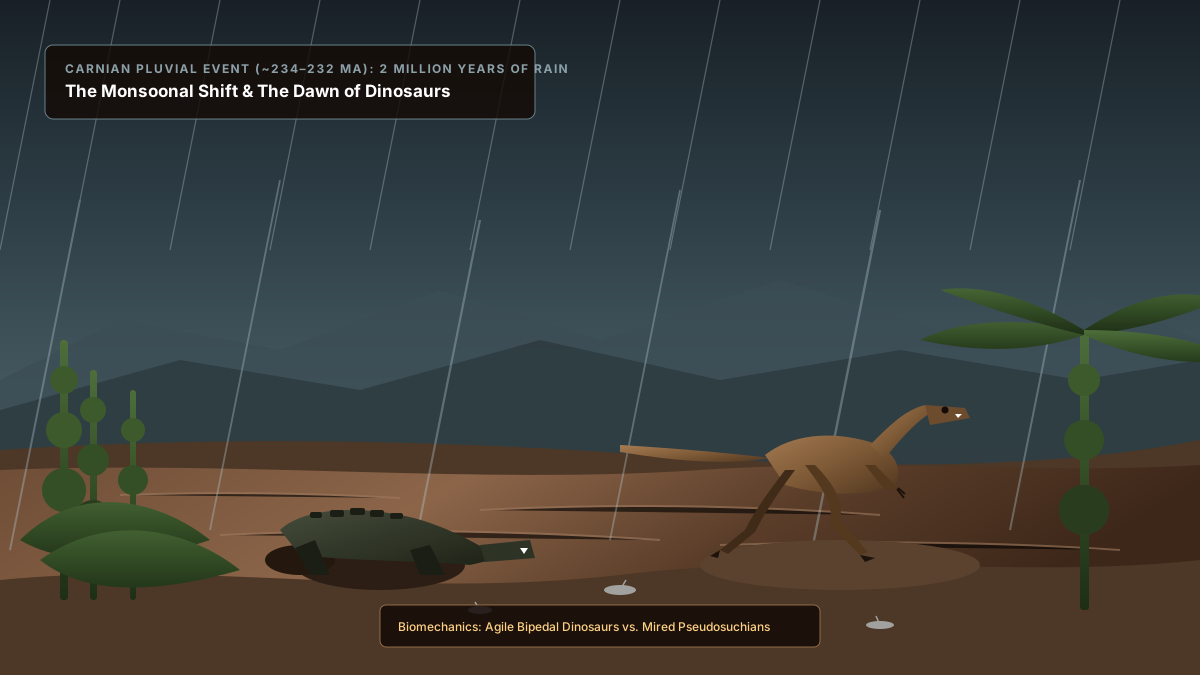
Pseudosuchian heavyweights struggled in the rapidly shifting floral landscape, while early bipedal dinosaurs—such as Herrerasaurus and Coelophysis—possessed athletic, agile body plans with high cursorial speeds and superior energetic efficiency. When the Triassic ended with another volcanic pulse from the Central Atlantic Magmatic Province (CAMP) at 201 Ma, the pseudosuchian apex predators were decimated. Dinosaurs walked through the extinction virtually unscathed, inheriting an empty planet.
2. The Engineering of Gigantism: Biomechanics, Air Sacs, and Bone Histology
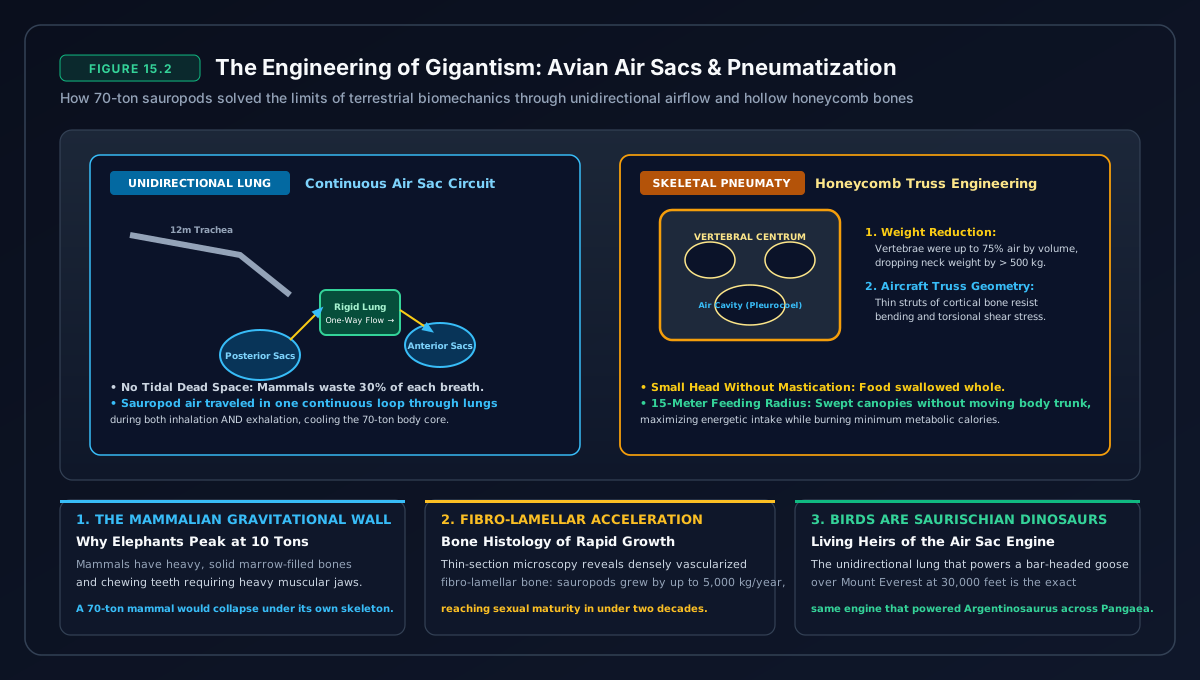
During the Jurassic and Cretaceous periods, sauropod dinosaurs achieved body masses exceeding 70 metric tons (e.g., Argentinosaurus, Patagotitan, and Brachiosaurus)—dimensions that have never been approached by any other terrestrial vertebrate in Earth history. Such colossal scale is biologically impossible under standard mammalian anatomy. Dinosaurs conquered the physical limits of mass through a synergistic cascade of evolutionary adaptations:

| Anatomical Innovation | Biophysical Mechanism | Ecological Advantage |
|---|---|---|
| Unidirectional Air Sac System | Continuous one-way air flow through non-vascular pulmonary air sacs into the lungs during both inspiration and expiration; no dead-end alveolar tidal mixing. | Maintained hyper-efficient oxygen uptake even during periods of low Mesozoic atmospheric oxygen; enabled rapid convective internal cooling. |
| Postcranial Skeletal Pneumaticity | Diverticula from air sacs invaded and hollowed out cervical and dorsal vertebrae (vertebral internal honeycombing). | Reduced skeletal density by up to 35% without compromising structural compressive strength, enabling 12-meter-long necks. |
| Lack of Mastication (Gastric Mills) | Swallowed vegetative matter whole without chewing; food was mechanically ground internally in muscular gizzards using swallowed gastroliths. | Permitted an extremely small, lightweight skull at the end of a vast cantilevered neck; eliminated energetic limits of chewing. |
| Oviparity & High Fecundity | Reproduction via large clutches of eggs rather than prolonged internal placental gestation. | Minimal reproductive downtime for giant females; populations could rebound rapidly from regional climatic stress. |
| Fibrolamellar Bone & Tachymetabolism | Rapidly deposited, highly vascularized fibrolamellar bone tissue matching that of modern birds and placental mammals. | Sub-adult sauropods exhibited explosive growth rates, gaining thousands of kilograms per year to quickly outgrow apex predators. |
In theropod predators—culminating in the 9-ton apex hunter Tyrannosaurus rex—evolution optimized bone-crushing biomechanics. T. rex developed fused nasal bones, deep kinetic skull joints, and incrassate, banana-shaped teeth anchored by deep periodontal roots, generating bite forces exceeding 35,000 Newtons—sufficient to shatter adult triceratops pelvises and extract calcium-rich marrow.
3. The Secret Nocturnal Mammalian Underworld (~220 to 66 Ma)
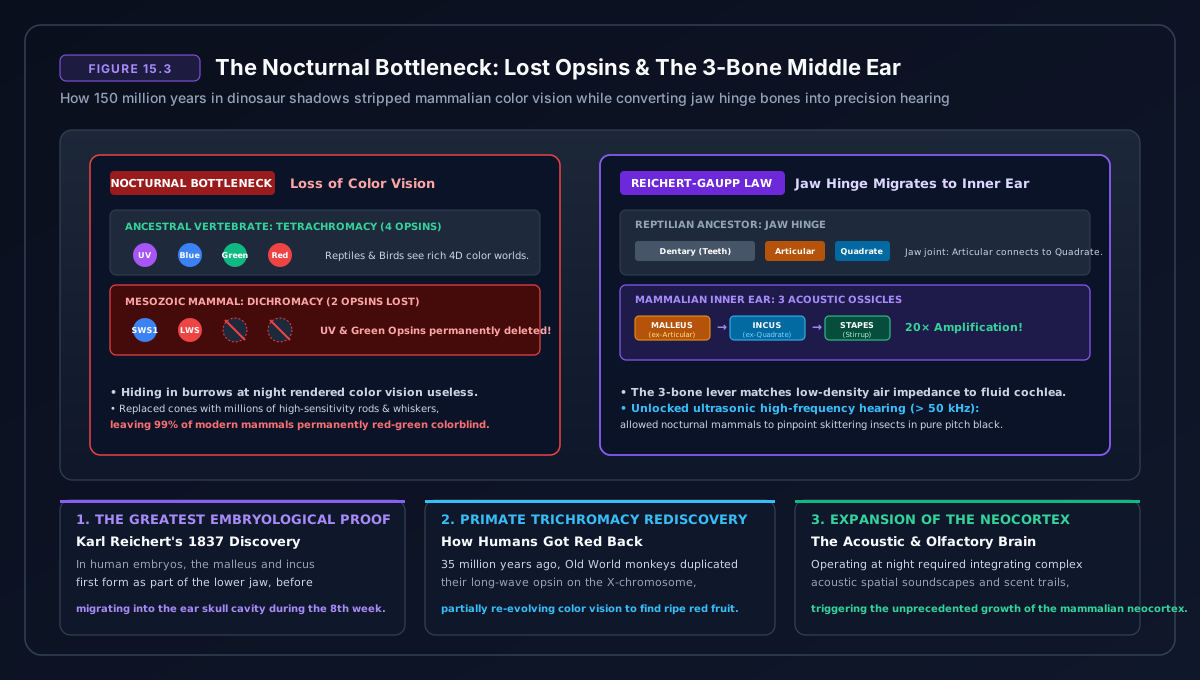
While dinosaurs dominated the diurnal landscape, early mammals were forced into a 160-million-year crucible of nocturnal obscurity. Far from an evolutionary dead-end, this intense ecological pressure drove the genesis of the most sophisticated neurological, sensory, and metabolic systems in the animal kingdom.
The Evolution of the Mammalian Middle Ear
In ancestral reptiles, the lower jaw consists of multiple bones (dentary, articular, angular, surangular), with the jaw hinge formed by the articulation between the articular and the skull’s quadrate. Mammals performed an astonishing evolutionary heist: as the dentary expanded to form the entire load-bearing lower jaw (articulating directly with the squamosal bone), the redundant postdentary bones detached from the jaw apparatus, migrated into the cranial cavity, and were miniaturized into the three delicate ossicles of the modern middle ear: the malleus (hammer, from the articular), the incus (anvil, from the quadrate), and the stapes (stirrup). This mechanical lever system impedance-matched airborne acoustic waves to the fluid of the cochlea, unlocking high-frequency acoustic resolution critical for nocturnal insect hunting.
To survive in cold darkness, early crown-group mammals (such as Morganucodon and the early Cretaceous eutherian Eomaia scansoria) developed:
- Endothermy and Pelage: Sustained elevated basal metabolic rates powered by dense, insulating coats of fur (keratin filaments), allowing vigorous nocturnal hunting when predatory reptiles were sluggish.
- The Neocortex: Massive cranial expansion dedicated to processing olfactory, auditory, and tactile information (whisker vibrissae), laying the anatomical foundation for advanced learning and behavioral plasticity.
- Diphyodont Heterodonty: Two successive sets of teeth (milk vs. adult) with interlocking, precise occlusal cusps (tribosphenic molars) capable of shearing insect chitin and grinding seeds with supreme caloric efficiency.
- Maternal Lactation: The transformation of ancestral apocrine sebaceous skin glands into specialized mammary glands secreting nutrient-dense milk, unburdening hatchlings and newborns from immediate foraging hazards.
4. The Angiosperm Revolution and Insect Co-Evolution (~130 to 80 Ma)
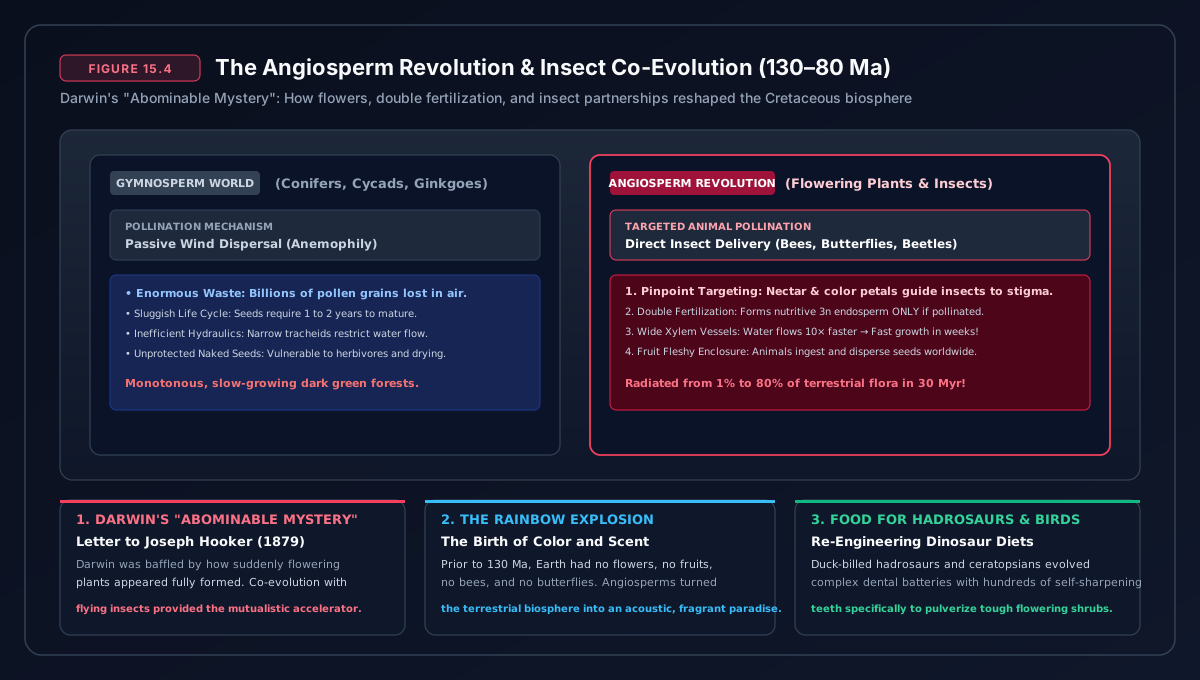
Until the Early Cretaceous, Earth’s flora was dominated by gymnosperms: conifers, cycads, ginkgoes, and seed ferns that relied on inefficient, wind-driven pollination. Around 130 million years ago, the first true flowering plants (angiosperms) burst onto the evolutionary scene.
Angiosperms revolutionized terrestrial ecosystems by inventing enclosed seeds protected within carpels (which mature into fruits) and vibrant floral structures that deployed chemical, color, and nectar rewards. Rather than releasing millions of pollen grains to the random whim of the breeze, angiosperms entered into a tight, reciprocal co-evolutionary pact with insects: hymenopterans (bees and wasps), lepidopterans (butterflies and moths), and dipterans (flies).
This botanical blitzkrieg rapidly pushed gymnosperms into polar and mountainous margins. By providing calorie-dense nectar, fruits, seeds, and fast-growing foliage, the angiosperm revolution triggered a secondary explosive diversification across insects, small mammals, squamate reptiles, and herbivorous dinosaurs like hadrosaurs and ceratopsians.
5. The Chicxulub Impact: The Execution of an Empire (66.04 Ma)
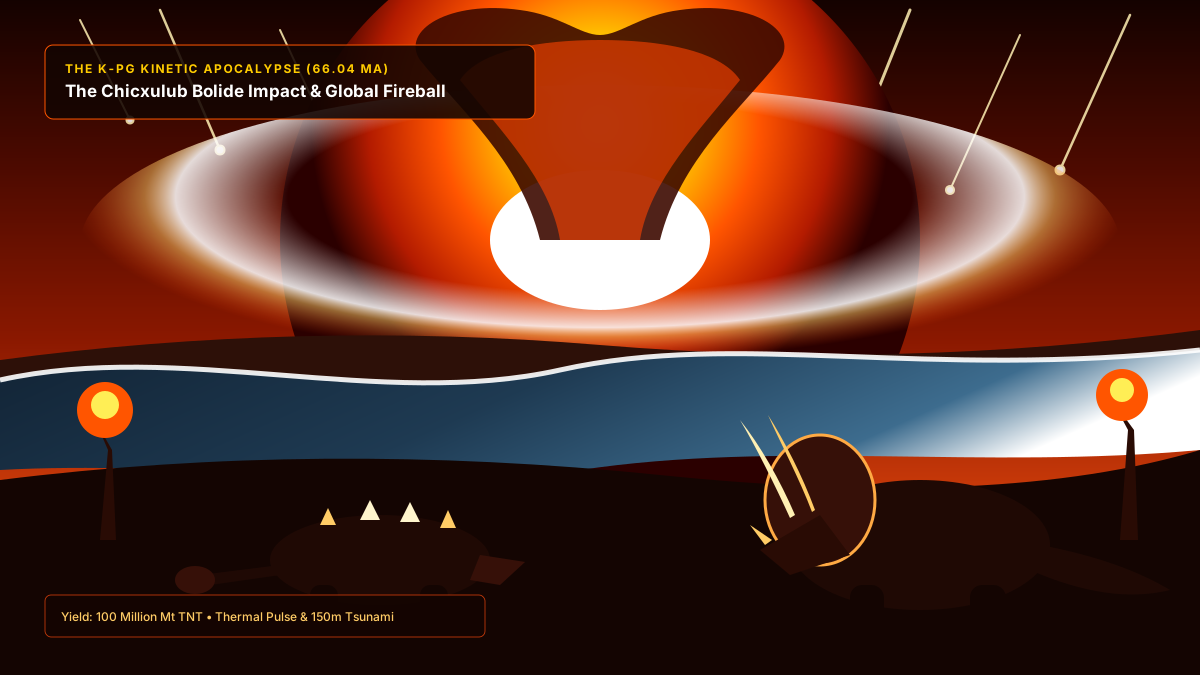
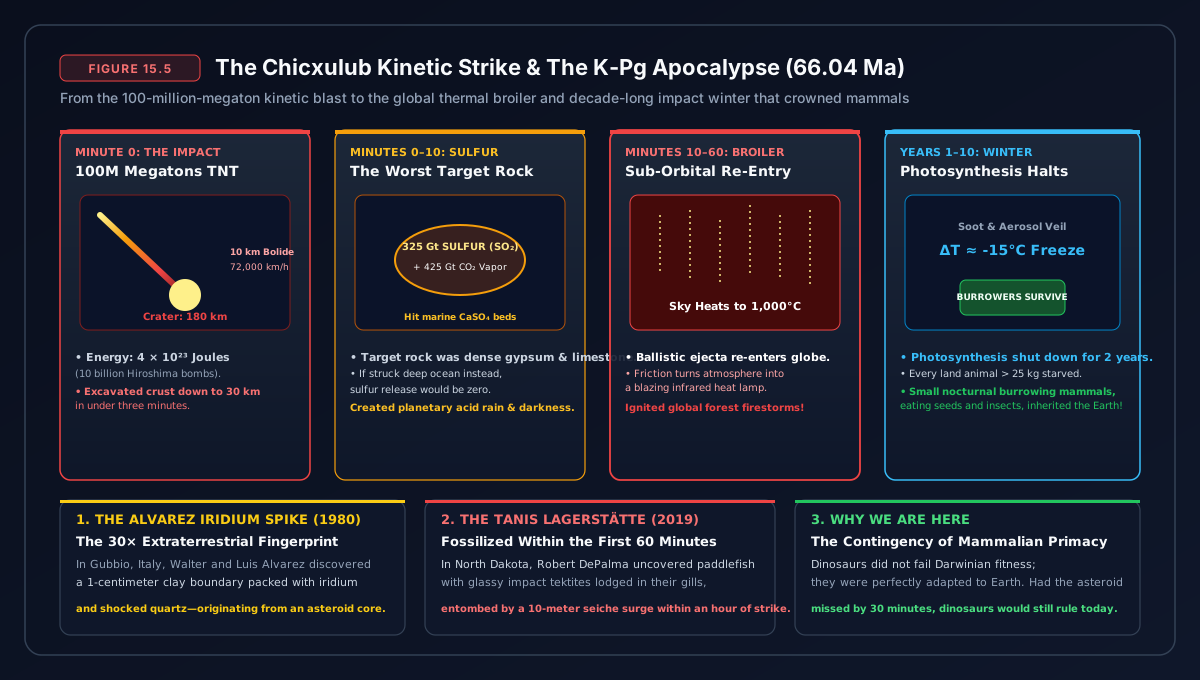
Sixty-six million and forty thousand years ago, an unremarkable carbonaceous chondrite asteroid—measuring approximately 10 to 14 kilometers in diameter—intersected Earth’s orbital trajectory at a velocity of 20 kilometers per second ($72,000 ext{ km/h}$). It struck the carbonate and anhydrite-rich continental shelf of the Yucatán Peninsula at a steep angle of 60 degrees, gouging a transient crater 100 kilometers wide and 30 kilometers deep that immediately collapsed into the modern Chicxulub crater.
The kinetic energy liberated upon impact is quantified as:
$$E_k = rac{1}{2} m v^2 approx rac{1}{2} (2 imes 10^{15} ext{ kg})(2 imes 10^4 ext{ m/s})^2 approx 4 imes 10^{23} ext{ J}$$This is equivalent to 100 million megatons of TNT—over two million times the yield of the largest thermonuclear weapon ever detonated by humanity. The planetary devastation unfolded across several distinct temporal phases:
- The Thermal Pulse (Minutes to Hours): Trillions of tons of pulverized crust were blasted into ballistic suborbital trajectories. As this incandescent ejecta re-entered Earth’s upper atmosphere over the ensuing hours, atmospheric friction turned the entire sky into an incandescent radiant broiler heating the surface to hundreds of degrees Celsius, igniting planetary-scale wildfires across all major continents.
- Megatsunamis & Seismic Shock (Hours): Magnitude 11+ earthquakes shattered regional fault lines, while shockwaves displaced trillions of tons of seawater, driving 150-meter-high megatsunamis deep into the interior seaways of North America.
- The Impact Winter & Sulfuric Acid Fall (Months to Decades): The target rocks contained immense deposits of gypsum ($ ext{CaSO}_4 cdot 2 ext{H}_2 ext{O}$). An estimated 325 gigatons of sulfur and 1,500 gigatons of soot were vaporized directly into the stratosphere, forming a dense global veil of sulfate aerosols and black carbon that blocked 90% of solar radiation. The surface plunged into freezing darkness, arresting photosynthesis in terrestrial plants and marine phytoplankton.
- Ocean Acidification & Collapse of the Photic Zone: Nitric acid rain ($ ext{HNO}_3$, synthesized by impact atmospheric ionization) and carbonic acid dissolved surface ocean carbonates, destroying calcareous nannoplankton, ammonites, and the marine food pyramid.
The Iridium Anomaly: Smoking Gun of the Cataclysm
In 1980, Nobel laureate physicist Luis Alvarez, his geologist son Walter Alvarez, and nuclear chemists Frank Asaro and Helen Michel discovered a razor-thin, centimeter-wide clay layer marking the Cretaceous-Paleogene (K-Pg) boundary at Gubbio, Italy, and Caravaca, Spain. This boundary clay exhibited concentrations of iridium—a platinum-group siderophile element exceedingly rare in Earth’s crust because it sank to the metallic core during planetary differentiation, but highly abundant in primitive chondritic asteroids—up to 160 times background levels. The discovery of shocked quartz grains bearing microscopic planar deformation features (PDFs) and microtektites (extraterrestrial melt spherules) cemented the impact hypothesis beyond scientific doubt.
6. The Mammalian Dawn
When the sun finally pierced through the dissipated sulfuric fog after a decade of freezing twilight, 75% of all species on Earth were gone. The non-avian dinosaurs, the flying pterosaurs, the marine mosasaurs and plesiosaurs, and the coiled ammonites were erased forever.
Survival was not random; it was dictated by physiology and ecological trophic rank. Large-bodied endotherms with immense caloric demands starved. Those who survived were the subterranean opportunists: small, burrowing mammals, freshwater crocodilians and turtles (protected by aquatic thermal inertia and detritus-based trophic chains), and small, feathered maniraptoran theropods capable of eating dormant seeds—the avian dinosaurs (birds).
In the vacant, predator-free expanses of the early Paleocene, surviving mammals found themselves in an ecological vacuum. Within a mere 400,000 years of the impact, placental lineages exploded in diversity and body mass. The archaic nocturnal foragers stepped out into the daylight, evolving into browsers, carnivores, ungulates, bats, cetaceans, and arboreal fruit-seekers with binocular stereoscopic vision. The stage was set for the Cenozoic Era—and the emergence of the Primates.
Academic Citations & Historical References
- Alvarez, L. W., Alvarez, W., Asaro, F., & Michel, H. V. (1980). Extraterrestrial cause for the Cretaceous-Tertiary extinction. Science, 208(4448), 1095–1108. doi:10.1126/science.208.4448.1095
- Schulte, P., Alegret, L., Arenillas, I., et al. (2010). The Chicxulub asteroid impact and mass extinction at the Cretaceous-Paleogene boundary. Science, 327(5970), 1214–1218. doi:10.1126/science.1177265
- Brusatte, S. L., Benton, M. J., Ruta, M., & Lloyd, G. T. (2008). Superiority, competition, and opportunism in the evolutionary radiation of dinosaurs. Science, 321(5895), 1485–1488. doi:10.1126/science.1161833
- Rowe, T. (1988). Definition, diagnosis, and origin of Mammalia. Journal of Vertebrate Paleontology, 8(3), 241–264. doi:10.1080/02724634.1988.10011708
- Benton, M. J. (2014). Vertebrate Palaeontology (4th ed.). Wiley-Blackwell. ISBN:978-1118406847.
- Chiarenza, A. A., Farnsworth, A., Mannion, P. D., et al. (2020). Asteroid impact, not volcanism, caused the end-Cretaceous dinosaur extinction. Proceedings of the National Academy of Sciences, 117(29), 17084–17093. doi:10.1073/pnas.2006087117
- Sander, P. M., Christian, A., Clauss, M., et al. (2011). Biology of the sauropod dinosaurs: the evolution of gigantism. Biological Reviews, 86(1), 117–153. doi:10.1111/j.1469-185X.2010.00137.x