
For two hundred thousand years, every human who ever lived was a nomad whose survival depended on memorizing seasonal animal migrations, edible tuber patches, and the locations of waterholes. But as the planet emerged from the chill of the Younger Dryas into the warm, predictable equilibrium of the Holocene epoch 11,700 years ago, a profound economic shift occurred. In the alluvial valleys of the Fertile Crescent, the Yangtze, the Indus, and Mesoamerica, humans laid down their spears, cleared forests, trapped rivers in irrigation canals, and altered the genomes of wild grasses through artificial selection. In doing so, humanity triggered an explosive cascade: demographic booms, the division of labor, the externalization of thought into written script, the rise of sovereign city-states, and ultimately the formulation of universal mathematical laws governing the cosmos.
1. The Holocene Climatological Oasis and the Neolithic Transition (~10,000 to 6000 BCE)
The Pleistocene was characterized by violent, chaotic climate swings: interglacials were punctuated by sudden plunges into subzero glacial maximums within a few decades. Under such unpredictable variability, long-term agriculture was thermodynamically impossible; planting crops requires reliable annual rainfall and stable growing seasons.
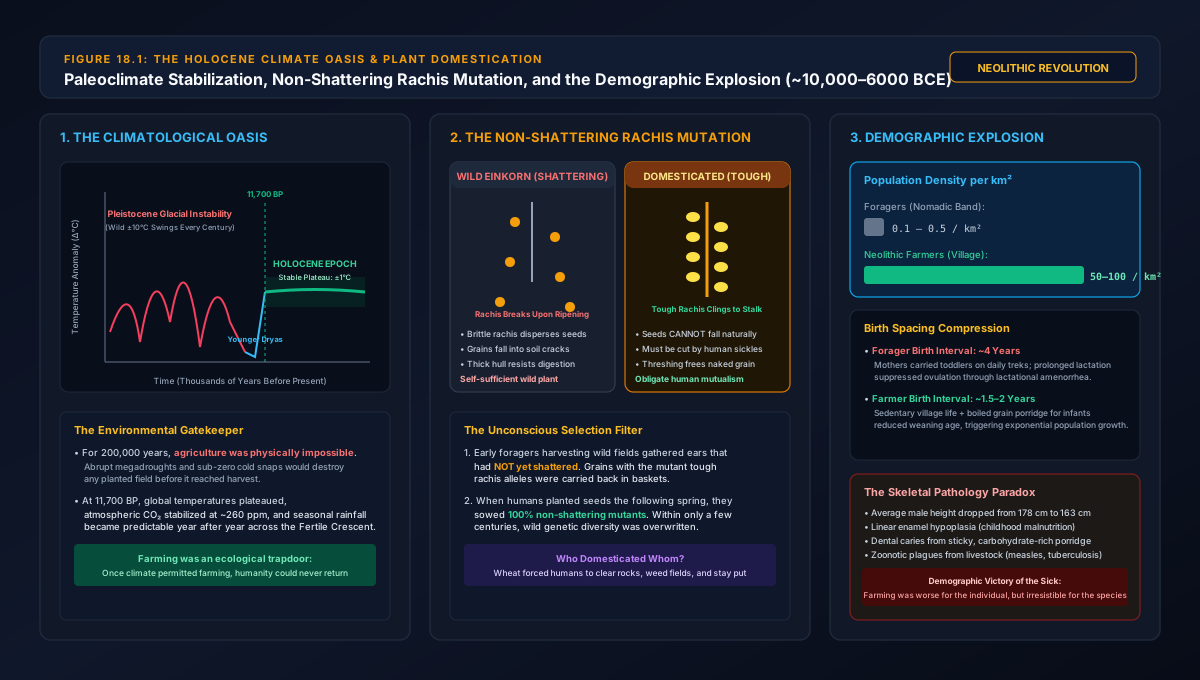
Approximately 11,700 years ago, the Earth entered the Holocene. Global temperatures stabilized within a narrow band of \± 1^°C\, atmospheric CO₂\ held steady at approximately 260 ppm, and seasonal monsoons settled into reliable cycles. In the Levant and Anatolia, hunter-gatherer bands who had established semi-sedentary base camps (the Natufian culture) began actively manipulating wild cereal stands.

The Genetic Remodeling of Cereal Grasses
In wild emmer (Triticum dicoccoides) and einkorn wheat, the central stem of the seed head—the rachis—is brittle. Upon ripening, the rachis shatters in the wind, scattering individual spikelets across the ground to ensure seed dispersal. When early foragers gathered wild wheat, they selectively harvested the mutant plants possessing a genetic defect: a non-shattering (tough) rachis that held seeds firmly to the stem. By planting only these retained seeds, early farmers conducted unconscious genetic engineering: within a few centuries, wheat lost its biological capacity to reproduce without human intervention, trading wild autonomy for exponential human cultivation.

Following plant domestication came the taming of herbivores: mouflon sheep, wild bezoar goats, aurochs (ancestors of cattle), and wild boar. Animals were selected for docility, reduced flight distance, and paedomorphic (juvenile) behavioral traits. By tapping into secondary animal products—milk, wool, traction power, and manure fertilizer—human communities multiplied their available kinetic energy by an order of magnitude.
2. The Hydraulic Megamachine: Uruk and the Urban Explosion (~4000 to 3000 BCE)
In the arid southern alluvial plains of Lower Mesopotamia, between the volatile floods of the Tigris and Euphrates rivers, simple rain-fed agriculture was impossible. Survival demanded massive collective engineering: digging hundreds of kilometers of irrigation canals, dredging silt, and constructing flood-control dykes.
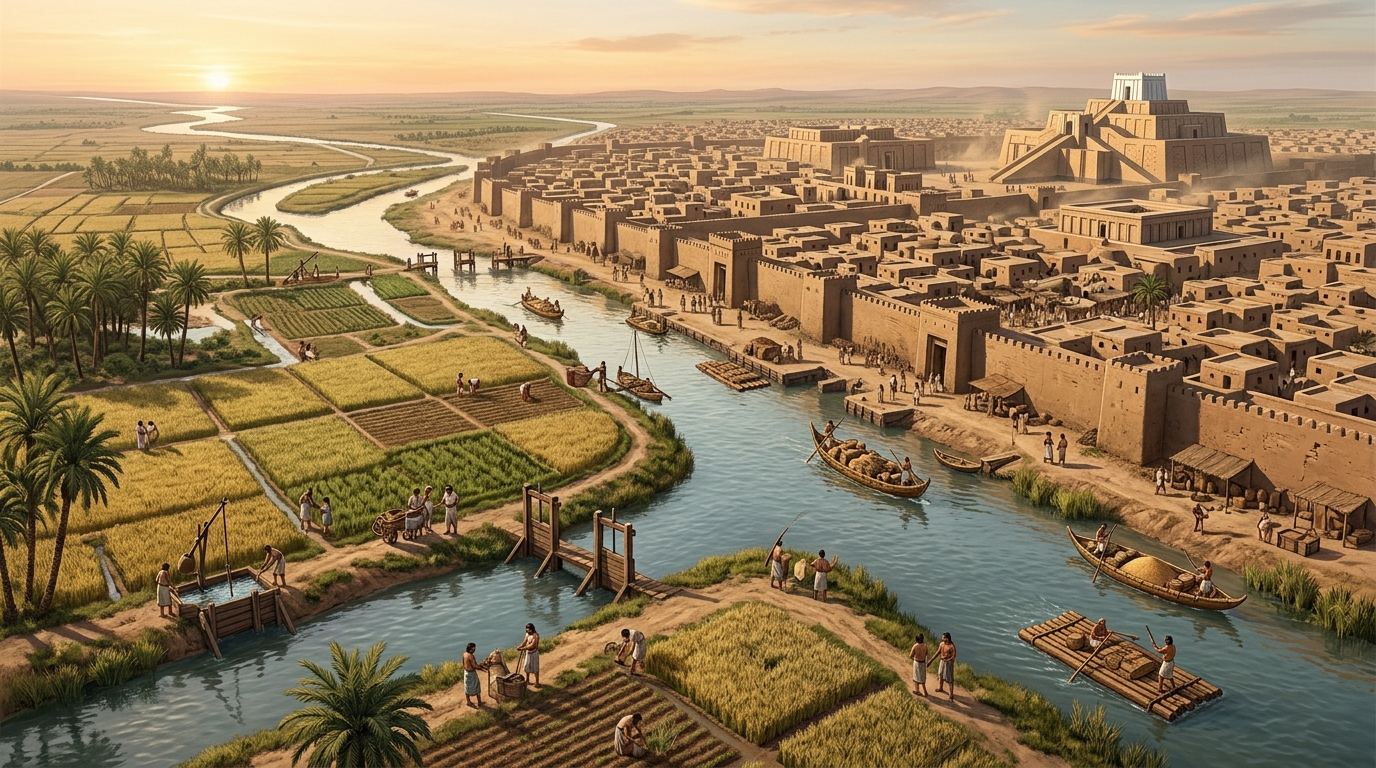
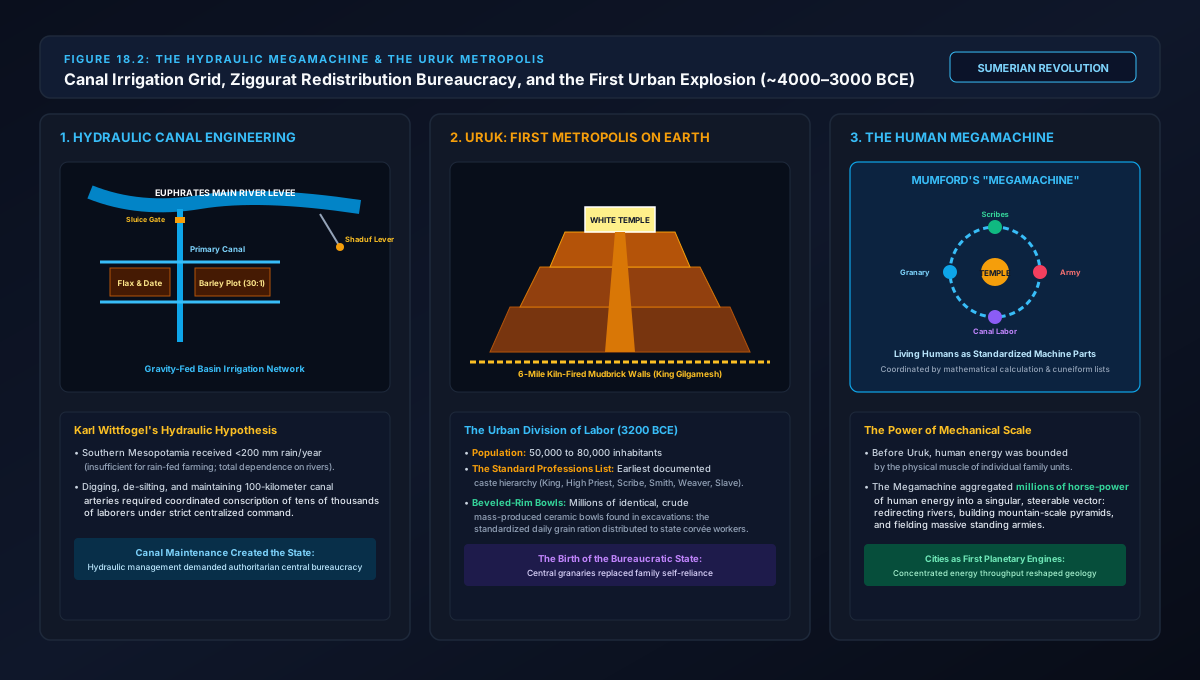
This hydraulic imperative birthed the world’s first true metropolis: Uruk. By 3200 BCE, Uruk housed an estimated 50,000 inhabitants within a six-square-kilometer circuit of brick defensive walls. For the first time in natural history, a biological community was divided into hyper-specialized professional castes:
| Social / Economic Stratum | Functional Role in the Urban Megamachine | Technological Catalyst |
|---|---|---|
| Agrarian Producers | Plowing, canal excavation, cereal cultivation, and animal husbandry. | Ard (scratch plow), copper sickles, oxen draft harnesses. |
| Craft Specialists | Mass production of standardized pottery, textiles, and metallurgy. | Potter’s fast wheel, lost-wax bronze casting (copper-tin alloy). |
| Scribes & Temple Bureaucrats | Taxation auditing, land surveying, grain redistribution, and astronomical calculation. | Proto-cuneiform clay tablets, sexagesimal (base-60) arithmetic. |
| The Sovereign Priesthood (Ensi) | Ideological legitimacy, ritual mediation with celestial pantheons, command over labor. | Monumental architecture (baked-mudbrick ziggurats), legal codes. |
3. The Externalization of Symbolic Memory: From Clay Tokens to the Alphabet
The human brain was never wired by natural selection to memorize the grain debts, land boundaries, and tax obligations of 50,000 citizens. Writing was not invented to compose lyric poetry or philosophical treatises; it was invented as a ledger accounting system for the temple storehouses of Mesopotamia.

The evolutionary trajectory of writing followed a strict developmental progression:
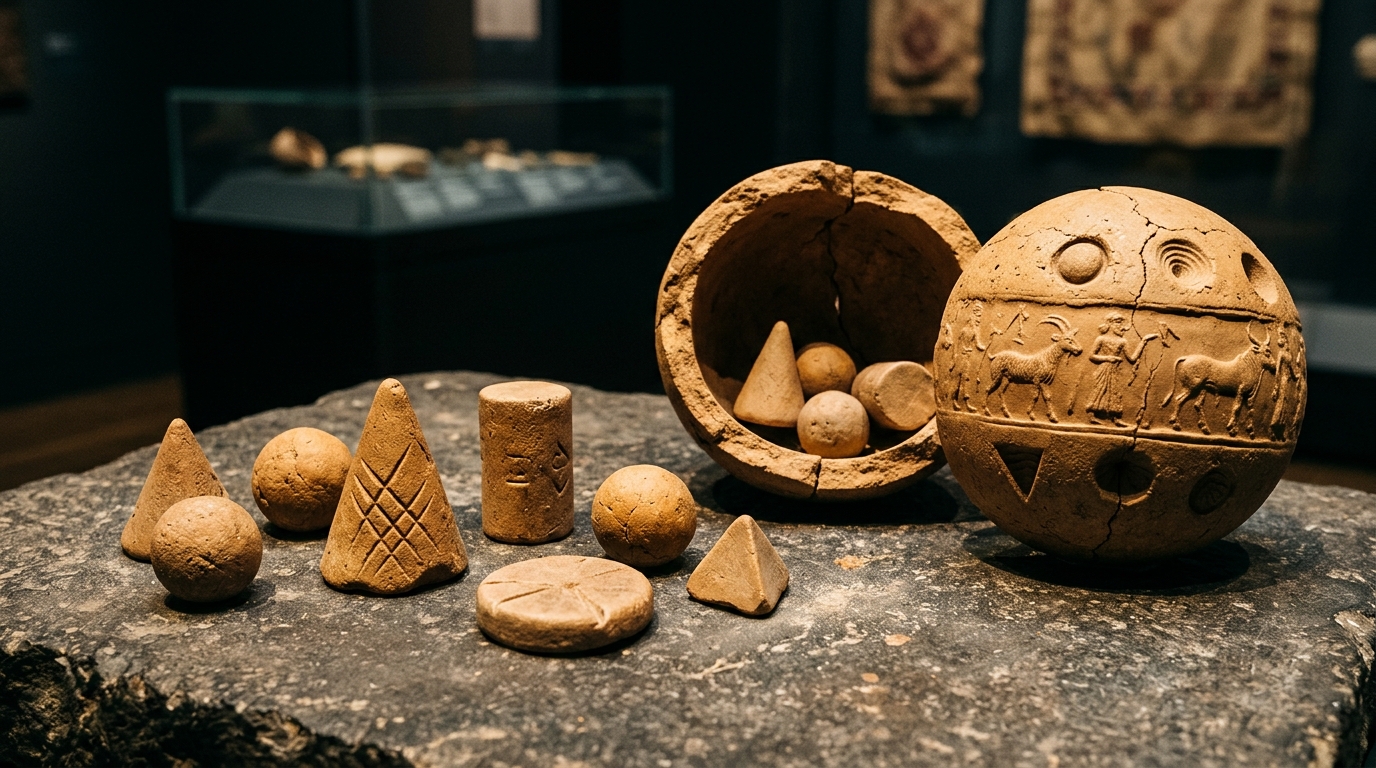
- Clay Accounting Tokens (~8000 BCE): Small geometric clay spheres, cones, and cylinders representing specific commodities (e.g., one cone = one bushel of barley; one sphere = one vessel of oil).
- Clay Bullae & Impressions (~3500 BCE): Tokens were sealed inside hollow spherical clay envelopes (bullae) stamped with cylinder seals. To verify contents without breaking the envelope, scribes pressed the tokens into the wet exterior clay. Scribes soon realized the interior tokens were redundant: two-dimensional stylus impressions on a flat clay tablet conveyed the identical information.
- Proto-Cuneiform to Phonetic Cuneiform (~3200 to 2500 BCE): Pictographic representations (e.g., a drawing of a head eating from a bowl representing “to eat” or “ration”) became increasingly stylized and wedge-shaped through the use of reed styluses. Crucially, scribes introduced the Rebus Principle: a pictograph was used not for its visual meaning, but for its phonetic sound value (e.g., using the pictograph for “reed” [*gi*] to represent the abstract verb “to render” [*gi*]).
- The Phonetic Alphabet Revolution (~1800 to 1000 BCE): While cuneiform and Egyptian hieroglyphs required memorizing hundreds of complex logographic signs—restricting literacy to an elite guild of lifetime scribes—Semitic miners in the Sinai adapted Egyptian hieroglyphs into the first consonantal alphabet (Abjad). By reducing written communication to roughly 22 phonetic signs corresponding to individual vocal phonemes, the Phoenicians and Greeks democratized literacy across the Mediterranean Basin.
4. The Axial Age: The Emergence of Philosophical Inquest (~800 to 200 BCE)
With the widespread dissemination of the alphabet and the advent of the Iron Age (which made durable iron plows and weapons universally accessible), human civilizations across Eurasia underwent a simultaneous philosophical awakening termed by Karl Jaspers as the Axial Age.

Between 800 and 200 BCE, thinkers decoupled moral inquiry and natural law from arbitrary priestly superstition:
- In Greece: Thales of Miletus proposed that natural phenomena were governed by immutable material principles (*arche*) rather than the whims of Olympian gods; Democritus hypothesized that all matter was composed of indivisible, eternal particles (*atomos*); Aristotle developed formal syllogistic logic and systematic biological classification.
- In India: The authors of the Upanishads, Mahavira, and Siddhartha Gautama (the Buddha) investigated the psychological phenomenology of consciousness, suffering (*dukkha*), and ethical causation (*karma*).
- In China: Confucius and Laozi debated the structural harmony of the state, personal virtue, and the cosmic order of the *Dao*.
5. The Mechanization of Thought and the Scientific Revolution (1543 to 1687 CE)
The accumulated philosophical and mathematical insights of antiquity were brought to explosive ignition through two technological amplifiers in Early Modern Europe:
The Printing Press and the Information Singularity
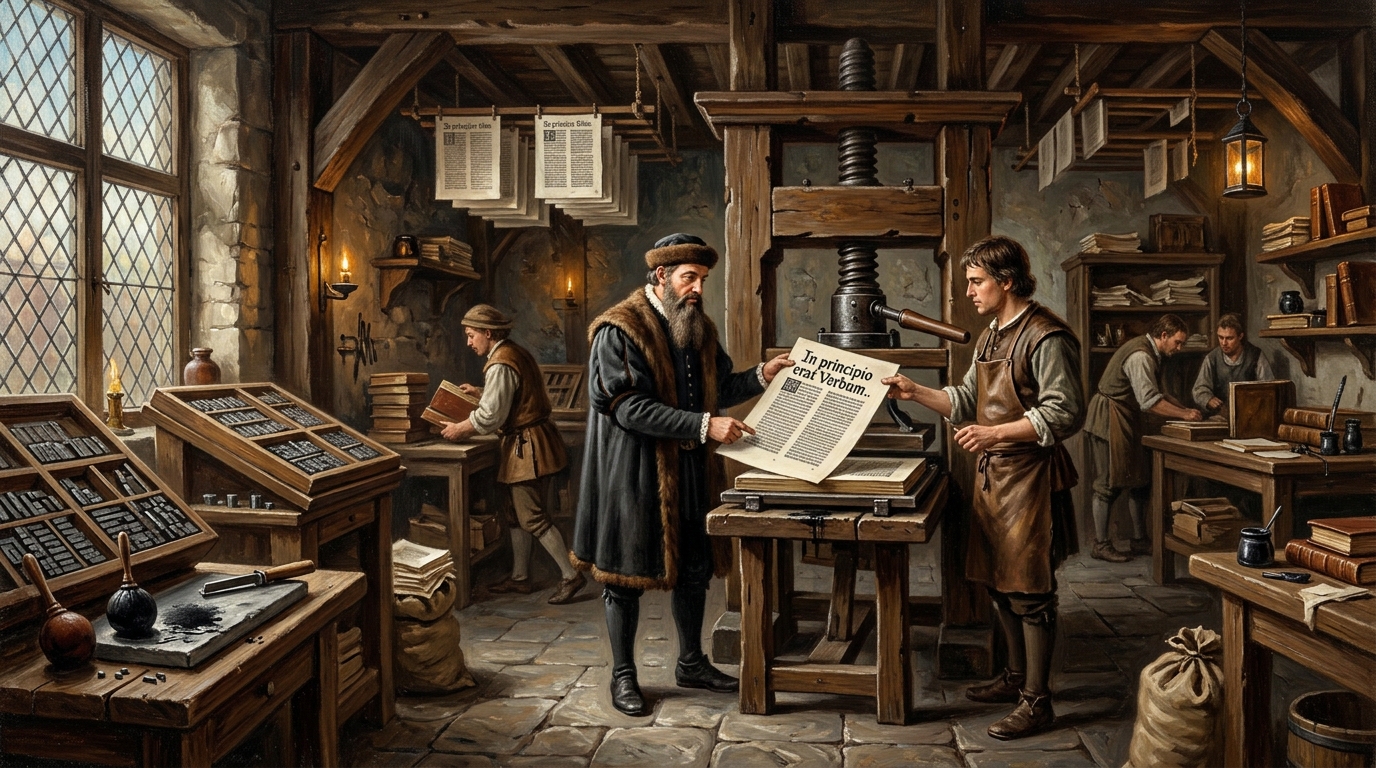
In 1440, Johannes Gutenberg synthesized movable metal type, oil-based ink, and a wooden screw press in Mainz, Germany. Prior to Gutenberg, copying a single volume of the Latin Bible required months of laborious manual scribe work on hundreds of sheepskin parchment folios. By reducing the marginal cost of textual reproduction by over 99%, the printing press made scientific treatises, astronomical tables, and anatomical drawings universally replicable, eliminating the risk of lost knowledge and catalyzing the Protestant Reformation, the Enlightenment, and the Scientific Revolution.
In 1543, Nicolaus Copernicus published De revolutionibus orbium coelestium, displacing Earth from the motionless center of the cosmos and establishing a heliocentric geometry. Johannes Kepler analyzed Tycho Brahe’s meticulous planetary observations, discovering that planets orbit in ellipses and formulating the mathematical laws of planetary motion.
Simultaneously, Galileo Galilei constructed a 30x refractive spyglass, discovering the moons of Jupiter, the phases of Venus, and sunspots—proving that the celestial bodies were imperfect, dynamic worlds governed by the same physical laws as Earth. Galileo formulated the foundational methodology of modern science: “The book of nature is written in the language of mathematics.”
6. Newton’s Principia: The Universal Synthesis (1687 CE)
The definitive culmination of the scientific awakening arrived in 1687 with the publication of Sir Isaac Newton’s Philosophiae Naturalis Principia Mathematica. Newton unified the terrestrial physics of falling apples with the celestial kinematics of orbiting planets under a single universal framework.
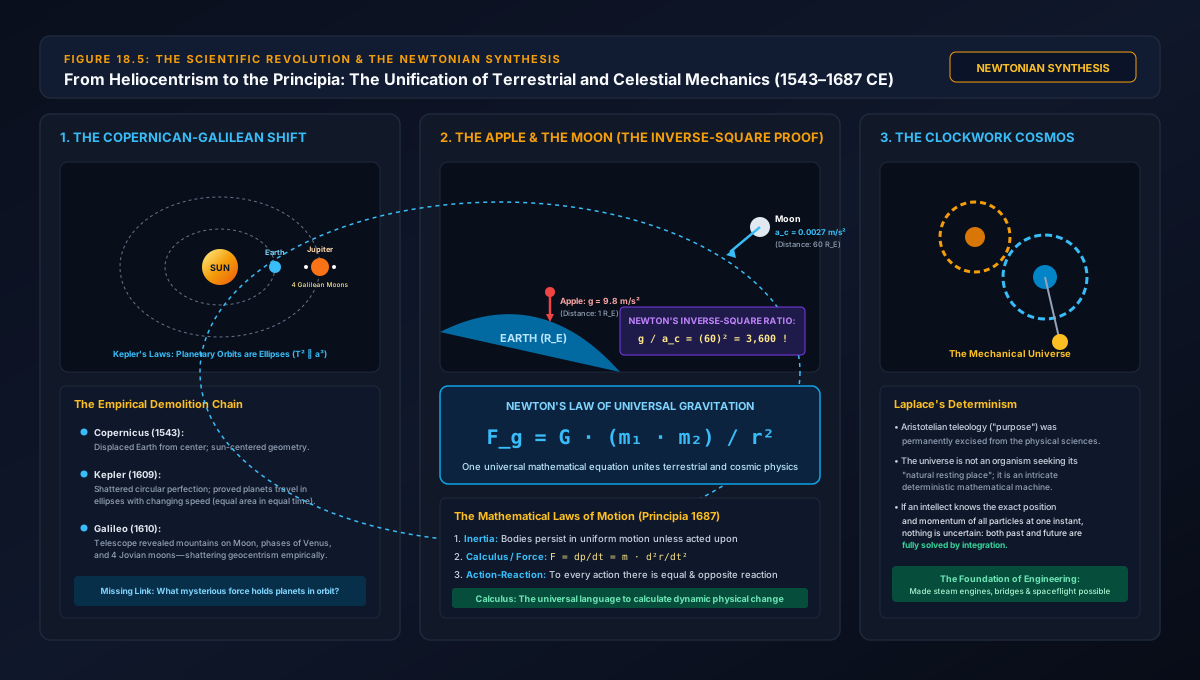
Newton invented the differential and integral calculus (the method of fluxions) to express dynamic rates of change, establishing the three fundamental laws of classical mechanics and the Law of Universal Gravitation:
$$\vec{F} = \frac{d\vec{p}}{dt} = m \frac{d^2\vec{r}}{dt^2}$$ $$F_g = G \frac{m_1 m_2}{r^2}$$For the first time in the history of the universe, matter had evolved to understand the invisible mathematical equations that orchestrated its own cosmic dance. The universe was no longer a realm of caprice, demons, or divine arbitrariness; it was a vast, elegant clockwork machine governed by deterministic mathematical principles. The intellectual engine that would unlock the Industrial Revolution, electricity, and the digital age was now permanently primed.
Academic Citations & Historical References
- Diamond, J. (1997). Guns, Germs, and Steel: The Fates of Human Societies. W. W. Norton & Company. ISBN:978-0393038910.
- Childe, V. G. (1936). Man Makes Himself. Watts & Company. ISBN:978-0851246499.
- Kramer, S. N. (1956). History Begins at Sumer: Thirty-Nine Firsts in Recorded History. University of Pennsylvania Press. ISBN:978-0812212761.
- Scott, J. C. (2017). Against the Grain: A Deep History of the Earliest States. Yale University Press. ISBN:978-0300182910.
- Eisenstein, E. L. (1979). The Printing Press as an Agent of Change. Cambridge University Press. ISBN:978-0521299558.
- Newton, I. (1687). Philosophiae Naturalis Principia Mathematica. Royal Society of London. doi:10.5479/sil.52166.39088015628391
- Jaspers, K. (1953). The Origin and Goal of History. Yale University Press. ISBN:978-0300001358.