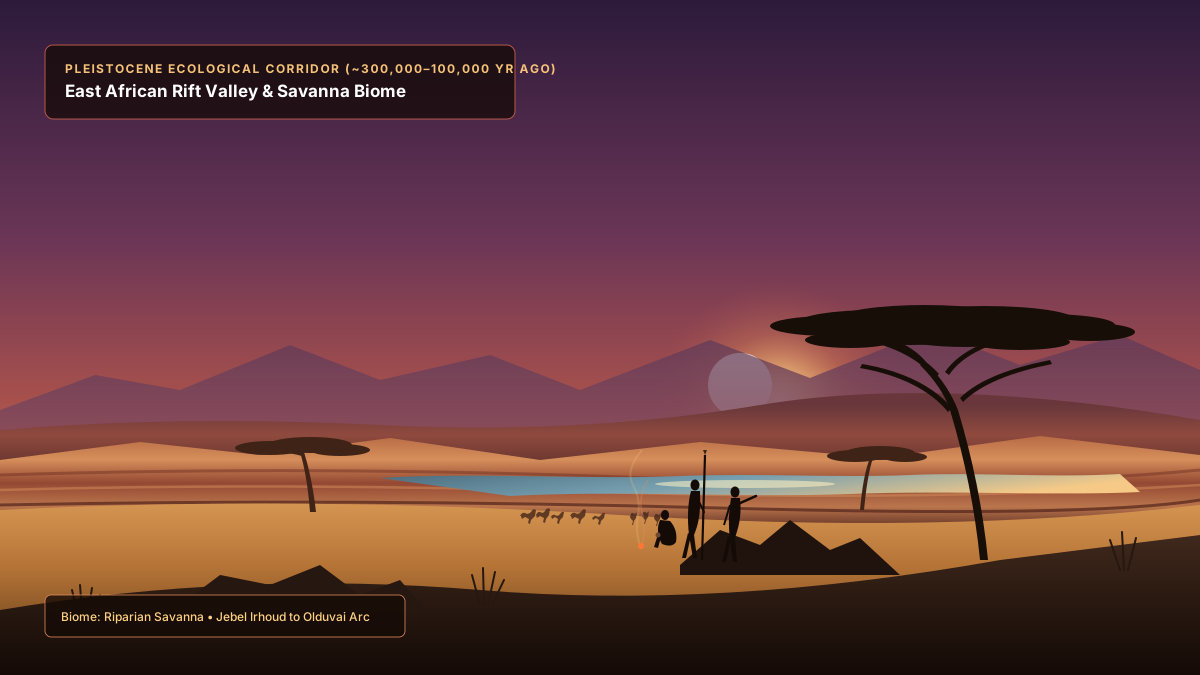
For more than ninety-nine percent of human evolutionary history, our ancestors were ecologically unremarkable primates. They chipped stones, tracked game across river valleys, and huddled around smoky hearths, yet their environmental impact was indistinguishable from that of baboons, leopards, or hyenas. Then, between one hundred thousand and seventy thousand years ago, an astonishing intellectual threshold was crossed. In a transformation evolutionary historians designate as the Cognitive Revolution, one African lineage developed recursive syntactic language, externalized symbolic thought through ochre engravings and cave art, and invented the capacity to believe in entities that exist solely within the collective imagination—unleashing a cooperative force that would sweep across every continent and alter the face of the Earth.
1. The Pan-African Origin of Homo sapiens (~315,000 to 100,000 yr ago)
Until recently, paleoanthropological orthodoxy held that Homo sapiens originated in a singular East African “Garden of Eden” around 200,000 years ago. However, the landmark 2017 excavations at Jebel Irhoud, Morocco, led by Jean-Jacques Hublin, revolutionized this paradigm by uncovering early modern human fossils and Middle Stone Age flint tools securely dated to 315,000 years ago.

Morphometric analyses revealed a vital evolutionary insight:
- The facial skeleton of the Jebel Irhoud fossils is completely modern, exhibiting delicate supraorbital tori (brow ridges), a retracted midface, and canine fossae indistinguishable from living humans.
- In contrast, the braincase remains archaic—elongated and archaic in shape (platycephalic), lacking the globularity that characterizes living modern humans.
The definitive anatomical hallmark of our species—cranial globularity—evolved gradually over the ensuing 200,000 years through the expansion of the parietal and cerebellar brain lobes. This neuroanatomical remodeling reflects the hyper-specialization of neural circuits dedicated to spatial processing, visuospatial integration, episodic memory, and mental self-projection.
2. The Neurogenetic Basis of Syntactic Speech and Recursion
While chimpanzees and monkeys possess distinct alarm vocalizations (signaling “eagle,” “snake,” or “leopard”), animal communication is strictly constrained to referential signals grounded in immediate sensory experience. The human linguistic breakthrough was not merely louder vocalization, but the emergence of infinite semantic recursion—the algorithmic ability to embed phrases within phrases to generate an infinite variety of thoughts from a finite alphabet of phonemes.

This linguistic capacity required a twin biological convergence:
| Biological Dimension | Anatomical / Genetic Mechanism | Linguistic Consequence |
|---|---|---|
| Vocal Tract Reorganization | Descent of the larynx into the pharynx; flexed basicranium creating a two-tube acoustic resonator with equal horizontal (oral) and vertical (pharyngeal) cavities. | Unlocked precise motor control over tongue and formant frequencies, enabling unambiguous differentiation of rapid vowel sounds (\/a/\, \/i/\, \/u/\). |
| The FOXP2 Transcription Factor | Two critical amino acid substitutions (threonine-to-asparagine at position 303 and asparagine-to-serine at position 325) unique to the human lineage. | Regulates synaptic plasticity in the striatum and cortico-basal ganglia loops, allowing rapid motor sequencing of rapid articulatory speech movements. |
| Arcuate Fasciculus Expansion | Massive axonal fiber bundle directly interconnecting Wernicke’s area (posterior superior temporal gyrus) with Broca’s area (inferior frontal gyrus). | Enables instantaneous translation between phonological sensory decoding and recursive syntactic hierarchical motor production. |
3. The Symbolic Awakening and Externalized Memory (~100,000 to 40,000 yr ago)
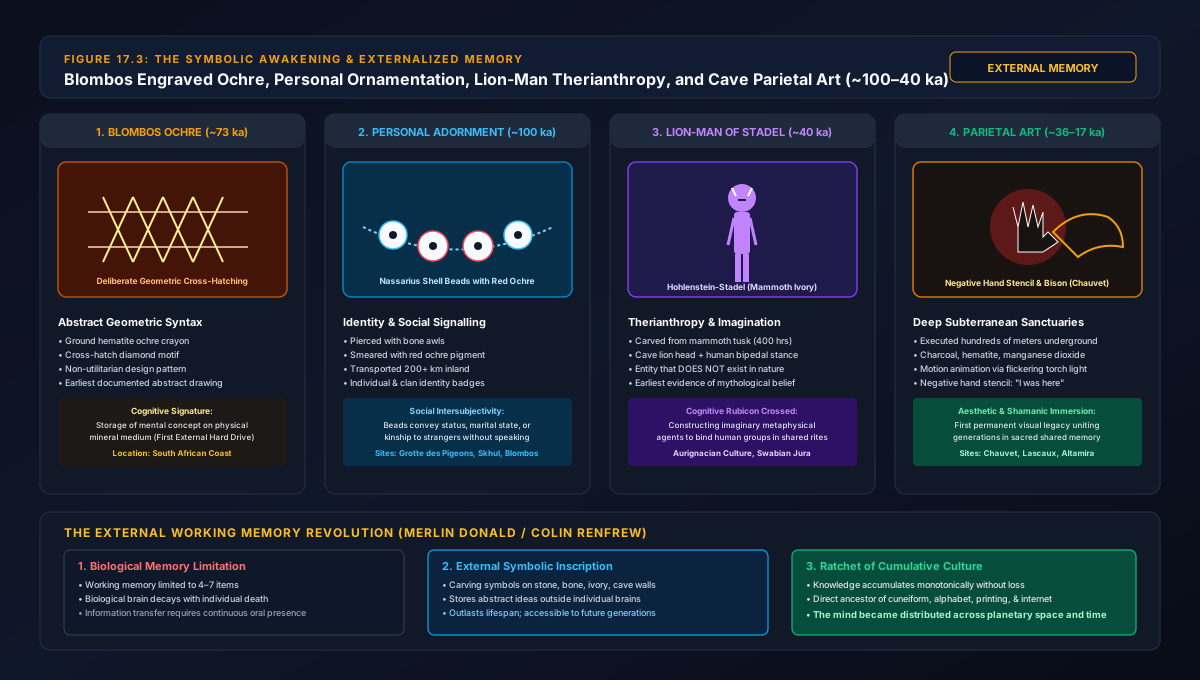
Linguistic syntax quickly metastasized into material culture. For millions of years, lithic tools like Acheulean handaxes remained structurally frozen across continents for tens of thousands of generations. Around 100,000 years ago in Southern Africa, this static toolmaking culture shattered into an explosion of symbolic artifacts:
The Ochre Engravings of Blombos Cave
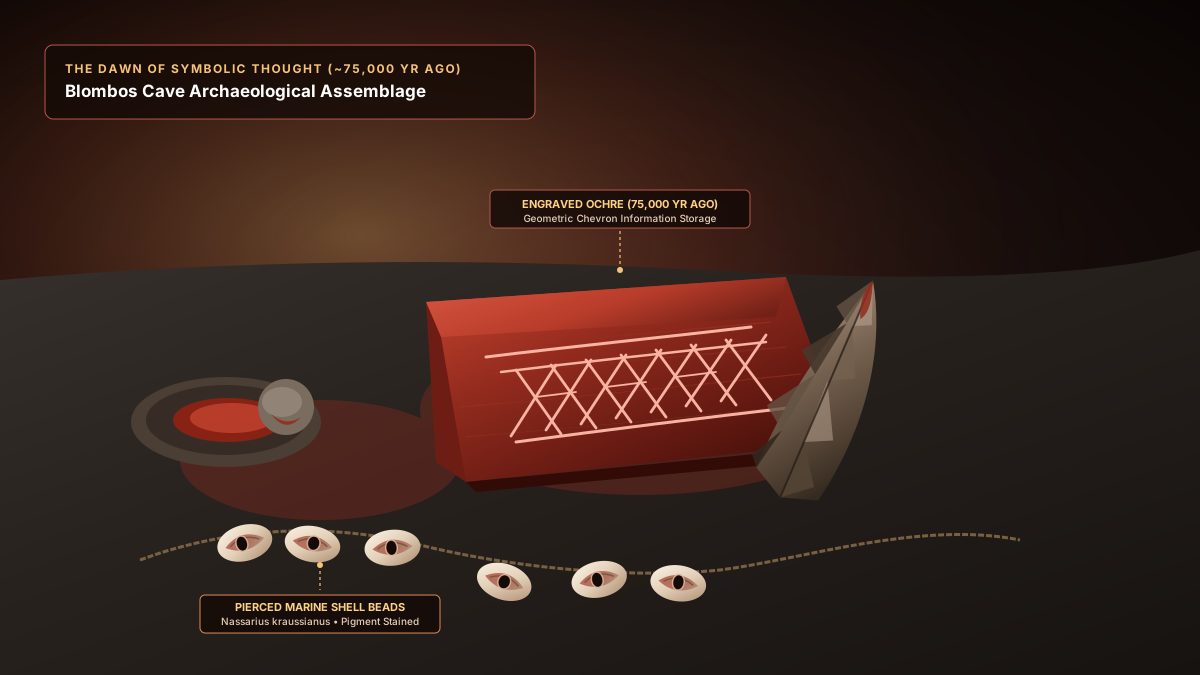
At Blombos Cave on the southern coast of South Africa, archaeologist Christopher Henshilwood excavated chunks of iron-rich red ochre dated to 75,000 years ago. Slices of smoothed ochre had been systematically carved with geometric cross-hatched chevron patterns using sharp lithic points. Along with perforated marine tick shells (Nassarius kraussianus) stained with red ochre and worn as personal necklaces, Blombos yielded indisputable evidence that early humans were using physical media to store and transmit abstract symbolic information across generational boundaries.
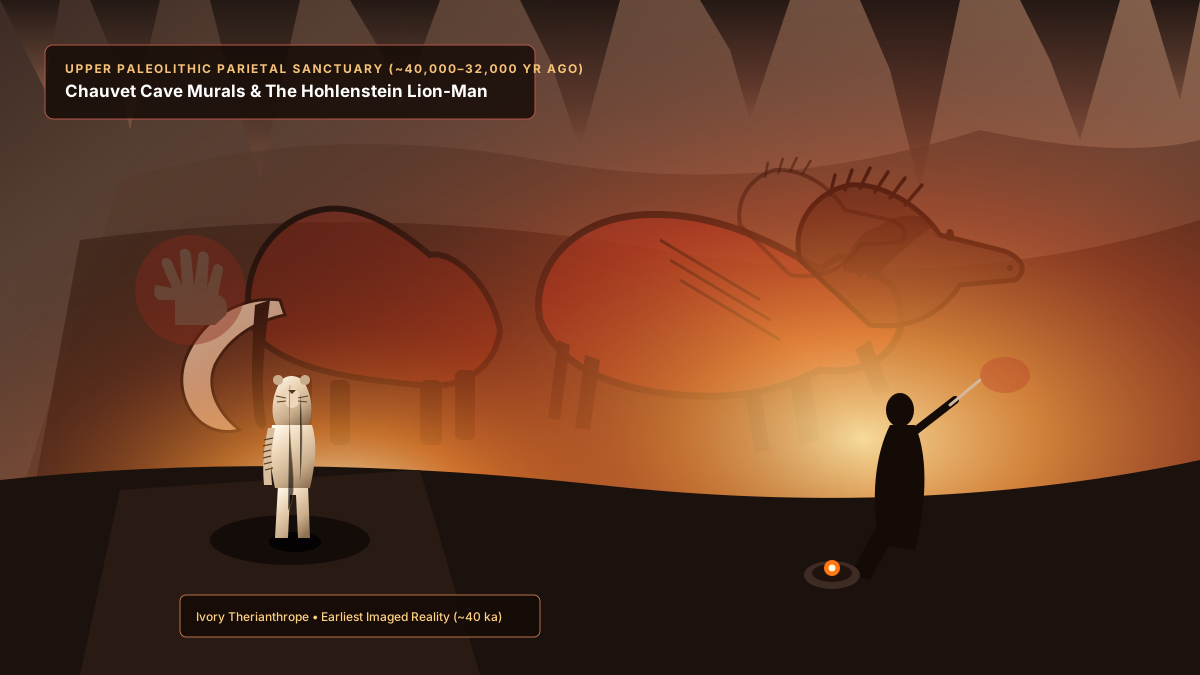
When modern humans entered Western Eurasia forty thousand years ago, this symbolic drive achieved sublime artistic heights. In the Swabian Jura of Germany, artisans sculpted the Lion-Man of Hohlenstein-Stadel from woolly mammoth ivory—a therianthropic figure combining a human torso with the head of a cave lion. This sculpture represents the earliest indisputable material proof of the human capacity to conceive of something that does not physically exist in nature.
In the subterranean sanctuaries of Chauvet, Lascaux, and Altamira, Upper Paleolithic artists used charcoal, hematite, and bone blowing-pipes to paint dynamic, anatomically flawless herds of stampeding mammoths, woolly rhinos, megaloceros deer, and horses. By utilizing natural convexities in the limestone walls, they created volumetric three-dimensional illusions that pulsed with life under the flickering light of animal-fat stone lamps.
4. Imagined Realities and Hyper-Cooperation: Breaking Dunbar’s Number
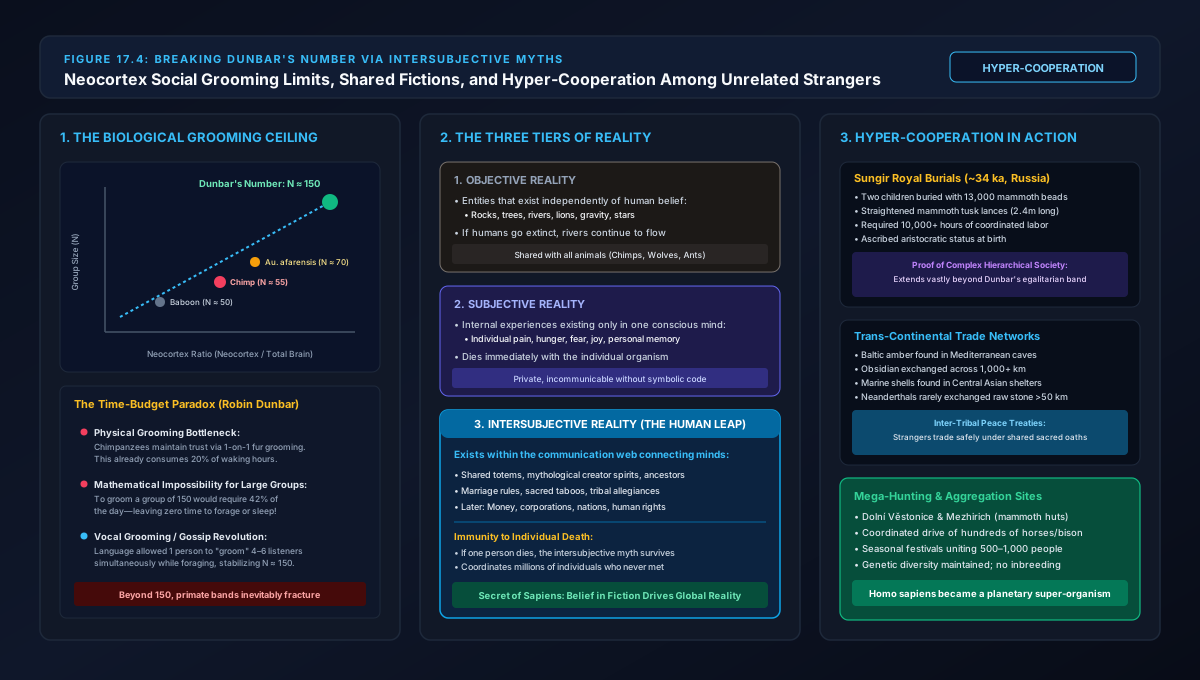
In evolutionary biology, British anthropologist Robin Dunbar established that a primate species\’ maximum sustainable social group size is mathematically bounded by the relative volume of its neocortex. For Homo sapiens, this biological ceiling—known as Dunbar’s number—is approximately 150 individuals. Above this threshold, a primate troop cannot maintain cohesion through direct personal grooming, reciprocal social bonds, and intimate behavioral monitoring; the group inevitably fragments into competing factions.
Yet modern human societies routinely organize millions of individuals into cohesive armies, states, and economic networks. How did our species break the biological cage of Dunbar’s number?
The answer, formulated compellingly by historian Yuval Noah Harari, is the creation of fictional constructs (imagined realities). Alone among all living beings, Homo sapiens can transmit shared cognitive fictions:
- Ancestral Spirits & Totems: Two strangers meeting in the Pleistocene tundra who shared a belief in the Sacred Bear would not fight to the death; they recognized each other as members of a shared metaphysical kinship, exchanging stone blades, shells, and matrimonial partners.
- Mythological Norms & Taboos: Moral rules codified in collective myths enforced social cooperation, punishing cheaters and free-riders through collective ostracism or execution.
- Intersubjective Value: The shared fiction that a polished cowrie shell or a rare piece of amber possessed intrinsic value enabled trading networks spanning thousands of kilometers across glacial Eurasia.
5. The Out-of-Africa Dispersal and the Fate of Archaic Humans (~70,000 to 30,000 yr ago)
Armed with recursive language, symbolic networks, bone projectile points (atlatls), and thermal tailored clothing stitched with eyed bone needles, a small diaspora of Homo sapiens crossed the Bab-el-Mandeb Strait and the Sinai Peninsula approximately 70,000 years ago.
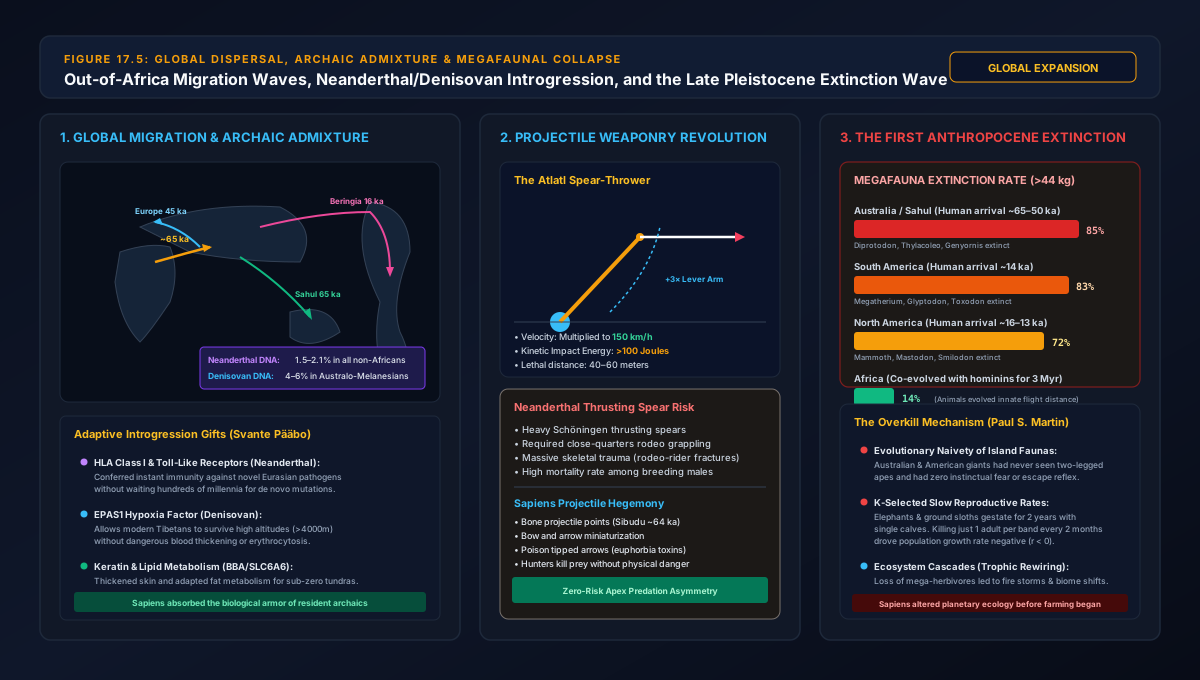
In Eurasia, they encountered archaic hominin cousins who had occupied the territory for hundreds of thousands of years: the cold-adapted Neanderthals (Homo neanderthalensis) in Europe and the Middle East, and the elusive Denisovans in Siberia and East Asia. Ancient genomic sequencing pioneered by Svante Pääbo and the Max Planck Institute revealed that these encounters were not merely combative; they involved episodic fertile hybridization:
- All contemporary non-African humans carry between 1% and 2% Neanderthal DNA, preserving genes that influenced keratin production in skin and hair, as well as immune receptors (HLA alleles) adapted to Eurasian pathogens.
- Indigenous populations of Melanesia, Australia, and the Philippines carry up to 4% to 6% Denisovan DNA, including the crucial EPAS1 transcription factor allele that prevents pulmonary hypoxia in high-altitude Tibetan populations.
Yet despite episodic interbreeding, wherever modern humans established permanent settlements, archaic hominins vanished within a few thousand years. Outcompeted by the symbolic coordination, superior projectile technology, and dense social trade networks of Homo sapiens, the last Neanderthals retreated to the cliff caves of Gibraltar and disappeared forever around 39,000 years ago.
6. The Overkill: The Pleistocene Megafaunal Extinction
The ecological consequence of the Cognitive Revolution was catastrophic for the planet\’s large fauna. For millions of years, the megafauna of Africa had co-evolved alongside hominins, developing deep-seated behavioral instincts to fear two-legged apes. But when Homo sapiens crossed open oceanic waters to reach Australia (~50,000 years ago) and crossed the Bering land bridge into the Americas (~15,000 years ago), the native megafauna had never encountered human hunters.
The devastation was swift and absolute:
- Australia: Within a few millennia of human arrival, 85% of all terrestrial animals weighing over 45 kg were exterminated—including Diprotodon (a wombat the size of a rhinoceros), Genyornis (a 250-kg flightless bird), and Thylacoleo carnifex (the marsupial lion).
- The Americas: Following the retreat of the Laurentide ice sheet, Clovis hunters armed with fluted spear points decimated 70% of North American megafauna within roughly one thousand years—erasing Columbian mammoths, mastodons, giant ground sloths (Megatherium), camelids, and saber-toothed cats (Smilodon).
By 10,000 BCE, humanity stood completely alone atop the terrestrial food chain. Every competing hominin lineage was extinct. The ancient megafaunal empires were shattered. As the last Pleistocene glaciers began to melt, the nomadic hunting bands of the fertile river valleys of the Near East were about to initiate the greatest economic gamble in human history: the domestication of seeds, beasts, and civilization itself.
Academic Citations & Historical References
- Hublin, J. J., Ben-Ncer, A., Bailey, S. E., et al. (2017). New fossils from Jebel Irhoud, Morocco and the pan-African origin of Homo sapiens. Nature, 546(7657), 289–292. doi:10.1038/nature22336
- Enard, W., Przeworski, M., Fisher, S. E., et al. (2002). Molecular evolution of FOXP2, a gene involved in speech and language. Nature, 418(6900), 869–872. doi:10.1038/nature01025
- Henshilwood, C. S., d\’Errico, F., Yates, R., et al. (2002). Emergence of modern human behavior: Middle Stone Age engravings from South Africa. Science, 295(5558), 1278–1280. doi:10.1126/science.1067575
- Green, R. E., Krause, J., Briggs, A. W., et al. (2010). A draft sequence of the Neandertal genome. Science, 328(5979), 710–722. doi:10.1126/science.1188021
- Dunbar, R. I. (1992). Neocortex size as a constraint on group size in primates. Journal of Human Evolution, 22(6), 469–493. doi:10.1016/0047-2484(92)90081-J
- Harari, Y. N. (2014). Sapiens: A Brief History of Humankind. Harper. ISBN:978-0062316097.
- Koch, P. L., & Barnosky, A. D. (2006). Late Quaternary extinctions: state of the debate. Annual Review of Ecology, Evolution, and Systematics, 37, 215–250. doi:10.1146/annurev.ecolsys.34.011802.132415