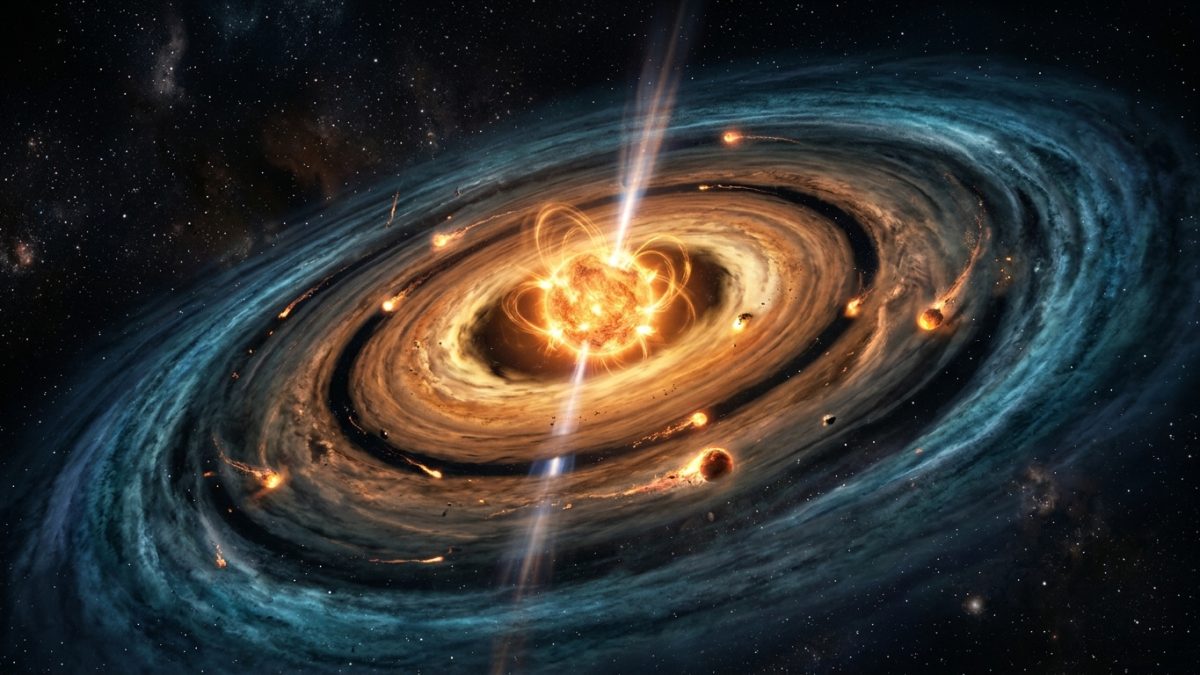
Roughly 4.567 billion years ago, deep within an unremarkable molecular gas cloud in the Milky Way’s Orion Arm, a localized shockwave triggered the collapse of the Solar Nebula. In the furious gravitational vortex that followed, 99.86% of the matter pooled into a thermonuclear furnace—our young Sun—while the remaining fraction of a percent flattened into a rotating circumstellar disk of gas, mineral dust, and ice. Through aerodynamic drag, electrostatic adhesion, and chaotic orbital collisions, microscopic grains assembled into the architectural framework of our Solar System.
The Supernova Trigger: The Birth Certificate of the Solar System
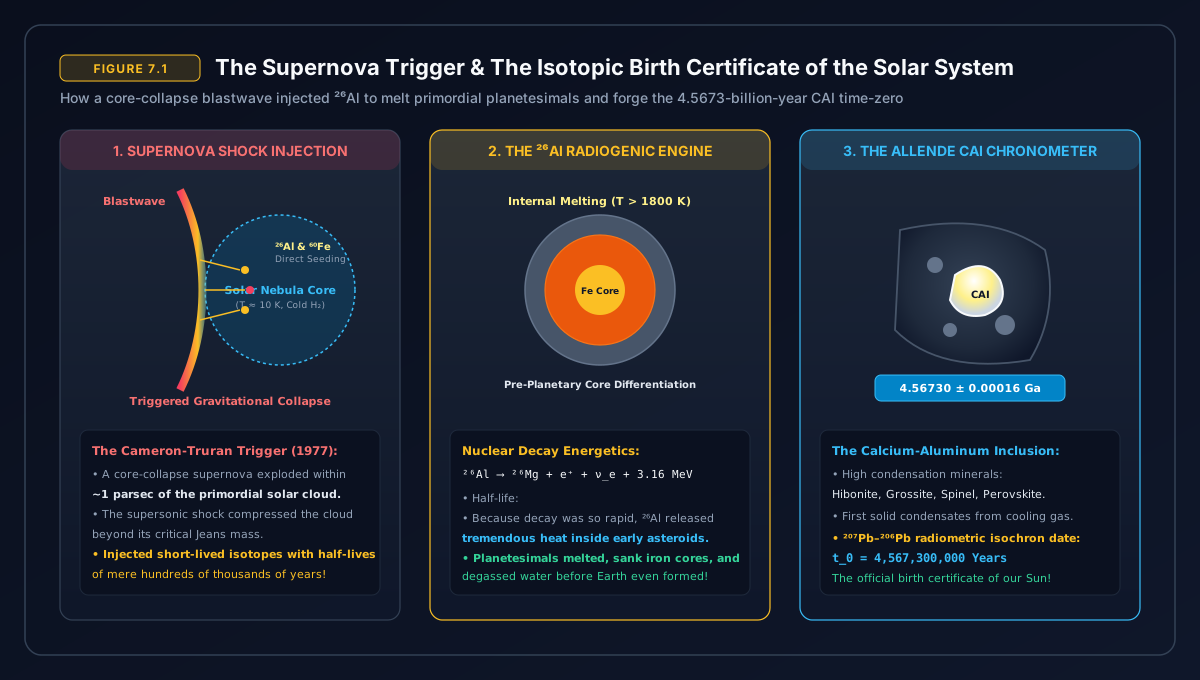
How do we know precisely when the Solar System began? The answer is preserved inside the oldest macroscopic solid objects in our planetary system: Calcium-Aluminum-rich Inclusions (CAIs) found within primitive carbonaceous chondrite meteorites, such as the Allende meteorite that fell in Mexico in 1969.
Using ultra-high-precision uranium-lead (²⁰⁷Pb–²⁰⁶Pb) radiometric dating, cosmochemists have measured the condensation age of CAIs to be exactly 4.56730 ± 0.00016 billion years. This date defines Year Zero of the Solar System.
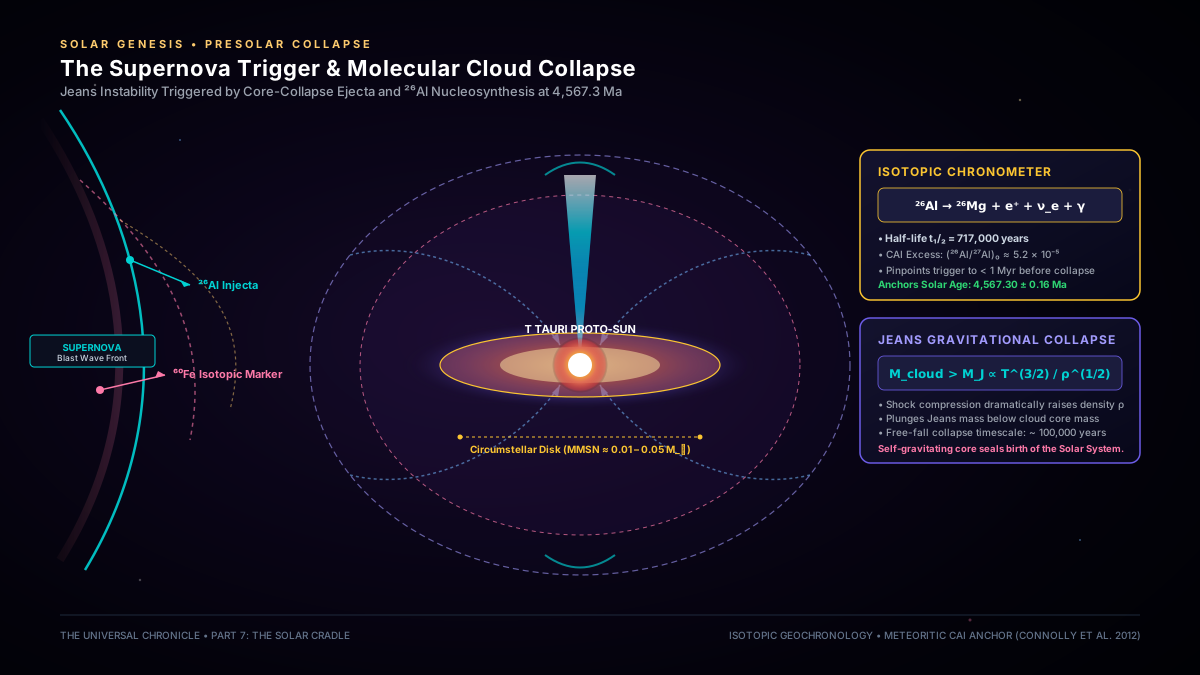
CAIs contain an excess of Magnesium-26 (^{26}Mg), the daughter isotope produced by the radioactive beta decay of Aluminium-26 (²⁶Al). Because ²⁶Al has an astronomically brief half-life of just 717,000 years, it could not have lingered from primordial galactic history. It had to be synthesized in a nearby core-collapse supernova or asymptotic giant star and injected into the Solar Nebula less than one million years before the gas collapsed. The shockwave of that dying star compressed our cold parental molecular cloud, triggering its gravitational collapse.
The T Tauri Proto-Sun and the Minimum Mass Solar Nebula
As the rotating nebula collapsed, conservation of angular momentum flattened the outer gas and dust into a circumstellar accretion disk—the Protoplanetary Disk—spanning over 100 Astronomical Units (AU) across. At the center, gravitational potential energy converted into heat via Kelvin-Helmholtz contraction, forming the Proto-Sun.
During its first 10 million years, the young Sun was in the violent T Tauri phase: it was not yet powered by core nuclear fusion, but shone brightly via gravitational contraction. It was an unruly star, rotating rapidly with magnetic field strengths thousands of times stronger than today. It unleashed ferocious bipolar plasma jets and powerful stellar winds that bombarded the inner disk with extreme ultraviolet and X-ray radiation.
The mass distribution of this disk is traditionally modeled as the Minimum Mass Solar Nebula (MMSN) (Hayashi 1981): adding back the light hydrogen and helium gas that was lost from the planets yields an initial disk mass of roughly 0.01 to 0.05 M_☉ (equivalent to 10 to 50 Jupiter masses of gas and dust).
The Condensation Sequence: Why Inner Planets Are Rocky and Outer Worlds Are Giants
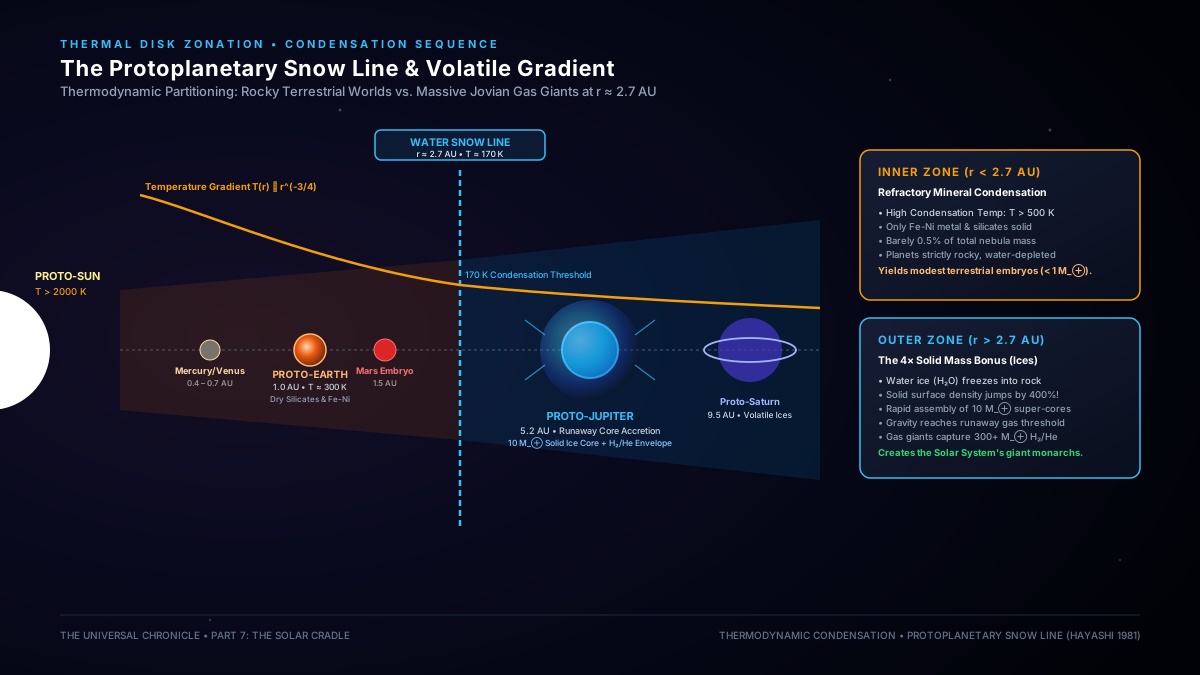
The temperature across the protoplanetary disk dropped steeply with distance from the central proto-Sun: from over 1,800 K near the center to less than 30 K in the outer reaches. This thermodynamic gradient dictated the chemical condensation sequence:
1. The Refractory Inner Zone (r < 2.7 AU)
Close to the Sun, temperatures were far too high for volatile compounds (water, ammonia, methane) to condense. Only refractory materials with high sublimation temperatures could crystallize into solid mineral grains:
- Aluminum, titanium, and calcium oxides (T_{cond} ~ 1,500–1, K)
- Iron-nickel alloys (T_{cond} ~ 1, K)
- Magnesium-rich silicate minerals: Forsterite (Mg_2SiO_4) and Enstatite (MgSiO_3) (T_{cond} ~ 1,300–1, K)
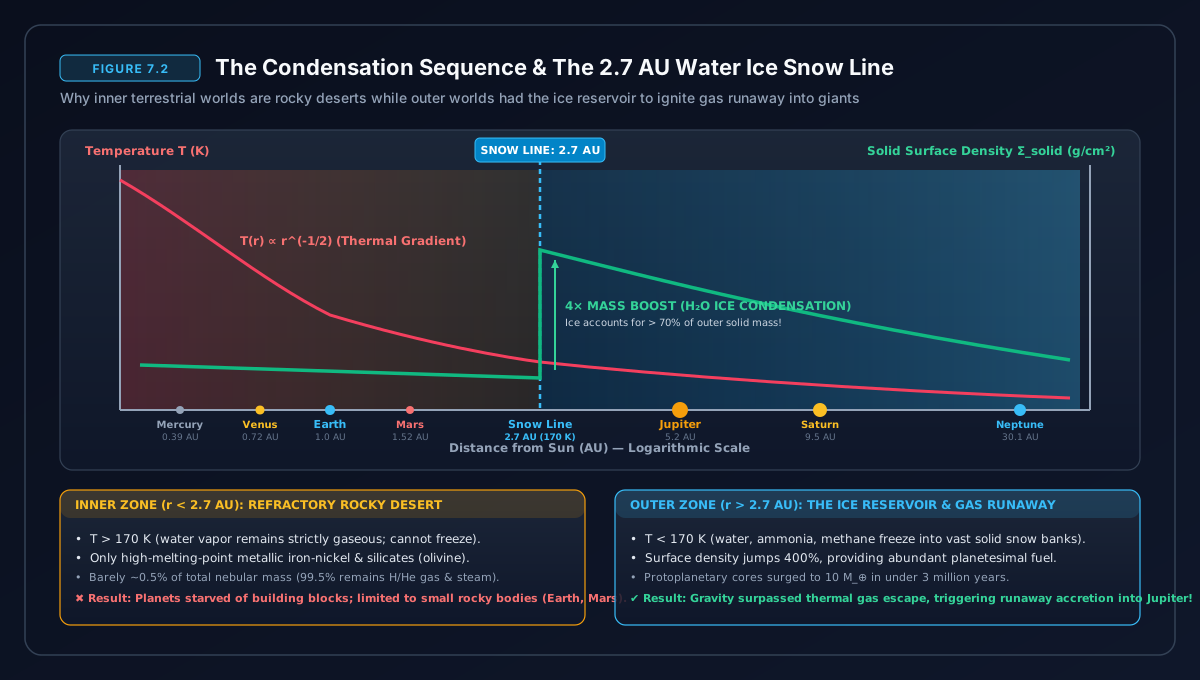
Because refractory elements constituted barely 0.5% of the total nebula mass, the inner solar system had very little solid raw material with which to build planets. The inner worlds—Mercury, Venus, Earth, and Mars—were starved of mass, remaining small, dense, rocky spheres.
2. The Snow Line (Frost Line) at ~ 2.7 AU
At an orbital distance of roughly 2.7 AU (the present-day location of the asteroid belt), the disk temperature dropped below 170 K. At this boundary—the Snow Line (Ice Line)—water vapor could spontaneously desublimate into microscopic ice crystals.
Because oxygen and hydrogen are among the most abundant elements in the cosmos, the condensation of water ice multiplied the density of solid surface material by a factor of four to five! Beyond the snow line, planetary embryos had access to mountains of solid ice, enabling them to grow rapidly into massive icy-rocky cores.
From Dust to Planetesimals: The Physics of the Meter Barrier
How do sub-micron mineral dust grains grow into thousand-kilometer planetary embryos? This process is fraught with formidable aerodynamic bottlenecks:
1. The Electrostatic Growth Phase (Microns to Centimeters)
In the earliest phase, microscopic dust grains suspended in the laminar gas disk collide gently via Brownian motion. At relative velocities of a few centimeters per second, van der Waals and electrostatic forces cause the grains to stick together, forming porous, fluffy, fractal aggregates up to pebble sizes.
2. The Radial Drift & Bouncing Barrier (The Meter Trap)
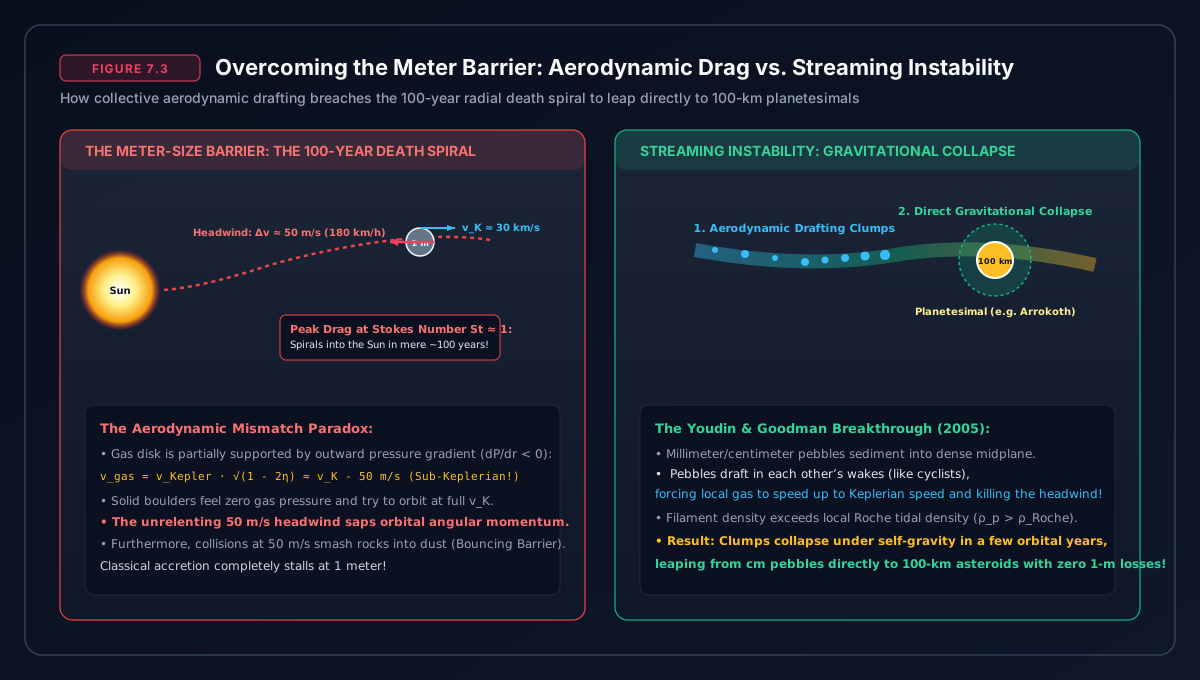
When particles reach millimeter to meter sizes, electrostatic adhesion fails: at collision velocities above 1 m/s, pebbles bounce off one another or shatter into dust. Worse still is gas drag.
Because the gas disk is partially supported by outward radial gas pressure, it rotates around the Sun at slightly sub-Keplerian velocity (Δ v ≈ 50 m/s). Solid boulders, which do not feel gas pressure, attempt to orbit at full Keplerian velocity. As a result, boulders feel a relentless, supersonic “headwind” from the slower gas. This aerodynamic headwind drains the boulders of orbital angular momentum, causing a meter-sized rock at 1 AU to spiral inward and vaporize into the young Sun in barely 100 years!
In 2005, astrophysicists Andrew Youdin and Jeremy Goodman discovered the mathematical mechanism that rescues planet formation: The Streaming Instability. As swarms of pebbles drift inward, their collective drag pushes back against the gas, slowing down the headwind. Pebbles behind them pile up into dense, turbulent clumping filaments.
When the local density of pebbles inside a filament exceeds the gas density by a factor of 100, the swarm becomes gravitationally unstable: the entire filament collapses directly under its own self-gravity in a matter of months, bypassing the meter-size barrier completely to forge 10 to 100-kilometer Planetesimals in a single leap!
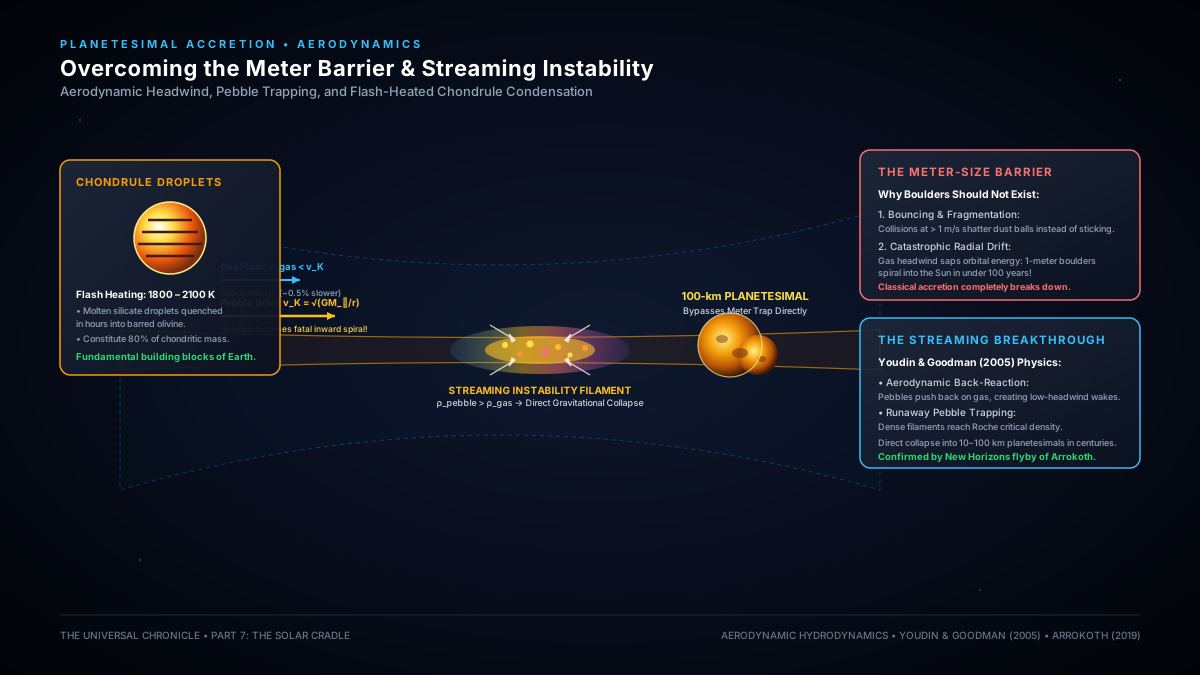
This theoretical mechanism was dramatically confirmed in 2019 when NASA’s New Horizons spacecraft flew past Kuiper Belt object Arrokoth, revealing a pristine, contact-binary planetesimal formed by the gentle gravitational coalescence of two swirling pebble clouds.
The Giant Planet Race: Core Accretion and the Grand Tack
Beyond the snow line, planetesimals grew via runaway and oligarchic accretion into a massive planetary embryo of roughly 10 to 15 Earth masses (M_⊕) in less than 3 million years. Once an embryo reached this critical mass, its escape velocity exceeded the thermal velocity of surrounding hydrogen and helium gas.
The embryo entered runaway gas accretion, vacuuming up enormous volumes of gas directly from the disk. This was the birth of Jupiter, followed closely by Saturn. This gas-capture window was brutally brief: within 3 to 10 million years, powerful T Tauri stellar winds from the young Sun and photoevaporation from nearby stars blew the gaseous disk away, freezing Jupiter at 318 M_⊕ and Saturn at 95 M_⊕. Further out, Uranus and Neptune formed too slowly to capture deep gas envelopes, remaining “ice giants” with thick water-methane-ammonia mantles.
The Grand Tack Hypothesis: How Jupiter Reshaped the Inner Solar System
In classical models, Mars should have accreted roughly the same mass as Earth or Venus. Why is Mars a diminutive world with barely 10% of Earth’s mass? Furthermore, why is the Asteroid Belt mostly empty, containing barely 0.05\% of Earth’s mass?
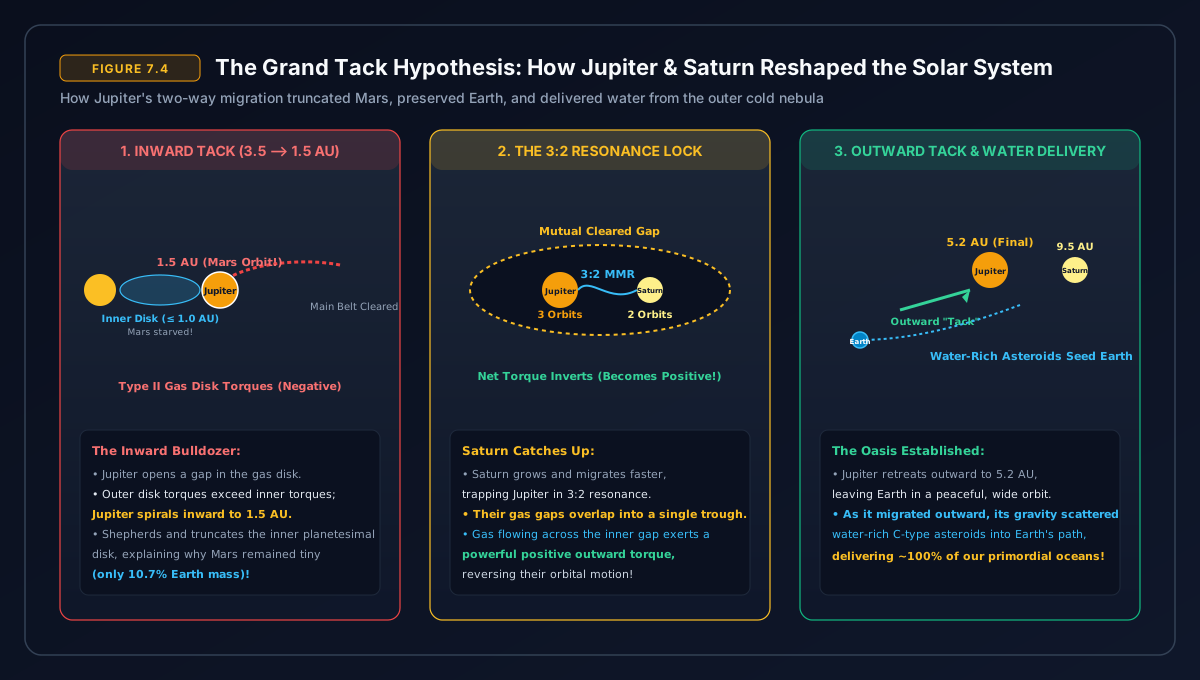
The leading explanation is the Grand Tack Hypothesis (Walsh et al. 2011). As Jupiter grew inside the gaseous disk, exchange of angular momentum with the gas caused it to migrate inward toward the Sun, plowing all the way to 1.5 AU (where Mars orbits today). Like a cosmic snowplow, Jupiter’s gravity scattered the inner planetesimal disk, truncating the reservoir of planet-forming material outside 1 AU.
Before Jupiter could plunge into the Sun and become a “hot Jupiter,” Saturn grew, caught up to Jupiter, and locked into a mutual 3:2 mean-motion orbital resonance. The gravitational resonance opened a clear gap in the gas disk between them, reversing their torque and pulling both giant planets “tacking” outward to their present orbits. This dramatic migration left Mars starved of accretion material, carved out the asteroid belt, and delivered volatile-rich carbonaceous asteroids into the inner solar system.
The Inner Crucible: Oligarchic Growth and Proto-Earth
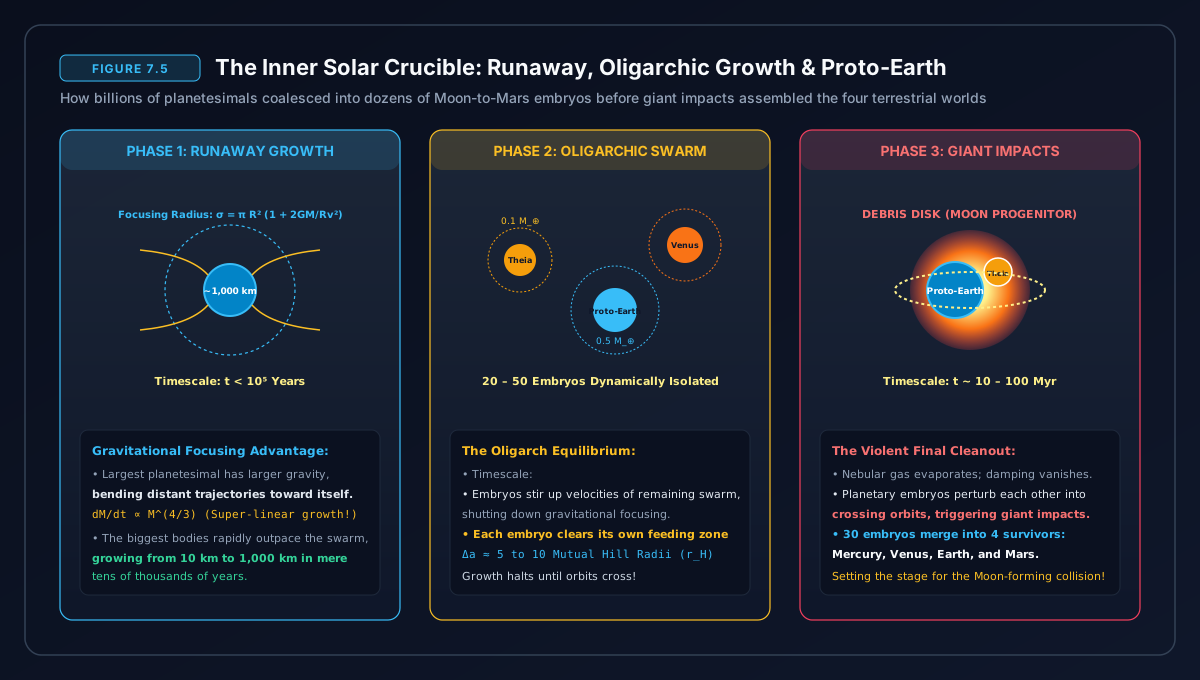
Inside the truncated inner disk (0.5 to 1.0 AU), the gas cleared, leaving behind a swarm of roughly 50 to 100 Moon- to Mars-sized protoplanetary embryos. For the next 30 to 100 million years, these embryos orbited in chaotic, intersecting ellipses.
This was the era of giant impacts: planetary embryos smashed into one another at orbital velocities of 30 km/s, merging and shattering in violent, incandescent collisions. From this cosmic demolition derby emerged four survivors: Mercury, Venus, Earth, and Mars.
Chronology Table: Assembly of the Solar System
| Stage / Milestone | Time from t_0 | Key Physical Processes | Observable Relic / Evidence |
|---|---|---|---|
| Supernova Shock & Nebula Collapse | -1 Myr to 0 | Gravitational collapse of molecular cloud; ²⁶Al and ⁶⁰Fe injection. | Isotopic anomalies in carbonaceous chondrites. |
| CAI Condensation (t_0) | 0.00 Myr (4.5673 Ga) | First high-temperature minerals condense at >1, K. | Calcium-Aluminum-rich Inclusions in Allende meteorite. |
| Planetesimal Formation | 0.1 to 1 Myr | Streaming instability concentrates pebbles; gravitational collapse into 10–100-km bodies. | Kuiper Belt object Arrokoth (contact binary). |
| Giant Planet Runaway Accretion | 1 to 5 Myr | Jupiter and Saturn core accretion exceeds 10 M_⊕; runaway gas capture. | Mass and atmospheric compositions of Jupiter/Saturn. |
| The Grand Tack & Disk Dispersal | 3 to 10 Myr | Jupiter migrates to 1.5 AU, tacks outward with Saturn; solar winds blow gas away. | Truncated mass of Mars; structure of Asteroid Belt. |
| Terrestrial Giant Impacts | 10 to 100 Myr | 50–100 embryos collide chaotically to assemble Mercury, Venus, Earth, and Mars. | Earth-Moon system; planetary core-mantle differentiation. |
Proto-Earth on the Brink of Cataclysm
By approximately 4.51 billion years ago—roughly 50 million years after the first CAIs condensed—our home planet had grown to roughly 90% of its current mass. Known as Proto-Earth, it was a searing, radioactive world heated by the decay of ²⁶Al and short-lived radionuclides, enveloped in a dense steam atmosphere.
Yet, the architecture of our world was not yet complete. Lurking nearby, sharing an unstable orbital resonance, was another planetary embryo roughly the size of Mars: a protoplanet that geochemists have named Theia. The inevitable collision between these two worlds would completely remake our planet, vaporize the oceans of magma, and forge the gravitational companion that stabilizes Earth’s climate to this day.
In Part 8 of The Universal Chronicle, we will witness the most violent day in our planet’s history: The Violent Genesis — The Hadean Earth, Theia Giant Impact, and the Birth of the Moon.
Academic Citations & Foundational Literature
- Connelly, J. N., et al. (2012). “The Absolute Chronology and Thermal Processing of Solids in the Solar Protoplanetary Disk.” Science, 338(6107), 651–655. doi:10.1126/science.1226919.
- Hayashi, C. (1981). “Structure of the Solar Nebula, Growth and Decay of Magnetic Fields and Effects of Magnetic and Turbulent Viscosities on the Nebula.” Progress of Theoretical Physics Supplement, 70, 35–53. doi:10.1143/PTPS.70.35.
- Youdin, A. N., & Goodman, J. (2005). “Streaming Instabilities in Protoplanetary Disks.” The Astrophysical Journal, 620(1), 459–469. doi:10.1086/426895.
- Walsh, K. J., Morbidelli, A., Raymond, S. N., O’Brien, D. P., & Mandell, A. M. (2011). “A low mass for Mars from Jupiter’s early gas-driven migration.” Nature, 475, 206–209. doi:10.1038/nature10201.
- ALMA Partnership (Brogan, C. L., et al.) (2015). “The 2014 ALMA Long Baseline Campaign: First Results from High Angular Resolution Observations toward the HL Tau Protoplanetary Disk.” The Astrophysical Journal Letters, 808(1), L3. doi:10.1088/2041-8205/808/1/L3.
- Stern, S. A., et al. (2019). “Initial results from the flyby of New Horizons at the Kuiper Belt object (486958) Arrokoth.” Science, 364(6441), eaaw9771. doi:10.1126/science.aaw9771.