The Big Bang was a profoundly conservative chemist: in its opening minutes, it synthesized only the simplest elements—hydrogen, helium, and a trace of lithium. Left to itself, the universe would have remained an inert cosmic desert incapable of producing rocks, water, or life. To build a living universe, the cosmos required alchemists: massive stars that crushed light nuclei into the rich periodic table within their searing cores, died in cataclysmic supernova detonations, and collided as neutron stars to scatter the building blocks of planets across interstellar space.
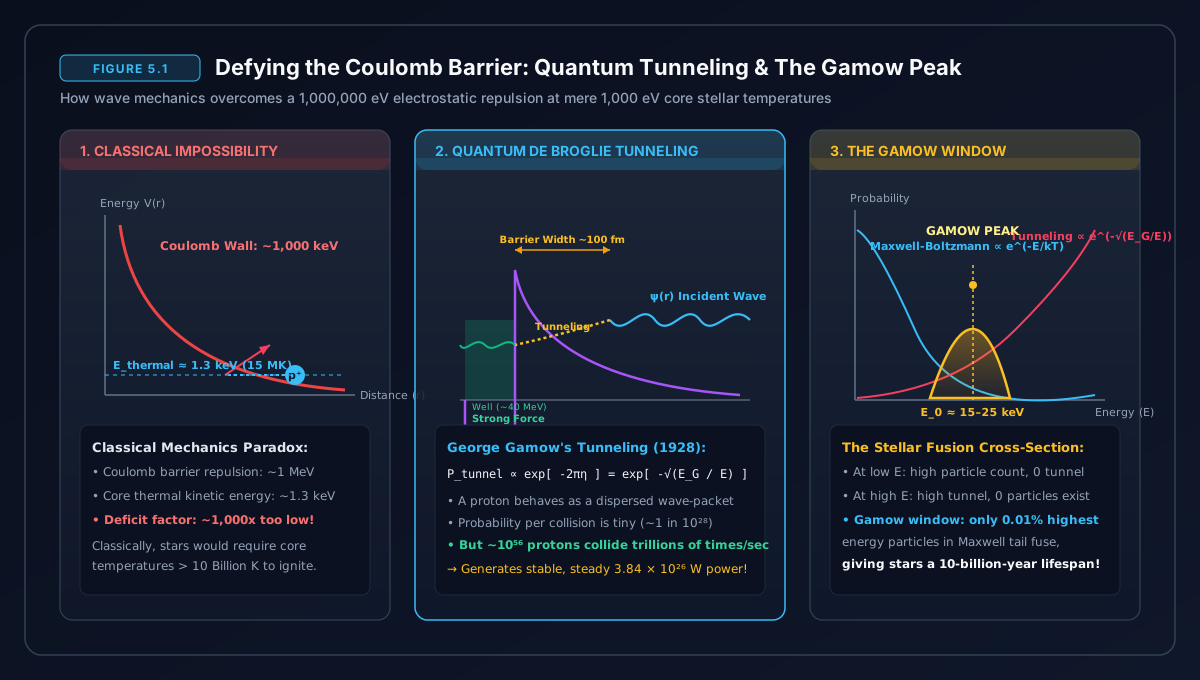
The Stellar Engine: How Stars Defy Coulomb Repulsion
Every atomic nucleus carries a positive electric charge proportional to its atomic number (Z). Because like charges repel according to Coulomb’s law, two approaching nuclei experience an electrostatic repulsion barrier that grows exponentially as they draw nearer:
$$U_C(r) = \frac{Z_1 Z_2 e^2}{4\pi \varepsilon_0 r}$$
In classical Newtonian mechanics, for two protons to collide and fuse, the core temperature of a star would have to exceed 10^9 K—a temperature that ordinary main-sequence stars like our Sun (T_{core} ≈ 1.5 × 10^ K) never reach. How, then, do stars shine?
In 1928, George Gamow discovered that quantum mechanics allows particles to behave as wavefunctions. Even when a proton lacks the classical kinetic energy to climb the Coulomb barrier, there is a finite probability (P ∝ exp(-2π η_G)) that it will tunnel directly through the barrier into the attractive domain of the strong nuclear force (r ≈ 10⁻¹⁵ m). The convolution of the Maxwell-Boltzmann energy distribution and the quantum tunneling probability creates a narrow energy sweet spot—the Gamow Window—where stellar fusion takes place.
In stars with masses similar to our Sun (M ≤ 1.3 M_☉), hydrogen fuses into helium primarily via the Proton-Proton (p-p) Chain, releasing 26.73 MeV per Helium-4 nucleus. In stars heavier than 1.3 M_☉, where core temperatures exceed 1.8 × 10^ K, the CNO (Carbon-Nitrogen-Oxygen) Cycle dominates, using carbon, nitrogen, and oxygen nuclei as nuclear catalysts to fuse protons at a rate proportional to T^{16}–T^{20}.
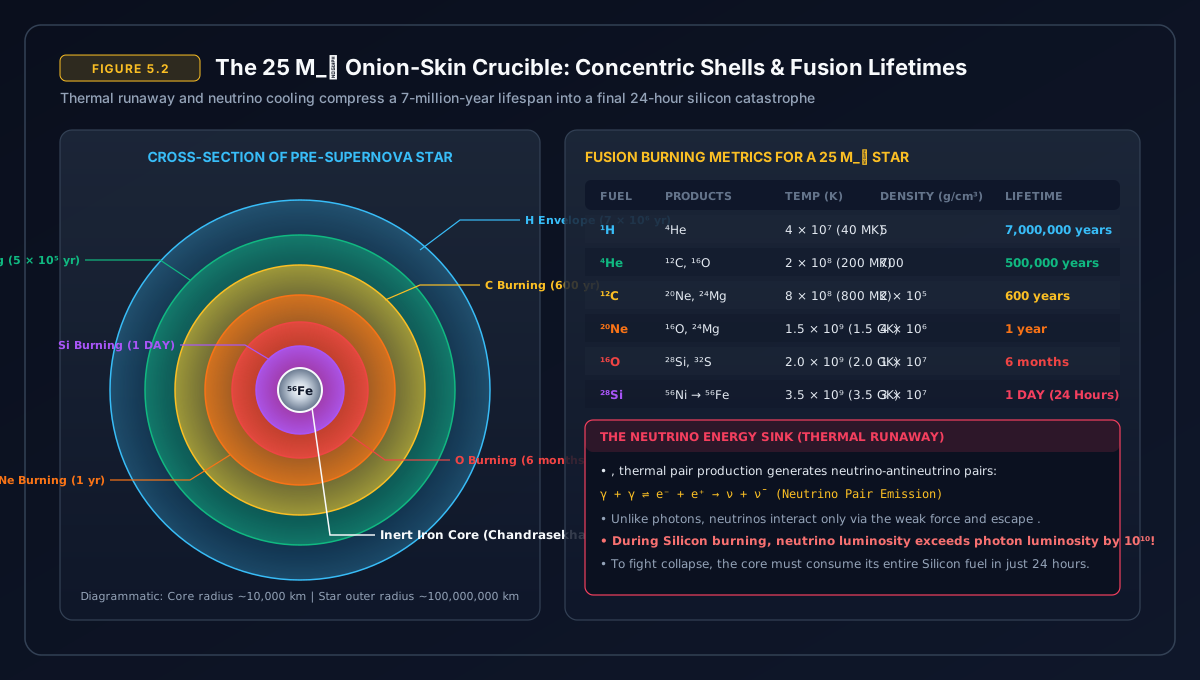
The Onion-Skin Crucible: Burning Stages of a 25 M_☉ Supergiant
When a star with mass M ≥ 8 M_☉ exhausts its central core hydrogen, hydrostatic equilibrium is disrupted. With radiation pressure diminished, gravity compresses the inert helium core, driving core temperatures up to 2 × 10^8 K and densities to 10^4 g/cm³. At this threshold, the Triple-Alpha Process ignites:
$$3 \, {}^4\text{He} \to {}^{12}\text{C} + \gamma \quad \text{followed by} \quad {}^{12}\text{C} + {}^4\text{He} \to {}^{16}\text{O} + \gamma$$
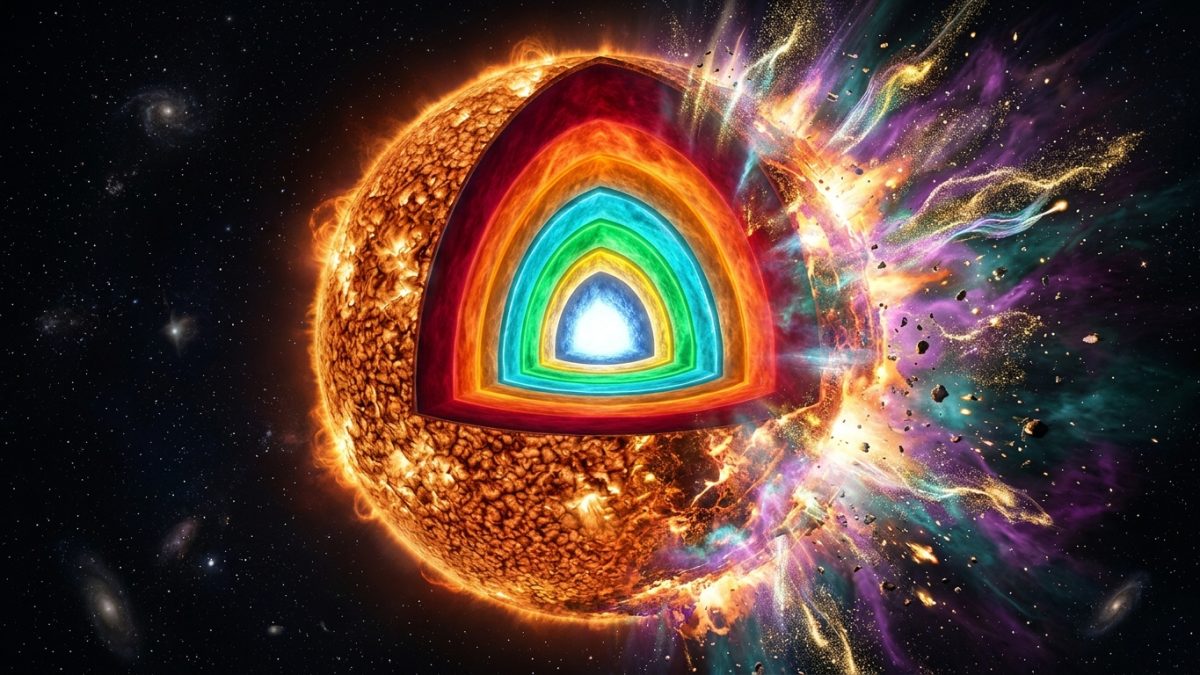
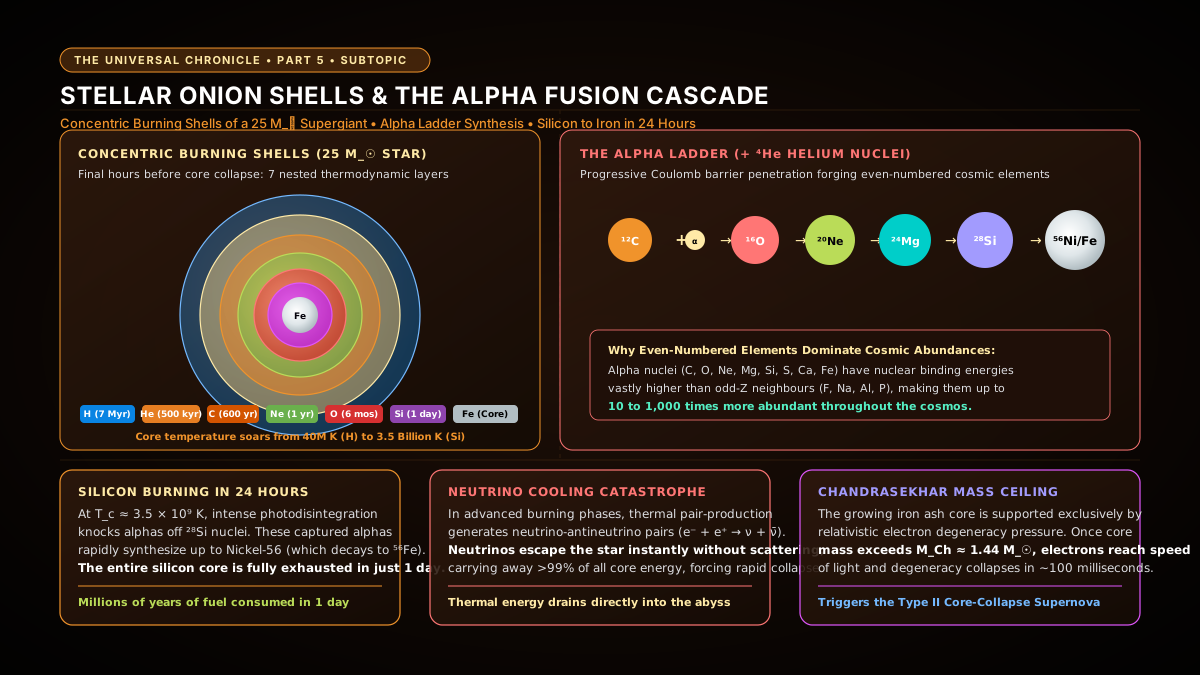
This cycle of exhaustion, gravitational contraction, heating, and ignition repeats with increasing speed and violence, transforming the interior of a massive evolved star into a concentric onion-skin structure of burning nuclear shells:
- 1. Hydrogen Burning Shell (T ~ 4 × 10^ K): Fuses hydrogen into helium. Duration: ≈ 7 million years.
- 2. Helium Burning Shell (T ~ 2 × 10^ K): Fuses helium into carbon and oxygen. Duration: ≈ 500,000 years.
- 3. Carbon Burning Shell (T ~ 8 × 10^ K): Fuses ¹²C + ¹²C → ²⁰Ne, ²⁴Mg, ²³Na. Duration: ≈ 600 years.
- 4. Neon Burning Shell (T ~ 1.5 × 10^ K): Photodisintegrates neon, triggering alpha capture: ²⁰Ne(α, γ)²⁴Mg. Duration: ≈ 1 year.
- 5. Oxygen Burning Shell (T ~ 2.0 × 10^ K): Fuses ¹⁶O + ¹⁶O → ²⁸Si, ³²S, ³¹P. Duration: ≈ 6 months.
- 6. Silicon Burning Core (T ~ 3.5 × 10^ K): Photodisintegration rearrangement creates a rapid alpha-capture cascade up to ⁵⁶Ni, which decays into ⁵⁶Fe. Duration: Barely 24 hours!
The Iron Catastrophe: Why Fusion Halts at Element 26
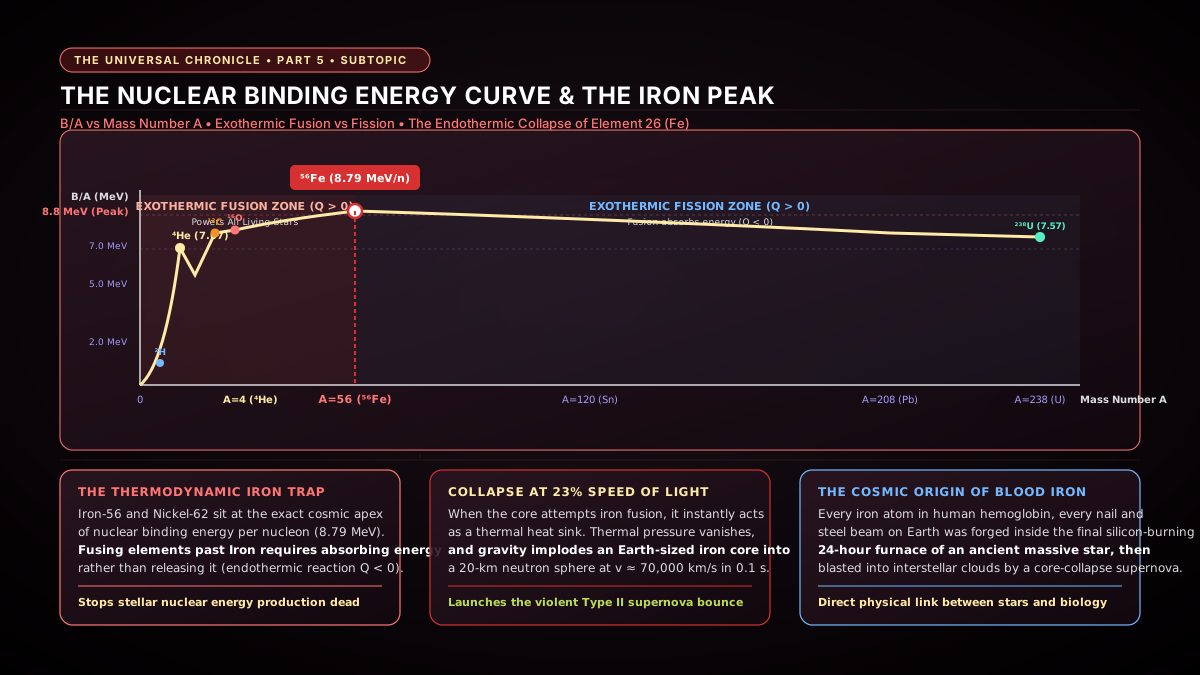
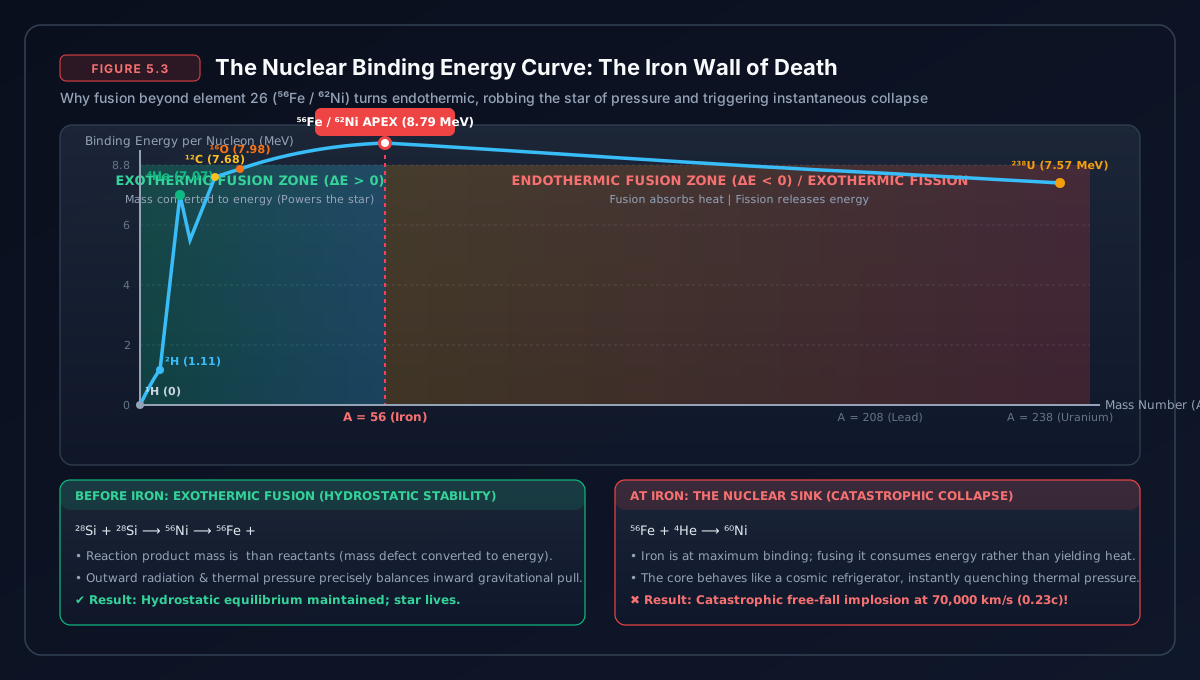
For millions of years, the star fought off gravitational collapse through exothermic nuclear fusion: whenever light nuclei fuse, the resulting nucleus has a lower mass than its constituents (E = Δ m c^2), and the mass defect is converted into thermal radiation pressure that supports the weight of the star.
However, the binding energy per nucleon curve peaks precisely at the iron-group nuclei—specifically Nickel-62, Iron-58, and Iron-56 (B/A ≈ 8.8 MeV per nucleon):
Iron-56 has zero extractable nuclear fusion energy. Attempting to fuse iron with another nucleus is strictly endothermic—it absorbs thermal energy from the core rather than releasing it. The moment an iron core accumulates inside a massive star, the nuclear engine dies. The thermal pressure supporting the core drops to zero in a fraction of a second.
Core-Collapse Supernovae: When a Star Rebounds off Nuclear Density
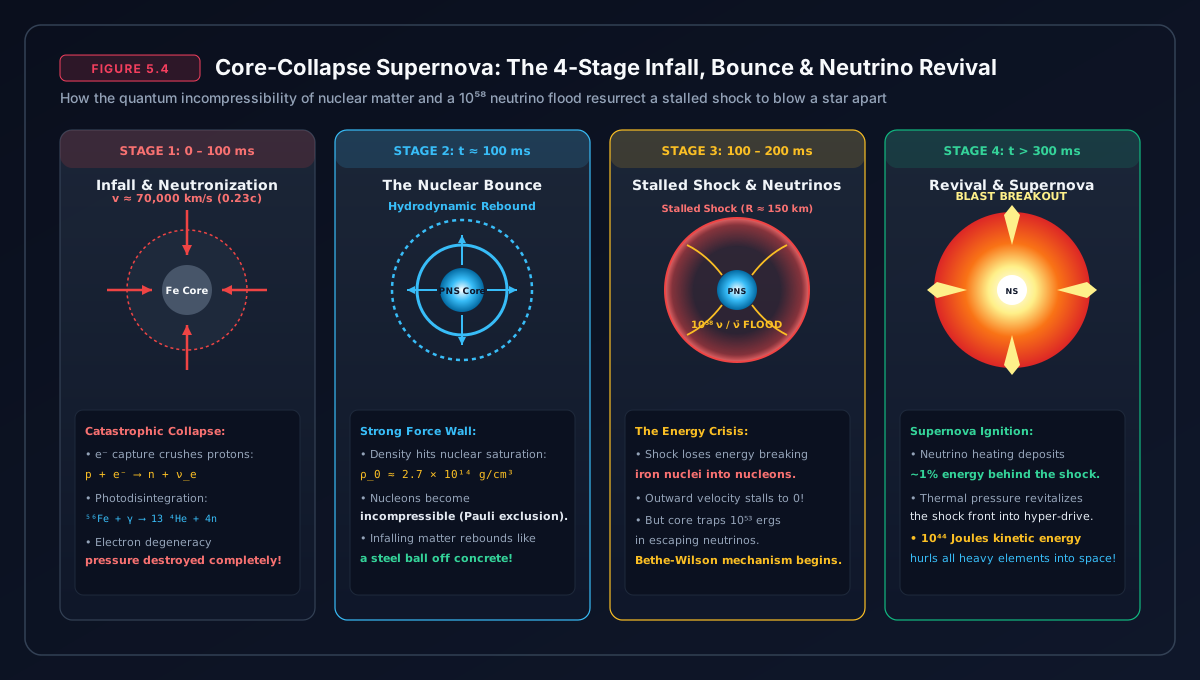
Once the mass of the iron core exceeds the Chandrasekhar Mass Limit (M_{Ch} ≈ 1.44 M_☉), electron degeneracy pressure—the quantum resistance of electrons against occupying identical quantum states—can no longer withstand gravity. The core collapses catastrophically:
1. Electron Capture & Photodisintegration (Milliseconds 0 to 100)
As density surges past 10^{11} g/cm³, energetic gamma rays smash into iron nuclei, shattering them back into alpha particles and free neutrons (photodisintegration). Simultaneously, electrons are crushed directly into protons via electron capture (inverse beta decay):
$$p + e^- \to n + \nu_e$$
This process completely neutralizes the core into a ball of pure neutrons, draining the core of electron degeneracy pressure. The iron core—an object roughly the diameter of the Earth—collapses down to a sphere just 20 kilometers in diameter in less than 100 milliseconds, plunging inward at nearly 25% of the speed of light (70,000 km/s).
2. The Nuclear Rebound and the Neutrino Shockwave
When the core reaches nuclear saturation density (ρ_nuc ≈ 3 × 10¹⁴ g/cm³), the strong nuclear force suddenly transitions from attractive to fiercely repulsive. Neutron degeneracy pressure halts the collapse like an unyielding concrete wall. The infalling outer core slams into this rigid ball of nuclear matter and rebounds, creating an outwards-propagating supersonic shockwave.
Although the shock initially stalls as it tears through the outer iron mantle, it is revitalized by an unfathomable flood of neutrinos escaping the proto-neutron star. A core-collapse supernova unleashes 10^{46} Joules of energy (10^{53} ergs)—more energy than our Sun will radiate in its entire 10-billion-year lifetime. Astonishingly, 99% of this energy is carried away by neutrinos, 1% becomes kinetic energy blasting the star apart, and barely 0.01% is emitted as visible light.
For several weeks, the exploding star outshines its entire host galaxy of hundreds of billions of stars, hurtling tens of solar masses of synthesized carbon, oxygen, neon, and silicon across interstellar space at 10,000 km/s.
Beyond Iron: The Slow (s) and Rapid (r) Neutron Capture Processes
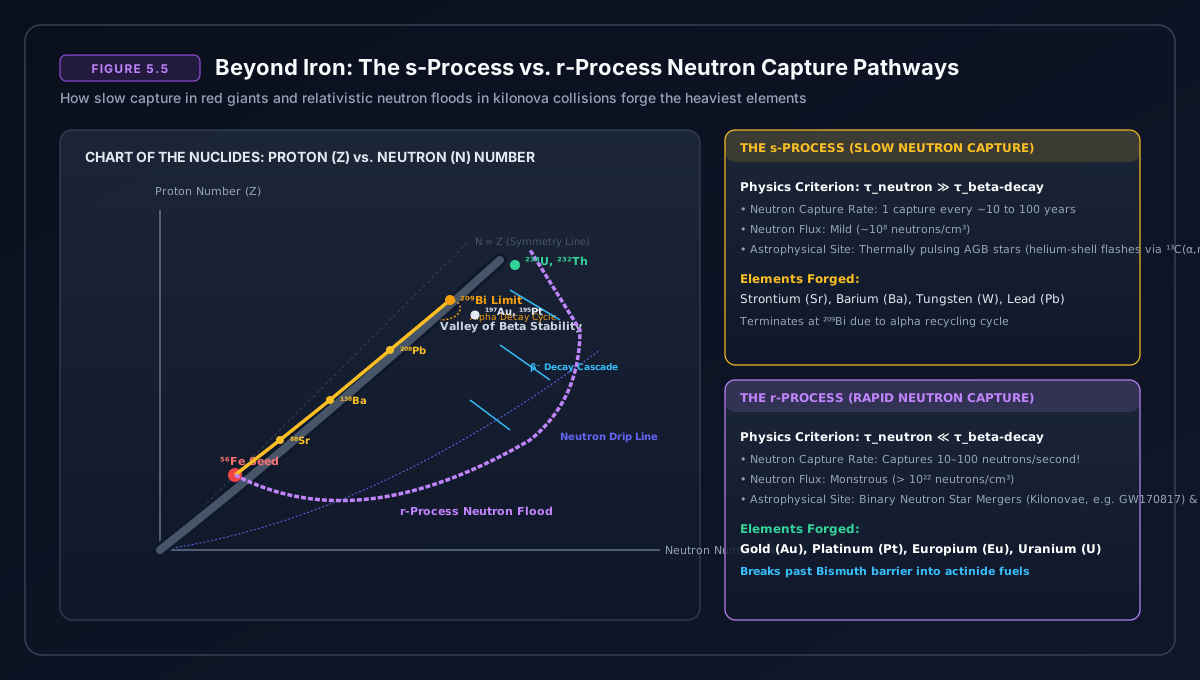
Because fusion cannot produce elements heavier than iron, elements such as copper, zinc, silver, iodine, barium, gold, platinum, and uranium must be forged through neutron capture. Because neutrons carry zero electric charge, they experience no Coulomb repulsion barrier, slipping effortlessly into atomic nuclei:
1. The s-Process (Slow Neutron Capture)
Occurs over thousands of years inside low- to intermediate-mass Asymptotic Giant Branch (AGB) stars. The neutron flux is low: an atomic nucleus captures a neutron, and if it becomes unstable, it has ample time to undergo beta decay (n → p + e^- + ν̄_e) into a new element with a higher atomic number before the next neutron arrives. The s-process builds half of the elements heavier than iron, including strontium, barium, yttrium, and lead.
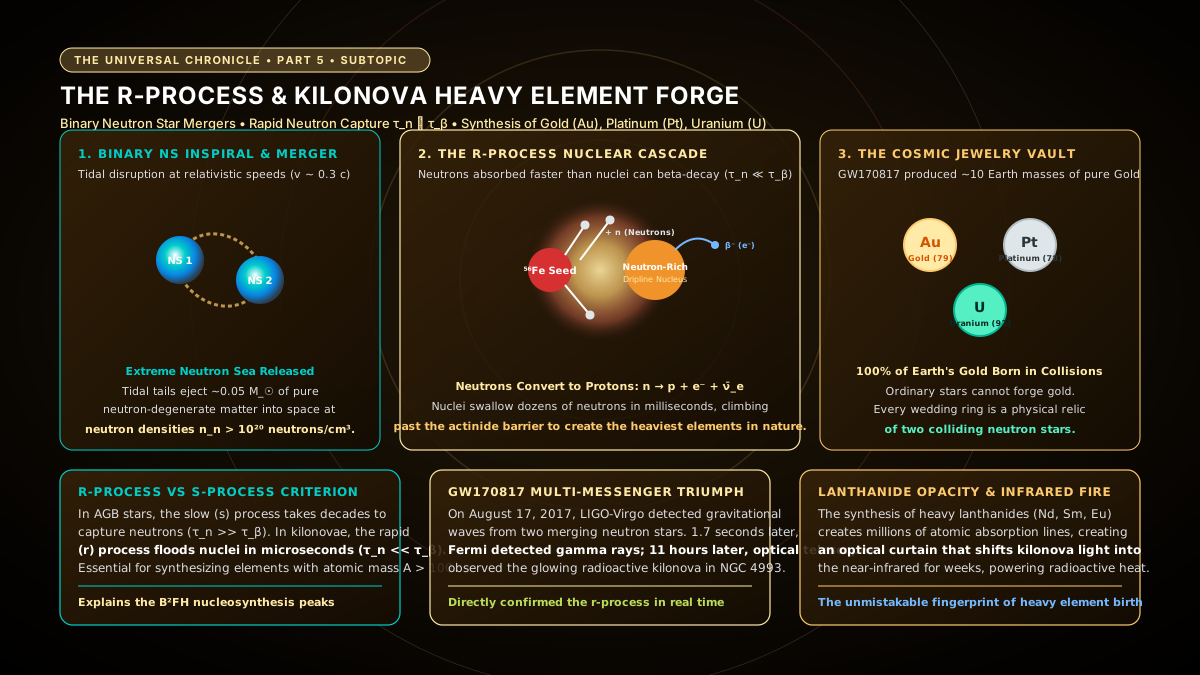
2. The r-Process (Rapid Neutron Capture in Kilonovae & Mergers)
Requires an extreme, violent environment where the neutron flux exceeds 10^{20} neutrons/cm³/s. Nuclei are bombarded by hundreds of neutrons in a fraction of a second, bloated far out toward the “neutron drip line” before cascading down via successive beta decays into stable, heavy, neutron-rich elements.
In 2017, the LIGO-Virgo gravitational wave observatory detected GW170817: the inspiral and collision of two neutron stars in the galaxy NGC 4993. Follow-up observations across electromagnetic bands (from gamma rays to optical and infrared) confirmed the radioactive glow of a Kilonova. The merger synthesized and ejected over ten times the mass of the Earth in pure gold and platinum, proving conclusively that neutron star mergers are the primary cosmic forge of gold, platinum, europium, and uranium.
The Cosmic Genealogy of the Periodic Table
| Origin Mechanism | Key Elements Synthesized | Cosmic Environment | Human / Terrestrial Importance |
|---|---|---|---|
| Big Bang Nucleosynthesis | Hydrogen (^1H), Helium (⁴He), trace Lithium (^7Li) | Cosmic furnace (t = 3–20 min) | Water molecules (H₂O), stellar fuel for the Sun. |
| Low & Medium Mass Stars (AGB) | Carbon (¹²C), Nitrogen (¹⁴N), s-process (Sr, Ba, Pb) | Planetary nebulae & stellar winds | Organic chemistry, DNA/RNA backbones, amino acids. |
| Core-Collapse Supernovae (Type II) | Oxygen (^{16}O), Silicon (^{28}Si), Magnesium (^{24}Mg), Sulfur (^{32}S) | Massive exploding stars (M > 8 M_☉) | Atmospheric oxygen, rocky planetary crusts (SiO₂). |
| Type Ia Supernovae (White Dwarfs) | Iron (^{56}Fe), Nickel, Chromium, Cobalt | Thermonuclear explosion of degenerate white dwarf | Hemoglobin in blood, Earth’s molten iron core & magnetic field. |
| Neutron Star Mergers (Kilonovae) | Gold (^{197}Au), Platinum (^{195}Pt), Uranium (²³⁸U), Europium | Relativistic collision of two neutron stars | Heavy jewelry, nuclear fuel, geothermal heating of Earth’s mantle. |
| Cosmic Ray Spallation | Boron (^{11}B), Beryllium (^9Be), Lithium (^6Li) | High-energy cosmic rays shattering nuclei | Trace minerals, high-tech industrial alloys. |
Carl Sagan’s Truism: We Are Star-Stuff
In 1957, Margaret Burbidge, Geoffrey Burbidge, William Fowler, and Fred Hoyle published their monumental paper “Synthesis of the Elements in Stars” (known universally as B^2FH), establishing the mathematical and nuclear architecture of stellar nucleosynthesis.
Their discovery revealed an extraordinary truth that astronomer Carl Sagan would later poeticize: “The cosmos is within us. We are made of star-stuff. We are a way for the cosmos to know itself.”
The nitrogen in our DNA, the calcium in our bones, the iron in our red blood cells, and the silicon in our microchips were not created at the beginning of time. They were forged inside the crushing pressure of ancient stellar cores that lived and died billions of years before the Earth existed. When those stars perished in fire, they hurled their ashes across the galaxy, enriching the interstellar gas clouds that would one day coalesce into our solar system.
In Part 6 of The Universal Chronicle, we will examine how these enriched clouds gathered into majestic rotating disk galaxies: The Architecture of Galaxies — Spiral Arms, Supermassive Black Holes, and the Milky Way.
Academic Citations & Foundational Literature
- Burbidge, E. M., Burbidge, G. R., Fowler, W. A., & Hoyle, F. (1957). “Synthesis of the Elements in Stars.” Reviews of Modern Physics, 29(4), 547–650. doi:10.1103/RevModPhys.29.547.
- Bethe, H. A. (1939). “Energy Production in Stars.” Physical Review, 55(5), 434–456. doi:10.1103/PhysRev.55.434.
- Woosley, S. E., Heger, A., & Weaver, T. A. (2002). “The evolution and explosion of massive stars.” Reviews of Modern Physics, 74(4), 1015–1071. doi:10.1103/RevModPhys.74.1015.
- Abbott, B. P., et al. (LIGO Scientific Collaboration and Virgo Collaboration) (2017). “GW170817: Observation of Gravitational Waves from a Binary Neutron Star Inspirall.” Physical Review Letters, 119(16), 161101. doi:10.1103/PhysRevLett.119.161101.
- Thielemann, F.-K., et al. (2011). “What are the sources of the r-process?” Progress in Particle and Nuclear Physics, 66(2), 346–353. doi:10.1016/j.ppnp.2011.01.032.
- Nomoto, K., Kobayashi, C., & Tominaga, N. (2013). “Nucleosynthesis in Stars and the Chemical Enrichment of Galaxies.” Annual Review of Astronomy and Astrophysics, 51(1), 457–509. doi:10.1146/annurev-astro-082812-140956.