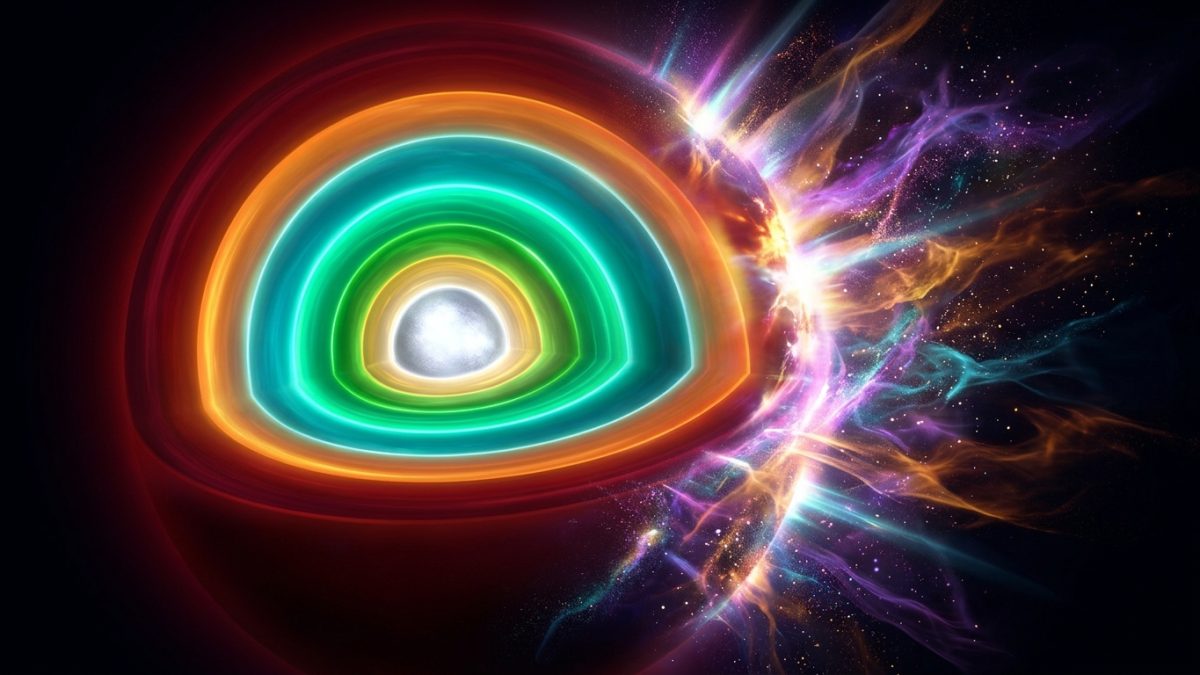
Roughly 2.4 billion years ago, a humble photosynthetic microbe committed the greatest ecological crime and the greatest evolutionary miracle in planetary history. By evolving a biochemical nanomachinery capable of splitting water molecules, Cyanobacteria began releasing free diatomic oxygen into a world that had known only anaerobic tranquility. The corrosive gas precipitated billions of tons of dissolved iron into the ocean floor, extinguished the dominant anaerobic biosphere, obliterated Earth’s greenhouse blanket to trigger a 300-million-year planetary ice age, and forged the thermodynamic foundation for complex multicellular life.
The Anoxic Earth: A World of Iron, Methane, and Sulfur
For the first half of Earth’s existence—the entire Archean Eon (4.0 to 2.5 billion years ago)—the atmosphere was devoid of free diatomic oxygen (O₂ < 10⁻⁵ of modern Present Atmospheric Level, PAL). In this anoxic world, anaerobic prokaryotes thrived across the global ocean:
- Methanogens (Archaea): Reduced volcanic carbon dioxide with hydrogen to generate methane (CO₂ + 4H₂ → CH₄ + 2H₂O), filling the sky with a warm, smoggy greenhouse blanket that kept the Archean Earth warm under the Faint Young Sun.
- Sulfate Reducers & Fermenters (Bacteria): Recycled organic debris into hydrogen sulfide (H₂S) and organic acids in total darkness.
- Anoxygenic Phototrophs: Early photosynthetic bacteria (such as purple and green sulfur bacteria) harvested sunlight, but they did not use water as an electron donor. They relied on dissolved hydrogen sulfide (H₂S → 2H⁺ + S + 2e^-) or dissolved ferrous iron (Fe²⁺). Because sulfur and iron springs were localized, early photosynthesis was chained to hydrothermal hotspots.
The Master Key: Cracking the Water Molecule
Water (H₂O) was infinite, blanketing the planet in oceans miles deep. But water holds onto its electrons with ferocious thermodynamic tenacity: the redox potential of the O₂ / H₂O half-reaction is +0.815 Volts. No biological enzyme on Earth could generate an electrochemical potential strong enough to rip an electron away from an oxygen atom.
Then, inside the ancestors of modern Cyanobacteria (blue-green algae), an extraordinary structural mutation occurred: the coupling of two distinct photosystems—Photosystem I and Photosystem II—into the Z-Scheme of Photosynthesis.
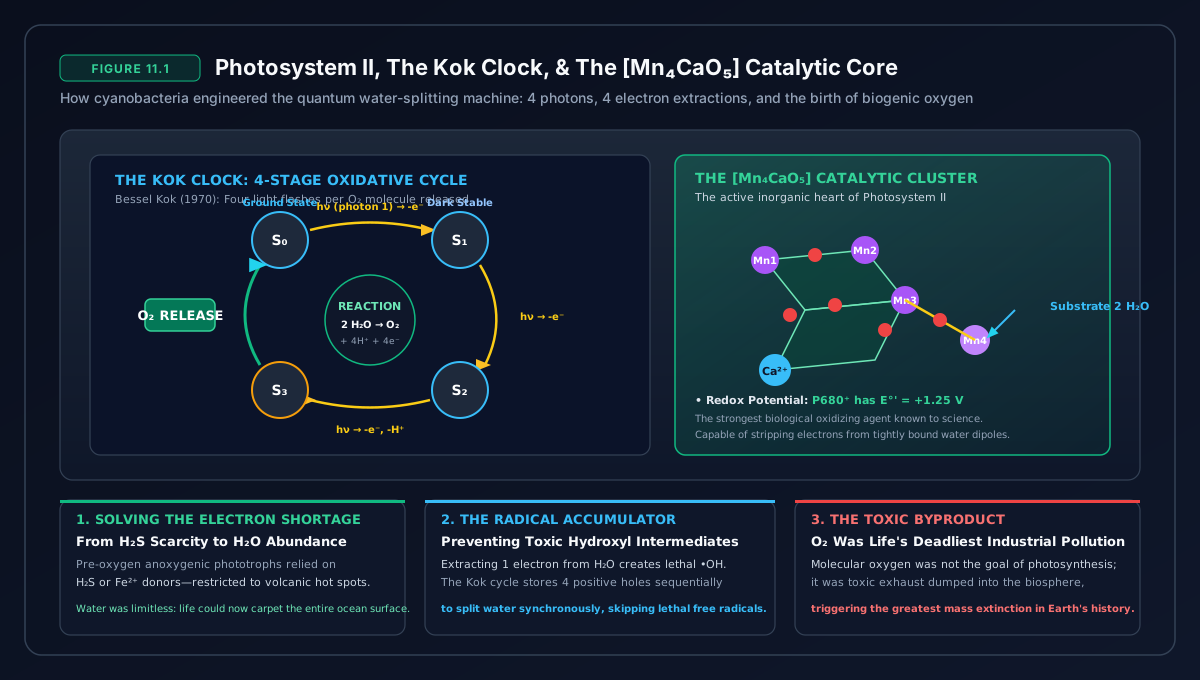
Inside Photosystem II lies the Oxygen-Evolving Complex (OEC), centered around an asymmetric inorganic cluster of four manganese atoms, one calcium atom, and five oxygen atoms (Mn_4CaO_5). Driven by absorbed photons of red sunlight (λ = 680 nm), chlorophyll reaction center P680 becomes the most powerful oxidizing agent in biological nature (E° ≈ +1.25 V).
Through four successive flashes of light (the Kok cycle), the cluster rips four electrons from two bound water molecules:
$$2\text{H}_2\text{O} + 4h\nu \to \text{O}_2 + 4\text{H}^+ + 4e^-$$
The protons (H⁺) drive ATP synthesis; the electrons reduce CO₂ into sugars; and the molecular oxygen (O₂) was discarded into the surrounding seawater as toxic biological waste.
The Great Chemical Sinks: Banded Iron Formations
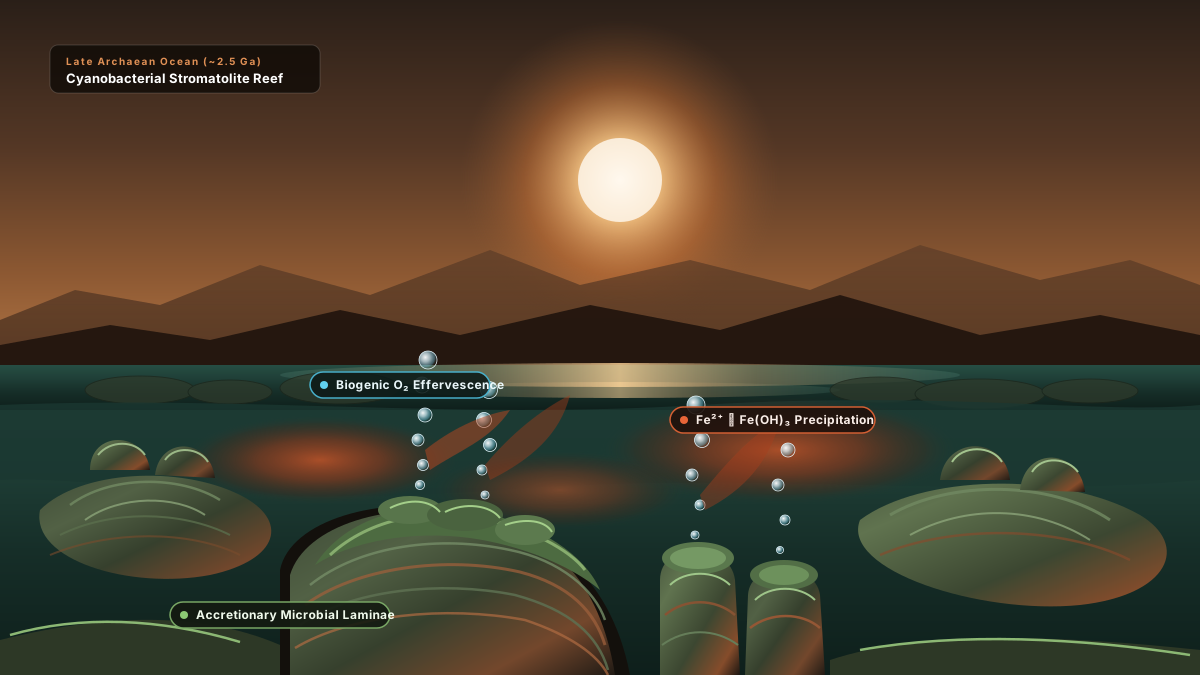
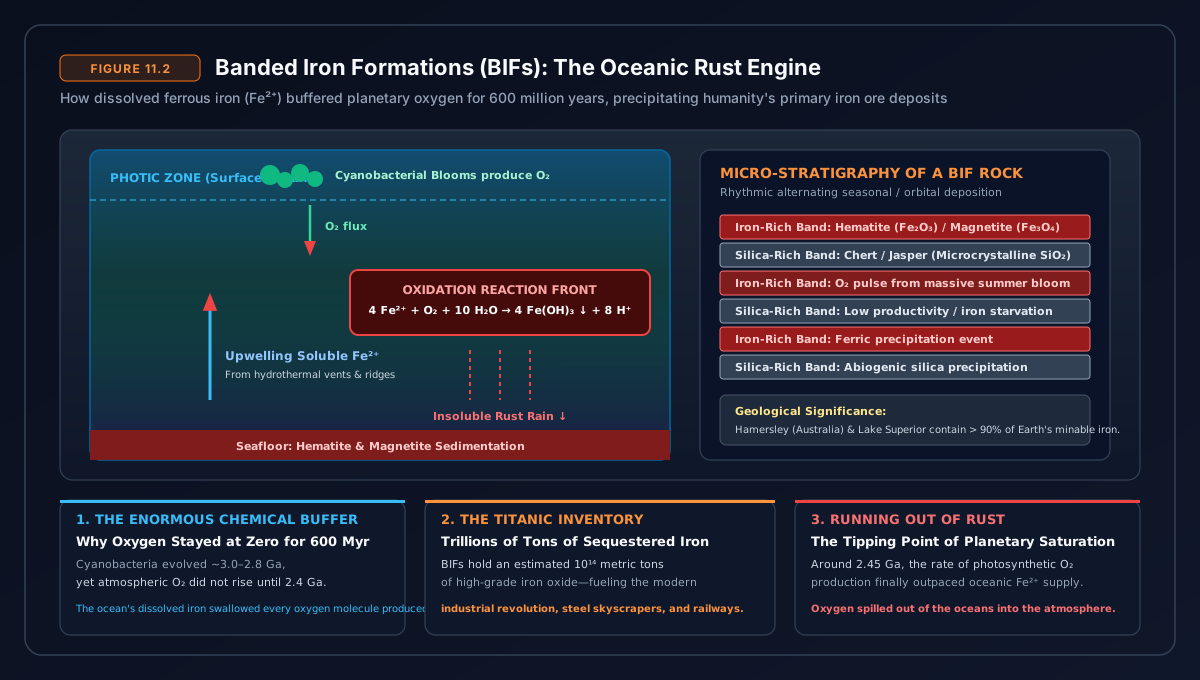
Cyanobacteria did not oxygenate the atmosphere overnight. For hundreds of millions of years (from roughly 2.8 to 2.4 billion years ago), the oxygen produced by microbial mats (stromatolites) was eagerly devoured by planetary chemical sinks.
The Archean oceans were vast chemical reservoirs of soluble ferrous iron (Fe²⁺), leached from hydrothermal vents and basaltic crusts. As cyanobacterial blooms released free oxygen, the oxygen immediately oxidized the dissolved iron into insoluble ferric iron (Fe³⁺):
$$4\text{Fe}^{2+} + \text{O}_2 + 10\text{H}_2\text{O} \to 4\text{Fe(OH)}_3 \downarrow + 8\text{H}^+$$
The precipitated ferric hydroxides settled to the abyssal ocean floor like red rust snow, consolidating into alternating seasonal layers of silver-black iron oxides (magnetite Fe_3O_4 and hematite Fe_2O₃) and red chert silica (SiO₂): Banded Iron Formations (BIFs).
These majestic geological formations—stretching across thousands of square kilometers in the Hamersley Range of Western Australia, the Carajás of Brazil, and the Lake Superior region—contain over 90% of all minable iron ore on Earth. The skyscrapers, bridges, cargo ships, and railways of modern human civilization are constructed from the fossilized rusted byproduct of cyanobacterial metabolism!

The Great Oxidation Event (GOE): The Catastrophe
By approximately 2.4 billion years ago (2,400 Ma), the oceanic iron buffer was exhausted. The iron had rusted out of the water. With no chemical sinks left to absorb it, free oxygen escaped the ocean surface and flooded the atmosphere: the Great Oxidation Event (GOE).
The Sulfur Isotope Smoking Gun: Disappearance of Δ³³S
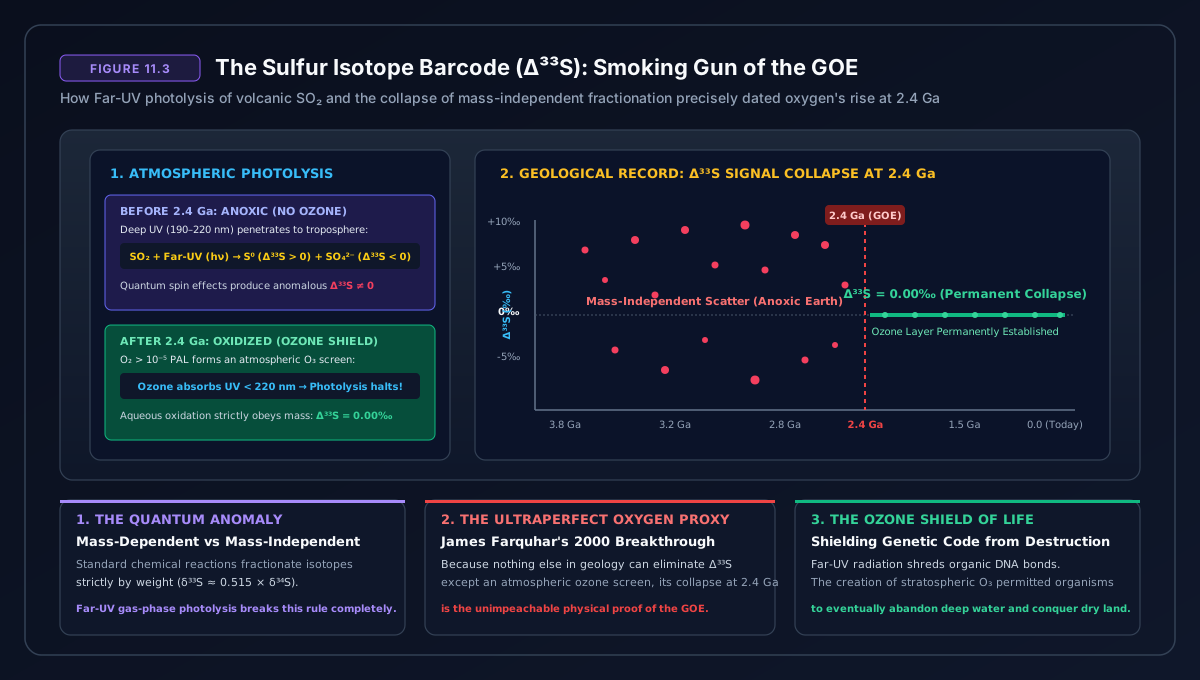
In 2000, geochemist James Farquhar discovered an unshakeable chemical line in the sand: in rocks older than 2.45 billion years, sedimentary sulfides display Mass-Independent Fractionation (MIF) of sulfur isotopes (Δ³³S ≠ 0), produced when deep solar ultraviolet radiation photolyzes atmospheric sulfur dioxide in an anoxic atmosphere. At exactly 2.45 Ga, the sulfur MIF signal vanishes completely and permanently from the geological record—conclusively proving that atmospheric O₂ surged past 0.001\% of modern levels, establishing the first stratospheric ozone shield.
The Anaerobic Holocaust
To the primitive anaerobic organisms that had ruled the planet for over a billion years, oxygen was not life; it was a deadly, corrosive poison. Oxygen greedily strips electrons from organic molecules, generating destructive Reactive Oxygen Species (ROS)—superoxide radicals (O₂^{•-}), hydrogen peroxide (H₂O_2), and hydroxyl radicals (OH^•) that tear apart DNA, denature proteins, and peroxidize cell membranes.
Lacking antioxidant protective enzymes (such as superoxide dismutase and catalase), untold trillions of anaerobic microbial lineages were wiped out in Earth’s first true planetary mass extinction. Obligate anaerobes were forced into permanent retreat—banished into deep subterranean rocks, stagnant anoxic lake muds, and the hydrothermal floor.
The Huronian Glaciation (2.4 to 2.1 Ga): The 300-Million-Year Winter
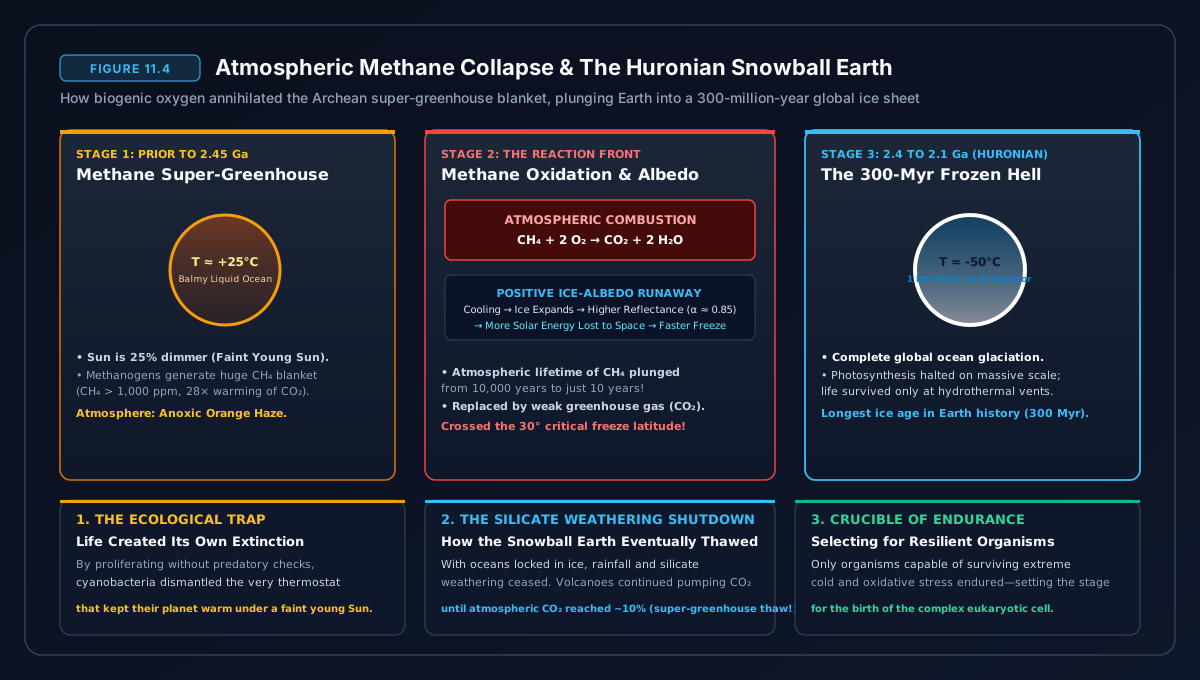
The ecological catastrophe soon triggered a planetary climatic nightmare. Throughout the Archean, Earth’s surface had remained warm under the Faint Young Sun due to a thick blanket of atmospheric methane (CH₄).
As oxygen surged into the atmosphere, it reacted with methane in photochemical oxidation chains:
$$\text{CH}_4 + 2\text{O}_2 \to \text{CO}_2 + 2\text{H}_2\text{O}$$
Carbon dioxide is a greenhouse gas, but methane is twenty-eight times more potent per molecule. Replacing the dense methane blanket with CO₂ destroyed Earth’s planetary insulation. Global temperatures crashed by dozens of degrees in a geological heartbeat.
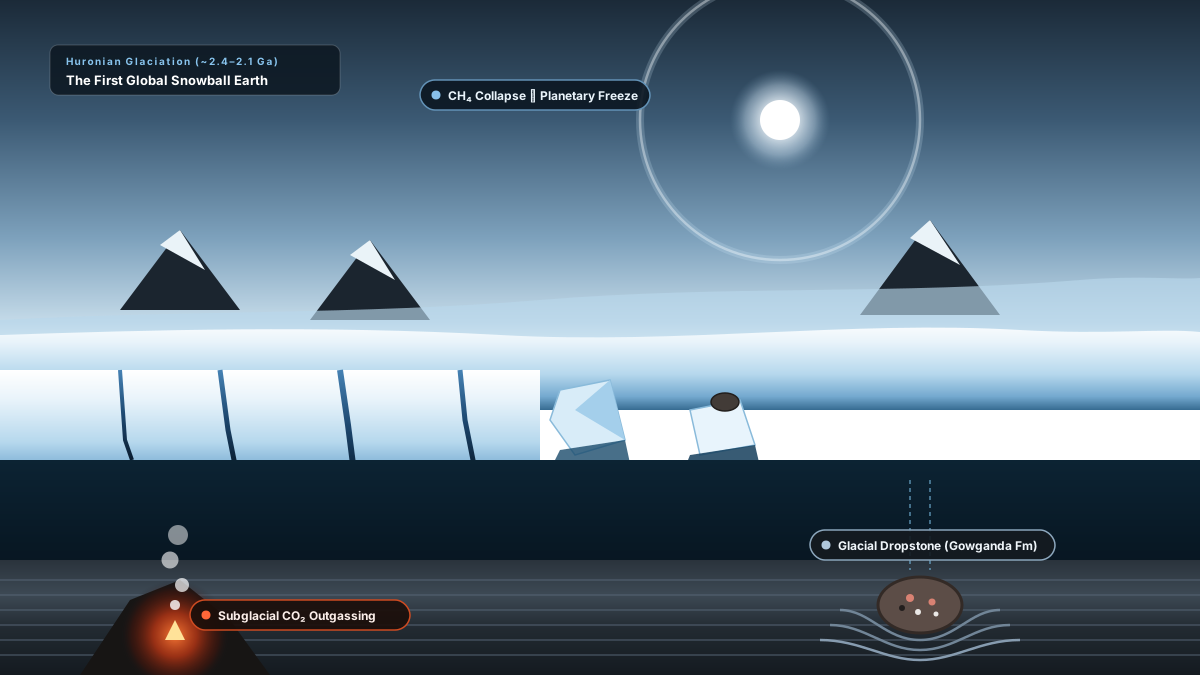
As continental glaciers expanded from the poles past 30° latitude, reflective white ice reflected solar radiation back into space, triggering a runaway positive feedback loop (the ice-albedo instability). Earth plunged into the Huronian Glaciation (2.4 to 2.1 billion years ago)—the longest and most severe Ice Age in Earth history.
For over 300 million years, Earth was an unbroken, reflective white “Snowball Earth,” with glaciers kilometers thick locking the oceans under ice right down to the equator. Life survived only in narrow cracks, geothermal hot springs, and around hydrothermal chimneys beneath the frozen sea.
The Miracle: The Thermodynamic Jackpot of Aerobic Respiration
Eventually, volcanic outgassing of CO₂ un-sequestered by liquid oceans accumulated to extreme levels (over 0.1 to 0.3 bars), overpowering the ice-albedo feedback and melting the Snowball Earth in a super-greenhouse thaw. The world that emerged was chemically transformed forever.
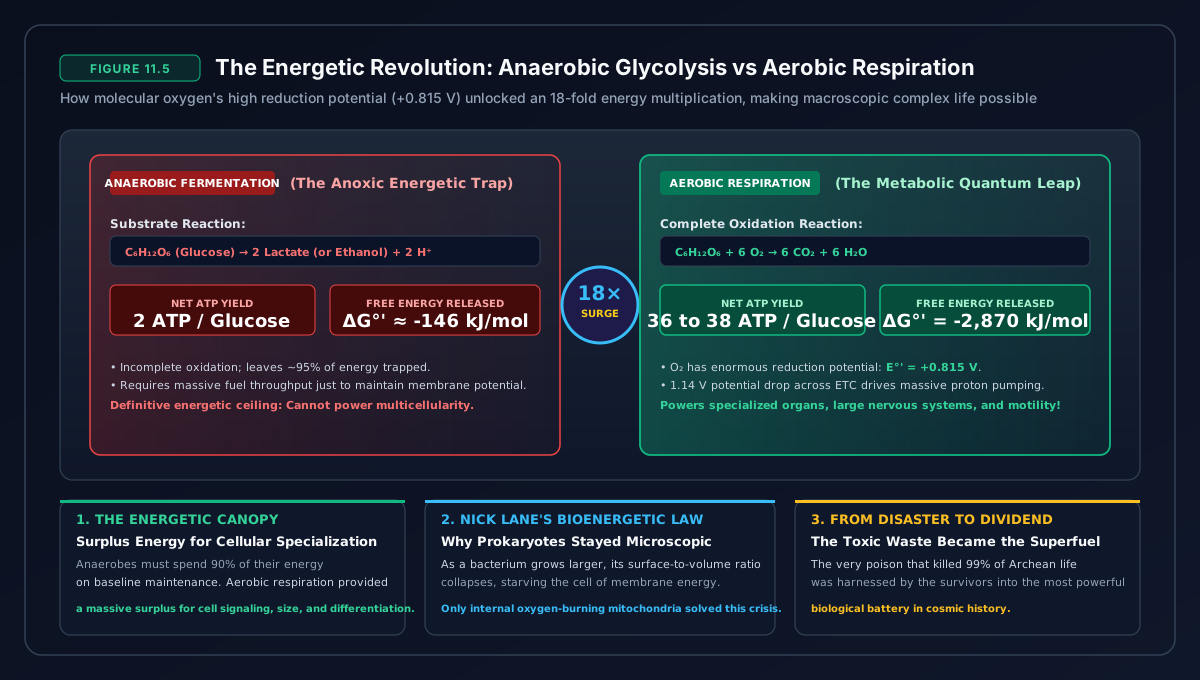
While oxygen was initially a poison, the microbes that learned to harness it unlocked an astronomical thermodynamic jackpot: Aerobic Respiration.
Under anaerobic fermentation, the breakdown of one molecule of glucose yields barely 2 molecules of ATP (adenosine triphosphate, the cellular energy currency). In aerobic respiration, using oxygen as the terminal electron acceptor in the electron transport chain, the complete oxidation of glucose releases 36 to 38 molecules of ATP:
$$\text{C}_6\text{H}_{12}\text{O}_6 + 6\text{O}_2 \to 6\text{CO}_2 + 6\text{H}_2\text{O} + 36\text{–}38\text{ ATP} \quad (\Delta G^\circ = -2,880\text{ kJ/mol})$$
This was an energetic expansion of nearly 1,800%! For two billion years, life had been limited to microscopic, sluggish single cells because anaerobic metabolism could not afford the energetic overhead of large, complex cellular structures. With aerobic respiration, life possessed the biochemical fuel to power complex genomic regulation, intracellular transport, and multicellularity.
Chronology Table: The Rise of Atmospheric Oxygen
| Stage / Epoch | Age (Ga) | Atmospheric O₂ (% PAL) | Key Physical & Geobiological Events |
|---|---|---|---|
| Pre-Photosynthetic Archean | > 3.0 Ga | < 0.0001\% | Anoxic oceans; methanogen greenhouse; mass-independent sulfur fractionation (Δ³³S ≠ 0). |
| Early Cyanobacteria & Iron Sinks | 2.8–2.45 Ga | Local “oxygen oases” | Water-splitting photosystem II evolves; banded iron formations (BIFs) precipitate in global ocean. |
| The Great Oxidation Event (GOE) | 2.45–2.22 Ga | 1 to 10\% | Oceanic iron sinks exhausted; Δ³³S vanishes; anaerobic mass extinction; methane haze destroyed. |
| The Huronian Snowball Earth | 2.4–2.1 Ga | Variable | Methane greenhouse collapse; global runaway glaciation lasts 300 million years; volcanic CO₂ accumulation breaks ice. |
| The “Boring Billion” Equilibrium | 1.8–0.8 Ga | ~ 1 to 5\% | Canfield ocean (anoxic, sulfidic deep water); stratospheric ozone shield forms; endosymbiosis and first eukaryotes emerge. |
The Stage is Set: The Threshold of the Eukaryotic Revolution
By approximately 2.0 billion years ago, Earth had stabilized into an oxygenated world shielded by a stratospheric ozone layer. The atmosphere and surface oceans possessed a steady supply of free oxygen, while the deep ocean remained anoxic and sulfidic.
Simple prokaryotic bacteria and archaea were now supercharged by aerobic respiration, but they hit an insurmountable morphological ceiling: without internal organelles and specialized bioenergetic membranes, a prokaryote cannot expand its genome size without suffering an energy crisis. To break through this energetic barrier, nature required a singular, once-in-a-billion-years partnership between two completely different single-celled organisms.
In Part 12 of The Universal Chronicle, we will explore the greatest biological merger of all time: The Leap to Complexity — Endosymbiosis, Eukaryotes, and the Genesis of Cellular Specialization.
Academic Citations & Foundational Literature
- Farquhar, J., Bao, H., & Thiemens, M. (2000). “Atmospheric Influence of Earth’s Earliest Sulfur Cycle.” Science, 289(5480), 756–758. doi:10.1126/science.289.5480.756.
- Lyons, T. W., Reinhard, C. T., & Planavsky, N. J. (2014). “The rise of oxygen in Earth’s early ocean and atmosphere.” Nature, 506, 307–315. doi:10.1038/nature13068.
- Fischer, W. W., Hemp, J., & Johnson, J. E. (2016). “Evolution of Oxygenic Photosynthesis.” Annual Review of Earth and Planetary Sciences, 44(1), 647–672. doi:10.1146/annurev-earth-060313-054632.
- Kopp, R. E., Kirschvink, J. L., Hilburn, I. A., & Nash, C. Z. (2005). “The Paleoproterozoic snowball Earth: A climate disaster triggered by the evolution of oxygenic photosynthesis.” Proceedings of the National Academy of Sciences, 102(32), 11131–11136. doi:10.1073/pnas.0504878102.
- Holland, H. D. (2006). “The oxygenation of the atmosphere and oceans.” Philosophical Transactions of the Royal Society B: Biological Sciences, 361(1470), 903–915. doi:10.1098/rstb.2006.1838.
- Ueno, Y., et al. (2006). “Quadruple sulfur isotope analysis of >3.8 Ga basalts: No evidence for the late heavy bombardment?” Geochimica et Cosmochimica Acta, 70(18), A664.