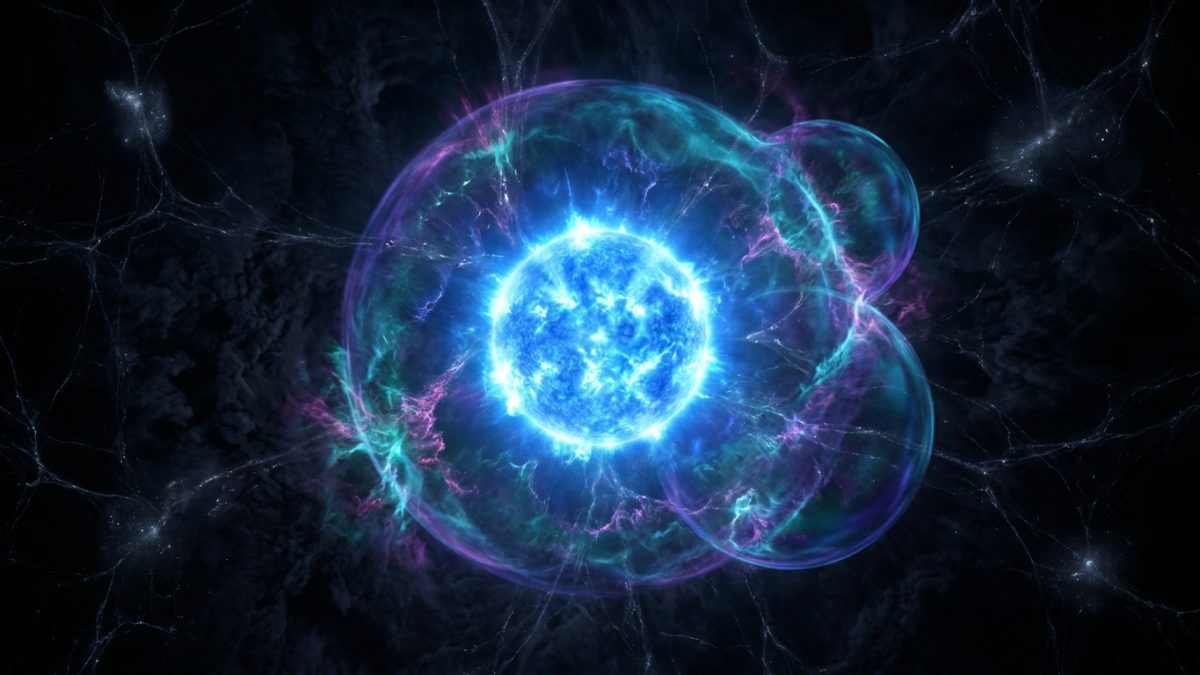
For over one hundred million years after the Big Bang, the universe was an unbroken, lightless desert of neutral hydrogen and cold dark matter. Then, deep within the gravitational wells of primordial mini-halos, pristine gas collapsed under immense pressure to ignite the first stars in cosmic history: Population III hyperstars. Colossal, scorching, and short-lived, these stellar titans illuminated the Cosmic Dawn, flooded the cosmos with ionizing ultraviolet radiation, and sowed the very first seeds of the periodic table.
The Physics of Primordial Collapse: The Molecular Hydrogen Bottleneck
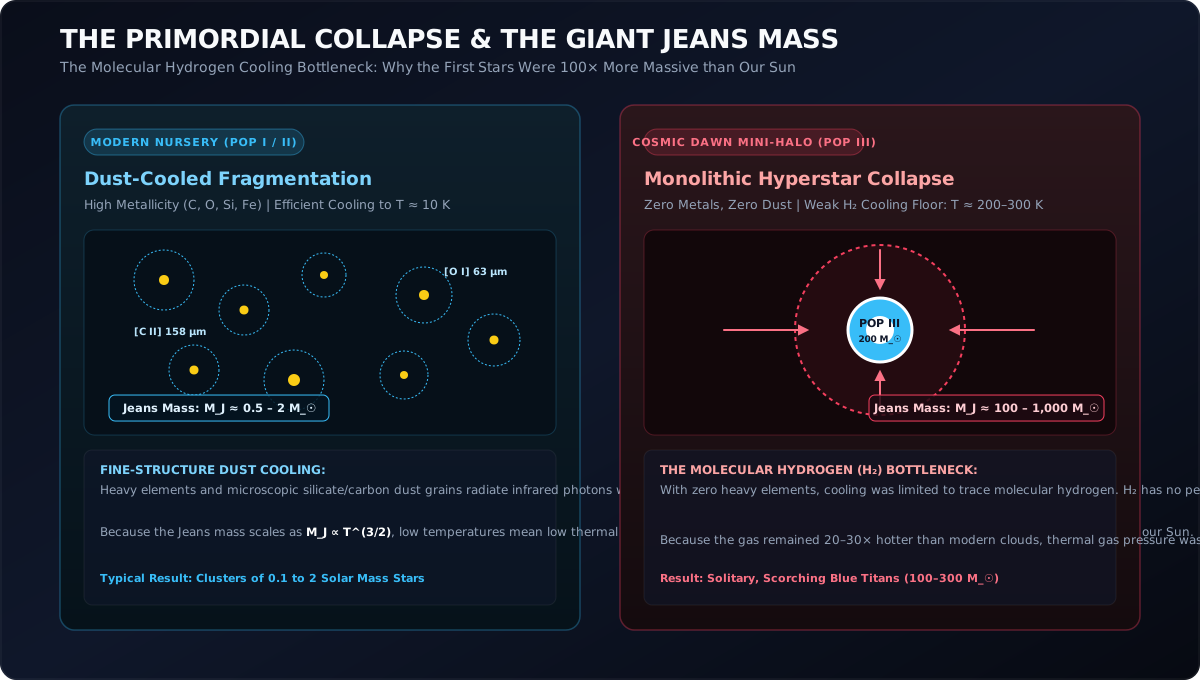
In modern stellar nurseries (such as the Orion Nebula), interstellar gas clouds collapse and fragment efficiently into low-mass stars like our Sun. This occurs because the modern interstellar medium is enriched with “metals”—astronomical shorthand for any element heavier than helium, such as carbon, oxygen, silicon, and iron. These heavy elements and dust grains possess thousands of closely spaced electronic and fine-structure transitions (such as [C II] at 158\,µm and [O I] at 63\,µm) that radiate infrared photons with exquisite efficiency, cooling clouds down to a frigid 10 K.
In the primordial universe, however, there were zero dust grains and zero heavy elements. The gas consisted purely of 75% hydrogen and 25% helium. Atomic hydrogen cannot radiate energy efficiently below 10,000 K because its first electronic excitation level (n=1 → n=2, Lyman-α) requires an enormous 10.2 eV of thermal energy.
The only coolant available in the entire early cosmos was trace amounts of molecular hydrogen (H₂), formed through fragile gas-phase catalytic pathways mediated by free electrons:
- H + e^- → H^- + γ
- H^- + H → H₂ + e^-
Because molecular hydrogen is a homonuclear diatomic molecule, it has no permanent electric dipole moment. Its cooling is restricted to quadrupole rotational transitions (J = 2 → 0), which have an energy spacing corresponding to T ≈ 512 K. As a result, primordial gas clouds could not cool below roughly 200 to 300 K.
The Jeans Mass: Why the First Stars Were Giants
The minimum mass required for a gas cloud to overcome thermal gas pressure and collapse under self-gravity is defined by the Jeans Mass (M_J):
$$M_J \propto \left( \frac{k_B T}{G \mu m_H} \right)^{3/2} \rho^{-1/2}$$
Because the temperature floor of the primordial gas (T ~ 200– K) was twenty to thirty times higher than in modern molecular clouds (T ~ K), the Jeans mass in primordial mini-halos was enormous: typically 100 to 1,000 Solar Masses (M_☉). Rather than fragmenting into thousands of tiny stars, primordial gas clouds collapsed into solitary, massive proto-stellar cores that accreted matter at ferocious rates (Ṁ ~ 10^{-3} to 10^{-2} M_☉/year).
Population III Hyperstars: The Blue Titans of the Dawn
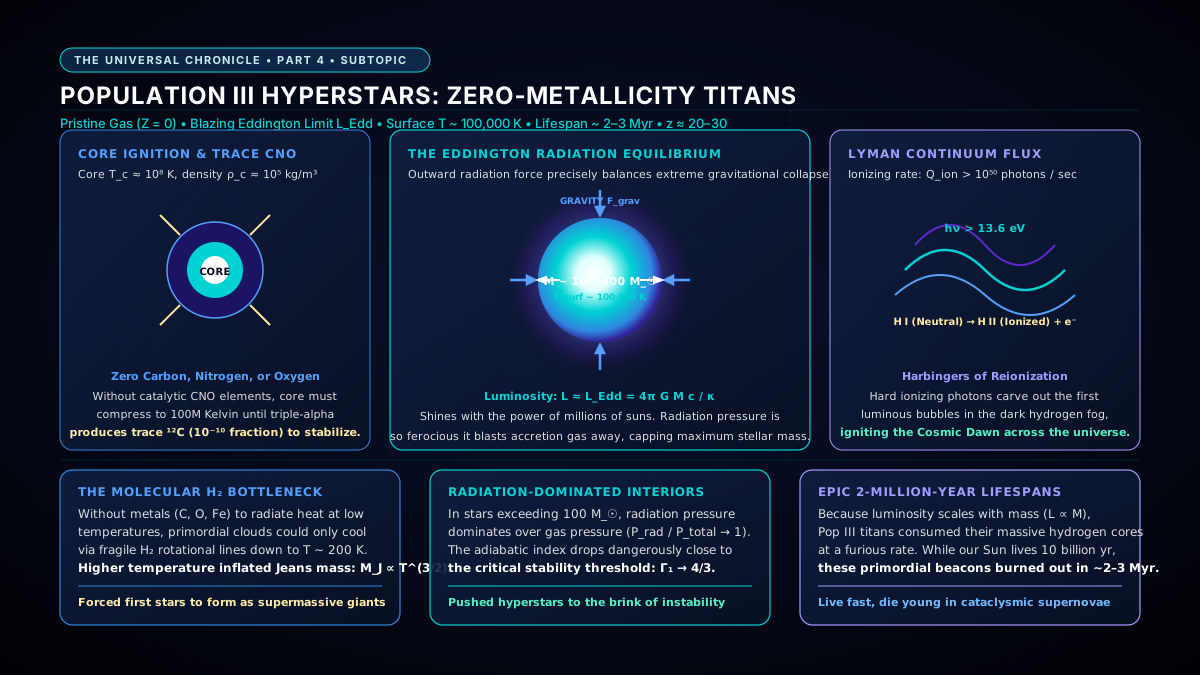
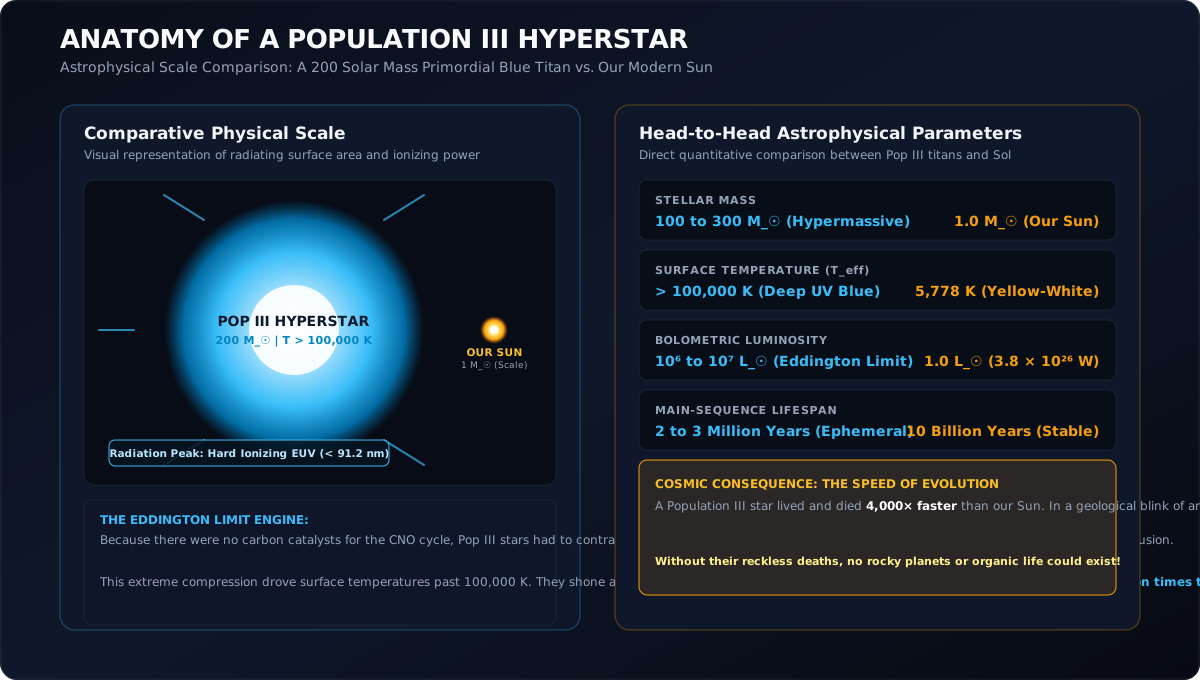
The stars that ignited at Cosmic Dawn (z ~ 20–30, or t ≈ 100–200 million years) were unlike anything existing in our galaxy today. Designated Population III stars, these titans possessed masses ranging from 30 M_☉ to upwards of 300 M_☉.
Surface Temperature: Because they possessed zero carbon to catalyze the CNO cycle, Population III stars had to contract until their central core temperatures reached a staggering 10^8 K to initiate the triple-alpha process and produce trace carbon. This intense core compression caused their surfaces to burn at blistering effective temperatures exceeding 100,000 K (compared to 5, K for our Sun).
Luminosity: They shone close to the theoretical Eddington limit, radiating millions of times more energy than the Sun (L ~ 10^6–10^7 L_☉). Their emission peaked not in visible light, but in hard, ionizing extreme ultraviolet (EUV) radiation.
Because they burned through their nuclear fuel with reckless ferocity, Population III hyperstars lived spectacularly brief lives. While our Sun has a lifespan of 10 billion years, a 200 M_☉ primordial star consumed its core hydrogen in barely 2 to 3 million years.
Catastrophic Deaths: Pair-Instability Supernovae and Black Hole Seeds
When a Population III hyperstar exhausted its core fuel, its fate depended strictly on its initial mass, leading to some of the most violent astrophysical phenomena in cosmic history:
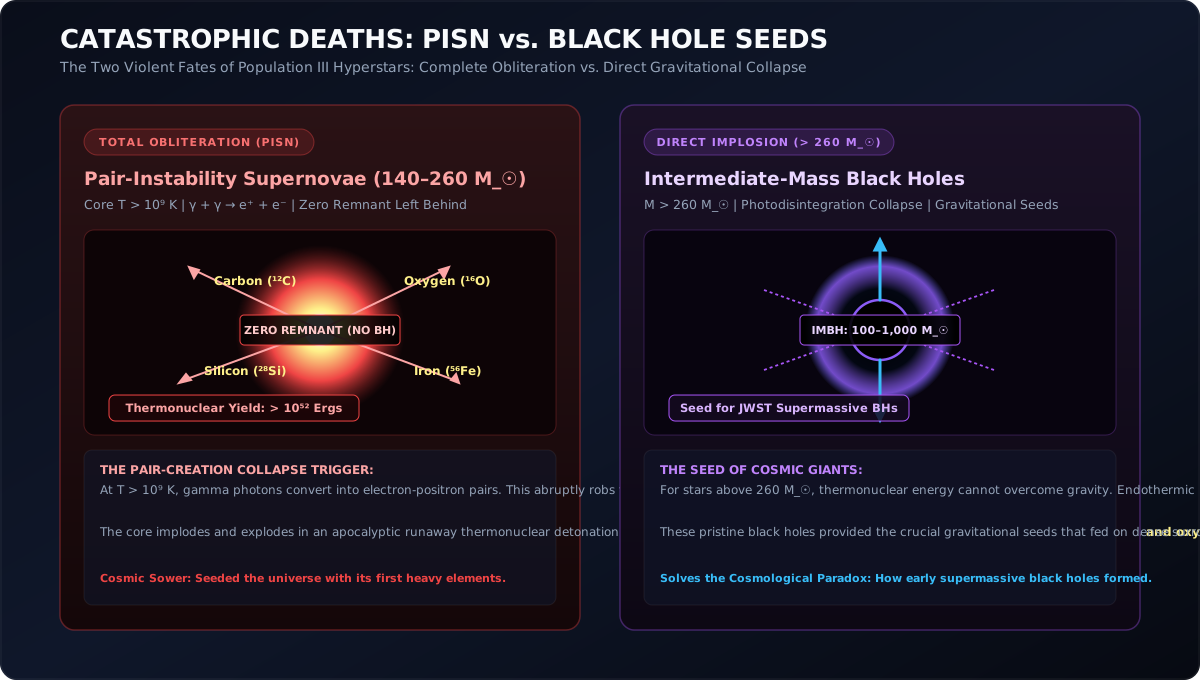
1. Pair-Instability Supernovae (PISN: 140–260 M_☉)
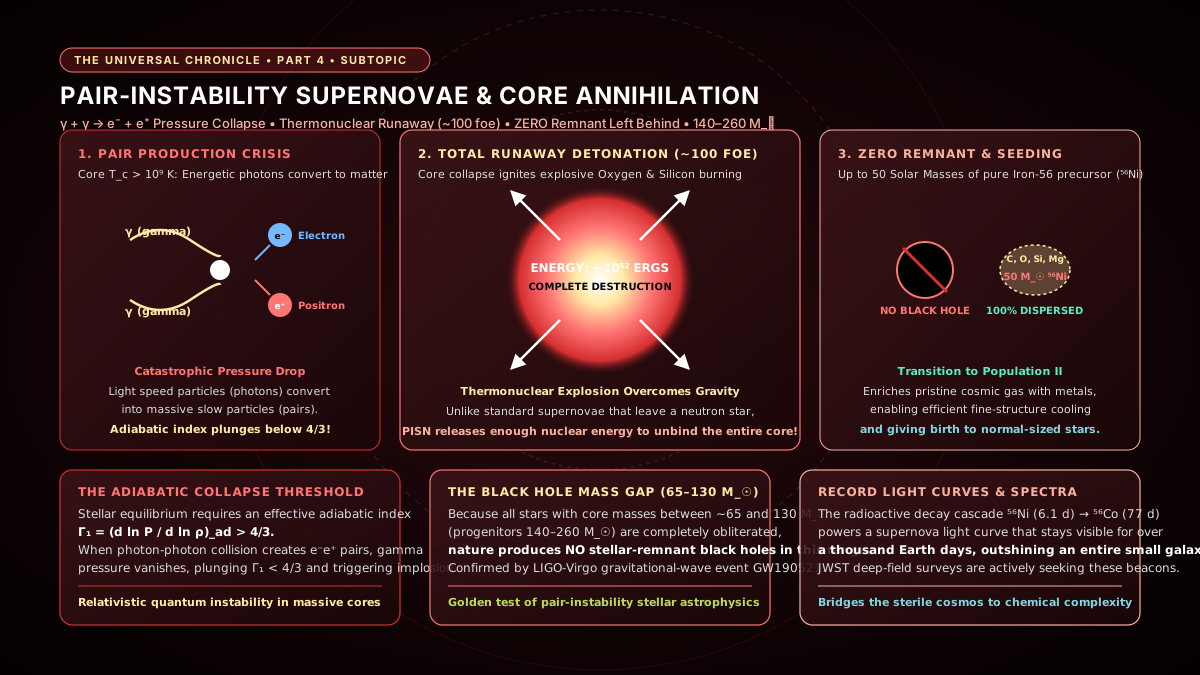
In stars with helium core masses between 64 M_☉ and 133 M_☉, core temperatures reached 10^9 K. At this threshold, the average thermal photons became so energetic that they spontaneously converted into electron-positron pairs via quantum pair production (γ + γ → e^+ + e^-).
This conversion abruptly replaced radiation pressure (which supports the star against gravity) with matter pressure, causing the adiabatic index Γ_1 to drop below the critical stability limit of 4/3. The core suffered an instantaneous, runaway gravitational collapse. The sudden compression ignited catastrophic, explosive oxygen and silicon burning, releasing more thermonuclear energy than the gravitational binding energy of the entire star. The entire star was completely obliterated in a single blast with zero remnant left behind—no neutron star, no black hole. Up to 50 M_☉ of pure synthesized iron, nickel, carbon, and oxygen was hurled into the surrounding pristine cosmos.
2. Direct Collapse to Intermediate-Mass Black Holes (> 260 M_☉)
For primordial stars exceeding 260 M_☉, the thermonuclear explosion was unable to overcome the immense gravitational potential. The star collapsed directly and completely into an Intermediate-Mass Black Hole (IMBH) of 100 to 1,000 M_☉. These primordial stellar corpses provided the elusive gravitational “seeds” that grew via hyper-Eddington accretion into the billion-solar-mass supermassive black holes observed at high redshifts by the James Webb Space Telescope.
The Epoch of Reionization (EoR): Ionizing the Cosmos
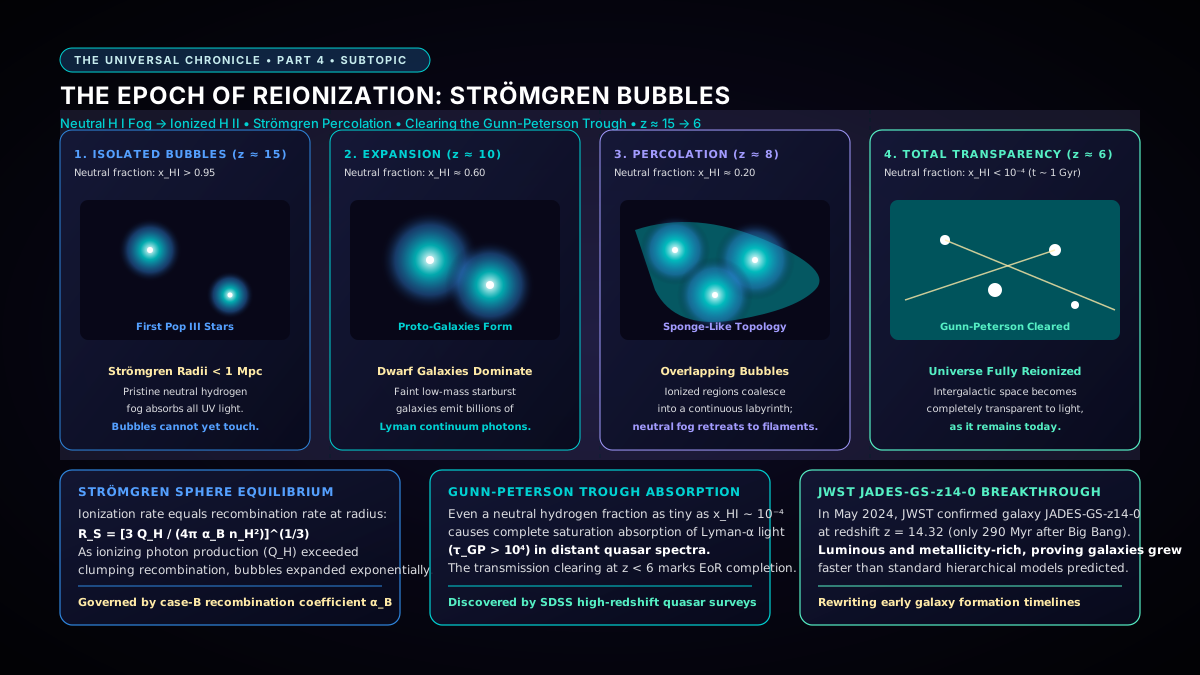
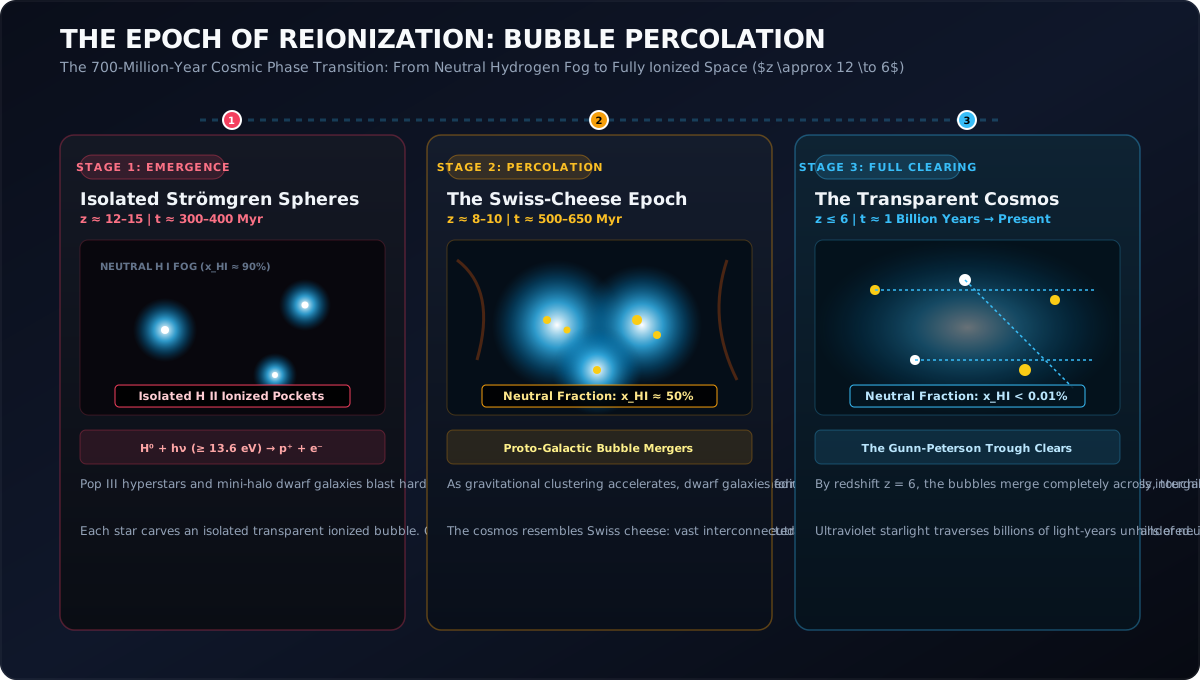
As the first stars ignited and aggregated into proto-galaxies, their ferocious extreme ultraviolet radiation began ionizing the surrounding neutral hydrogen gas. Each star created a localized Strömgren sphere—an expanding bubble of transparent, ionized plasma (H II):
$$\text{H}^0 + h\nu (\ge 13.6\text{ eV}) \to p + e^-$$
Throughout the Epoch of Reionization (z ≈ 12 → 6, corresponding to t ≈ 300 million to 1 billion years), these isolated bubbles grew, overlapped, and merged across cosmological distances. By redshift z ≈ 6, over 99.9% of all intergalactic hydrogen had been re-ionized back into a hot, diffuse plasma (T ~ 10^ K).
Astronomers confirmed the timeline of this transformation through observations of high-redshift quasars using the Gunn-Peterson Trough: at z > 6.2, the spectrum of distant quasars is completely blotted out blueward of the Lyman-α line by residual neutral hydrogen fog, while at z < 6, the spectrum clears as the universe becomes fully transparent to ultraviolet light once more.
The Revolution of the James Webb Space Telescope (JWST)
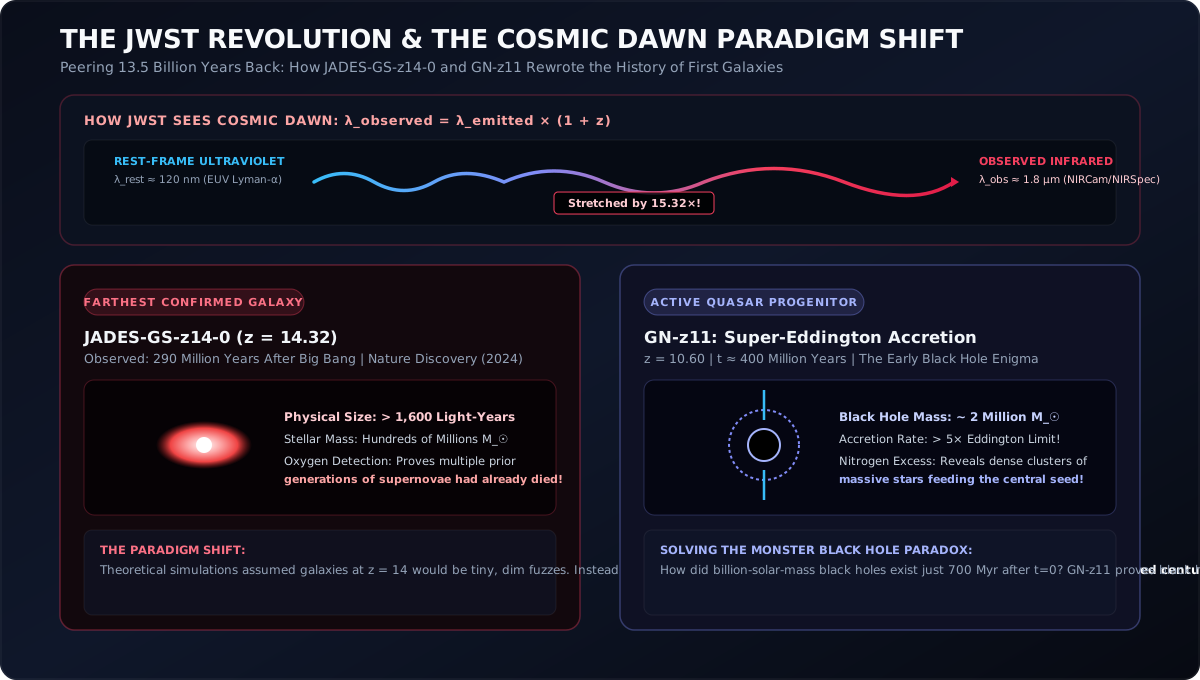
Launched on Christmas Day 2021, NASA’s James Webb Space Telescope (JWST) was engineered specifically to peer through cosmic redshift and capture the infrared signatures of the first galaxies. In its first two years of operations, JWST shattered previous theoretical models by discovering luminous, mature galaxies far earlier than standard cosmological simulations had predicted:
- JADES-GS-z14-0 (z = 14.32): Observed just 290 million years after the Big Bang, this galaxy spans over 1,600 light-years across and contains hundreds of millions of solar masses in stars, proving that star formation ignited with unexpected vigor deep inside the Dark Ages.
- GN-z11 (z = 10.6): Confirmed to host an active, luminous supermassive black hole accreting matter at over five times its theoretical Eddington limit just 400 million years after t=0.
Chronology Table: From Dark Ages to Cosmic Dawn
| Cosmic Epoch | Redshift (z) | Time Elapsed (t) | Characteristic Phenomena |
|---|---|---|---|
| Dark Ages Minimum | z ≈ 30–50 | 50–100 Myr | Cold dark matter mini-halos (10^5–10^6 M_☉) form; pristine gas accumulates; H₂ cooling initiates. |
| Ignition of Population III Stars | z ≈ 20–30 | 100–180 Myr | First stars ignite; masses 50–300 M_☉; T_{eff} > 100, K; EUV radiation carves first Strömgren spheres. |
| First Supernovae & Chemical Enrichment | z ≈ 15–20 | 180–270 Myr | Pair-instability supernovae obliterate first stars; first carbon, oxygen, and iron enrich the intergalactic medium; Population II star formation begins. |
| Proto-Galaxy Assembly | z ≈ 10–15 | 270–480 Myr | Mergers of mini-halos create first dwarf galaxies (JADES-GS-z14-0, GN-z11); early black hole seeds grow via rapid accretion. |
| Overlap & Completion of Reionization | z ≈ 6–8 | 650 Myr to 1 Gyr | Ionized bubbles merge; intergalactic medium reaches >99.9\% ionization; Gunn-Peterson trough clears. |
The Legacy: A Chemically Transformed Universe
The reign of Population III stars was brief, violent, and utterly transformative. Before them, the universe was sterile, composed solely of hydrogen and helium. Through their fierce thermonuclear cores and cataclysmic pair-instability deaths, these ancient titans synthesized and dispersed the universe’s first heavy nuclei—the initial carbon, oxygen, nitrogen, and magnesium.
Once the metallicity of gas clouds crossed a critical threshold (Z_{crit} ≈ 10^{-5.5} Z_☉), dust grains formed, efficient fine-structure cooling took over, and the cosmos transitioned forever to Population II stellar generations—smaller, stable stars capable of forming solar systems. In Part 5 of The Universal Chronicle, we will explore the great stellar alchemists that followed: The Alchemists of the Universe — Stellar Nucleosynthesis, Supernovae, and the Forging of Heavy Elements.
Academic Citations & Foundational Literature
- Barkana, R., & Loeb, A. (2001). “In the beginning: the first sources of light and the reionization of the universe.” Physics Reports, 349(2), 125–238. doi:10.1016/S0370-1573(01)00019-9.
- Bromm, V., & Larson, R. B. (2004). “The First Stars.” Annual Review of Astronomy and Astrophysics, 42(1), 79–118. doi:10.1146/annurev.astro.42.053102.134034.
- Heger, A., & Woosley, S. E. (2002). “The Nucleosynthetic Signature of Population III.” The Astrophysical Journal, 567(1), 532–543. doi:10.1086/338487.
- Fan, X., Carilli, C. L., & Keating, B. (2006). “Observational Constraints on Cosmic Reionization.” Annual Review of Astronomy and Astrophysics, 44(1), 415–462. doi:10.1146/annurev.astro.44.051905.092521.
- Robertson, B. E., et al. (2015). “Cosmic reionization and early star-forming galaxies: a joint analysis of new constraints from Planck and the Hubble Space Telescope.” The Astrophysical Journal Letters, 802(2), L19. doi:10.1088/2041-8205/802/2/L19.
- Carniani, S., et al. (JADES Collaboration) (2024). “A shining cosmic dawn: spectroscopic confirmation of two luminous galaxies at z ~ 14.” Nature, 633, 318–322. doi:10.1038/s41586-024-07680-y.
- Gunn, J. E., & Peterson, B. A. (1965). “On the Density of Neutral Hydrogen in Intergalactic Space.” The Astrophysical Journal, 142, 1633–1636. doi:10.1086/148444.