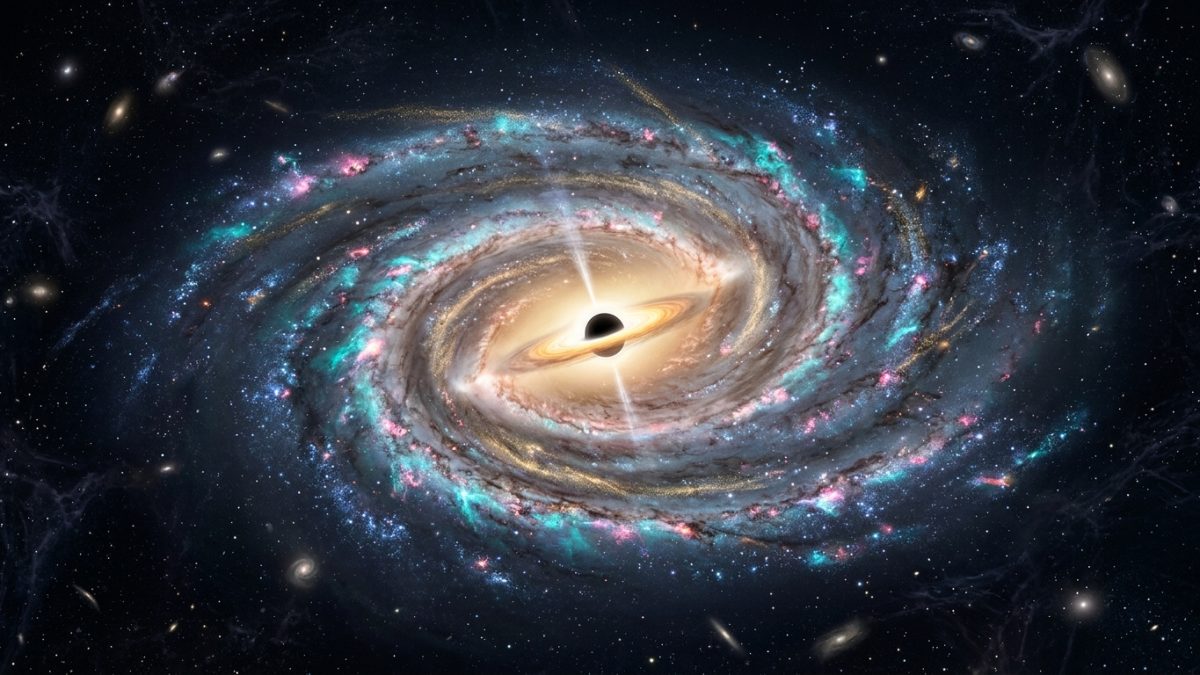
Galaxies are the great island empires of the cosmos—sprawling gravitational architectures containing hundreds of billions of stars, interstellar dust nurseries, and supermassive black holes. Far from being random clusters of stars, spiral galaxies like our Milky Way are dynamic, self-regulating machines shaped by the invisible scaffolding of dark matter halos, sculpted into graceful rotating disks by the conservation of angular momentum, and pinned in equilibrium around central gravitational singularities.
From Primordial Halos to Rotating Disks: Conservation of Angular Momentum
In the standard ΛCDM (Lambda Cold Dark Matter) cosmological framework, galaxies do not assemble in isolation. They form at the intersections of the Cosmic Web—a vast, sponge-like network of dark matter filaments woven during the first fractions of a second following the Big Bang.
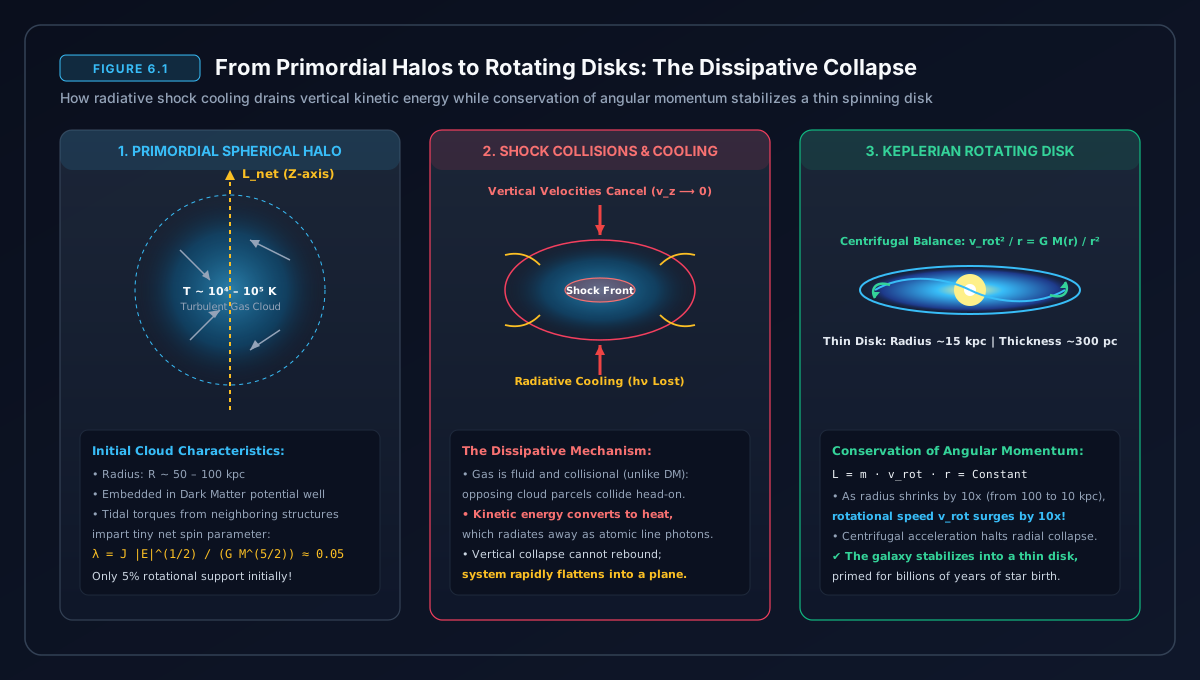
As primordial gas fell into these dark matter potential wells, it was subjected to tidal gravitational torques from neighboring overdensities. This tidal shearing imparted a net orbital angular momentum (J) to the collapsing gas cloud. While dark matter particles are collisionless and remain suspended in a vast, spherical or triaxial halo, baryonic gas is collisional and dissipative: when gas clouds collide, they shock, heat up, and radiate away their thermal energy via electromagnetic radiation.
Because gas can radiate away kinetic energy parallel to the rotation axis through collisions, but cannot eliminate its net angular momentum perpendicular to the axis (J = Iω = constant), the collapsing gas cloud inevitably collapses along its rotational poles while resisting collapse along its equatorial plane. In a few hundred million years, a turbulent, three-dimensional spherical gas cloud is flattened into a thin, centrifugally supported, rotating galactic disk.
The Winding Dilemma: Why Spiral Arms Are Not Physical Structures
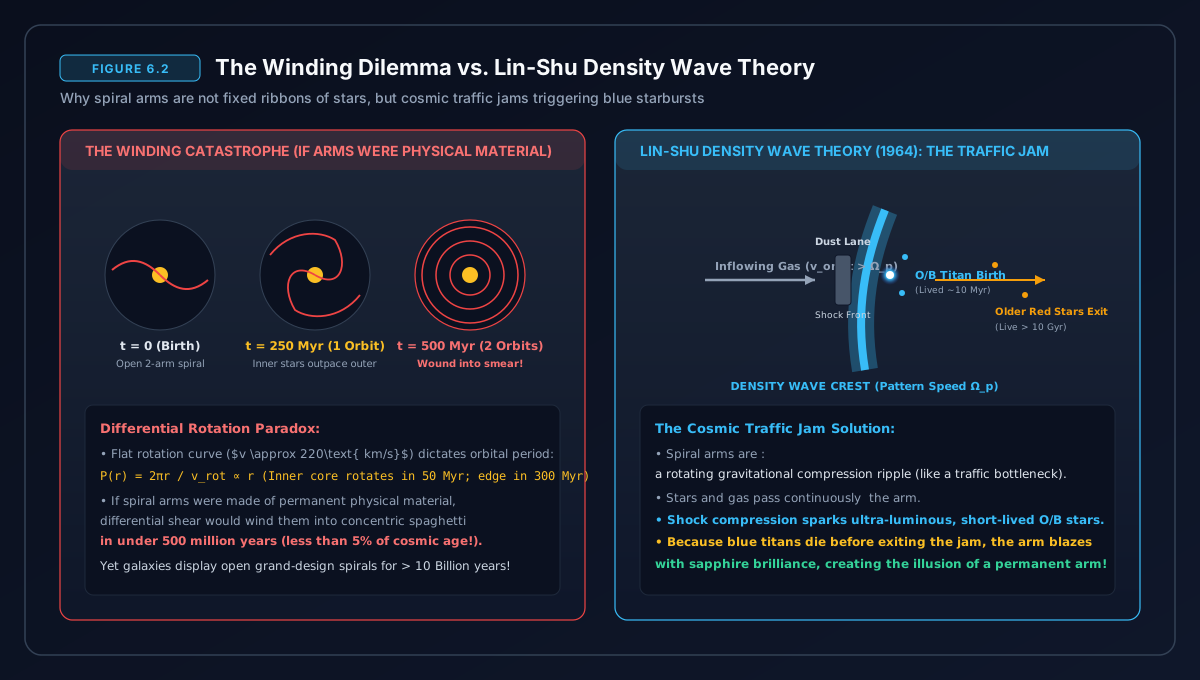
When astronomers in the early 20th century first photographed grand-design spiral galaxies like Messier 51 (the Whirlpool Galaxy), they encountered a fundamental mathematical paradox known as the Winding Dilemma.
Galaxies exhibit differential rotation: stars near the galactic center complete an orbit far faster than stars on the outer periphery. In the Milky Way, a star at 2 kpc orbits in ~ 50 million years, while our Sun at 8 kpc requires ~ 230 million years. If spiral arms were rigid, physical strings of stars tied together, the inner sections would wind tightly around the core like spaghetti on a fork, wiping out all visible spiral structure within two or three rotations (~ 500 million years). Yet, spiral galaxies have persisted with open, majestic arms for over ten billion years!
The Lin-Shu Density Wave Theory (1964)
In 1964, mathematicians Chia-Chiao Lin and Frank Shu formulated the definitive resolution: spiral arms are not physical objects made of the same stars; they are propagating gravitational density waves—cosmic traffic jams traveling through the galactic disk.
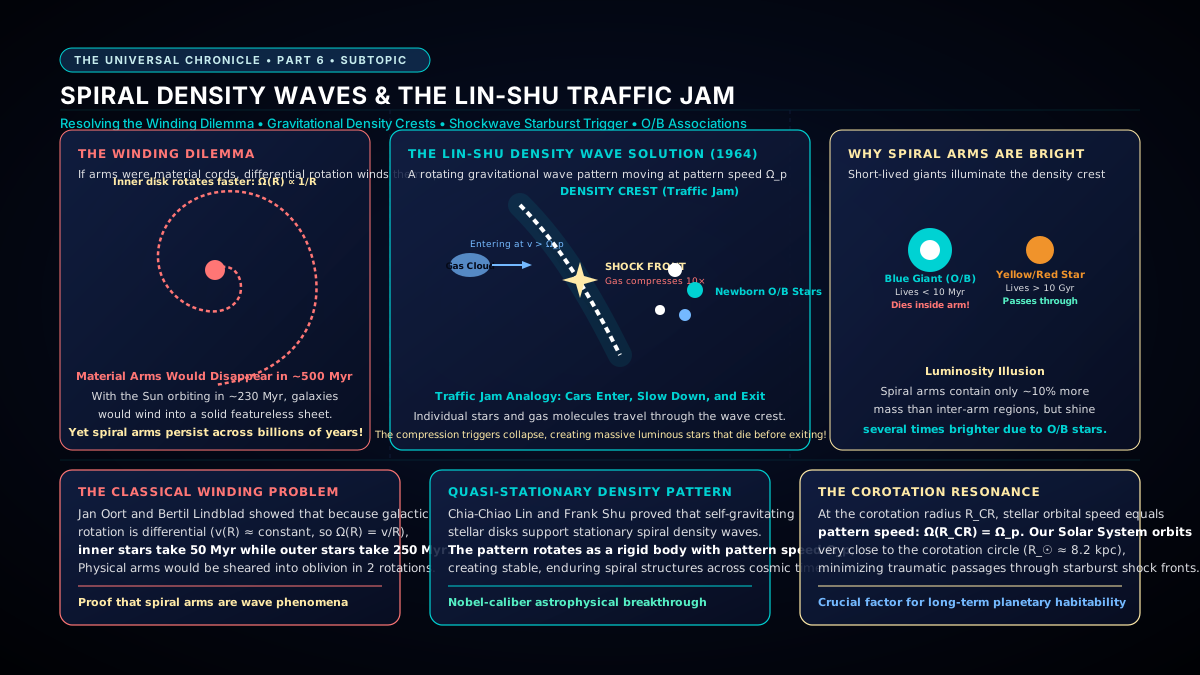
Consider a slow-moving highway truck: cars bunch together behind the truck, move slowly through the high-density cluster, and accelerate away once past it. The high-density traffic jam remains stationary or moves slowly, even though individual cars constantly enter and exit it. Similarly, stars and interstellar gas clouds orbit freely through the disk, moving in and out of the spiral arms:
- Shock Compression: As diffuse interstellar gas plows into the crest of a gravitational density wave, it is compressed violently, triggering gravitational collapse.
- Starburst Nurseries: The compressed gas fragments into dense molecular clouds, birthing thousands of bright, massive, hot O- and B-type stars.
- Why Arms Look Blue: Massive O/B stars are millions of times more luminous than ordinary stars, radiating intense blue-white light. Because these titans live only 5 to 20 million years, they die in supernovae before they can exit the other side of the spiral arm! Consequently, the spiral arms shine with brilliant electric blue starlight and pink hydrogen-emission (H II) nebulae, while older, yellow-red dwarf stars like our Sun disperse smoothly across the inter-arm disk.
The Heart of the Whirlpool: Supermassive Black Holes and Co-Evolution
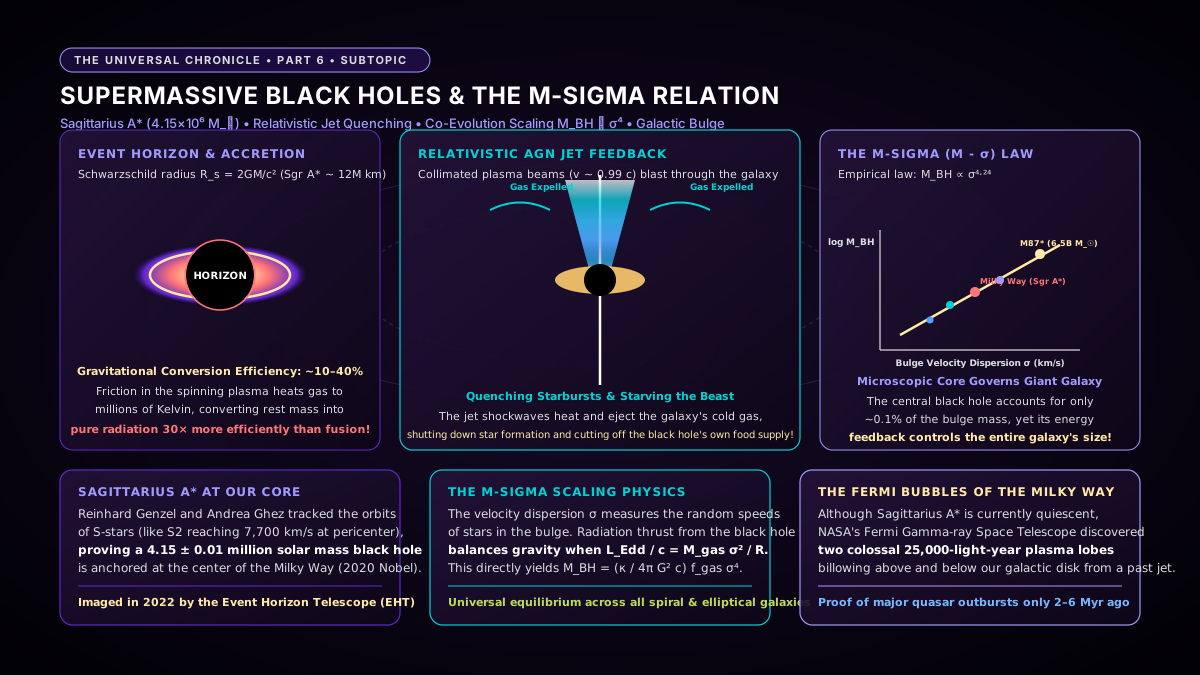
At the exact gravitational center of virtually every massive galaxy lies a gravitational monster: a Supermassive Black Hole (SMBH) containing millions to billions of times the mass of the Sun. In the heart of our own Milky Way, concealed behind 26,000 light-years of obscuring interstellar dust in the constellation Sagittarius, lies Sagittarius A* (Sgr A*)—a singularity possessing a mass of 4.297 ± 0.012 × 10^6 M_☉, confined within a volume smaller than the orbit of Mercury.
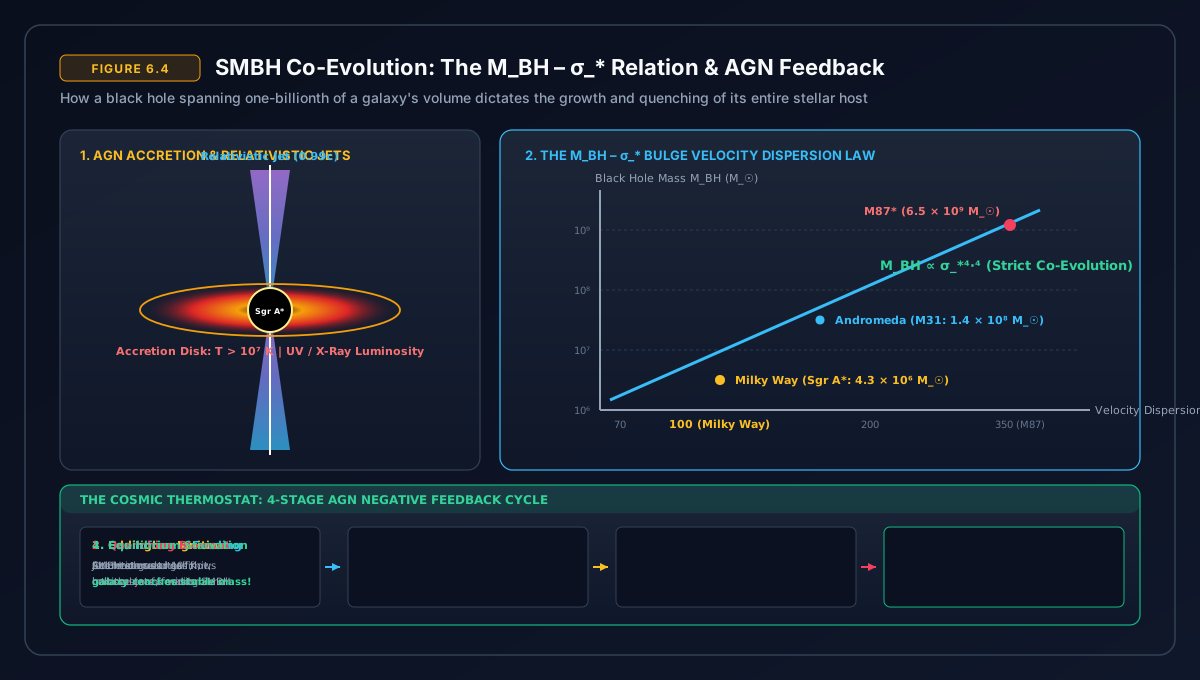
For decades, astronomers debated whether central black holes were passive byproducts of galaxy formation or active directors. In the early 2000s, astrophysicists discovered the M–σ Relation (Ferrarese & Merritt, Gebhardt et al.):
$$M_{\text{BH}} \propto \sigma_*^{4 \text{ to } 5}$$
There exists an astonishingly tight power-law correlation between the mass of a galaxy’s central black hole (M_{BH}) and the velocity dispersion (σ_*) of stars in the galaxy’s central bulge—even though the black hole’s direct gravitational pull extends only a few light-years, while the stellar bulge spans tens of thousands of light-years! How could a tiny central speck dictate the kinematics of an entire galaxy?
The answer is AGN Feedback. In the early universe, when immense inflows of cold gas plunged into the galactic center, the black hole accreted matter at ferocious rates, becoming an ultra-luminous Quasar. The accretion disk radiated colossal energies, launching relativistic plasma jets and radiation-driven winds at thousands of kilometers per second. These winds blasted through the host galaxy, heating and expelling the cold gas required for star formation—effectively “quenching” the galaxy and shutting down both star birth and black hole growth simultaneously. Galaxies and their central black holes grew in intimate lockstep.
Vera Rubin’s Triumph: The Invisible Giant of Dark Matter
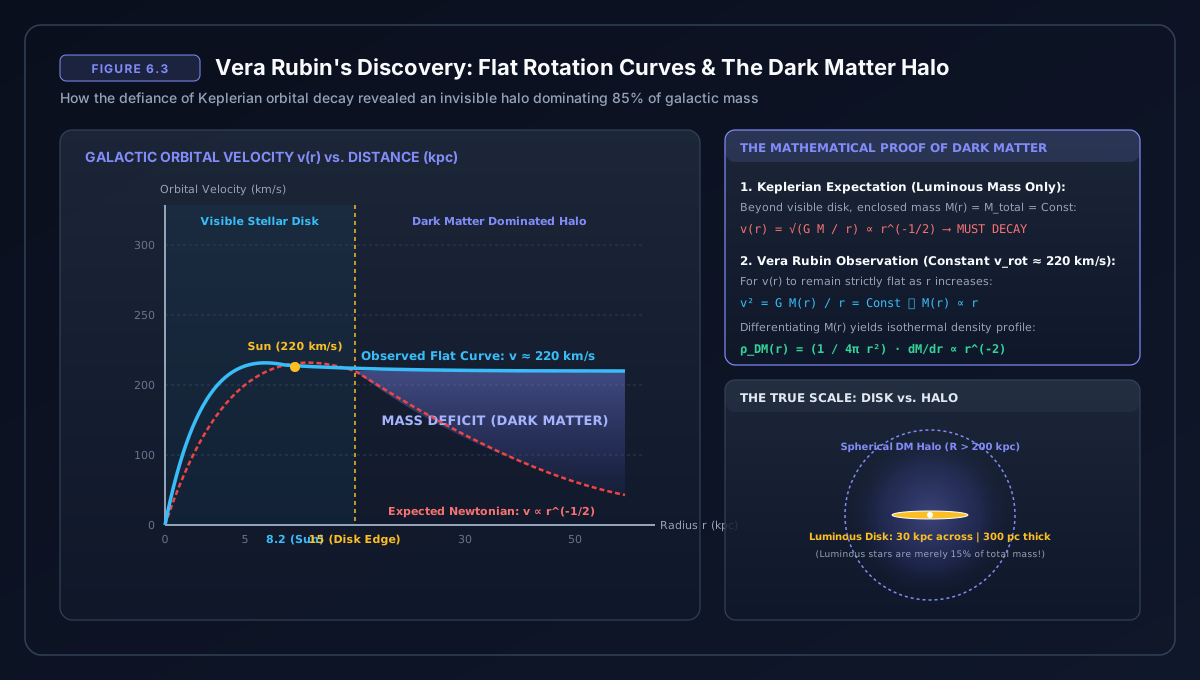
According to classical Keplerian mechanics, orbital velocities in a gravitationally bound system should decrease with distance from the central mass (v ∝ r^{-1/2})—exactly as Neptune moves far slower than Mercury in our solar system. In the 1970s, astronomer Vera Rubin and instrument maker Kent Ford measured the optical emission lines of ionized gas across the disks of dozens of spiral galaxies.
Instead of falling off at large radii, the orbital velocities remained flat (v(r) ≈ constant) all the way to the visible edge of the disks. In the Milky Way, stars 60,000 light-years from the center are orbiting at over 220 km/s—velocities so high that the gravitational pull of all visible stars, gas, and dust combined is insufficient to hold them. By all laws of physics, the galaxy should have flown apart like a loose spinning wheel.
Rubin’s flat rotation curves provided the undeniable empirical proof that spiral galaxies are embedded inside enormous, quasi-spherical Dark Matter Halos. In our Milky Way, while visible baryonic stars and gas account for roughly 6 × 10^{10} M_☉, the invisible dark matter halo extends over 600,000 light-years into intergalactic space with a total mass exceeding 1.1 × 10¹² M_☉. Over 85% of the Milky Way’s mass is completely invisible.
Anatomy of our Island Home: The Structure of the Milky Way
Our galaxy is classified as an SBbc barred spiral galaxy, spanning roughly 100,000 light-years in diameter and hosting between 100 and 400 billion stars. It consists of four distinct structural components:
- 1. The Central Bar and Bulge: A rotating peanut-shaped central bar of older stars spanning 27,000 light-years, housing Sagittarius A* and dense stellar populations.
- 2. The Thin Disk: A razor-thin sheet with a vertical scale height of only ~ 300 parsecs (~ 1,000 light-years). Contains the vast majority of interstellar gas, active star-forming regions, and metal-rich Population I stars like our Sun.
- 3. The Thick Disk: Extends to a scale height of ~ 1 kpc (~ 3,300 light-years), populated by older, intermediate-metallicity stars born during the turbulent early merger history of the galaxy.
- 4. The Stellar & Dark Matter Halo: A diffuse, spherical swarm of ancient, metal-poor Population II stars and over 150 dense Globular Clusters—relic stellar fossils dating back to the first billion years after the Big Bang—all shrouded within the colossal dark matter halo.
The Galactic Habitable Zone: Finding Safe Harbor in the Cosmos
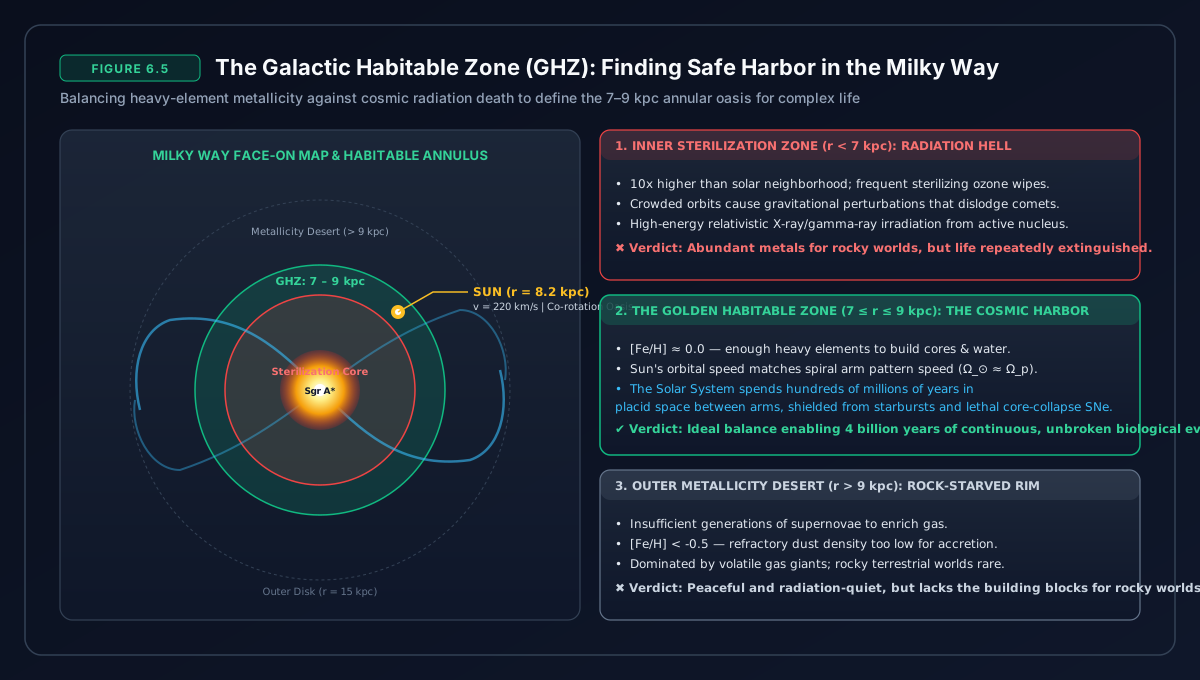
Just as a planetary system possesses a circumstellar habitable zone where liquid water can exist on a planet’s surface, a galaxy possesses a Galactic Habitable Zone (GHZ) (formulated by Guillermo Gonzalez, Donald Brownlee, and Peter Ward)—a ring-like region where complex biological life can emerge and survive over geological timescales:
If a planetary system forms too close to the galactic center (r < 4 kpc), stellar densities are so extreme that gravitational encounters strip planets from their orbits. Furthermore, frequent nearby supernovae, relativistic gamma-ray bursts (GRBs), and active flares from the central supermassive black hole repeatedly strip planetary atmospheres with lethal ionizing radiation.
Conversely, if a star forms too far on the galactic periphery (r > 10 kpc), the chemical evolution of the galaxy has been too sluggish: the metallicity ([Fe/H]) is too low to provide the heavy elements (iron, silicon, magnesium) required to condense rocky terrestrial planets or form metallic planetary cores capable of generating protective magnetic dynamos.
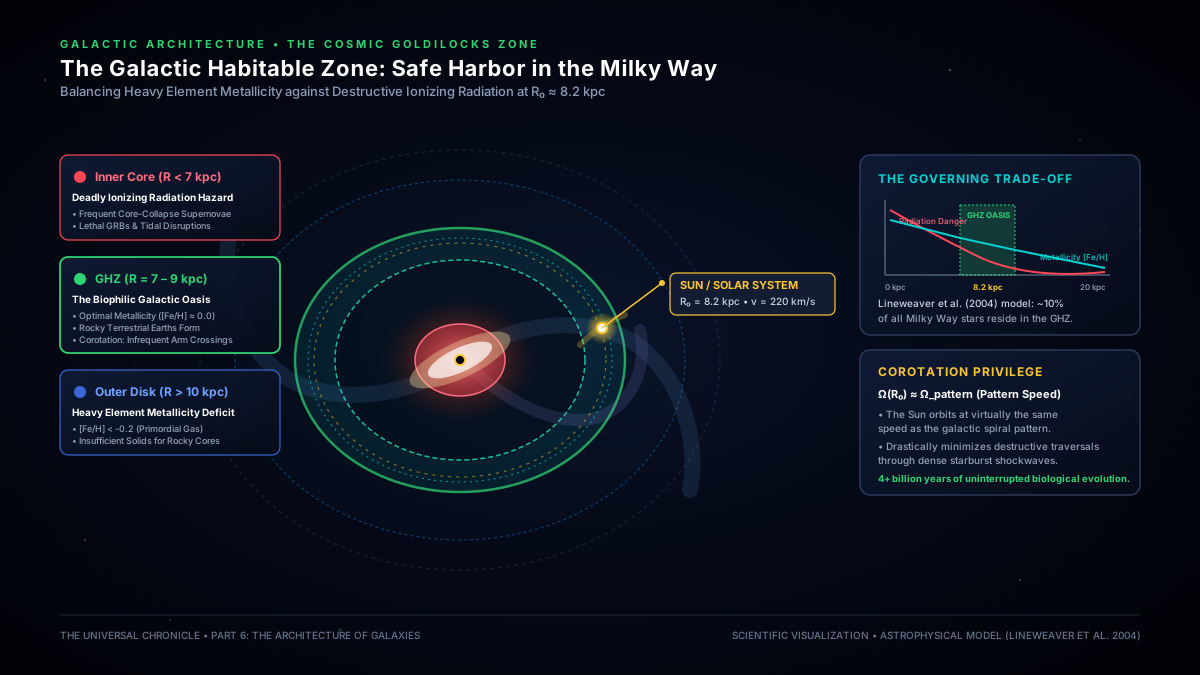
Our Solar System orbits at a radius of 8.2 kpc (~ 26,700 light-years) from the galactic core, nestled inside the local Orion-Cygnus Spur between the major Sagittarius and Perseus spiral arms. Here, in this tranquil cosmic oasis, stellar metallicity is optimal (Z ≈ Z_☉), dangerous supernova sterilizations occur only once every few hundred million years, and the orbital velocity of the Sun matches the speed of the spiral density wave itself—preventing our star from crossing violent starburst shock fronts too frequently.
Structural Metrics of the Milky Way
| Component / Parameter | Dimension / Value | Mass (M_☉) | Key Physical Characteristics |
|---|---|---|---|
| Total Virial Mass | Radius ~ 200 kpc | ~ 1.1 × 10¹² M_☉ | Dominated (>85\%) by Cold Dark Matter halo. |
| Total Stellar Mass | Diameter ~ 30 kpc (~ 100,000 ly) | ≈ 5.5 × 10^{10} M_☉ | 100 to 400 billion stars. |
| Thin Disk | Scale height ~ 300 pc | ≈ 4.5 × 10^{10} M_☉ | Houses spiral arms, gas reservoirs, Population I stars (e.g., Sun). |
| Thick Disk | Scale height ~ 1,000 pc | ≈ 6 × 10^9 M_☉ | Older, metal-poor stars; relic of early galactic mergers. |
| Galactic Bulge & Bar | Length ~ 8 kpc | ≈ 1.5 × 10^{10} M_☉ | Old Population II stars, triaxial rotating bar. |
| Sagittarius A* (SMBH) | R_{Schw} ≈ 12.7 million km | 4.297 × 10^6 M_☉ | Central singularity, quiescent accretion disk. |
| Solar Position | R_0 = 8.2 kpc (26,700 ly) | — | Galactic Habitable Zone; orbital period 230 Myr at 220 km/s. |
The Stage is Set: The Collapse of a Solar Cradle
Roughly 4.6 billion years ago—nearly nine billion years after the Big Bang—the Milky Way was a mature, chemically enriched spiral galaxy. In a quiet, suburban backwater of the galactic disk, inside the Orion spiral arm, a giant molecular cloud of cold hydrogen, helium, and synthesized stardust was drifting in space.
The universe had forged the space, the matter, the forces, the heavy elements, and the galactic harbor. Now, a localized trigger—the shockwave of a dying neighbor star—would disturb this peaceful cloud, initiating gravitational collapse. In Part 7 of The Universal Chronicle, we will witness the birth of our home star system: The Solar Cradle — The Protoplanetary Disk, Planetesimal Accretion, and the Young Sun.
Academic Citations & Foundational Literature
- Lin, C. C., & Shu, F. H. (1964). “On the Spiral Structure of Disk Galaxies.” The Astrophysical Journal, 140, 646–655. doi:10.1086/147955.
- Rubin, V. C., & Ford, W. K. (1970). “Rotation of the Andromeda Nebula from a Spectroscopic Survey of Emission Regions.” The Astrophysical Journal, 159, 379–403. doi:10.1086/150317.
- Ferrarese, L., & Merritt, D. (2000). “A Fundamental Relation between Supermassive Black Holes and Their Host Galaxies.” The Astrophysical Journal Letters, 539(1), L9–L12. doi:10.1086/312838.
- Gonzalez, G., Brownlee, D., & Ward, P. (2001). “The Galactic Habitable Zone: Galactic Chemical Evolution.” Icarus, 152(1), 185–200. doi:10.1006/icar.2001.6617.
- Bland-Hawthorn, J., & Gerhard, O. (2016). “The Galaxy in Context: Structural, Kinematic, and Integrated Properties.” Annual Review of Astronomy and Astrophysics, 54(1), 529–596. doi:10.1146/annurev-astro-081915-023441.
- Event Horizon Telescope Collaboration (Akiyama, K., et al.) (2022). “First Sagittarius A* Event Horizon Telescope Results. I. The Shadow of the Supermassive Black Hole in the Center of the Milky Way.” The Astrophysical Journal Letters, 930(2), L12. doi:10.3847/2041-8213/ac6674.