For the first 380,000 years of cosmic history, the universe was completely blind. Space was filled with an impenetrable, glowing white-hot plasma where photons could not travel a fraction of a millimeter without crashing into free electrons. Then, in an epoch-defining phase transition known as Recombination, atomic nuclei captured those electrons, the universe abruptly turned transparent, and the first light broke free across the cosmos—initiating the mysterious, silent hundred-million-year epoch of the Cosmic Dark Ages.
The Foggy Furnace: Why the Early Universe Was Opaque
In the aftermath of Big Bang Nucleosynthesis, the universe had cooled from billions of degrees to tens of thousands of degrees. Although atomic nuclei (protons, alpha particles, and trace lithium) were already fully assembled, they could not retain orbital electrons. The thermal energy of the radiation bath was far higher than the ionization energy of hydrogen (13.6 eV), keeping all matter in a fully ionized plasma state.
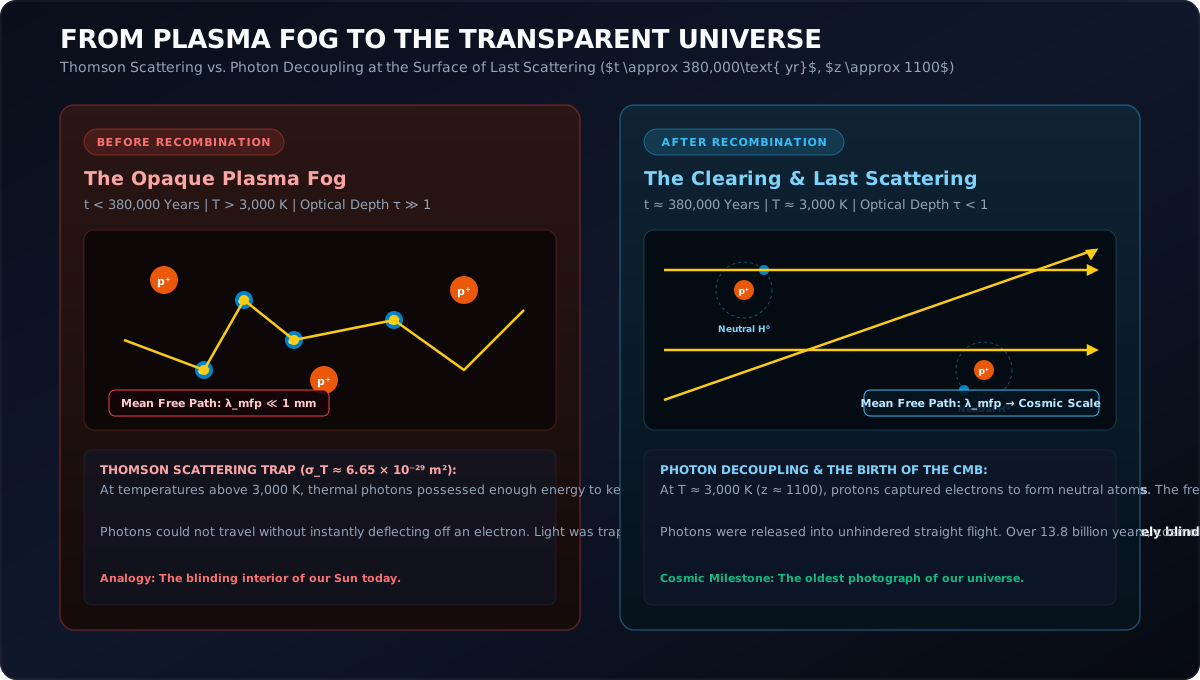
Whenever a photon attempted to travel through this plasma, it instantly collided with an unattached, free electron via Thomson scattering (σ_T = (8π/3) r_e² ≈ 6.65 × 10⁻²⁹ m²). Because the density of free electrons was immense, the mean free path of a photon—the average distance light could travel before being deflected—was infinitesimally short:
$$\lambda_{\text{mfp}} = \frac{1}{n_e \sigma_T}$$
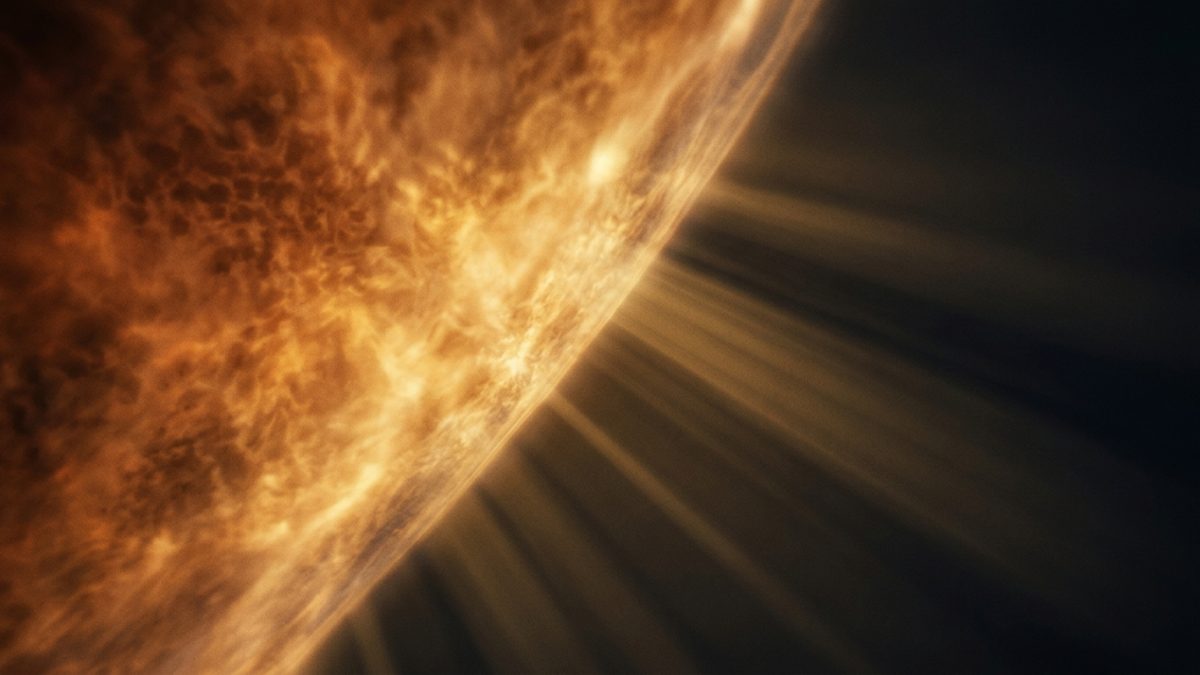
Photons were trapped in an endless, diffusive random walk, scattering billions of times per second. The universe was an optically thick, completely opaque glowing fog—much like the blinding, luminous interior of the Sun today. If an observer had existed inside this epoch, they would have been immersed in an omnidirectional, uniform glare with zero visibility.
Matter-Radiation Equality (t ≈ 50,000 Years): The Shift of Power
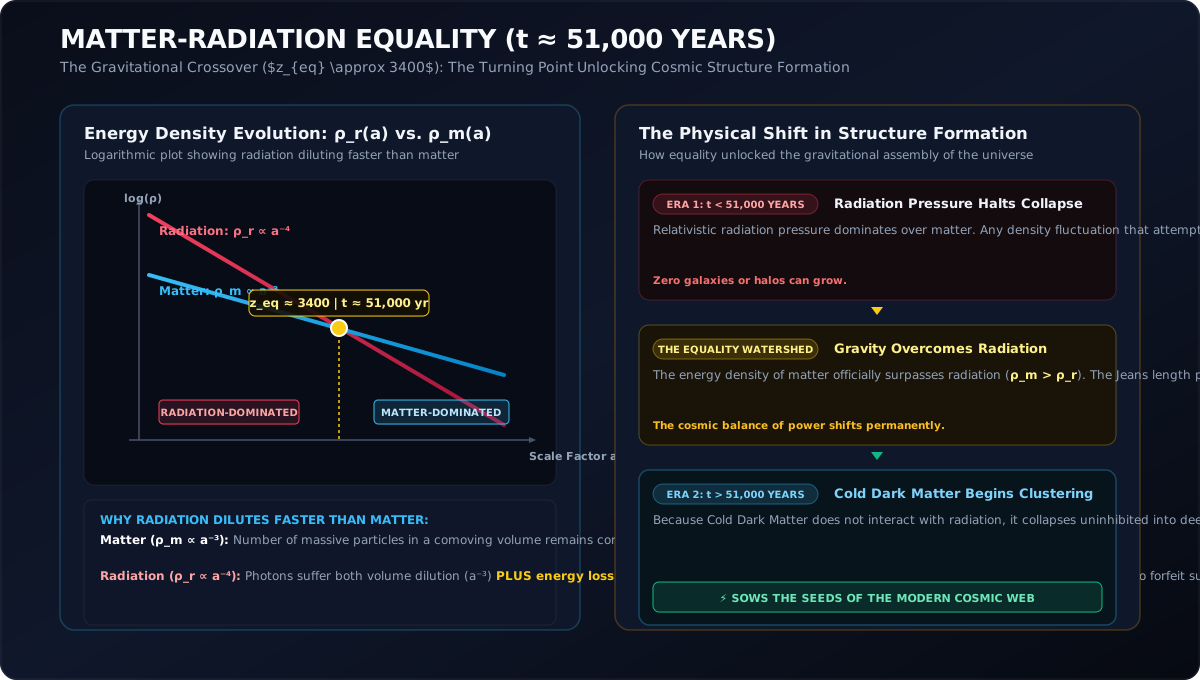
As the universe expanded, the energy densities of matter and radiation diluted at fundamentally different rates:
- Matter Density (ρ_m): Dilutes strictly with the expansion of spatial volume: ρ_m(a) ∝ a⁻³.
- Radiation Energy Density (ρ_r): Dilutes with spatial volume (a⁻³) plus an additional factor of a^{-1} because cosmological expansion stretches the wavelength of individual photons (λ ∝ a, hence E = hc/λ ∝ a^{-1}). Therefore: ρ_r(a) ∝ a⁻⁴.
Because radiation diluted faster than matter, their densities eventually crossed at a critical junction known as Matter-Radiation Equality (z_{eq} ≈ 3400, corresponding to t ≈ 51,000 years):
Prior to equality, the relativistic pressure of radiation dominated the universe, suppressing the gravitational collapse of matter. Once matter took the gravitational helm (ρ_m > ρ_r), cold dark matter could begin collapsing into gravitational potential wells without being blown apart by radiation pressure, laying the silent groundwork for the future cosmic web.
The Physics of Recombination (z ≈ 1100, t ≈ 380,000 Years): The Great Neutralization
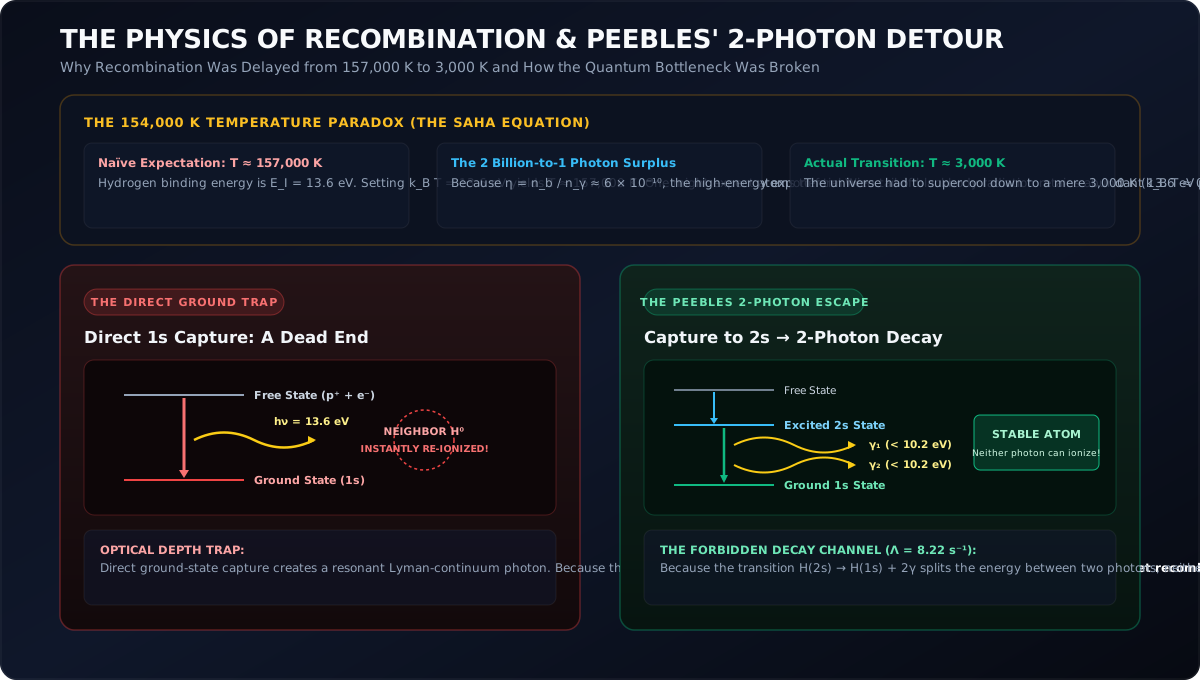
A student of atomic physics might expect recombination to occur when the average thermal kinetic energy of the universe (k_B T) dropped below the binding energy of the hydrogen ground state (E_I = 13.6 eV), which corresponds to a temperature of approximately 157,000 K. Yet, the universe did not recombine until it cooled to a mere 3,000 K (k_B T ≈ 0.26 eV)—a delay of hundreds of thousands of years!
The reason for this immense delay lies in the baryon-to-photon ratio (η = n_b / n_γ ≈ 6 × 10^{-10}). Because there were nearly two billion high-energy photons for every proton and electron, the high-energy exponential Wien tail of the Planck blackbody radiation curve contained an overwhelming surplus of ionizing photons (hν > 13.6 eV), even when the average temperature was far below 13.6 eV.
The equilibrium ionization fraction X_e = n_e / (n_p + n_H) is governed by the Saha Ionization Equation:
$$\frac{X_e^2}{1 – X_e} = \frac{1}{n_b} \left( \frac{m_e k_B T}{2\pi \hbar^2} \right)^{3/2} \exp\left(-\frac{E_I}{k_B T}\right)$$
Furthermore, when an electron falls directly into the ground state of a hydrogen atom (e^- + p → H(1s) + γ), it emits a Lyman-continuum ultraviolet photon (13.6 eV). In the dense plasma, this newly emitted photon was instantly reabsorbed by an adjacent neutral atom, re-ionizing it. Net recombination could only proceed through a slow, bottlenecked detour formulated by Jim Peebles: electrons captured into excited 2s or 2p states, followed by two-photon decay from the 2s state (H(2s) → H(1s) + γ_1 + γ_2), which has an agonizingly slow transition rate of just 8.22 s^{-1}.
By t ≈ 380,000 years (z ≈ 1090), the ionization fraction plummeted below 10^{-4}. Free electrons were locked into neutral, bound hydrogen and helium atoms. In a geological blink of an eye, the free electron density vanished.
Photon Decoupling: The Birth of the Cosmic Microwave Background
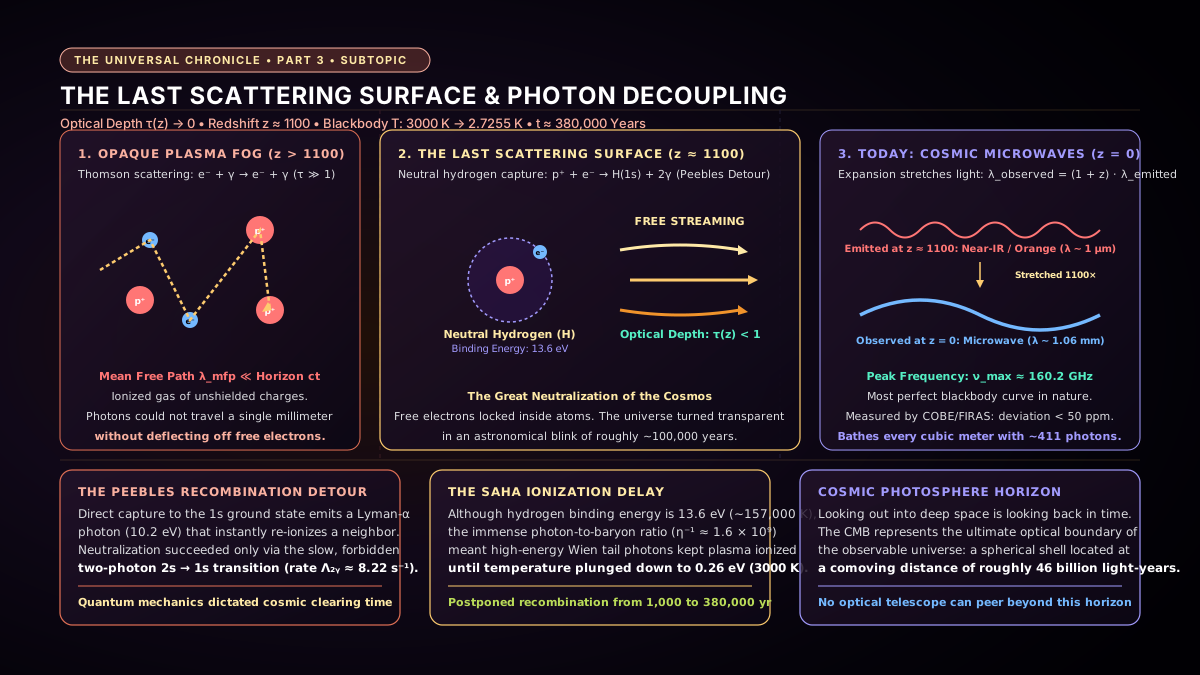
With the disappearance of free electrons, the Thomson scattering optical depth (τ) dropped below unity:
$$\tau = \int \sigma_T n_e c \, dt < 1$$
Suddenly, the mean free path of light expanded to the edge of the universe. Photons were no longer scattered, trapped, or refracted. The heavens cleared.
The last layer of plasma that scattered these photons is called the Surface of Last Scattering. The light released at that moment was an intense, warm, incandescent glow—radiating at 3,000 K, equivalent to the golden-orange light of a low-wattage incandescent lightbulb. Over the subsequent 13.8 billion years of cosmic expansion, spacetime stretched the wavelength of these photons by a factor of 1,100 (z ≈ 1090):
$$\lambda_{\text{today}} = \lambda_{\text{emission}} \times (1 + z) \approx 1100 \times \lambda_{\text{emission}}$$
That ancient visible orange glow was redshifted out of the visible spectrum, through the infrared, and into the microwave band. Today, it bathes every cubic centimeter of the cosmos in a faint, uniform sea of approximately 411 photons per cubic centimeter, cooled to an icy 2.72548 ± 0.00057 K: the Cosmic Microwave Background (CMB).
In 1990, the Far-Infrared Absolute Spectrophotometer (FIRAS) aboard NASA’s COBE satellite measured the spectral energy distribution of the CMB. The data points matched Max Planck’s theoretical blackbody radiation formula so flawlessly that the error bars were narrower than the thickness of the printed curve line—confirming with unprecedented precision that the early universe was in complete thermal equilibrium.
The Cosmic Rosetta Stone: Reading the Ripples of the CMB
When Arno Penzias and Robert Wilson discovered the CMB in 1965 at Bell Labs, it appeared completely smooth and isotropic. However, theoretical cosmologists recognized that if the universe were 100% smooth, gravity would have had no starting points to gather matter into galaxies.
In 1992, COBE detected the first temperature anisotropies—microscopic fluctuations on the order of Δ T / T ≈ 10⁻⁵ (one part in 100,000), representing temperature differences of barely 30 microkelvins. Subsequent orbital observatories—NASA’s WMAP (2001–2010) and ESA’s Planck satellite (2009–2018)—mapped these ripples across the entire celestial sphere with ultra-high angular resolution.
Baryon Acoustic Oscillations (BAO): Sound Waves of Creation
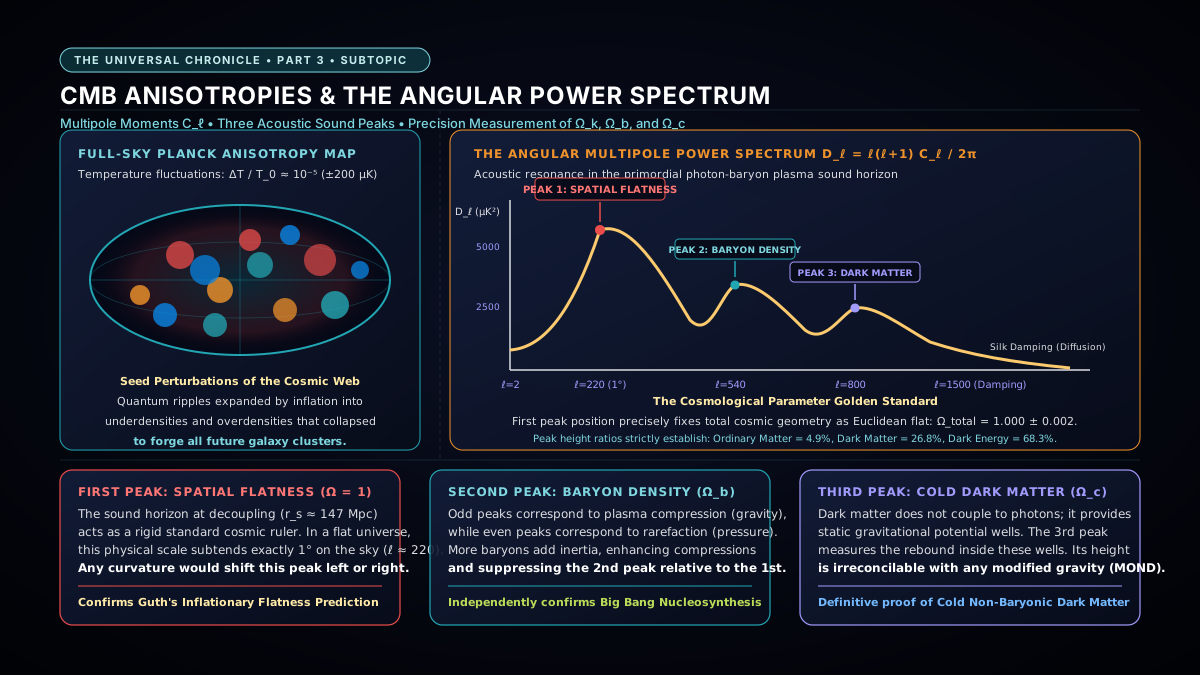
These temperature ripples are not random noise; they are the frozen acoustic harmonics of the primordial universe. Prior to recombination, regions of overdensity pulled matter inward via gravity, while radiation pressure pushed outward. This tug-of-war set up compression and rarefaction sound waves traveling through the plasma at more than half the speed of light (c_s = c / √(3(1 + 3ρ_b/4ρ_γ)) ≈ 0.57c).
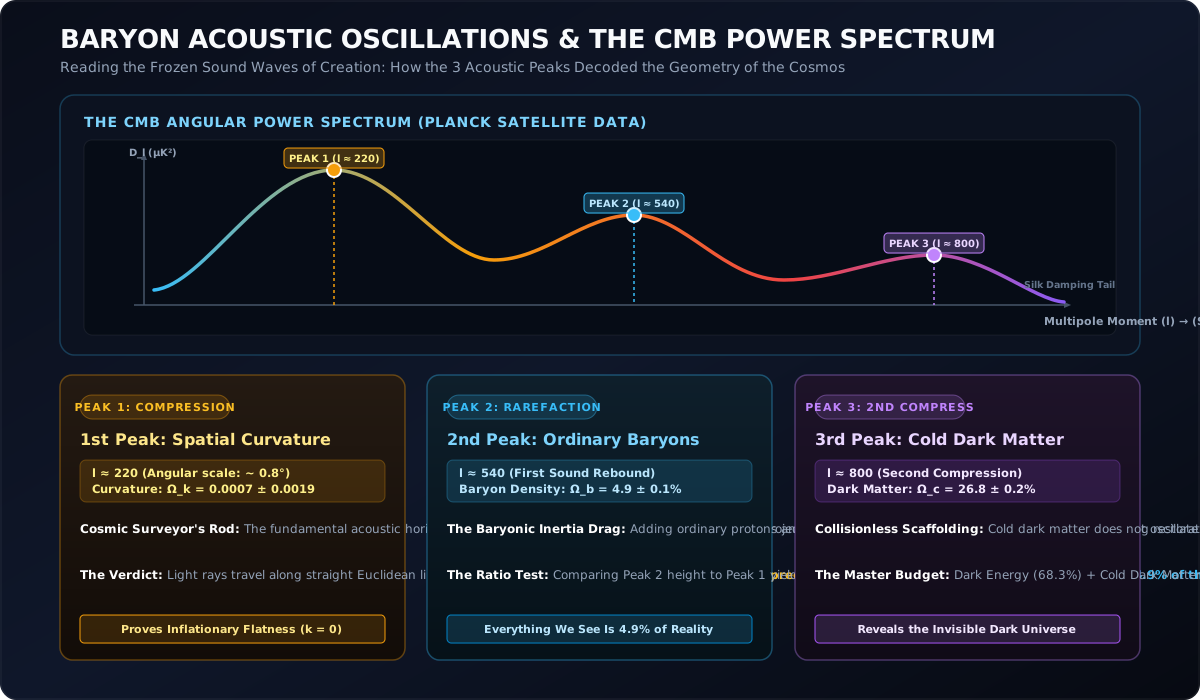
When recombination occurred, the sound waves were suddenly frozen in time. Decomposing these temperature ripples into spherical harmonics produces the legendary CMB Angular Power Spectrum:
- The 1st Acoustic Peak (l ≈ 220): Represents the fundamental sound wave that had just reached maximum compression at recombination. Its angular size on the sky (0.8°) acts as a cosmic surveyor’s rod, proving that spatial curvature is flat (Ω_k = 0.0007 ± 0.0019).
- The 2nd Acoustic Peak (l ≈ 540): Measures the maximum rarefaction (rebound) of the sound wave. The ratio of the second to first peak reveals the exact density of ordinary baryonic matter: Ω_b ≈ 4.9%.
- The 3rd Acoustic Peak (l ≈ 800): Measures the second compression cycle, directly constraining the density of Cold Dark Matter (Ω_c ≈ 26.8%), while the remainder is Dark Energy (Ω_Λ ≈ 68.3%).
The Cosmic Dark Ages (t = 380,000 to 100 Million Years): The Silent Abyss
Once the last scattering photons decoupled and redshifted into invisible infrared wavelengths, the universe was plunged into an epoch of utter, pitch-black darkness: the Cosmic Dark Ages.
There was not a single star, galaxy, quasar, or accretion disk in existence. The cosmos was a vast, cold, expanding ocean of neutral gas: 75% neutral atomic hydrogen and 25% helium, with no heavy elements. No chemical combustion was possible, and no stellar fusion had ignited. For over 100 million years, an observer traveling through the universe would have experienced total sensory void.
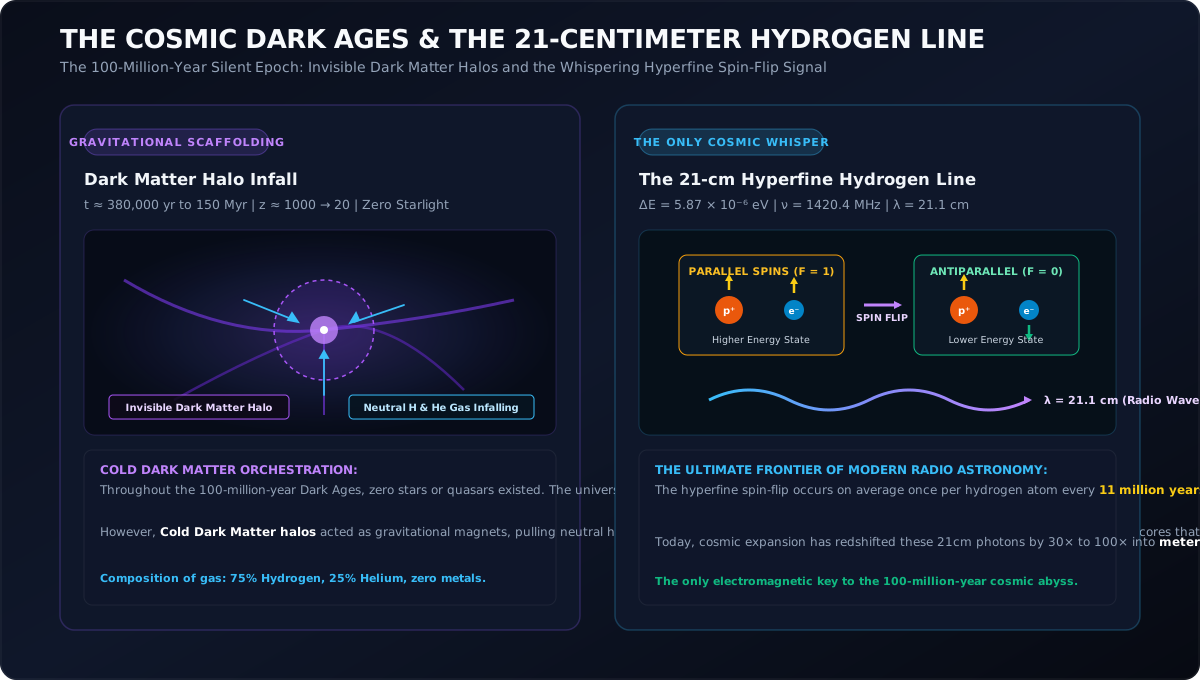
Yet, this darkness was not passive. Beneath the veil of invisibility, the invisible hand of Cold Dark Matter was orchestrating the future of the universe. Because dark matter interacts only through gravity and does not scatter photons, it had already begun collapsing into vast, invisible filaments and spherical halos during the radiation era. During the Dark Ages, ordinary hydrogen and helium gas fell gravitationally into these deep dark matter gravitational wells.
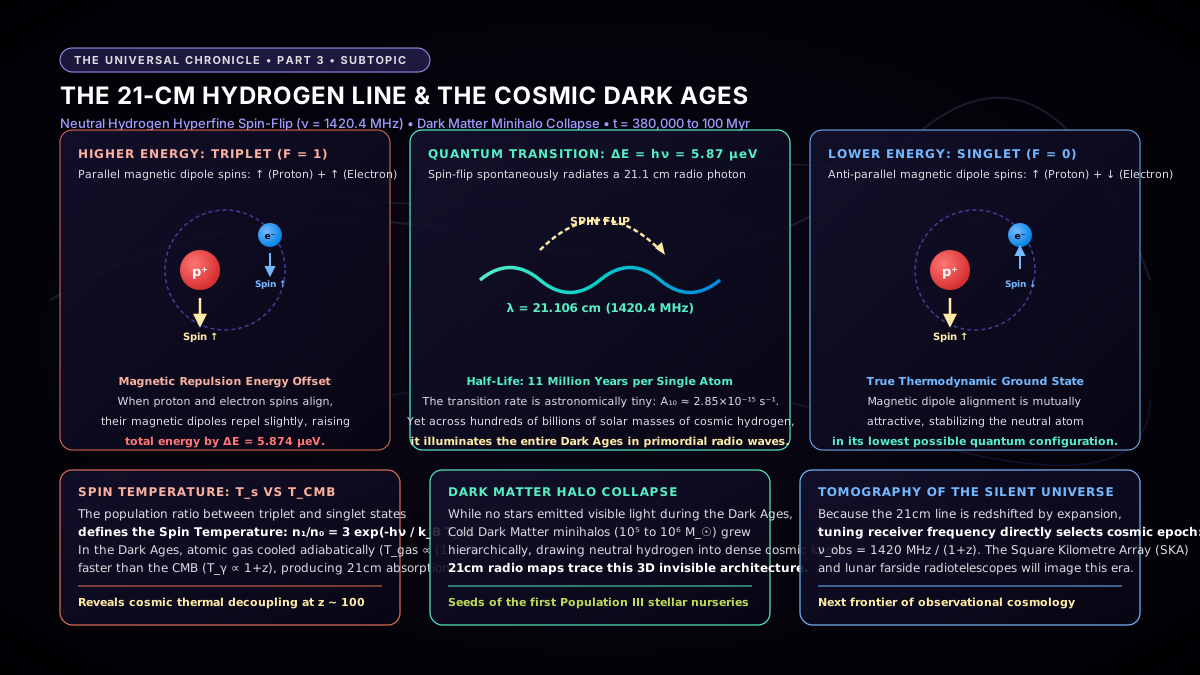
The only electromagnetic radiation emitted throughout the entire Dark Ages was the subtle 21-centimeter line—a hyperfine radio transition produced when the spin of a hydrogen atom’s solitary electron flips from parallel to antiparallel relative to the proton’s nuclear spin (Δ E = 5.87 × 10^{-6} eV). This faint, ancient radio signal, redshifted into low-frequency meters-long radio waves today, represents the ultimate frontier of modern radio astronomy (such as the Square Kilometre Array).
Chronology Table: From Plasma Fog to the Edge of Starlight
| Epoch / Event | Redshift (z) | Cosmic Time (t) | Temperature (K) | Physical Characteristics |
|---|---|---|---|---|
| Matter-Radiation Equality | z ≈ 3400 | 51,000 years | ~ 9, K | Matter energy density surpasses radiation; dark matter begins unhindered gravitational collapse. |
| Recombination Era | z ≈ 1300 → 1000 | 260,000 → 380,000 yr | 4,000 → 3, K | Electrons combine with protons via 2-photon decay (2s → 1s); ionization drops from 100% to <0.01%. |
| Photon Decoupling (Last Scattering) | z ≈ 1090 | 380,000 years | 2, K | Optical depth drops below 1; photons stream freely across space; the Cosmic Microwave Background is released. |
| The Cosmic Dark Ages | z ≈ 1000 → 20 | 380,000 yr to 150 Myr | 3,000 → K | Zero stellar light; space is cold and black; neutral hydrogen gas accumulates inside dark matter halos; 21-cm hyperfine radio emission. |
| Cosmic Dawn (First Stars) | z ≈ 20 → 15 | ~ 150 → 250 Myr | ~ K | Gravitational gas collapse reaches critical density; Population III hypermassive stars ignite; Reionization begins. |
The Verdict: How the CMB Anchors Modern Cosmology
The discovery and precision mapping of the Cosmic Microwave Background transformed cosmology from philosophical speculation into an exact physical science. Every fundamental parameter of our universe—its age (13.787 ± 0.020 billion years), its spatial flatness, its expansion rate (H_0 ≈ 67.4 km/s/Mpc), and its cosmic recipe (68.3% Dark Energy, 26.8% Cold Dark Matter, 4.9% Baryonic Matter)—is encoded directly into the subtle thermal ripples of the last scattering surface.
As the Dark Ages progressed, gravitational potential wells grew deeper. Massive primordial hydrogen gas clouds began to cool via molecular hydrogen rotational transitions, slowly falling inward under their own immense gravity. In Part 4 of The Universal Chronicle, the silence will finally shatter: Cosmic Dawn — Population III Monster Stars, the First Galaxies, and the Epoch of Reionization.
Academic Citations & Foundational Literature
- Penzias, A. A., & Wilson, R. W. (1965). “A Measurement of Excess Antenna Temperature at 4080 Mc/s.” The Astrophysical Journal, 142, 419–421. doi:10.1086/148307.
- Dicke, R. H., Peebles, P. J. E., Roll, P. G., & Wilkinson, D. T. (1965). “Cosmic Black-Body Radiation.” The Astrophysical Journal, 142, 414–419. doi:10.1086/148306.
- Peebles, P. J. E. (1968). “Recombination of the Primeval Plasma.” The Astrophysical Journal, 153, 1–11. doi:10.1086/149628.
- Sunyaev, R. A., & Zel’dovich, Y. B. (1970). “Small-scale fluctuations of relic radiation.” Astrophysics and Space Science, 7(1), 3–19. doi:10.1007/BF00653471.
- Mather, J. C., et al. (1990). “A measurement of the cosmic microwave background spectrum by the COBE FIRAS instrument.” The Astrophysical Journal, 354, L37–L40. doi:10.1086/185717.
- Smoot, G. F., et al. (1992). “Structure in the COBE differential microwave radiometer first-year maps.” The Astrophysical Journal, 396, L1–L5. doi:10.1086/186504.
- Planck Collaboration (Aghanim, N., et al.) (2020). “Planck 2018 results. VI. Cosmological parameters.” Astronomy & Astrophysics, 641, A6. doi:10.1051/0004-6361/201833910.
- Hu, W., & Dodelson, S. (2002). “Cosmic Microwave Background Anisotropies.” Annual Review of Astronomy and Astrophysics, 40(1), 171–216. doi:10.1146/annurev.astro.40.060401.093926.