
Seven million years ago, the African continent was torn apart along a six-thousand-kilometer tectonic fault. As the Somali and Nubian plates pulled asunder, creating the towering highlands of the East African Rift System, the continuous equatorial rainforest that had sustained Miocene apes was sheared by a devastating rain shadow. In the desiccating interior, dense canopies dissolved into an open mosaic of wood-scattered grasslands. Stripped of the protective arboreal canopy and forced into direct competition with specialized cursorial carnivores, a singular lineage of hominoids stood upright, freed their forelimbs from locomotion, knapped crystalline stone into razor-edged butchery tools, and harnessed the exothermic power of combustion—initiating the most consequential evolutionary trajectory in planetary history.
1. The Tectonic Crucible: The East African Rift and Environmental Desiccation (~7 to 3 Ma)
The genesis of humanity was fundamentally an architectural consequence of plate tectonics. During the Late Miocene and Early Pliocene, mantle upwelling beneath the Afar triple junction fractured the African lithosphere. The resulting uplift of the Ethiopian and East African plateaus created a dual-ridge mountain wall that intercepted moist zonal moisture from the Indian and Atlantic oceans.
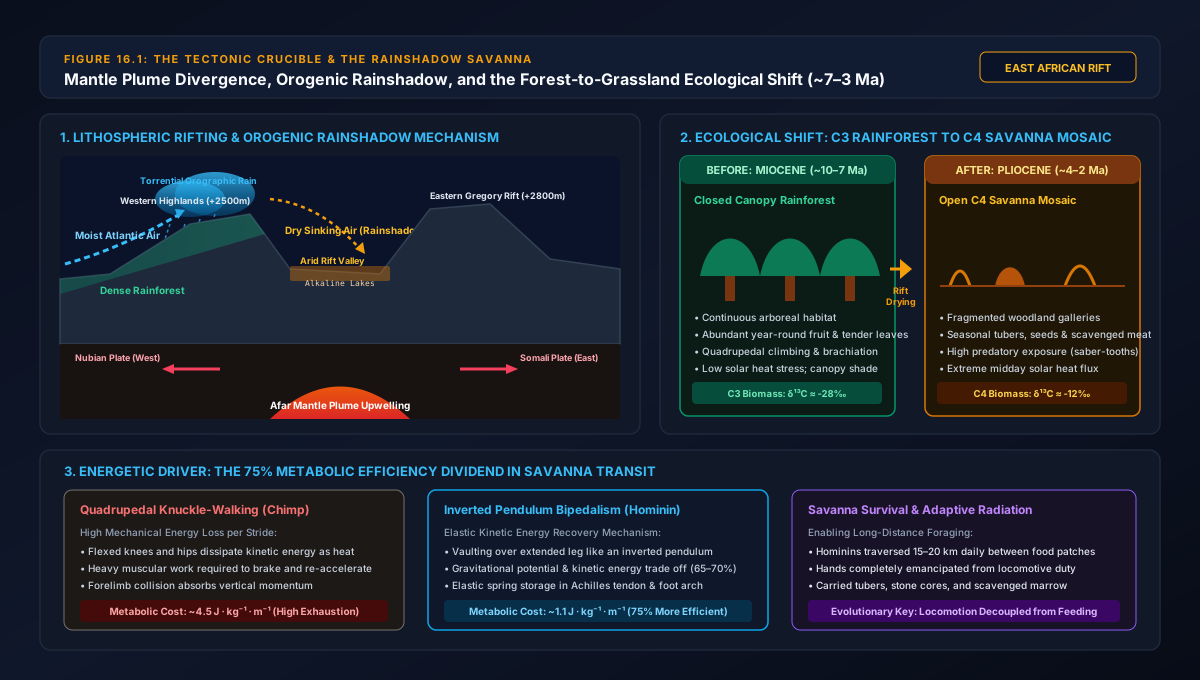
Deprived of continuous precipitation, the closed tropical rainforests contracted into fragmented riverine galleries. The hominoid populations residing to the east of the rift faced an existential crisis: fruit-bearing trees were now separated by vast, hostile expanses of C4 savannah grasses. Foraging required traversing miles of open terrain under relentless equatorial solar irradiation. In this ecological crucible, knuckle-walking quadrupedalism—the mode of locomotion retained by ancestral chimpanzees and gorillas—became an energetic liability.
2. The Mechanical Revolution of Obligate Bipedalism
Biomechanical analyses by Rodman, McHenry, and Herman Pontzer demonstrate that quadrupedal knuckle-walking is energetically expensive, consuming approximately four times more metabolic energy per unit distance than habitual human striding bipedalism. Natural selection violently favored any anatomical mutation that reduced the caloric cost of locomotion across the savannah.
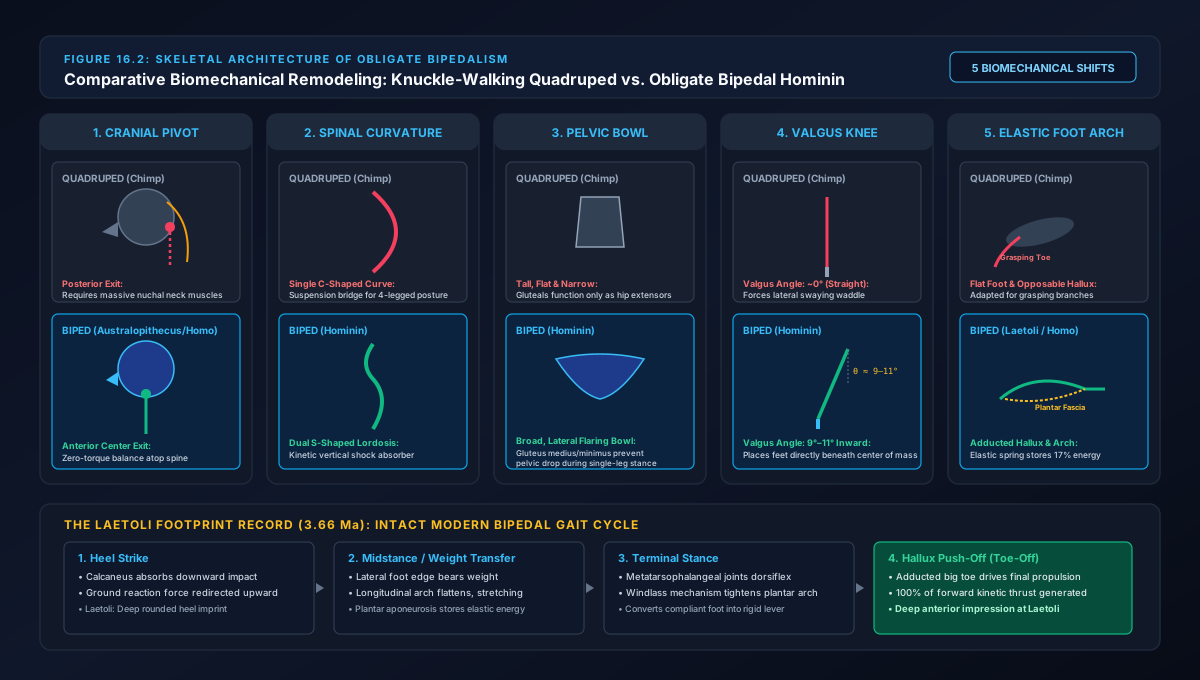
The Morphological Reorganization for Upright Stride
Transitioning from a quadruped to an obligate biped required an extensive overhaul of the primate skeletal architecture:
- Cranial Re-alignment: The foramen magnum (the occipital hole through which the spinal cord exits the braincase) migrated forward from the posterior position seen in chimpanzees to an anterior, inferior position directly beneath the skull’s center of gravity.
- Lumbar Lordosis: Evolution warped the straight ape spine into an elastic S-curve (lumbar and cervical lordosis), acting as a mechanical shock absorber that centers body mass over the pelvis.
- Pelvic Transformation: The iliac blades shortened, broadened, and curved laterally into a bowl-like pelvic basin, redirecting the lesser gluteal muscles (gluteus medius and minimus) from hindlimb extensors into lateral stabilizers that prevent the pelvic basin from collapsing during single-leg stance.
- The Valgus Knee & Arched Foot: The femur angled inward toward the midline (bicondylar or valgus angle), keeping feet directly beneath the torso. The ancestral grasping opposable hallux (big toe) was aligned in parallel with other digits (adduction), while the tarsals and metatarsals formed rigid longitudinal and transverse arches that store and release mechanical elastic strain during running.
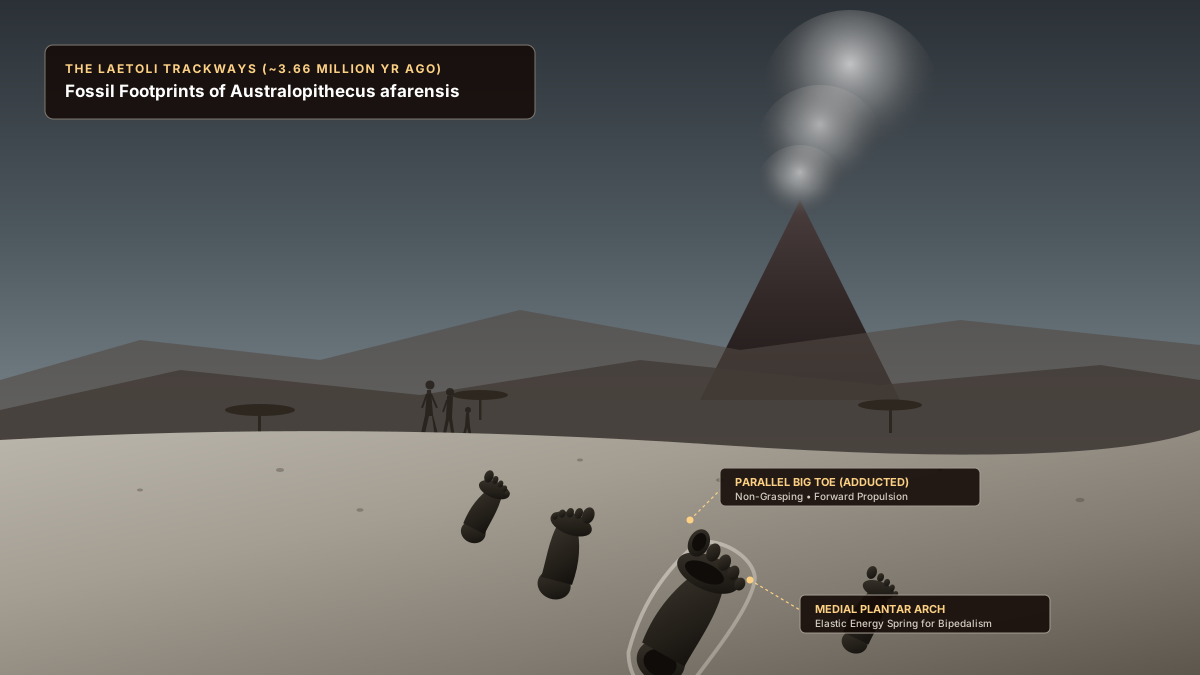
The fossil record traces this architectural progression with crystalline clarity: from the six-to-seven-million-year-old Sahelanthropus tchadensis (exhibiting an anteriorly placed foramen magnum) and the four-million-year-old Ardipithecus ramidus (a facultative biped with a grasping foot), to the magnificent three-million-year-old Australopithecus afarensis (exemplified by the “Lucy” skeleton and the Laetoli footprint trackways in Tanzania, which prove completely modern, non-divergent heel-strike to toe-off bipedal kinematics).
3. The Precision Grip and Lithic Archaeology (~3.3 to 1.8 Ma)
The most profound secondary consequence of bipedalism was the total liberation of the upper limbs from the mechanical constraints of weight support. Freed from locomotion, the primate hand evolved from a hook-like climbing apparatus into the most sensitive, versatile kinematic manipulator on the planet.
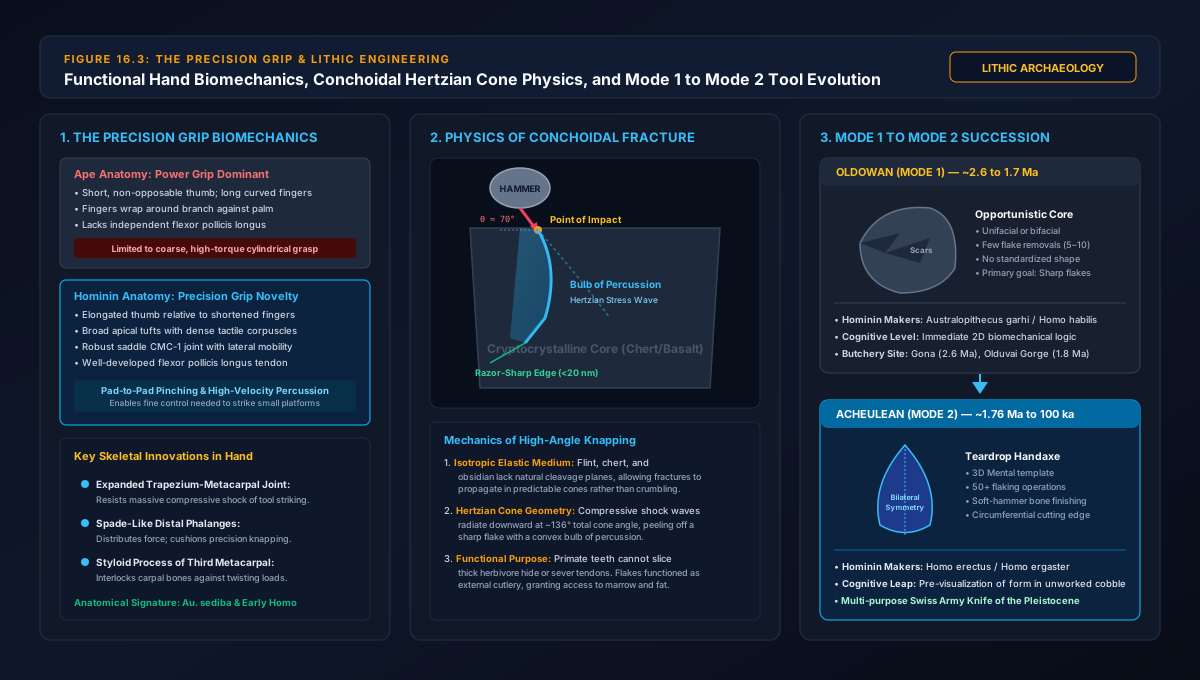
Human lineage hands developed an elongated, highly muscular opposable thumb powered by a unique, dedicated muscle: the flexor pollicis longus. Expanded apical pads with dense tactile mechanoreceptors (Merkel discs and Meissner corpuscles) permitted both the robust “power grip” (for holding heavy clubs) and the delicate “precision grip” (pinching between thumb and fingertip pads).
| Lithic Industry | Approximate Age | Technological Signature | Associated Hominin |
|---|---|---|---|
| Lomekwian | 3.3 Ma | Passive anvil technique; massive basalt blocks shattered against fixed anvils to yield jagged edges. | Kenyanthropus platyops / Australopithecus afarensis |
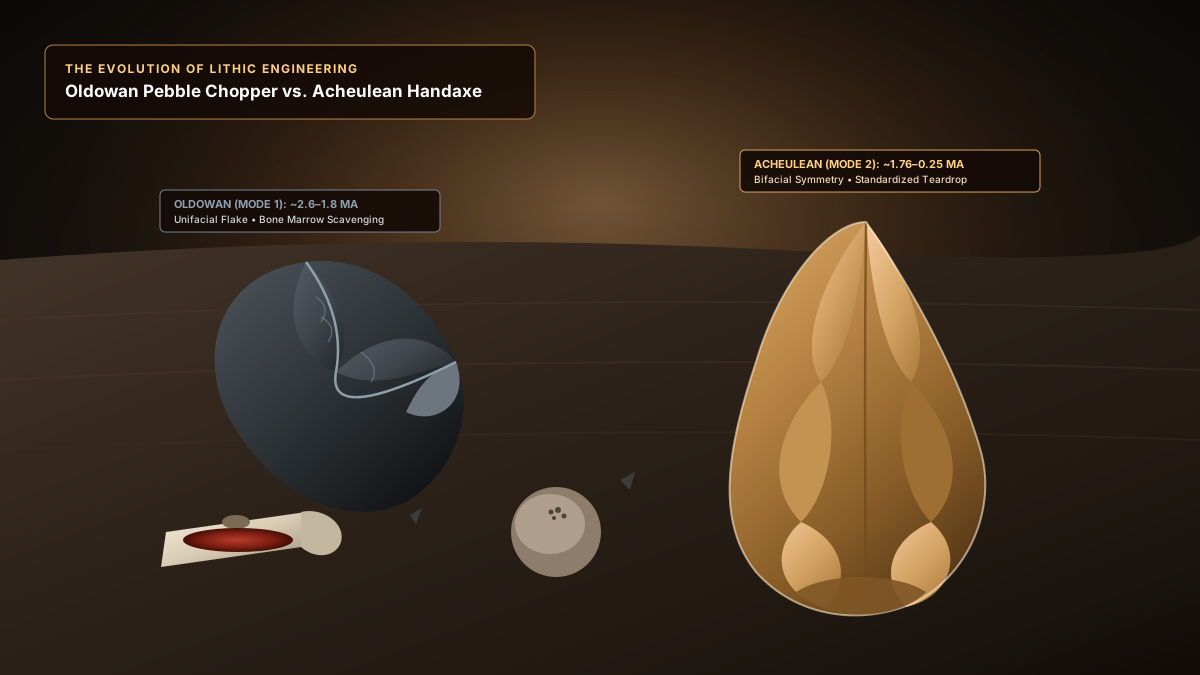
| Oldowan (Mode 1) | 2.6 – 1.7 Ma | Systematic freehand percussion; striking a volcanic core with a hammerstone at acute angles to produce sharp unifacial flakes. | Homo habilis / Homo rudolfensis |
| Acheulean (Mode 2) | 1.76 – 0.25 Ma | Bifacial symmetry; methodical knapping from both sides to manufacture standardized, teardrop-shaped handaxes and cleavers. | Homo erectus / Homo ergaster |
With Oldowan flake tools, early hominins broke into an entirely vacant ecological niche: scavenging bone marrow from large ungulate carcasses left behind by saber-toothed cats (Megantereon) and giant hyenas. While other scavengers were barred by thick cortical bone, hominins utilized hammerstones to split femurs, gaining access to dense, sterile, lipid-rich marrow that provided high-calorie fatty acids (DHA and AA) essential for brain development.
4. Homo erectus and the Physiology of the Cursorial Hunter (~1.9 Ma)
At 1.9 million years ago, a radically new creature emerged in the African savannah: Homo erectus (often classified in its early African phase as Homo ergaster). The discovery of the remarkably complete “Turkana Boy” (KNM-WT 15000) revealed an individual of modern human stature (1.6 meters at age eight), long legs, narrow hips, and an expanded cranial capacity exceeding 850 cm³.
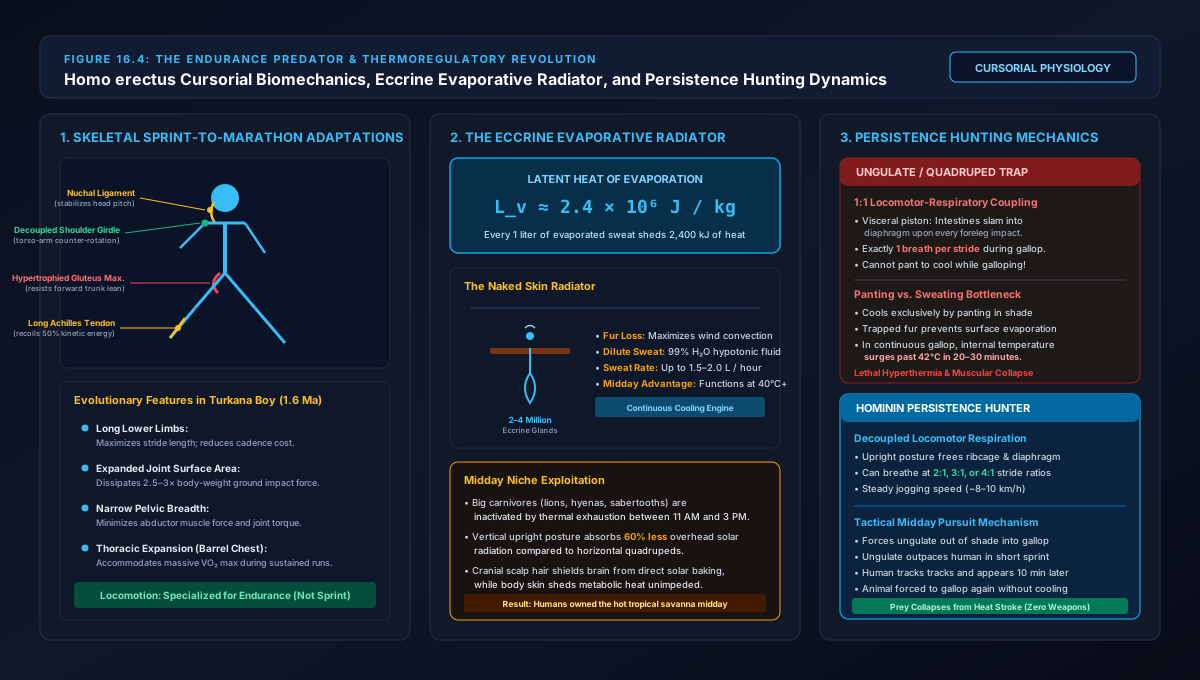
As demonstrated by Daniel Bramble and David Lieberman, Homo erectus was anatomically engineered for persistence hunting—running quadrupedal herbivores to exhaustion under the scorching midday sun. Quadrupeds gallop faster than humans in short sprints, but their respiratory anatomy forces a strict 1:1 coupling between stride frequency and respiration (the viscera piston against the diaphragm). Moreover, hairy quadrupeds cannot pant while galloping and must stop to dissipate internal heat, risking lethal hyperthermia.
Humans overcame this thermodynamic ceiling through two radical evolutionary adaptations:
- Alopecia (Loss of Body Hair): Dense insulating fur was abandoned, exposing bare epidermis directly to ambient air.
- Eccrine Sweat Glands: The proliferation of two to four million eccrine sweat glands across the entire dermal surface. While apocrine glands in mammals secrete oily, protein-rich fluids for scent marking, eccrine glands secrete a dilute, hypotonic aqueous solution (99% H2O).
The latent heat of vaporization of water is immense:
$$L_v \approx 2.4 \times 10^6\text{ J/kg}$$By evaporating up to two liters of sweat per hour, a running human can continuously dissipate over 1,000 Watts of thermal energy, decoupled completely from breathing frequency. Homo erectus could relentlessly pursue antelopes at a steady endurance trot for five hours in thirty-five-degree heat until the prey collapsed from heat stroke.
5. The Pyrotechnic Revolution and the Expensive-Tissue Hypothesis (~1.5 to 0.4 Ma)
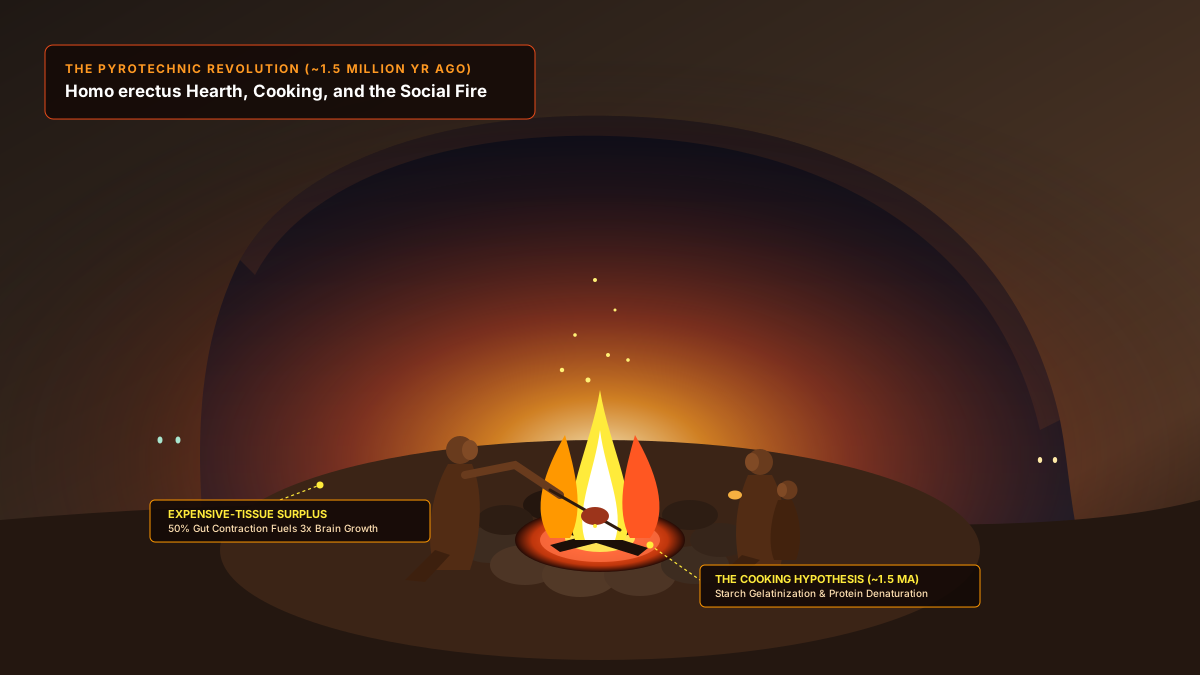
The definitive threshold separating hominins from all other organisms on Earth was the controlled mastery of fire (pyrotechnology). Archaeological evidence from Wonderwerk Cave in South Africa and Gesher Benot Ya’aqov in Israel confirms systematic hearth usage dating back between 1.0 and 1.5 million years.
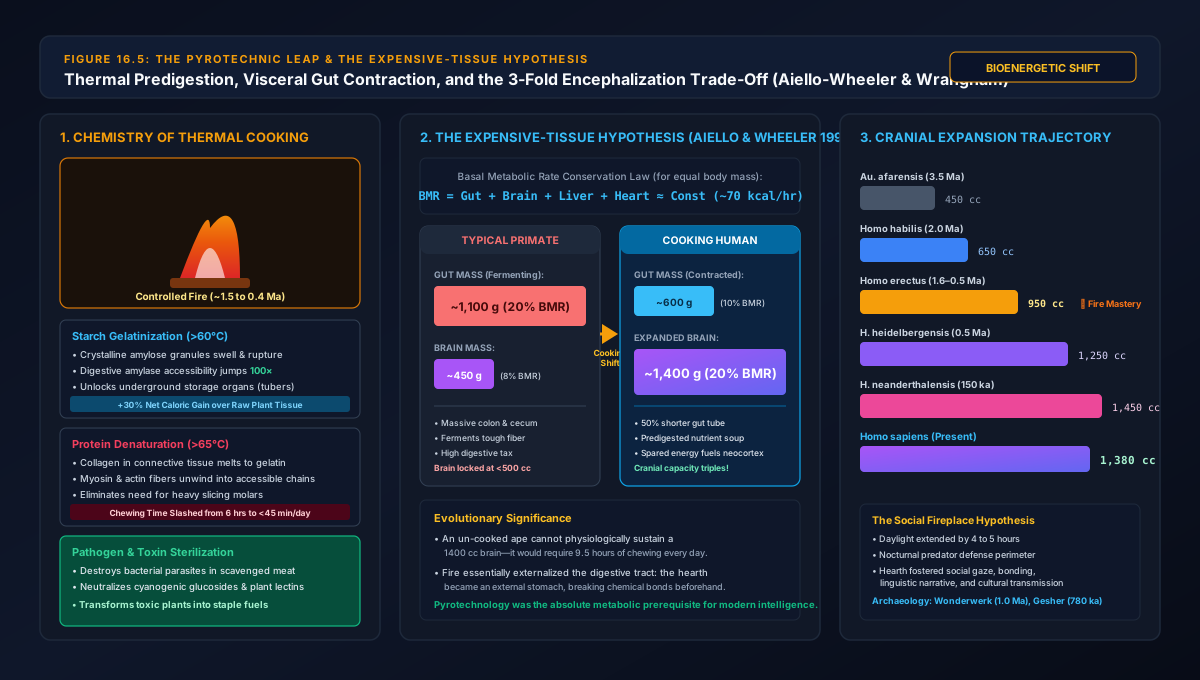
Biologist Richard Wrangham formulated the Cooking Hypothesis, establishing that thermal processing of food was the primary physiological driver of human encephalization. Raw foraging is energetically ruinous: chimpanzees spend between six and seven hours every day simply chewing fibrous raw leaves and tough wild meat, expending enormous metabolic energy on digestion.
The Biochemistry of Cooking
Applying fire to organic foodstuffs completely alters their nutritional availability:
- Starch Gelatinization: Heat swells and bursts the rigid semicrystalline starch granules in roots and tubers, breaking down amylose and amylopectin into easily hydrolyzable glucose polymers.
- Protein Denaturation: Heat uncoils complex, folded fibrous proteins (collagen, myosin, actin), exposing peptide bonds directly to stomach pepsin and pancreatic proteases.
- Pathogen Elimination: High heat sterilizes spoiled meat, neutralizing bacteria and parasites that would otherwise cause debilitating immune activation.
Under Leslie Aiello and Peter Wheeler’s Expensive-Tissue Hypothesis, metabolic basal energy is strictly conserved across major organ systems. Both brain tissue and gastrointestinal tissue are metabolically voracious, consuming approximately twenty times more energy per gram than skeletal muscle. Because cooked food is pre-digested externally by fire, Homo erectus no longer required the massive, fermenting large intestine and lengthy colon seen in apes.
As gut mass shrank by 60%, the liberated metabolic surplus was channeled directly into the central nervous system. Brain volume surged from 450 cm³ in australopithecines to 900 cm³ in Homo erectus, and ultimately to 1,400 cm³ in Neanderthals and archaic *Homo sapiens*. Fire not only nourished the brain; it extended the day into the night, banished apex carnivores from cave mouths, and created the social hearth—the primordial theater around which language, storytelling, and human culture were born.
Academic Citations & Historical References
- Wrangham, R. (2009). Catching Fire: How Cooking Made Us Human. Basic Books. ISBN:978-0465013623.
- Bramble, D. M., & Lieberman, D. E. (2004). Endurance running and the evolution of Homo. Nature, 432(7015), 345–352. doi:10.1038/nature03052
- Aiello, L. C., & Wheeler, P. (1995). The Expensive-Tissue Hypothesis: The brain and the digestive system in human and primate evolution. Current Anthropology, 36(2), 199–221. doi:10.1086/204350
- Lovejoy, C. O. (1981). The origin of man. Science, 211(4480), 341–350. doi:10.1126/science.211.4480.341
- Pontzer, H., Raichlen, D. A., & Rodman, P. S. (2014). Bipedalism and the energetic cost of human locomotion. Journal of Human Evolution, 73, 112–122. doi:10.1016/j.jhevol.2014.06.002
- White, T. D., Asfaw, B., Beyene, Y., et al. (2009). Ardipithecus ramidus and the paleobiology of early hominids. Science, 326(5949), 75–86. doi:10.1126/science.1175802
- Johanson, D. C., & White, T. D. (1979). A systematic assessment of early African hominids. Science, 203(4378), 321–330. doi:10.1126/science.104384