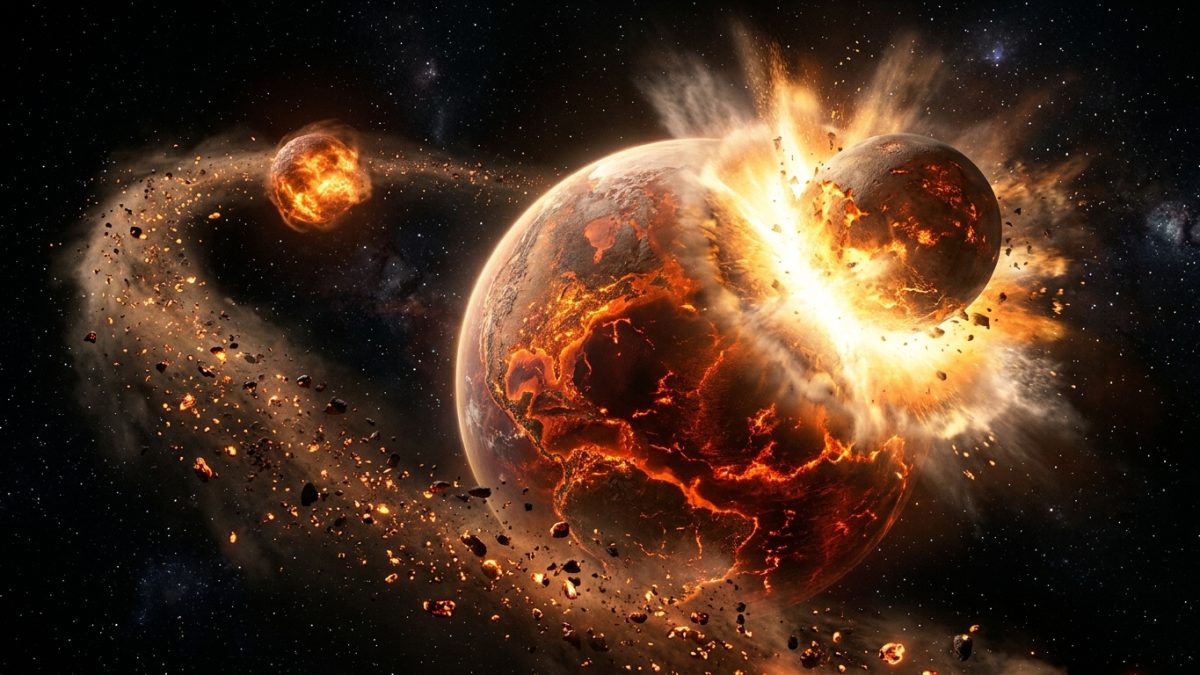
Four and a half billion years ago, the inner Solar System was an astronomical war zone of colliding protoplanets. In the most catastrophic event in our planet’s history, an infant world named Theia struck the young Proto-Earth at ten kilometers per second. The cataclysmic energy vaporized both worlds into a swirling donut of incandescent silicate gas, plunged Theia’s metallic core into Earth’s center, and launched a glowing orbital ring from which our Moon coalesced in less than a millennium—bestowing upon Earth the gravitational gyroscope that made complex life possible.
The Hadean Infancy: Melting a Planet and the Iron Catastrophe
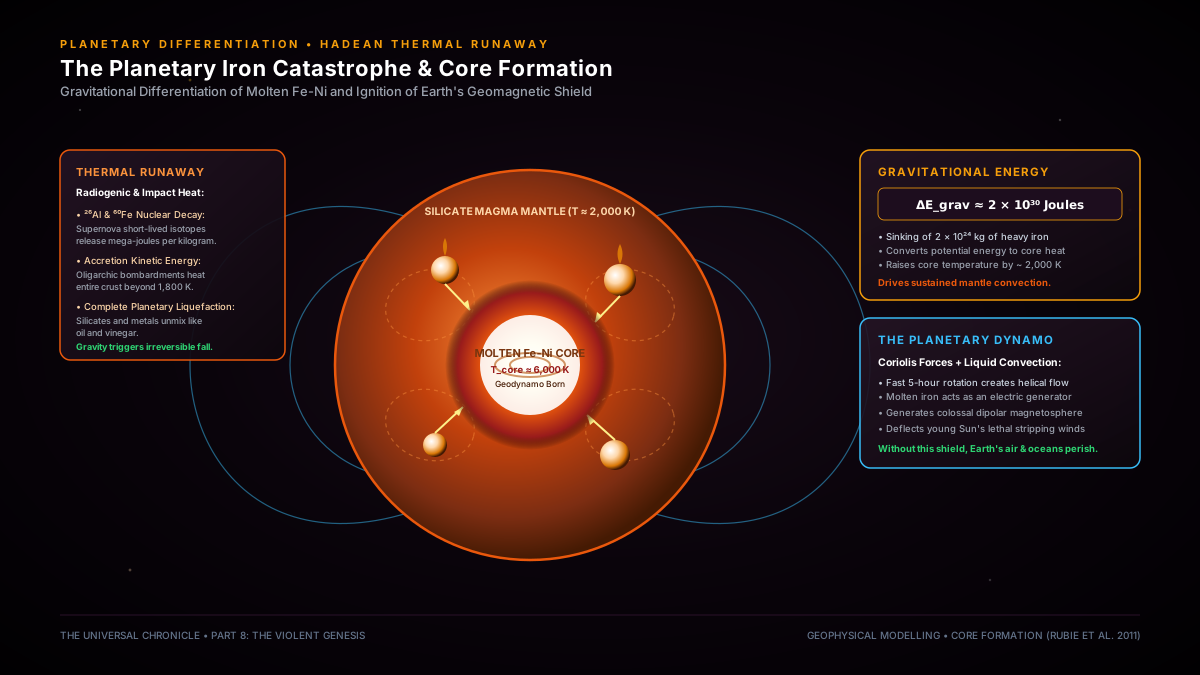
The earliest geological eon of Earth history is named the Hadean (after Hades, the Greek god of the underworld). In popular imagination, the Hadean is pictured as a static landscape of volcanic lava. In planetary physics, however, the Hadean was a dynamic crucible driven by extreme internal heat sources:
- Short-Lived Radionuclides: The decay of extinct isotopes injected by the ancestral supernova, primarily ²⁶Al (t_{1/2} ≈ 717,000 yr) and ⁶⁰Fe (t_{1/2} ≈ 2.6 Myr), pumped billions of joules of radioactive heat into the interior.
- Gravitational Accretion Energy: Every kinetic impact of an incoming planetesimal converted kinetic energy (½mv²) directly into thermal energy upon impact.
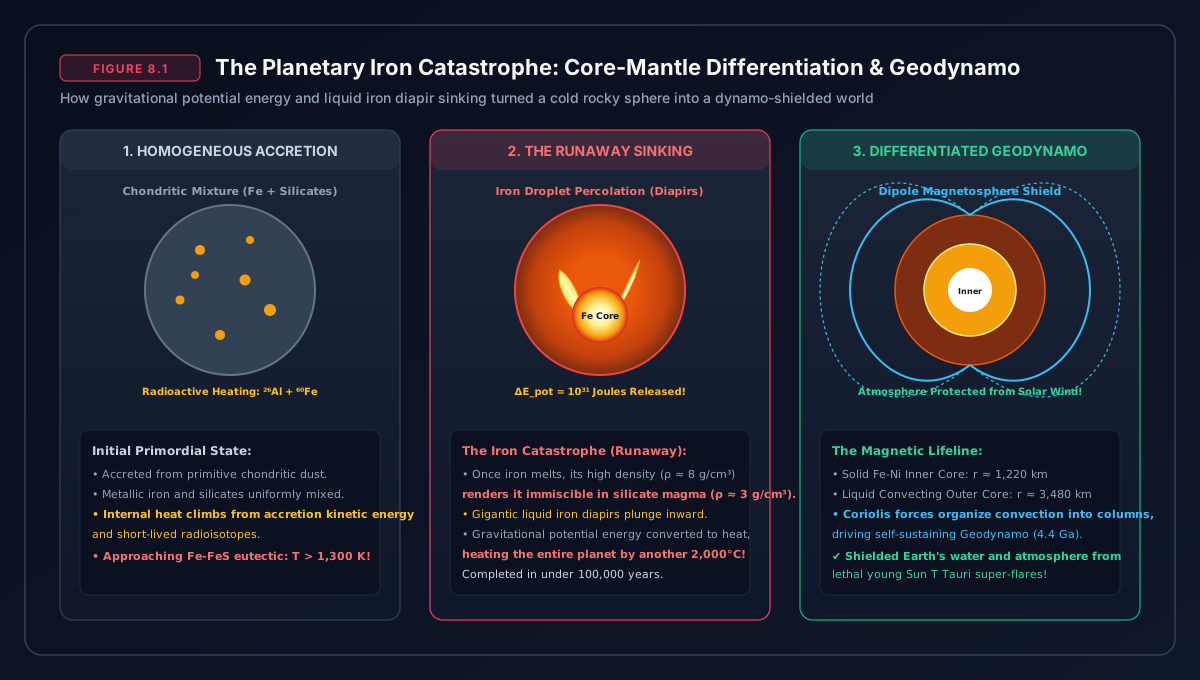
- Gravitational Core Differentiation: The sinking of dense iron released additional potential energy, heating the planet by an additional 2,000 K.
Within its first 30 million years, Proto-Earth melted completely, transforming into a global Magma Ocean extending over 1,000 kilometers deep. In this molten bath occurred the defining geochemical event of our planet’s interior: The Iron Catastrophe.
In 1923, Victor Goldschmidt demonstrated that elements partition according to their chemical affinities. Dense, metallic siderophile (“iron-loving”) elements—primarily iron, nickel, cobalt, gold, and platinum—became immiscible in liquid silicates and sank under gravity toward the planet’s center in massive metallic diapirs. Floating above them, the lighter lithophile (“rock-loving”) elements—silicon, oxygen, aluminum, magnesium, and calcium—formed a thick silicate mantle. Earth had acquired its metallic core (r ~ 3,480 km), setting up the geodynamo that generates our protective magnetic shield.
The Giant Impact: The Day Earth and Theia Collided
By approximately 4.51 billion years ago (t_0 + 50–70 million years), Proto-Earth had grown to roughly 90% of its current mass. But orbiting in the same chaotic neighborhood—likely originating at the Sun-Earth L_4 or L_5 Lagrange point before being nudged into an eccentric orbit—was another protoplanetary embryo roughly the size of Mars (10% of Earth’s mass), named by astronomers Theia (after the Titaness who was the mother of Selene, the Moon).
At an oblique angle of approximately 45°, Theia slammed into Proto-Earth at a relative velocity exceeding 10 kilometers per second (36,000 km/h).
1. The Energetics of Annihilation
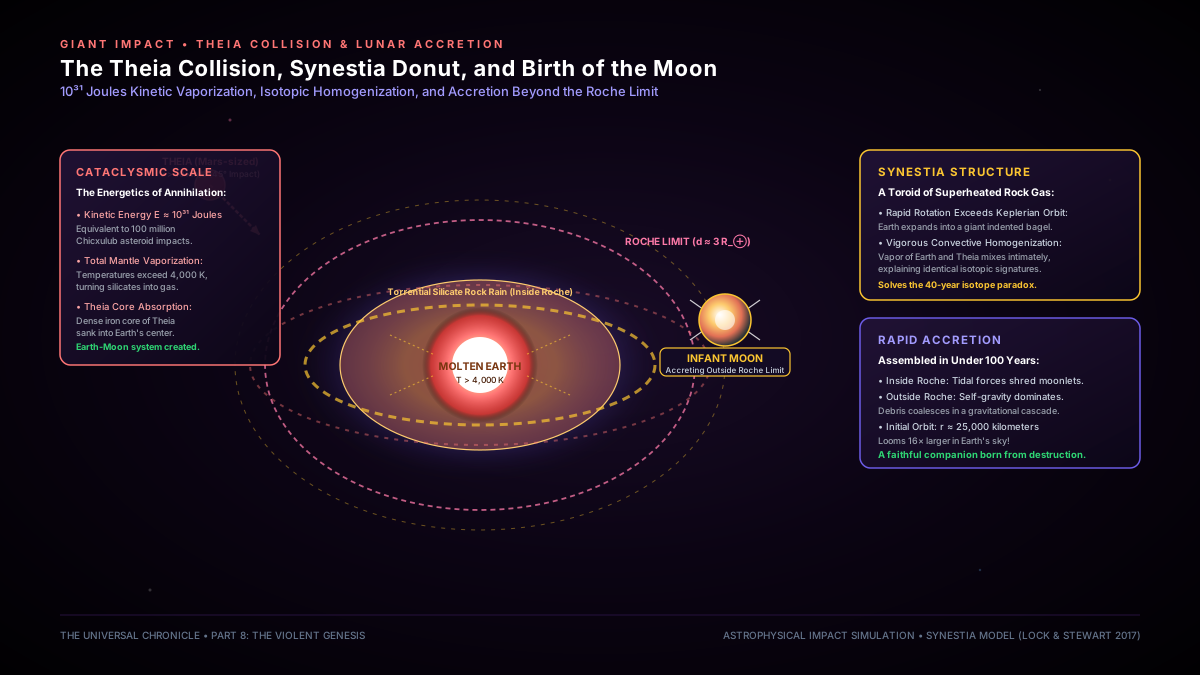
The kinetic energy unleashed in the collision was staggering: roughly 10^{31} Joules (10^{38} ergs)—the equivalent of trillions of Tsar Bomba nuclear detonations. In less than 30 minutes, Theia was completely shattered. Its metallic core plowed straight through Proto-Earth’s mantle and merged permanently with Earth’s molten core, creating an oversized, ultra-dense metallic heart for our planet.
2. The Synestia Hypothesis: A Donut of Vaporized Rock
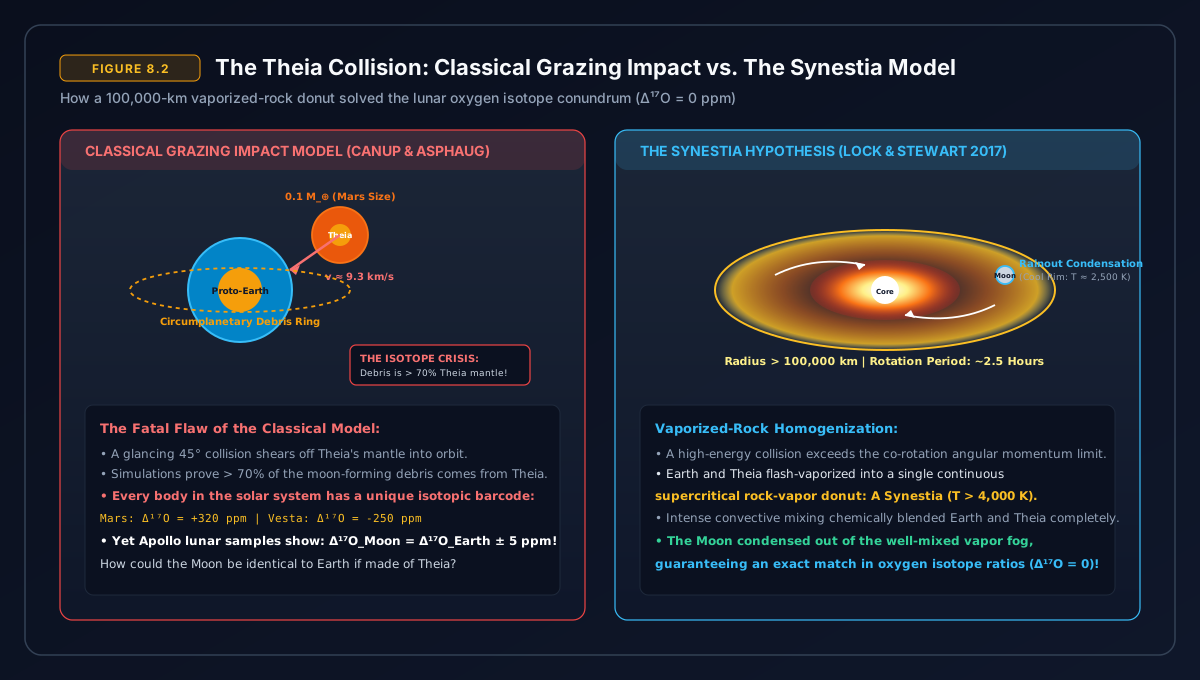
For decades, simple numerical models assumed Theia struck a glancing blow that kicked a solid/liquid debris disk into orbit. However, in 2017, planetary scientists Simon Lock and Sarah Stewart proved that a giant impact between rapidly rotating planets generates temperatures exceeding 4,000 to 6,000 K, far beyond the vaporization point of silicate rock (T_{vap} ≈ 2, K).
The collision transformed Earth into a Synestia—a colossal, rapidly rotating, donut-shaped mass of vaporized rock and supercritical fluid spanning over 100,000 kilometers across, rotating faster than its orbital velocity. Inside this vaporized rock cloud, the material of Earth and Theia was vigorously mixed, homogenizing their isotopic compositions.
The Rapid Accretion of the Moon: Assembled in Centuries
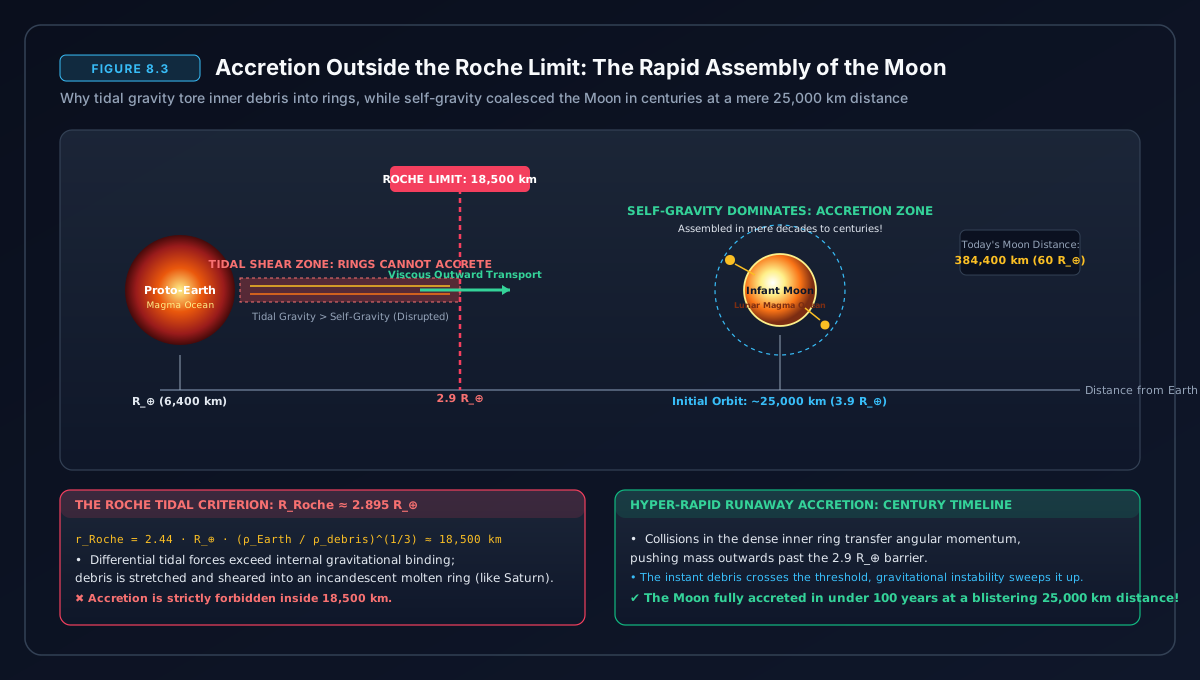
As the outer perimeter of the vaporized synestia cooled, silicate rock droplets condensed like rain outside Earth’s Roche Limit (~ 3–5 R_⊕ ≈ 18,000 km)—the distance within which planetary tidal forces tear celestial bodies apart.
High-resolution supercomputer simulations reveal that once outside the Roche limit, gravitational instability caused this molten ring of debris to coalesce into the Moon with astonishing speed: not over millions of years, but in barely 100 to 1,000 years!
The Oxygen Isotope Fingerprint
Every celestial body in the Solar System possesses a distinct isotopic fingerprint: meteorites from Mars, Vesta, and chondrite parent bodies have unique ratios of Oxygen-17 to Oxygen-18 (Δ^{17}O). Yet, when Apollo astronauts brought back lunar basalt samples, mass spectrometers revealed that Earth rocks and Moon rocks share an identical Δ^{17}O ratio to within a few parts per million. The total vaporization and turbulent isotopic mixing inside the post-impact synestia explains this identical geochemical parentage perfectly.
The Moon’s Indispensable Gifts: Why Earth Needs its Lunar Companion
Earth has the largest satellite relative to its own size of any terrestrial planet in the Solar System (M_{Moon} ≈ 1.2\% M_⊕). Without this oversized companion, Earth would be a vastly different, hostile world:
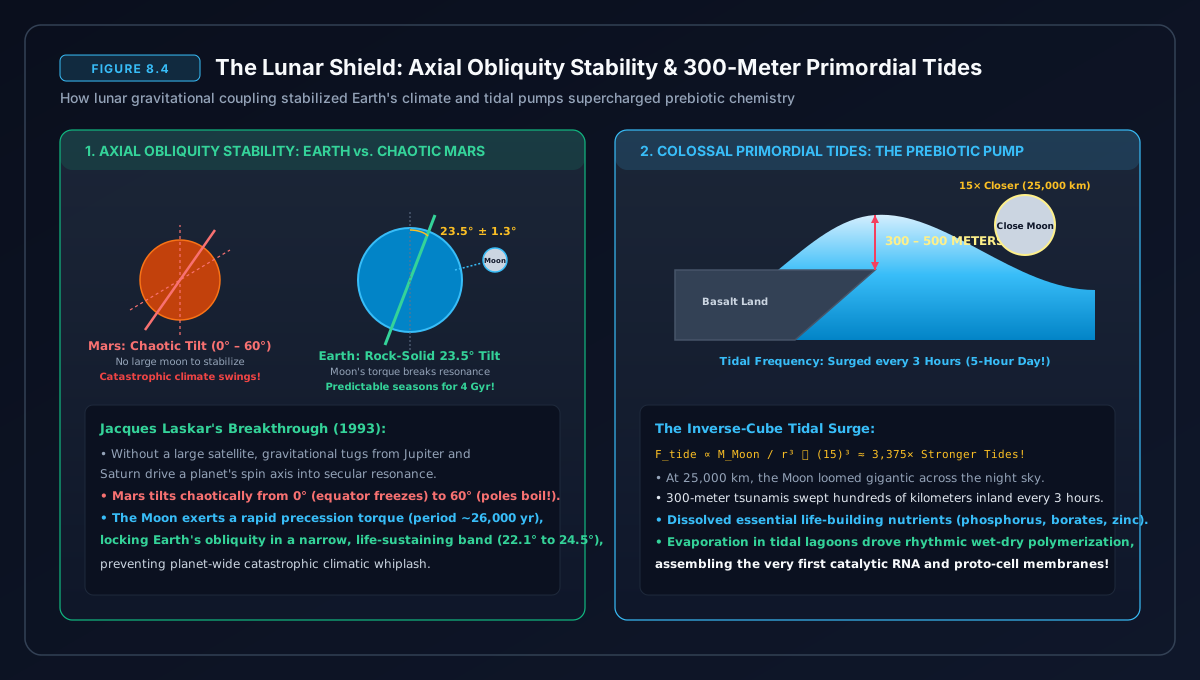
- 1. Gyroscopic Obliquity Stabilization (Touma & Wisdom 1993): The gravitational torque of the Moon locks Earth’s axial tilt into a remarkably stable variation between 22.1° and 24.5° over a 41,000-year Milankovitch cycle (currently 23.44°). Without the Moon, gravitational perturbations from Jupiter and Saturn would cause Earth’s obliquity to swing wildly from 0° to over 85°—plunging the equator into permanent ice and scorching the poles, rendering sustained evolutionary ecosystems nearly impossible. (Mars, lacking a massive moon, experiences chaotic axial tilt swings up to 60°).
- 2. Braking the 5-Hour Day: Immediately after the impact, Earth was spinning at a dizzying velocity, with a day lasting barely 5 hours. Through gravitational tidal friction, the Moon has been transferring Earth’s rotational angular momentum to its own orbital distance, slowing Earth’s rotation down over billions of years to a comfortable 24-hour cycle.
- 3. Colossal Ancient Tides: When the Moon first formed, it orbited at a distance of barely 25,000 kilometers (compared to 384,400 km today), appearing sixteen times larger in the sky. Lunar tides were kilometers high, sweeping vast distances across ancient continental margins twice a day. These immense tidal cycles created dynamic intertidal flats with alternating wetting, drying, and salinity cycles that served as prime geological crucibles for prebiotic chemistry.
Comparative Metrics: Earth, Theia, and the Infant Moon
| Property / Metric | Proto-Earth (Pre-Impact) | Theia (Impactor) | Modern Earth | The Moon |
|---|---|---|---|---|
| Mass | ~ 0.90 M_⊕ | ~ 0.10 M_⊕ (Mars size) | 5.972 × 10^{24} kg (1.0 M_⊕) | 7.342 × 10^{22} kg (0.0123 M_⊕) |
| Radius | ~ 6,100 km | ~ 3,390 km | 6,371 km | 1,737 km |
| Core Mass Fraction | ~ 30\% | ~ 20–30\% | 32.5\% (Oversized) | < 2\% (Depleted) |
| Initial Day Length | ~ 8–10 hours | Unknown | ~ 5 hours (Post-impact) | Tidally locked (27.3 days) |
| Initial Orbital Distance | 1.0 AU | ~ 1.0 AU (Lagrange orbit) | 1.0 AU | ~ 25,000 km (384,400 km today) |
| Volatile Content (H₂O, K) | Moderate | Moderate | Preserved / Replenished | Extremely depleted in volatiles |
The Aftermath: The Freezing of the Magma Ocean
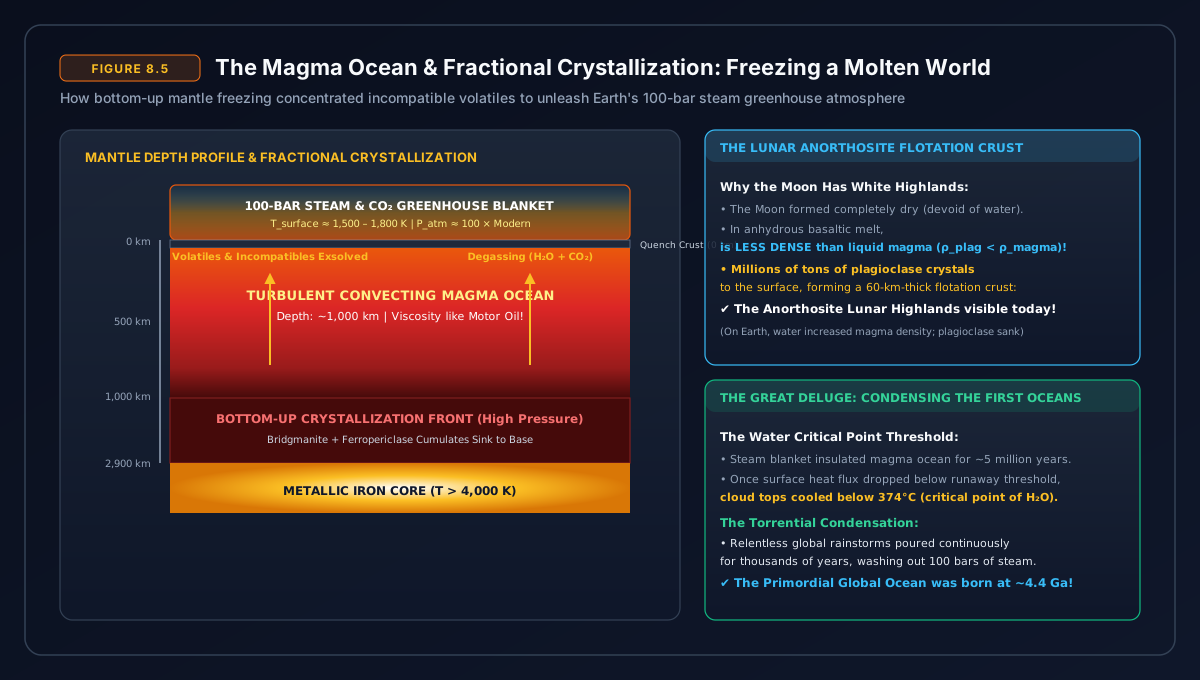
Following the departure of Theia and the coalescence of the Moon, Earth was enveloped in a glowing supercritical atmosphere of vaporized rock and high-pressure steam (> 100 bars). Surface temperatures hovered near 2,000 K, glowing dull orange in the dark of space.
Yet, the radiative physics of space is unforgiving. Radiating energy outward at hundreds of watts per square meter, the surface began to cool. Within two to three million years, the outer magma ocean froze into a brittle basaltic crust. Beneath this fragile shell, intense mantle convection churned, while volcanic degassing belched gigatons of steam, carbon dioxide, sulfur, and nitrogen into the cooling sky.
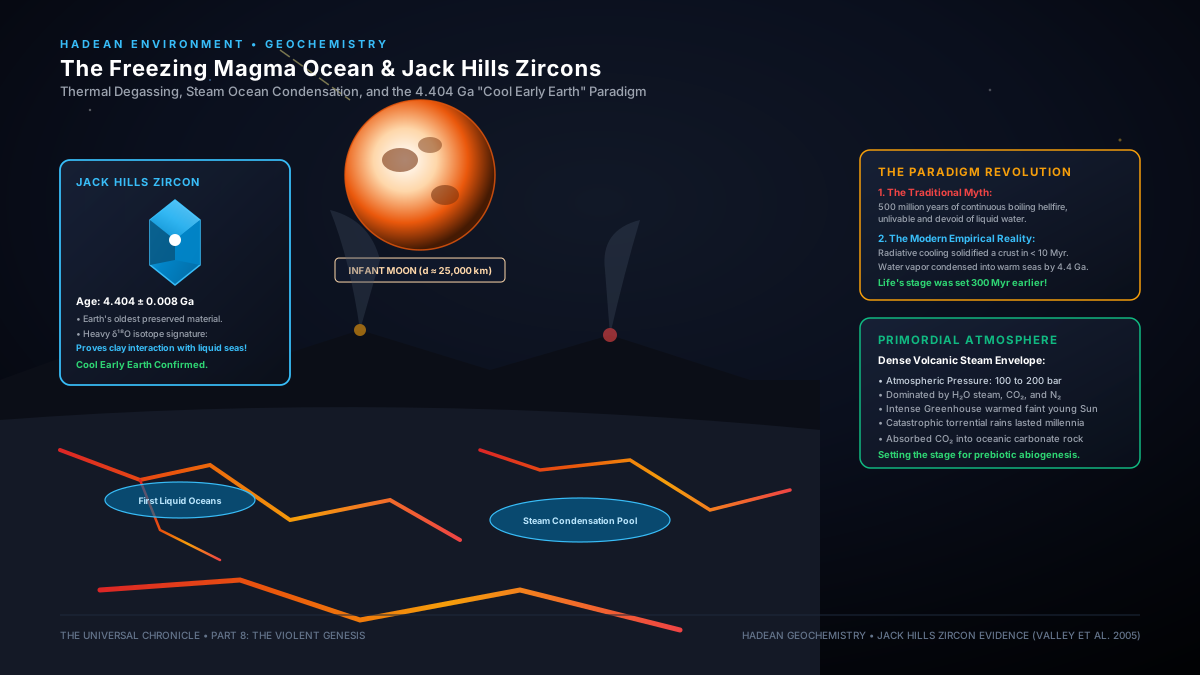
The stage was set for the greatest deluge in terrestrial history. When the atmospheric temperature finally dropped below the critical point of water, the steam clouds condensed into torrential, planetary rain. In Part 9 of The Universal Chronicle, we will witness the birth of the hydrosphere: The Primordial Cradle — Volcanic Degassing, Cometary Bombardment, and the First Oceans.
Academic Citations & Foundational Literature
- Hartmann, W. K., & Davis, D. R. (1975). “Satellite-sized planetesimals and lunar origin.” Icarus, 24(4), 504–515. doi:10.1016/0019-1035(75)90070-6.
- Cameron, A. G. W., & Ward, W. R. (1976). “The Origin of the Moon.” Lunar and Planetary Science Conference Proceedings, 7, 120–122.
- Canup, R. M., & Asphaug, E. (2001). “Origin of the Moon in a giant impact during the end of the Earth’s formation.” Nature, 412, 708–712. doi:10.1038/35089010.
- Touma, J., & Wisdom, J. (1993). “The Chaotic Obliquity of Mars.” Science, 259(5099), 1294–1297. doi:10.1126/science.259.5099.1294.
- Lock, S. J., & Stewart, S. T. (2017). “The structure and evolution of synestias: A new type of planetary object formed by high-energy, high-angular-momentum giant impacts.” Journal of Geophysical Research: Planets, 122(5), 950–982. doi:10.1002/2016JE005239.
- Barboni, M., et al. (2017). “Early formation of the Moon 4.51 billion years ago.” Science Advances, 3(1), e1602365. doi:10.1126/sciadv.1602365.