During the opening twenty minutes of existence, the universe functioned as a single, cosmos-spanning thermonuclear reactor. In this blindingly dense furnace, the fundamental building blocks of matter emerged from a nearly frictionless fluid of unbound quarks, survived an existential annihilation against antimatter, and fused into the exact primordial chemical recipe—75% hydrogen and 25% helium—that powers every star shining in the night sky today.
The Electroweak Epoch (10^{-12} Seconds): How Particles Acquired Mass
Following the end of cosmic inflation and the turbulent fires of reheating, the universe expanded into the Electroweak Epoch. The cosmos was filled with a searing relativistic soup of leptons, quarks, and gauge bosons at temperatures exceeding 1015 K (E ~ 100 GeV). At these energies, the electromagnetic force and the weak nuclear force were indistinguishable, operating under a unified SU(2)_L × U(1)_Y electroweak gauge symmetry.
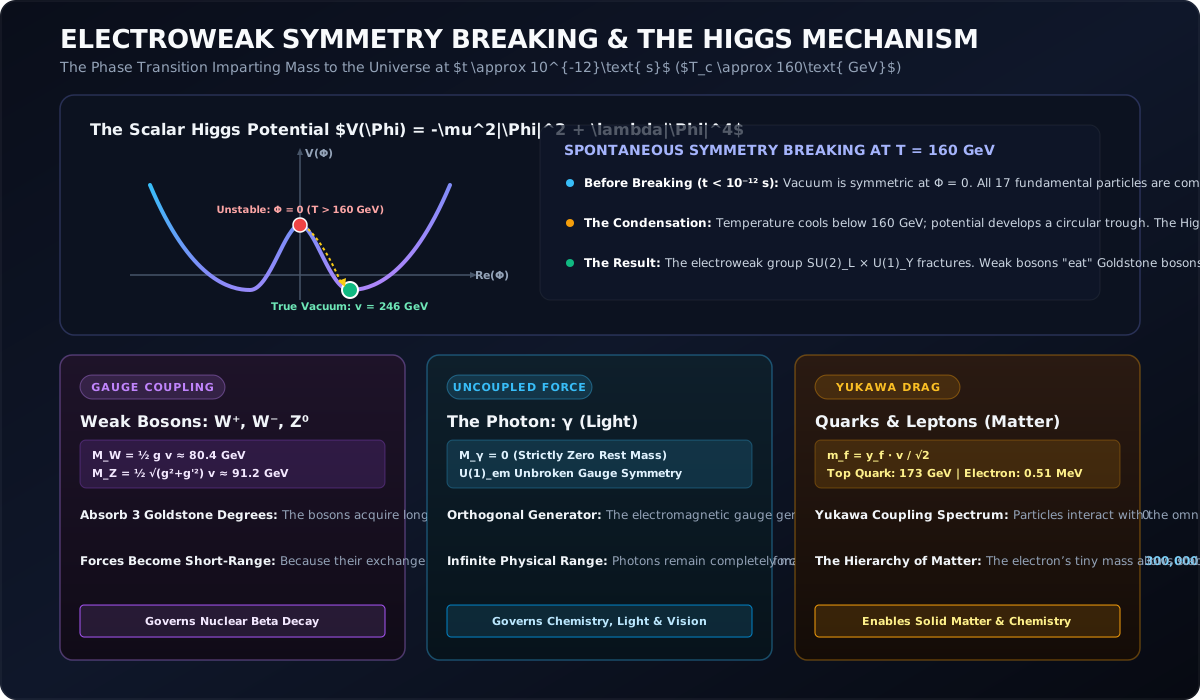
All fundamental particles were massless, hurtling through the cosmos at the speed of light. However, at t ≈ 10^{-12} seconds, the temperature dropped below the critical electroweak threshold (T_c ≈ 160 GeV). The scalar Higgs field underwent electroweak symmetry breaking, settling into a non-zero vacuum expectation value (v ≈ 246 GeV):
- The Weak Gauge Bosons (W^+, W^-, and Z^0): Strongly coupled to the Higgs field, acquiring immense inertial rest masses (≈ 80.4 GeV and 91.2 GeV). Because their carriers were now heavy, the weak nuclear force collapsed into a short-range interaction operating only within subatomic distances (10-18 meters).
- The Photon (γ): Remained completely uncoupled to the Higgs vacuum expectation value, preserving its zero rest mass. Electromagnetism became an infinite-range force governed by unbroken U(1)_{em} symmetry.
- Fermions (Quarks & Charged Leptons): Acquired distinct rest masses via Yukawa coupling to the Higgs condensate. The top quark coupled fiercely, becoming the heaviest elementary particle (173 GeV), while the electron coupled weakly (0.511 MeV).
The Quark-Gluon Plasma: The Universe’s “Perfect Liquid”
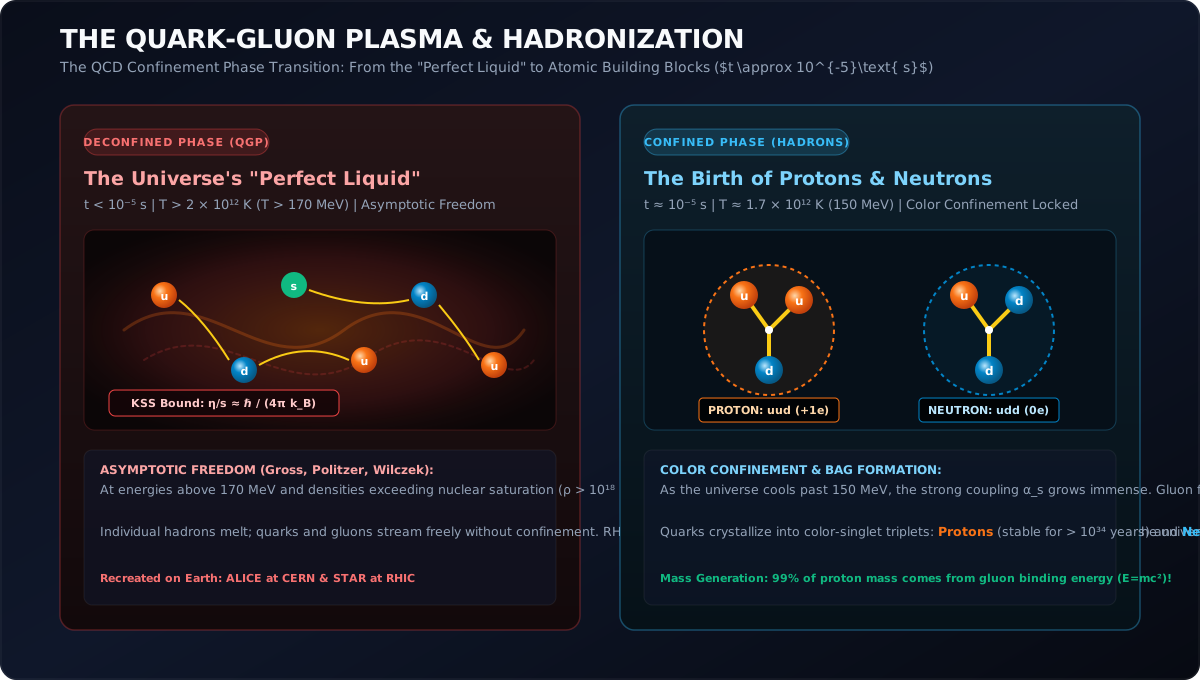
Between 10^{-12} and 10-5 seconds, the universe was dominated by a state of matter so extreme that it has only been recreated on Earth inside the core collision chambers of the Relativistic Heavy Ion Collider (RHIC) at Brookhaven and the Large Hadron Collider (LHC) at CERN: the Quark-Gluon Plasma (QGP).
Under ordinary terrestrial conditions, the strong nuclear force is governed by quantum chromodynamic (QCD) color confinement: quarks can never exist in isolation. If you attempt to pull two quarks apart, the energy stored in the gluon flux tube between them increases linearly until it becomes energetically favorable to create a new quark-antiquark pair from the vacuum (E = mc^2).
In 1973, David Gross, Frank Wilczek, and David Politzer demonstrated that the strong coupling constant α_s decreases logarithmically at ultra-high energies and microscopic distances. In the primordial universe, when densities exceeded nuclear saturation density (ρ > 10^{18} kg/m³) and temperatures rose above 2 × 10¹² K (T > 170 MeV), individual hadrons melted. Quarks, antiquarks, and gluons moved freely as an unconfined, deconfined plasma.
Crucially, experiments at RHIC and the LHC’s ALICE detector revealed that the Quark-Gluon Plasma does not behave like an ideal gas of billiard-ball particles. Instead, it is a strongly coupled quantum fluid with the lowest shear viscosity-to-entropy density ratio (η/s) ever measured in nature—approaching the fundamental holographic Kovtun-Son-Starinets (KSS) quantum bound:
$$\frac{\eta}{s} \approx \frac{\hbar}{4\pi k_B}$$
The primordial universe was not an erratic gas; it was an ultra-dense, near-frictionless perfect liquid swirling with turbulent quantum vortices.

The Mystery of Baryogenesis: Why Anything Exists at All
One of the deepest enigmas in modern physics is why our universe is composed almost exclusively of matter rather than an equal mixture of matter and antimatter. The equations of Quantum Electrodynamics (QED) and the Standard Model are nearly symmetric: whenever pure energy transforms into matter via pair production (γ + γ → q + ¯q), it generates particles and antiparticles in equal numbers.
Had this symmetry remained absolute during the early universe, then as the temperature cooled below particle creation thresholds, every quark would have encountered an antiquark, annihilating into pure gamma-ray photons:
$$q + \bar{q} \to \gamma + \gamma$$
The cosmos would have ended as an empty, sterile sea of cold radiation, completely devoid of protons, neutrons, atoms, stars, or observers. Yet, we observe a universe containing roughly 1080 protons and neutrons, with no macroscopic pockets of primordial antimatter detected anywhere in the observable cosmos.
The Three Sakharov Conditions (1967)
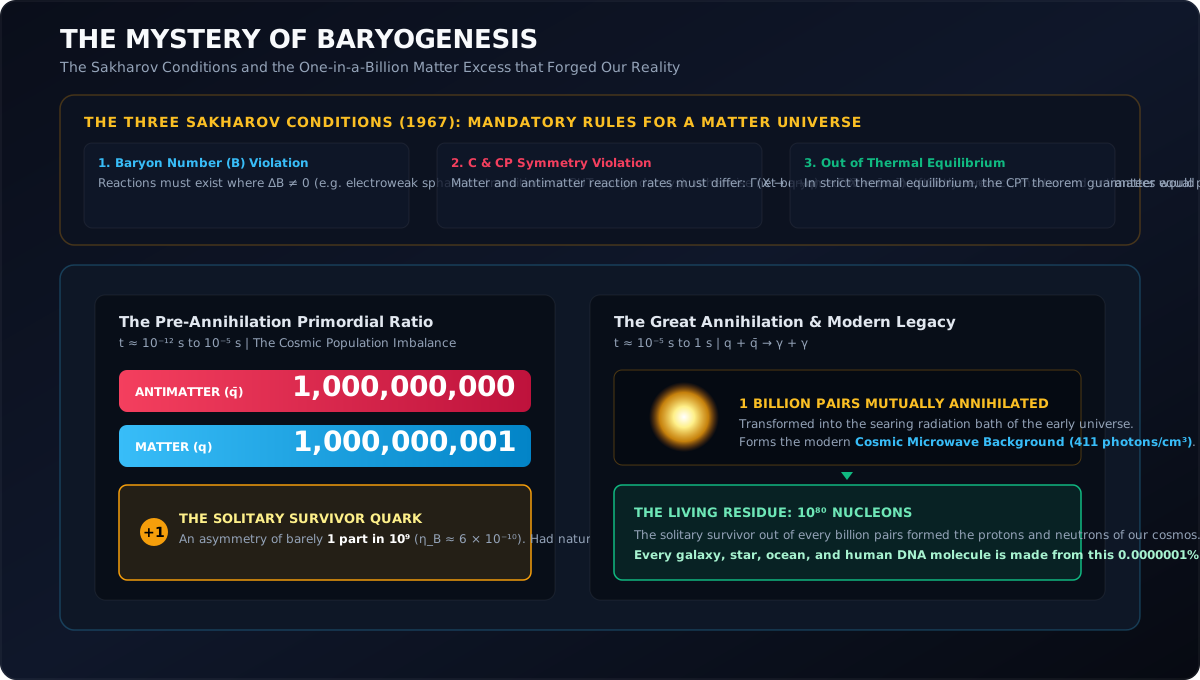
In 1967, Soviet nuclear physicist and dissident Andrei Sakharov identified the three mandatory mathematical conditions required to generate a net baryon asymmetry from an initially symmetric state:
- 1. Baryon Number (B) Violation: There must exist physical processes that do not conserve the total number of baryons. In the Standard Model, non-perturbative electroweak sphaleron transitions can violate B while conserving B – L. In Grand Unified Theories, superheavy gauge bosons directly decay into unequal numbers of quarks and leptons.
- 2. C and CP Symmetry Violation: Charge conjugation (C) and the combination of Charge conjugation and Parity (CP) must be violated. If CP were exact, the rate of a reaction producing matter (Γ(X → q + q)) would precisely equal the rate of the conjugate reaction producing antimatter (Γ(¯X → ¯q + ¯q)), resulting in zero net surplus. While CP violation is observed in the Cabibbo-Kobayashi-Maskawa (CKM) matrix of the quark sector, its magnitude is insufficient to explain the observed universe, pointing to undiscovered physics (such as leptogenesis via heavy Majorana neutrinos).
- 3. Departure from Thermal Equilibrium: In strict thermodynamic equilibrium, the CPT theorem guarantees that the phase space density of matter and antimatter remains identical. Therefore, the baryon-generating reactions had to occur during a rapid out-of-equilibrium phase transition—such as bubble nucleation during a first-order phase transition or the decay of heavy particles during the expansion of the universe.
Because these conditions were met, a microscopic asymmetry emerged: for every 1,000,000,000 antiquarks, there were 1,000,000,001 quarks. When the universe cooled and the great annihilation took place, one billion quark-antiquark pairs canceled out into a bath of light. The entire tangible universe—every galaxy, every carbon atom, every drop of water, and every human brain—is made from the solitary, triumphant survivor of that one-in-a-billion excess.
Hadronization (t ≈ 10⁻⁵ Seconds): The Birth of Protons and Neutrons
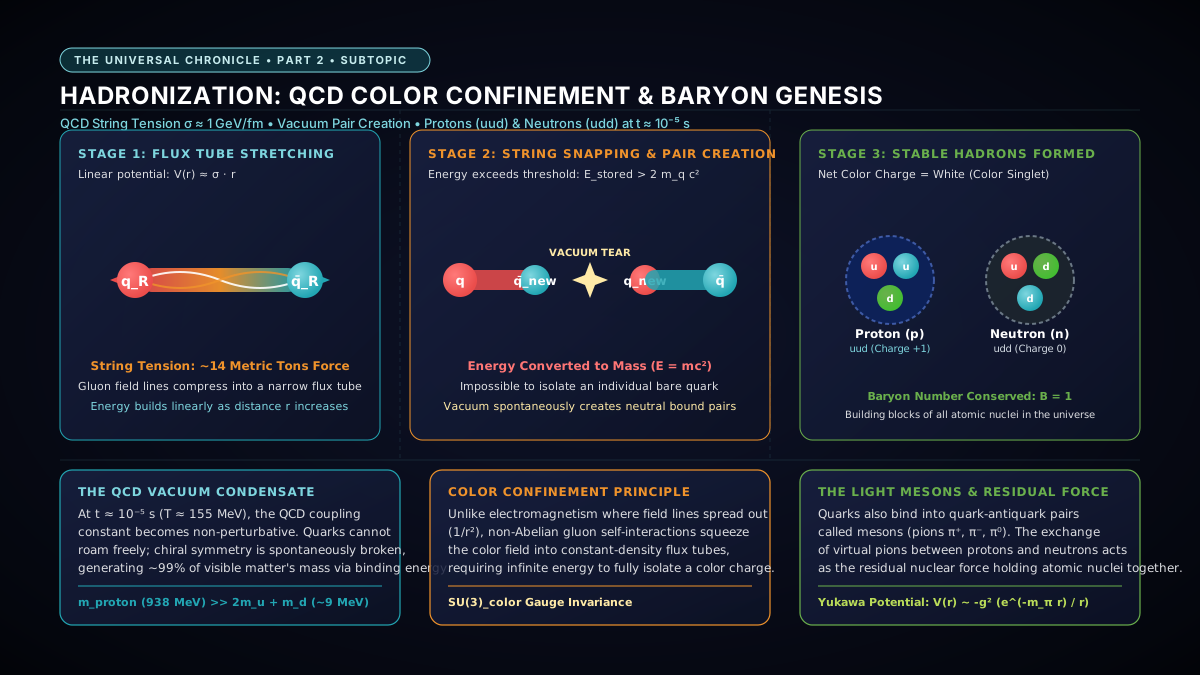
By t ≈ 10 microseconds (10-5 s), the universe expanded and cooled to T ≈ 1.7 × 10¹² K (150 MeV). At this temperature, the strong coupling constant α_s grew so powerful that the Quark-Gluon Plasma could no longer maintain asymptotic freedom. The universe underwent the QCD confinement phase transition, or Hadronization.
Quarks were bound permanently by gluon exchange into color-neutral composite particles (hadrons):
- Protons (p = uud): Two up quarks (+2/3 e each) and one down quark (-1/3 e), yielding an electric charge of +1. Stable against decay.
- Neutrons (n = udd): One up quark (+2/3 e) and two down quarks (-1/3 e each), yielding an electric charge of 0. A free neutron is slightly heavier than a proton (Δ m ≈ 1.293 MeV) and decays via beta decay (n → p + e^- + ν̄_e) with a half-life of roughly 879 seconds (14.6 minutes).
- Mesons (π^+, π^-, π^0): Quark-antiquark pairs that rapidly decayed into photons and leptons.
At this moment, the universe entered the Lepton Epoch (t ≈ 10⁻⁵ s to 1 second). The temperature was still high enough to generate copious electron-positron pairs (e^- + e^+ ↔ γ + γ), while neutrinos roamed freely. At (t ≈ 1 s)econd (T ≈ 10^{10} K ≈ 1 MeV), the weak interaction rate dropped below the Hubble expansion rate. Neutrinos decoupled from the plasma, streaming freely through space to form the Cosmic Neutrino Background (CνB), an invisible relic that permeates the cosmos today at a temperature of K.
Big Bang Nucleosynthesis (t = 10 Seconds to 20 Minutes): The First Atoms
Between 10 seconds and 20 minutes after the Big Bang, the universe underwent its most critical chemical transformation: Big Bang Nucleosynthesis (BBN). For the first and only time in cosmic history, the entire universe was dense and hot enough to function as an all-encompassing fusion reactor.
1. The Neutron-to-Proton Freeze-Out Ratio
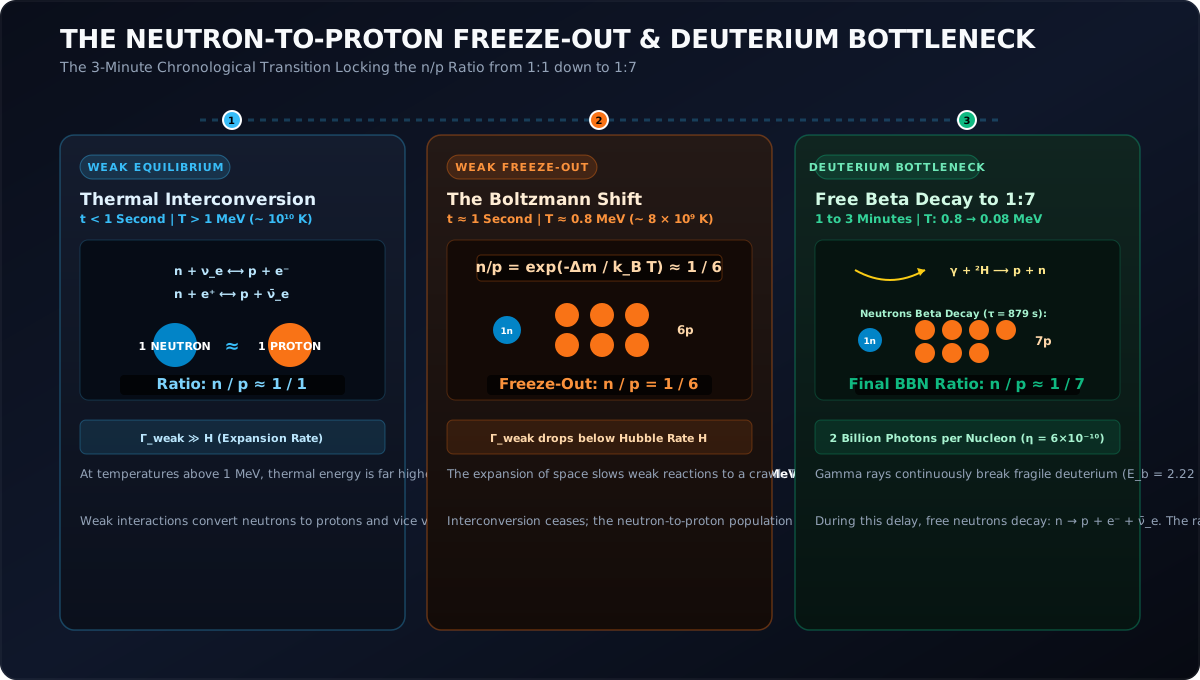
Early in the lepton epoch, protons and neutrons converted back and forth effortlessly through weak interactions mediated by electron neutrinos:
$$n + \nu_e \leftrightarrow p + e^- \quad \text{and} \quad n + e^+ \leftrightarrow p + \bar{\nu}_e$$
Because the neutron is 1.293 MeV heavier than the proton, the Boltzmann distribution favored the lower-energy proton state (n/p ∝ e^{-Δ m / k_B T}). When the temperature dropped below 0.8 MeV (t ≈ 1 s), the weak reactions became too slow to keep pace with the expansion. The ratio froze out at roughly n/p ≈ 1/6.
Over the next several minutes, free neutrons underwent beta decay (n → p + e^- + ν̄_e). By the time nuclear fusion could begin in earnest, the ratio had shifted to approximately n/p ≈ 1/7 (one neutron for every seven protons).
2. The Deuterium Bottleneck
To build heavier nuclei, the universe had to start by fusing a proton and a neutron into a deuterium nucleus (heavy hydrogen):
$$p + n \to {}^2\text{H} + \gamma$$
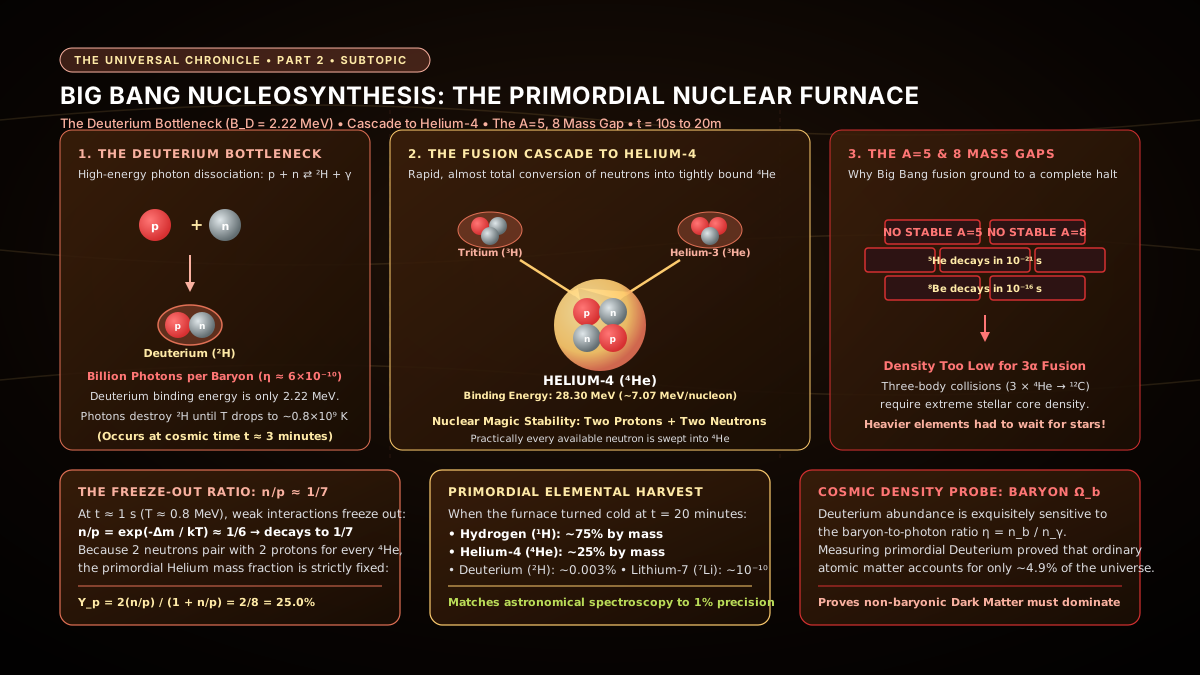
The binding energy of deuterium is relatively fragile: E_b = 2.22 MeV. Although the average thermal energy of the universe was well below 2.22 MeV, the ratio of photons to baryons was immense—approximately two billion photons for every single baryon (η ≈ 6 × 10^{-10}). In this high-energy Planckian tail of the blackbody radiation spectrum, there were millions of gamma-ray photons capable of instantly shattering any newly formed deuterium back into a lone proton and neutron.
This delay is known as the Deuterium Bottleneck. Fusion could not proceed until the universe cooled to T ≈ 8 × 10^ K (0.08 MeV), at roughly t ≈ 3 minutes.
3. The Fusion Cascade to Helium-4
Once the temperature fell low enough for deuterium to survive, an explosive cascade of nuclear reactions consumed nearly all available neutrons in seconds:
- ²H + p → ³He + γ (Helium-3)
- ²H + n → ³H + γ (Tritium)
- ²H + ²H → ³He + n
- ³H + ²H → ⁴He + n (Helium-4)
- ³He + ²H → ⁴He + p (Helium-4)
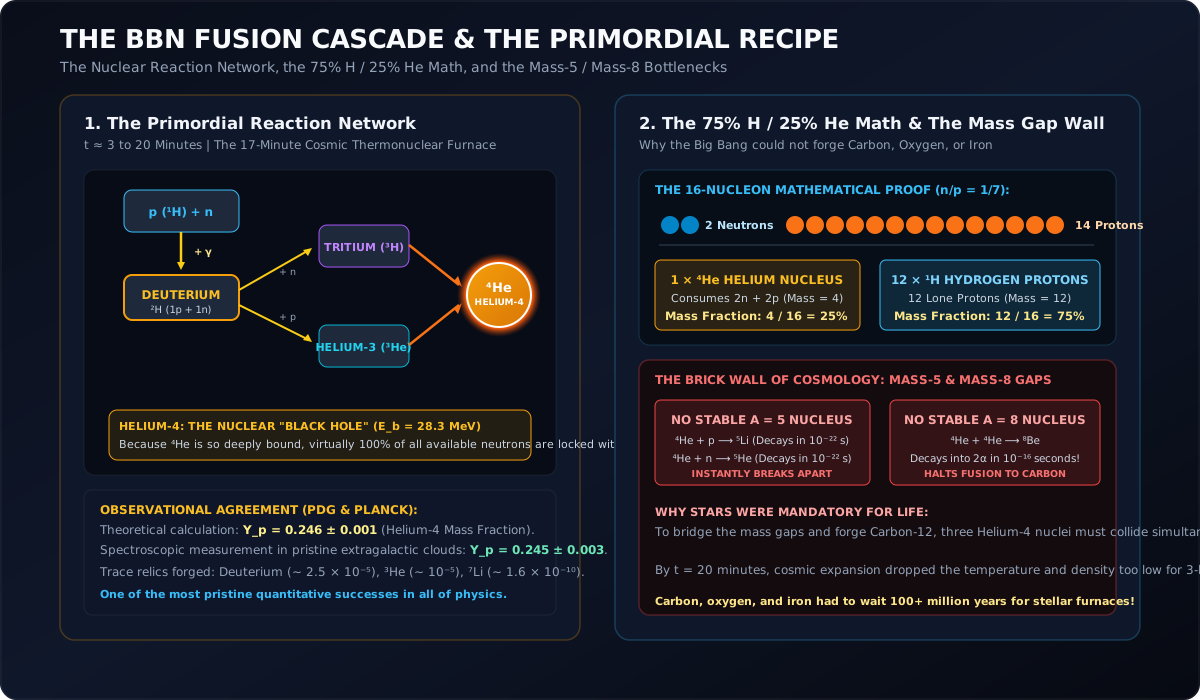
Because Helium-4 (⁴He) has an exceptionally tight binding energy (28.3 MeV, or 7.07 MeV per nucleon), it acts as a nuclear “black hole”—virtually all available neutrons were bound into Helium-4 nuclei. With an initial ratio of 1 neutron to 7 protons, a simple calculation reveals the ultimate mass fraction of the universe:
Consider 16 nucleons: 2 neutrons and 14 protons (a 1:7 ratio). The 2 neutrons combine with 2 protons to form a single ⁴He nucleus (mass = 4). This leaves 14 – 2 = 12 free protons (Hydrogen nuclei, mass = 12).
The mass fraction of Helium-4 is therefore:
$$Y_p = \frac{\text{Mass of Helium}}{\text{Total Mass}} = \frac{4}{4 + 12} = \frac{4}{16} = 25\%$$
The remaining 75% of the baryonic mass stayed as free protons—the nuclei of ordinary Hydrogen.
4. Why the Big Bang Could Not Forge Carbon or Iron
Why did nucleosynthesis halt at helium? Why didn’t the universe continue fusing carbon, nitrogen, oxygen, and iron, as massive stars do?
There are two insurmountable nuclear bottlenecks in nature: there are no stable nuclei with mass numbers A = 5 or A = 8. If Helium-4 captures a proton or neutron, it forms ⁵Li or ⁵He, both of which disintegrate instantaneously (10-21 s). If two Helium-4 nuclei fuse, they form Beryllium-8 (⁸Be), which decays back into two alpha particles with a half-life of just 10-16 seconds.
In the dense, gravitational cores of red giant stars, this bottleneck is overcome via the triple-alpha process (⁴He + ⁴He + ⁴He → ¹²C), which requires sustained, immense densities and millions of years. In the early universe, the cosmic expansion was so rapid that by t ≈ 20 minutes, the temperature and density had plummeted far below the threshold for nuclear fusion. The cosmic forge closed forever.
Only trace quantities of heavier isotopes managed to form: a tiny remnant of unburned Deuterium (²H/H ≈ 2.5 × 10⁻⁵), Helium-3 (³He/H ≈ 10⁻⁵), and a whisper of Lithium-7 (⁷Li/H ≈ 1.6 × 10^{-10}).
Chronology Table: From Quark Soup to the First Atomic Nuclei
| Stage / Epoch | Time Elapsed | Temperature (K) | Energy Scale | Key Physical Transitions |
|---|---|---|---|---|
| Electroweak Symmetry Breaking | 10-12 s | 1015 K | 100 GeV | Higgs field acquires vacuum expectation value; W^±, Z^0 acquire mass; electromagnetism separates from weak force. |
| Quark-Gluon Plasma (QGP) | 10^{-12} to 10⁻⁵ s | > 2 × 10¹² K | > 170 MeV | Asymptotic freedom; quarks and gluons roam unbound as a near-zero-viscosity quantum perfect liquid. |
| Baryogenesis Era | 10^{-11} to 10^{-6} s | ~ 10^{13} K | ~ 1 GeV | Sakharov conditions generate a 1-in-a-billion matter surplus; mutual annihilation leaves pure matter residue and cosmic photon bath. |
| Hadronization | 10-5 s (10 µ s) | 1.7 × 10¹² K | 150 MeV | Color confinement locks quarks into protons (uud) and neutrons (udd). Mesons decay. |
| Neutrino Decoupling | 1.0 s | 1010 K | 1 MeV | Weak force freezes out; n/p ratio freezes at ~ 1/6; neutrinos decouple to form the Cosmic Neutrino Background (CνB). |
| Deuterium Bottleneck | 10 to 180 s | 10^9 to 8 × 10^ K | 0.1 MeV | High photon-to-baryon ratio delays fusion; free neutrons decay until n/p ≈ 1/7. |
| Primordial Nucleosynthesis (BBN) | 3 to 20 min | 8 × 10^8 to 3 × 10^ K | < 0.05 MeV | Nuclear fusion cascade; forms 75% ¹H, 25% ⁴He, trace Deuterium, ³He, and ⁷Li. Cosmic expansion halts fusion. |
The Legacy: The Golden Fingerprint of the Big Bang
Big Bang Nucleosynthesis stands alongside the Cosmic Microwave Background and cosmological redshift as one of the three foundational observational pillars of the Big Bang model. In 1948, Ralph Alpher, Hans Bethe, and George Gamow published their landmark αβγ paper predicting that the universe must be predominantly hydrogen and helium formed in the opening minutes.
Modern spectroscopic observations of pristine, metal-poor intergalactic gas clouds and ancient dwarf galaxies confirm these calculations with breathtaking accuracy: the primordial helium fraction is measured to be Y_p = 0.245 ± 0.003, matching the mathematical predictions of BBN to within fractions of a percent. The ratio of primordial deuterium directly constrains the total density of baryonic matter in the cosmos (Ω_b h^2 ≈ 0.022), proving that ordinary atomic matter accounts for barely 5% of the total energy density of the universe.
The stage was set. The atomic nuclei were forged. Yet, the universe remained an opaque, blinding fog of free electrons and protons where light could not travel. In Part 3 of The Universal Chronicle, we will explore the great clearing of the heavens: The Clearing of the Heavens — Recombination, the Cosmic Microwave Background, and the 100-Million-Year Dark Ages.
Academic Citations & Foundational Literature
- Alpher, R. A., Bethe, H., & Gamow, G. (1948). “The origin of chemical elements.” Physical Review, 73(7), 803–804. doi:10.1103/PhysRev.73.803.
- Sakharov, A. D. (1967). “Violation of CP invariance, C asymmetry, and baryon asymmetry of the universe.” Soviet Physics Uspekhi, 161(5), 61–64. doi:10.1070/PU1991v034n05ABEH002497.
- Wagoner, R. V., Fowler, W. A., & Hoyle, F. (1967). “On the synthesis of elements at very high temperatures.” The Astrophysical Journal, 148, 3–49. doi:10.1086/149126.
- Gross, D. J., & Wilczek, F. (1973). “Ultraviolet behavior of non-Abelian gauge theories.” Physical Review Letters, 30(26), 1343–1346. doi:10.1103/PhysRevLett.30.1343.
- Politzer, H. D. (1973). “Reliable perturbative results for strong interactions?” Physical Review Letters, 30(26), 1346–1349. doi:10.1103/PhysRevLett.30.1346.
- ALICE Collaboration (Abelev, B., et al.) (2013). “Centrality dependence of charged particle production at large transverse momentum in Pb-Pb collisions at √s_NN = 2.76 TeV.” Physics Letters B, 720(1–3), 52–62. doi:10.1016/j.physletb.2013.01.051.
- Fields, B. D., Molaro, P., & Sarkar, S. (2020). “Big-Bang Nucleosynthesis.” In Review of Particle Physics (Particle Data Group), Progress of Theoretical and Experimental Physics, 2020(8), 083C01. doi:10.1093/ptep/ptaa104.
- Kovtun, P., Son, D. T., & Starinets, A. O. (2005). “Viscosity in strongly interacting quantum field theories from black hole physics.” Physical Review Letters, 94(11), 111601. doi:10.1103/PhysRevLett.94.111601.