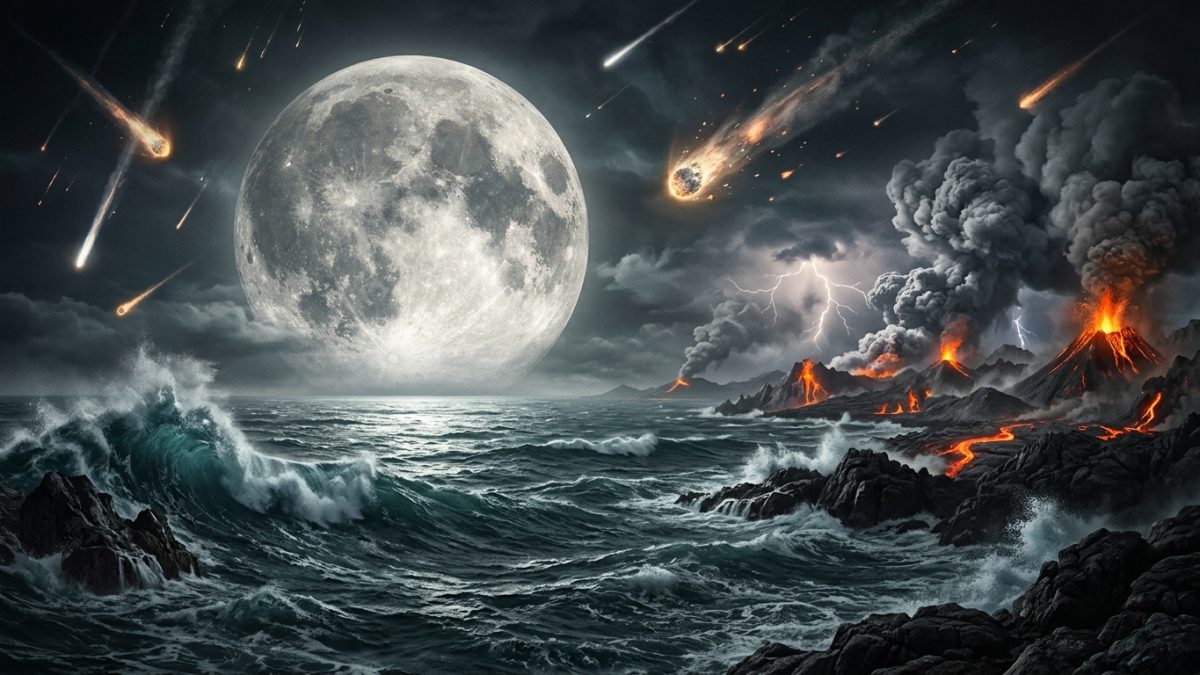
For over two centuries, geology envisioned the infant Earth as a dry, radioactive wasteland of boiling magma that persisted for half a billion years. In recent decades, however, microscopic crystal zircons from Western Australia revealed a radical truth: within barely 160 million years of the Solar System’s birth, the surface cooled, supercritical steam clouds condensed into a torrential planetary deluge, and a vast, dark, global ocean swept across the world—illuminated by an immense Moon orbiting dangerously close in the sky.
The Collapse of the Steam Atmosphere: The Great Planetary Deluge
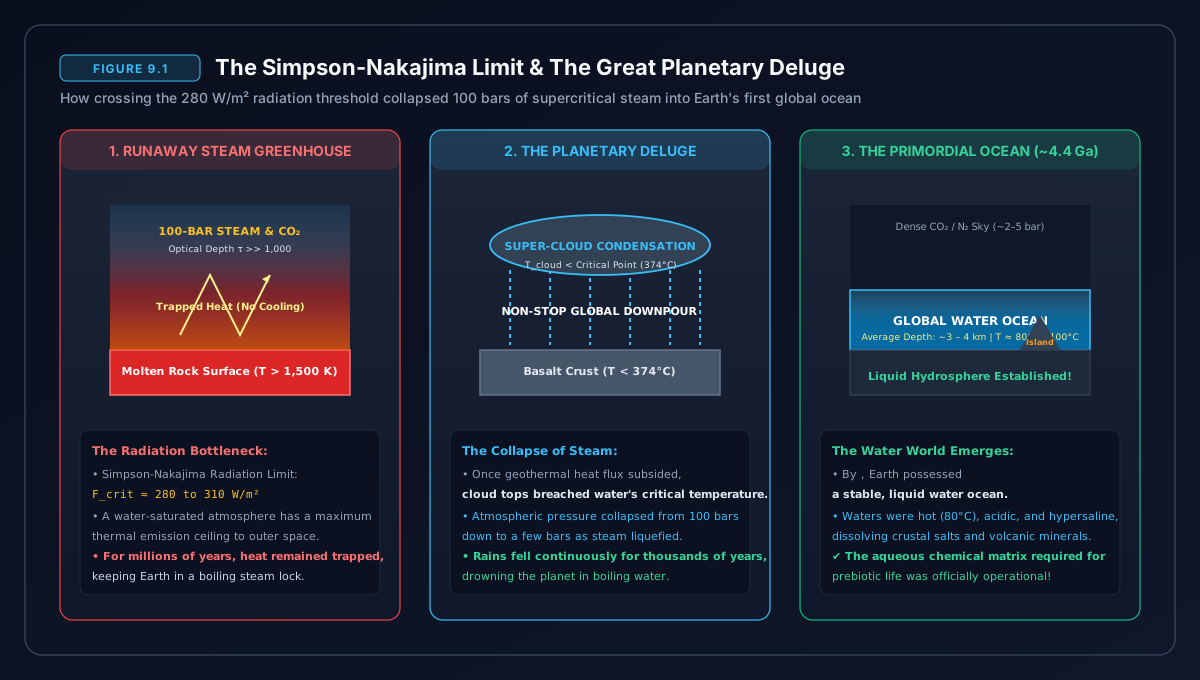
In the direct aftermath of the Theia giant impact, Earth was enveloped in a scorching, supercritical atmosphere composed primarily of water vapor (H₂O), carbon dioxide (CO₂), carbon monoxide (CO), molecular nitrogen (N₂), and sulfur gases. The atmospheric pressure at the molten surface was crushing—exceeding 100 to 200 bars (equivalent to the hydrostatic pressure one to two kilometers beneath modern oceans).
Because water vapor is a potent greenhouse gas, it trapped planetary thermal radiation, creating a thermal blanket. However, as the outer magma ocean froze into an insulating basaltic crust, the heat flux from the planetary interior dropped by orders of magnitude. The top of the steam atmosphere radiated heat directly into the cold vacuum of space at the Simpson-Nakajima runaway greenhouse limit (~ 280–310 W/m²).
Under a crushing surface pressure of 100 atmospheres, water does not boil at 100°C ( K); its condensation temperature is elevated to over 300°C ( K). When the surface crust finally cooled past this critical threshold, the atmospheric moisture reached saturation. The steam atmosphere collapsed into a continuous, torrential rainfall that pounded the planet uninterrupted for thousands of years, filling the low-lying impact basins and tectonic depressions with liquid water.
Where Did Earth’s Water Come From? Comets vs. Asteroids
One of the classic mysteries of planetary science is how Earth acquired its oceans. Because Earth formed inside the Solar System’s snow line (r < 2.7 AU), where high temperatures prevented water ice from condensing, early planetary models assumed Earth must have formed completely bone-dry. The standard hypothesis for decades was that Earth's water was delivered late by a swarm of icy comets from the frozen outer Solar System.
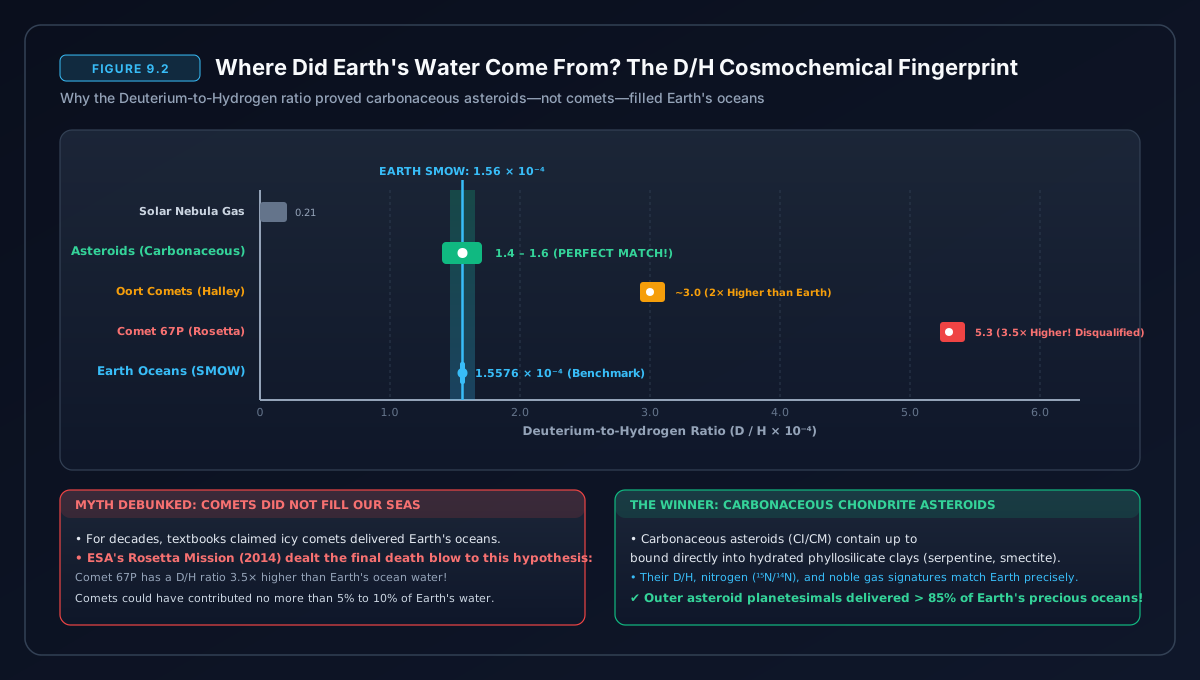
The definitive test of this hypothesis lies in the Deuterium-to-Hydrogen (D/H) Ratio. Deuterium (²H) is heavy hydrogen with an extra neutron. The ratio of D/H in Earth’s oceans is defined as SMOW (Vienna Standard Mean Ocean Water):
$$(D/H)_{\text{SMOW}} = (1.5576 \pm 0.001) \times 10^{-4}$$
Between 1986 and 2015, space missions analyzed the water vapor evaporating from comets:
- Oort Cloud Comets (Halley, Hyakutake, Hale-Bopp): Exhibited D/H ratios of (3.0 ± 0.5) × 10^{-4}—roughly twice as high as Earth’s oceans.
- Kuiper Belt Comet 67P/Churyumov-Gerasimenko: In 2014, the ROSINA mass spectrometer aboard the European Space Agency’s Rosetta orbiter measured a D/H ratio of (5.3 ± 0.7) × 10^{-4}—over three times higher than Earth’s oceans!
If comets had delivered Earth’s oceans, our water would be far richer in deuterium. Instead, isotopic measurements of Carbonaceous Chondrite Asteroids (specifically CI and CM chondrites from the outer asteroid belt) revealed a D/H ratio and nitrogen isotopic composition that matches Earth’s ocean water with astonishing precision. Earth’s water was delivered not by icy comets, but by hydrated phyllosilicate minerals (clay minerals containing bound hydroxyl groups, OH⁻) inside carbonaceous asteroids scattered into the inner Solar System by the migration of Jupiter and Saturn!
The Jack Hills Zircons: Physical Proof of a Cool, Wet Early Earth
Because plate tectonics and mantle convection constantly recycle the Earth’s crust, no intact rock formations survive from the first 500 million years of Earth history. The oldest known intact rocks on Earth—the Acasta Gneiss in northern Canada—date to roughly 4.03 billion years ago. For generations, scientists believed the first 500 million years were lost forever.
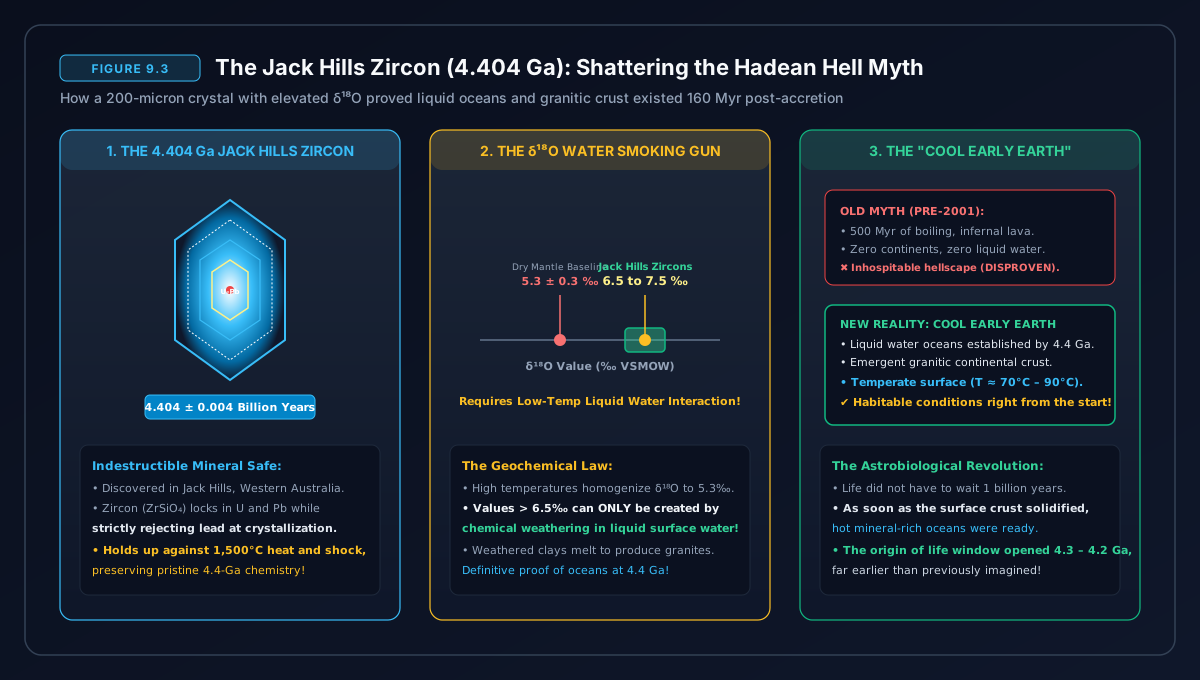
Then, geochemists turned their attention to the Jack Hills in the desert of Western Australia. Embedded within younger Archean quartzites were microscopic, indestructible crystals of Zircon (ZrSiO_4) barely a tenth of a millimeter across.
In 2001, a team led by Simon Wilde and John Valley dated an individual zircon crystal (W74/2-36) using ion microprobe (²⁰⁷Pb/²⁰⁶Pb) uranium-lead dating to 4.404 ± 0.008 billion years old—just 160 million years after the formation of the Solar System.
Crucially, analysis of the Oxygen-18 isotopes (δ¹⁸O) inside these ancient zircons revealed enriched values (δ¹⁸O = 6.5 to 7.5‰), significantly higher than the mantle baseline (5.3‰). In petrology, such high δ¹⁸O signatures can only be produced when rocks are altered at low temperatures by liquid surface water before being remelted into granitic magmas. The Jack Hills zircons provided indisputable chemical proof: Earth had liquid oceans, continental granite crust, and a temperate surface climate by 4.4 billion years ago!
The Faint Young Sun Paradox: Why Earth Did Not Freeze
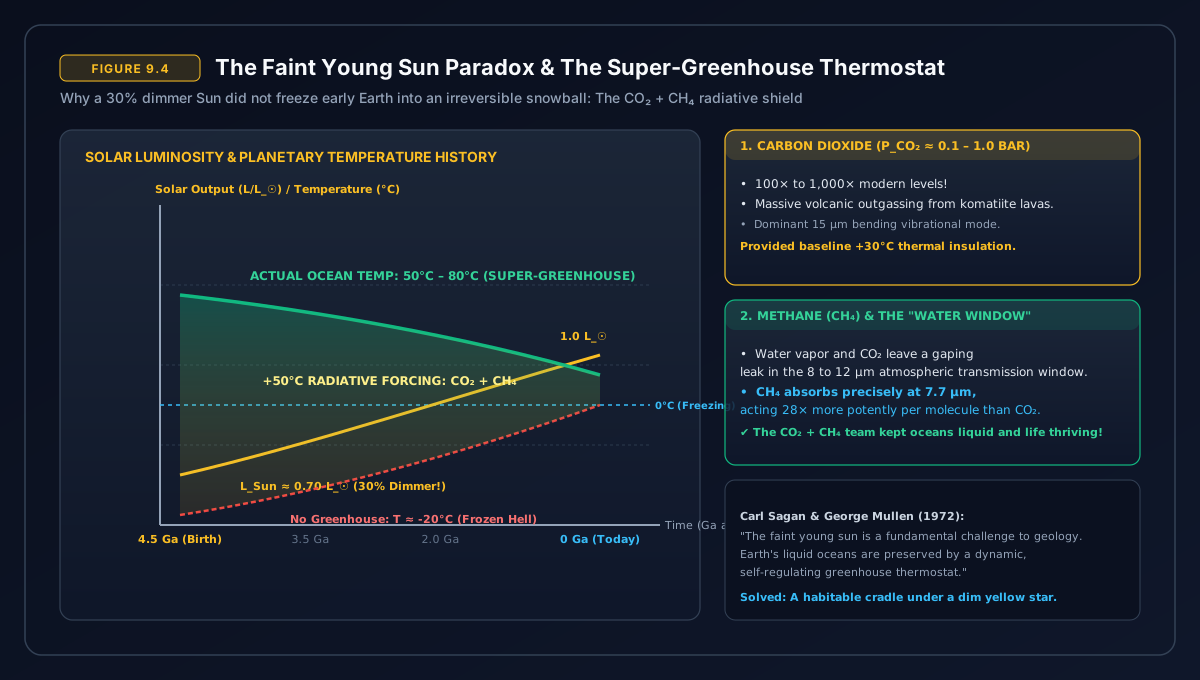
The discovery of 4.4-billion-year-old oceans created a profound astrophysical paradox first articulated by Carl Sagan and George Mullen in 1972: the Faint Young Sun Paradox.
According to standard stellar evolution models, young main-sequence stars have a lower core density and temperature. 4.4 billion years ago, the Sun’s core was fusing hydrogen at a slower rate, making our Sun 25% to 30% fainter than it is today (L ~ 0.70–0.75 L_☉).
If modern Earth were suddenly exposed to a Sun 25% fainter, global surface temperatures would plunge to -30°C, freezing the entire planet into an irreversible, reflective “Snowball Earth.” How did Earth maintain liquid oceans under a dim, faint young Sun?
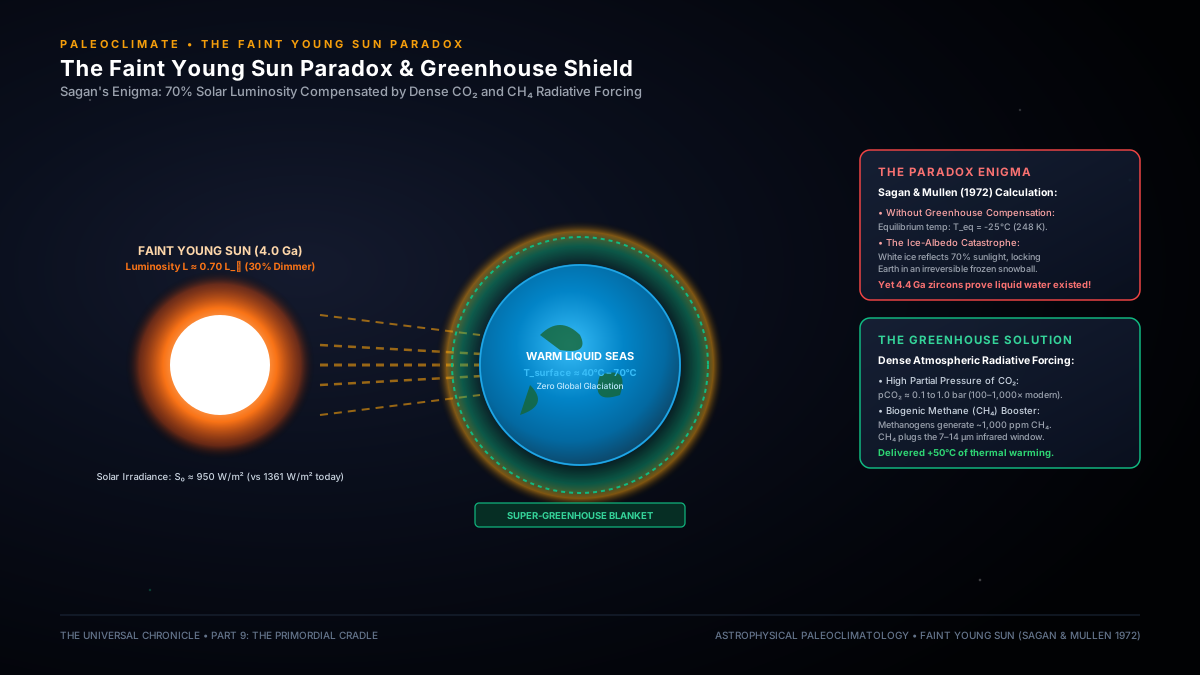
The solution was a powerful, dense greenhouse atmosphere:
- Carbon Dioxide Blanket: The Hadean atmosphere contained between 0.5 and 5 bars of CO₂ (hundreds of times higher than modern levels), released by continuous mantle outgassing and un-sequestered by modern continental carbonate weathering.
- Methane Greenhouse (CH₄): Hydrothermal serpentinization reactions between seawater and ultramafic olivine rocks (Olivine + Water → Serpentine + Magnetite + Hydrogen) produced copious hydrogen, which combined with dissolved carbon to generate methane—a greenhouse gas 28 times more potent than CO₂.
- Reduced Surface Albedo: With few exposed continents and no polar ice caps, the dark, iron-rich ocean absorbed over 90% of incident solar radiation.
The Archean Ocean: A Ferrous, Green-Black Cauldron
If a time-traveler could stand on the shores of Earth 4.2 billion years ago, the landscape would be alien beyond imagination:
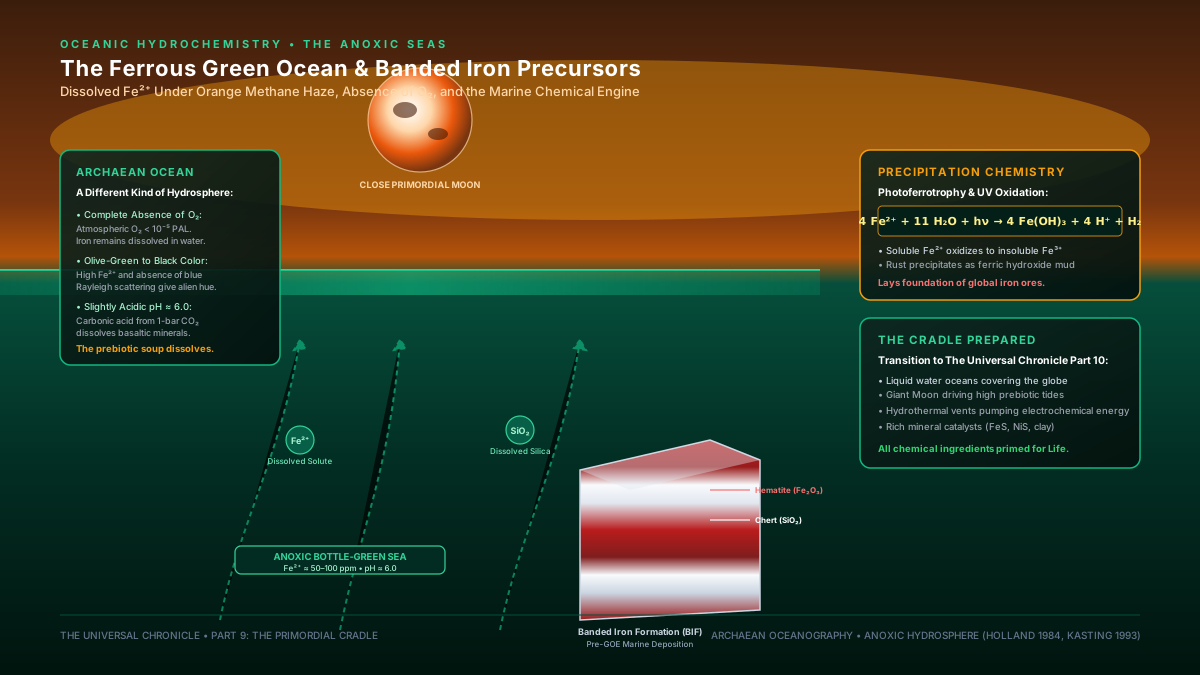
- The Sky: An orange-tinted or salmon-colored sky dominated by dense N₂ and CO₂, with zero free oxygen (O₂ < 10⁻⁵ PAL). Heavy cloud cover generated frequent, violent lightning storms fueled by volcanic ash.
- The Moon: Hanging immense and luminous in the sky, orbiting at a fraction of its modern distance. Colossal, kilometers-high tides rushed in and out of coastal basins every few hours.
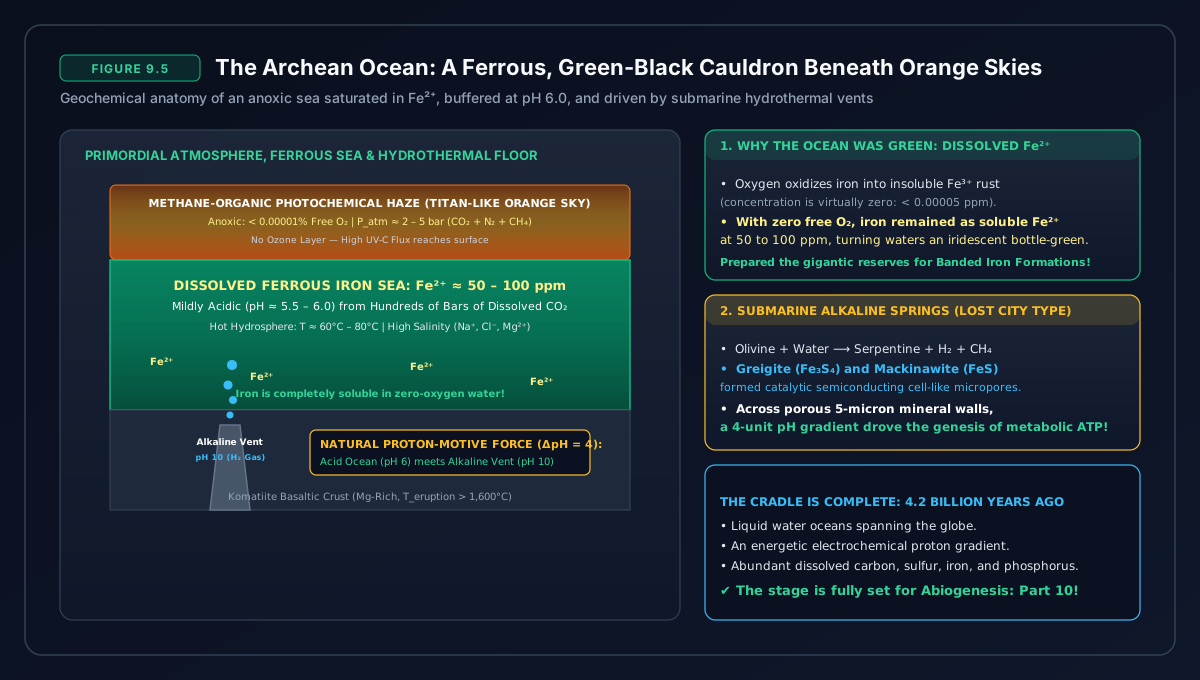
- The Ocean: An acidic, warm (40°C to 70°C), slightly effervescent sea saturated with dissolved ferrous iron (Fe²⁺) and silica (SiO₂). In the absence of oxygen, iron remained completely dissolved, tinting the ocean deep olive-green to black.
Geochemical Profile of the Hadean / Early Archean Earth
| System / Reservoir | Primary Composition | Estimated Temperature | Key Physical / Chemical Dynamics |
|---|---|---|---|
| Atmosphere | CO₂ (80–90\%), N₂ (10–15\%), CH₄, CO, H₂O | 40° to 85°C | Pressure 1 to 10 bars; anoxic (no O₂); resolving Faint Young Sun. |
| Hydrosphere (Oceans) | H₂O saturated with Fe²⁺, Mg²⁺, Cl^-, SiO₂ | 50° to 70°C | Volume 1.5 to 2.0× modern oceans; slightly acidic (pH 5.5–6.5); green/black hue. |
| Crust & Landmasses | Basaltic oceanic crust, tonalite-trondhjemite-granodiorite (TTG) proto-continents | 300–500°C (Deep) | Thin, fast-moving proto-plates; high volcanic heat flux (3× modern). |
| Tidal Dynamics | Lunar distance 30,000–60,000 km | — | Day length 6 to 10 hours; tidal amplitudes 10 to 100 meters; massive intertidal flushing. |
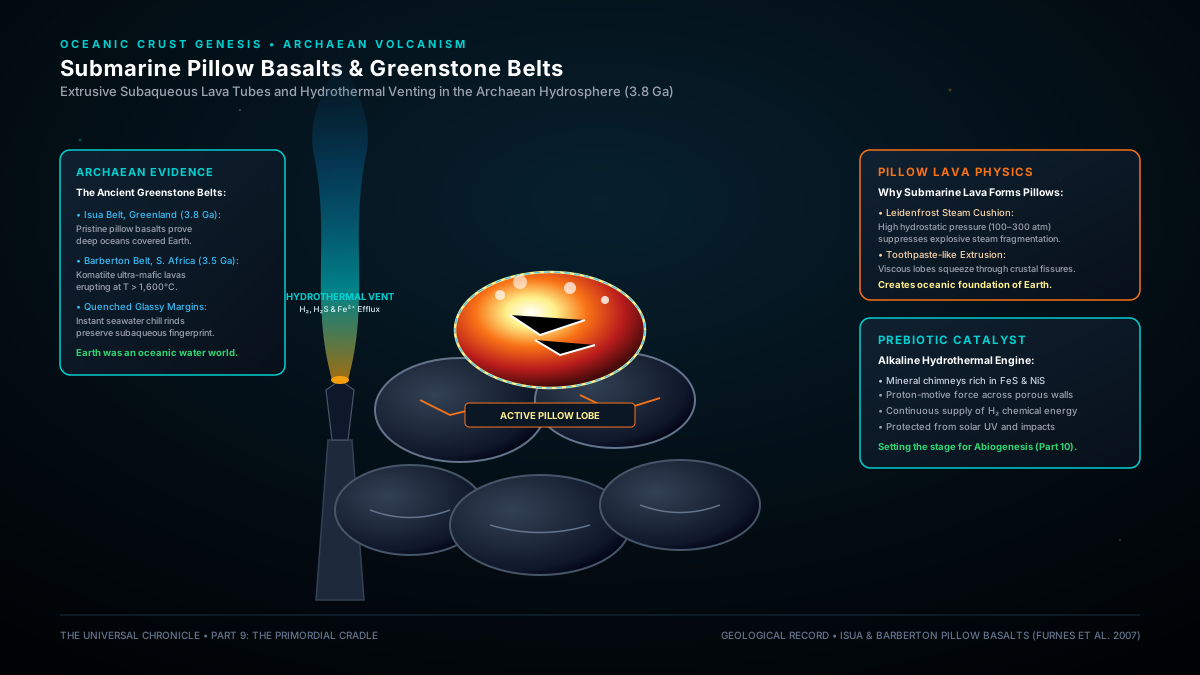
| Ocean Floor | Ultramafic peridotite, komatiite, serpentine | Hydrothermal vents >300°C | Alkaline hydrothermal vents; serpentinization generating hydrogen (H₂) and proton gradients. |
The Cradle is Prepared: The Threshold of Life
By four billion years ago, the universe had achieved an extraordinary physical milestone. Out of quantum foam, inflationary expansion, nuclear nucleosynthesis, stellar explosions, galactic rotation, and planetary collision, a stable terrestrial world had emerged: an iron-core planet cloaked in protective magnetic fields, warmed by a dense greenhouse sky, and blanketed by deep, warm, mineral-rich oceans.
On the abyssal ocean floor, along the submarine volcanic fissures where the hot crust met the dark sea, alkaline hydrothermal vents were pumping chemical energy, catalytic transition metals (iron, nickel, sulfur), and proton concentration gradients into the water. The physical and chemical stage was set for the greatest qualitative leap in the history of matter: the transition from geochemical physics to self-replicating biological code.
In Part 10 of The Universal Chronicle, we cross the threshold into Phase III: The Spark of Abiogenesis — Alkaline Hydrothermal Vents, Prebiotic Chemistry, and the RNA World.
Academic Citations & Foundational Literature
- Wilde, S. A., Valley, J. W., Peck, W. H., & Graham, C. M. (2001). “Evidence from detrital zircons for the existence of continental crust and oceans on the Earth 4.4 Gyr ago.” Nature, 409, 175–178. doi:10.1038/35051550.
- Valley, J. W., et al. (2014). “Hadean age for a post-magma-ocean zircon confirmed by atom-probe tomography.” Nature Geoscience, 7, 219–223. doi:10.1038/ngeo2075.
- Sagan, C., & Mullen, G. (1972). “Earth and Mars: Evolution of Atmospheres and Surface Temperatures.” Science, 177(4043), 52–56. doi:10.1126/science.177.4043.52.
- Alexander, C. M. O’D., et al. (2012). “The Provenance of Carbonaceous Chondrites and the Origin of Earth’s Water.” Science, 337(6095), 721–723. doi:10.1126/science.1223474.
- Altwegg, K., et al. (2015). “67P/Churyumov-Gerasimenko, a Jupiter family comet with a high D/H ratio.” Science, 347(6220), 1261952. doi:10.1126/science.1261952.
- Kasting, J. F. (1993). “Earth’s early atmosphere.” Science, 259(5097), 920–926. doi:10.1126/science.11536547.
- Sleep, N. H., Zahnle, K., & Neuhoff, P. S. (2001). “Initiation of clement surface conditions on the earliest Earth.” Proceedings of the National Academy of Sciences, 98(7), 3666–3672. doi:10.1073/pnas.071045698.