For millennia, human civilization relied exclusively on muscle, wind, water, and draft animals to perform physical work, while symbolic reasoning remained locked within the biological confines of the human cranium. But between the late eighteenth and mid-twentieth centuries, an extraordinary dual convergence occurred. Physics unlocked the ability to convert thermal energy into kinetic work and unified electricity and magnetism into light itself; simultaneously, mathematical logicians discovered that formal thought could be mechanized as discrete symbolic manipulation. By etching millions, then billions, of quantum-engineered switches onto wafers of purified silicon, humanity constructed an external electronic nervous system—transmuting dead mineral rock into machines that think.
1. The Thermodynamics of Industrial Muscle (~1769 to 1850 CE)
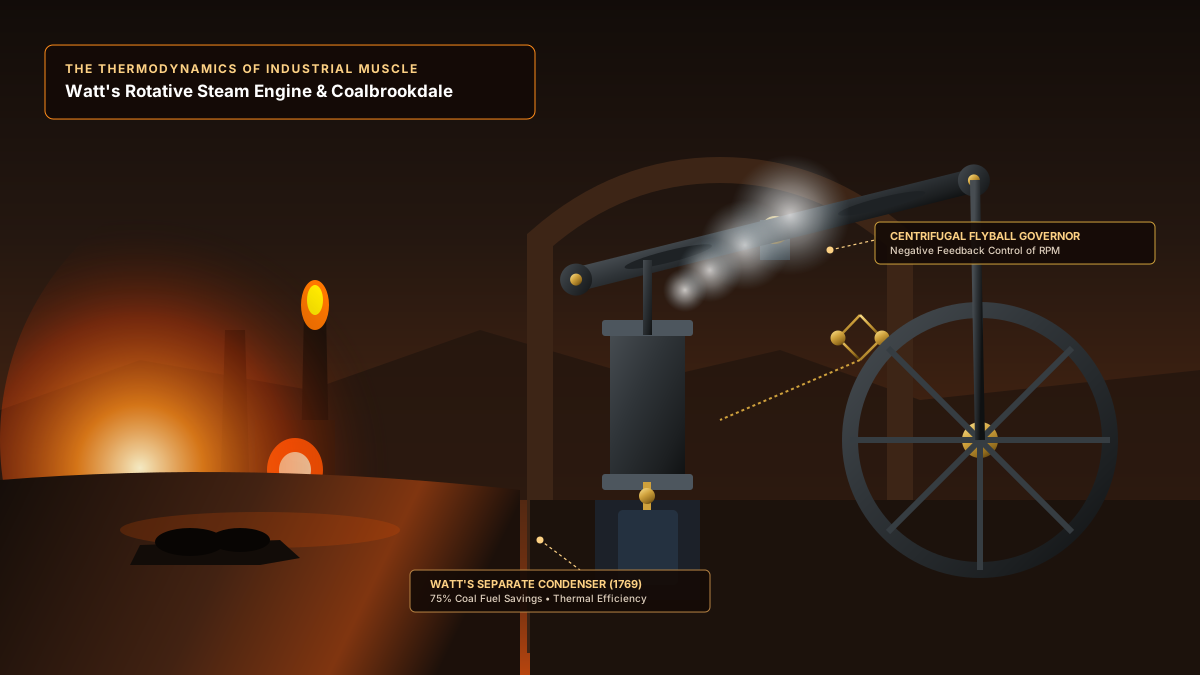
The dawn of modernity was an energy transition. Prior to the eighteenth century, society was trapped in an “organic economy” bounded by annual biological photo-conversion: forests could only grow so fast, and draft animals required arable pasture. The breakthrough came when James Watt patented the separate condenser steam engine in 1769, unlocking the subterranean solar energy stored three hundred million years earlier in Carboniferous coal seams.
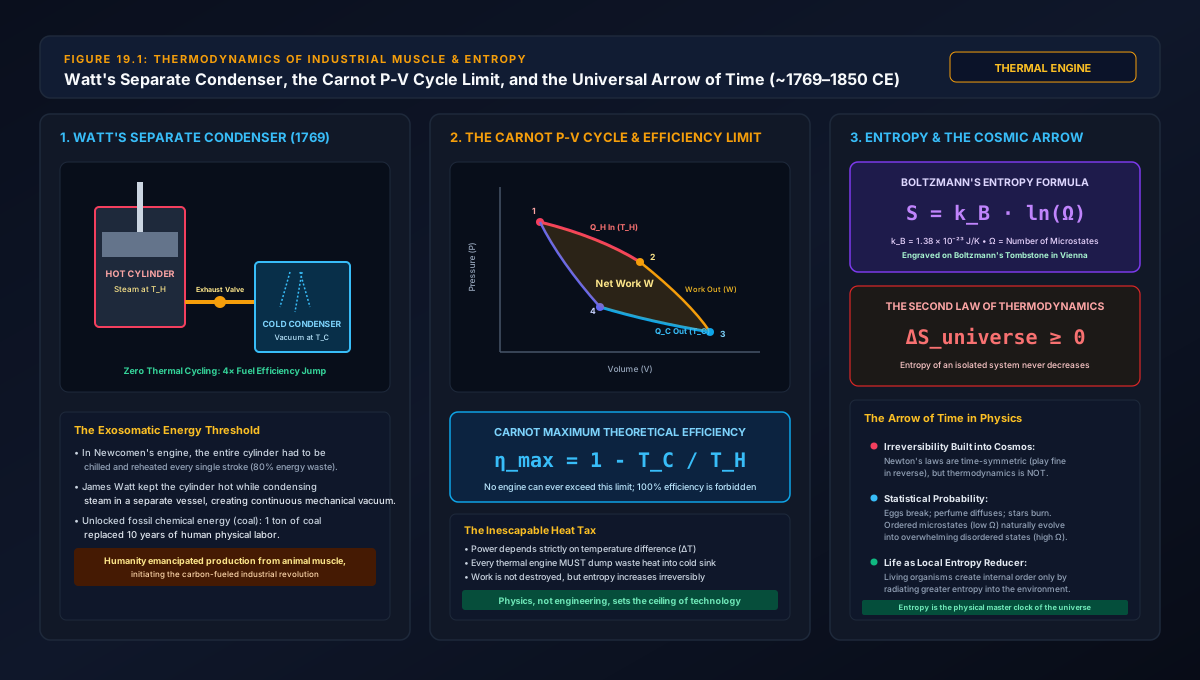
The engineering of steam engines forced the creation of a rigorous new science: thermodynamics. Sadi Carnot, Rudolf Clausius, and Lord Kelvin established that heat and mechanical work are interconvertible expressions of energy, bounded by an immutable cosmic asymmetry—the Second Law of Thermodynamics:
$$\Delta S_{\text{universe}} \ge 0$$While the total energy of a closed system is strictly conserved (First Law), every spontaneous thermodynamic cycle incurs an irreversible tax: entropy (S), or microscopic thermodynamic disorder, inexorably increases. To generate local order, work, or computation, a system must continuously ingest high-grade free energy and dissipate waste entropy into its environment.
2. Maxwell’s Synthesis: The Unification of Electromagnetism (1865 CE)
While thermodynamic engines conquered mechanical force, natural philosophers investigated the enigmatic phenomena of electrostatic charge, galvanic currents, and magnetic attraction. Through meticulous empirical experimentation, Michael Faraday demonstrated that a changing magnetic field induces an electromotive force (electromagnetic induction)—the principle underlying every modern electric generator and motor.
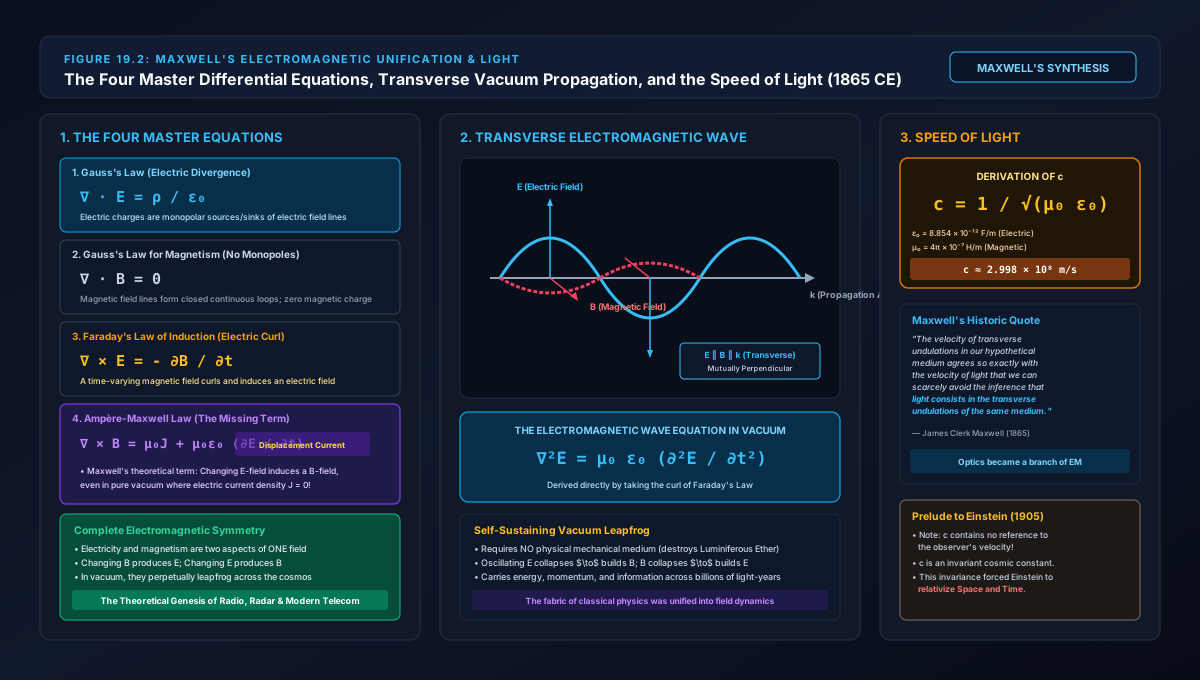
In 1865, Scottish mathematical physicist James Clerk Maxwell published A Dynamical Theory of the Electromagnetic Field, synthesizing all observed electrical and magnetic phenomena into a set of four coupled partial differential equations (presented here in modern vector calculus notation):
$$\nabla \cdot \vec{E} = \frac{\rho}{\epsilon_0}$$ $$\nabla \cdot \vec{B} = 0$$ $$\nabla \times \vec{E} = -\frac{\partial \vec{B}}{\partial t}$$ $$\nabla \times \vec{B} = \mu_0 \vec{J} + \mu_0 \epsilon_0 \frac{\partial \vec{E}}{\partial t}$$The Velocity of Light Derived from Pure Logic
Maxwell noticed a profound mathematical asymmetry in Ampère\’s circuital law: in dynamic circuits, charge conservation required an additional term, which he coined the displacement current ($$\mu_0 \epsilon_0 \frac{\partial \vec{E}}{\partial t}$$). By taking the curl of Faraday\’s law in empty space (ρ=0, J = 0) and substituting this displacement current, Maxwell derived the electromagnetic wave equation:
$$\nabla^2 \vec{E} = \mu_0 \epsilon_0 \frac{\partial^2 \vec{E}}{\partial t^2}$$The wave propagation speed was directly governed by two fundamental laboratory constants: the permittivity of vacuum (ε₀) and the permeability of vacuum (µ₀):
$$c = \frac{1}{\sqrt{\mu_0 \epsilon_0}} \approx 2.998 \times 10^8\text{ m/s}$$Maxwell realized with breathtaking astonishment: “Light consists in the transverse undulations of the same medium which is the cause of electric and magnetic oscillations.”
3. Alan Turing and the Universal Machine (1936 CE)
At the turn of the twentieth century, mathematician David Hilbert challenged the mathematical world with the Entscheidungsproblem (the Decision Problem): could there exist a definitive, step-by-step mechanical procedure (an algorithm) that could take any formal mathematical statement and decide whether it is universally true or false?

In 1931, Kurt Gödel shattered Hilbert\’s dream of complete mathematical certainty with his Incompleteness Theorems, proving that any consistent axiomatic formal system capable of arithmetic contains true propositions that cannot be proven from within the system. But it was a 24-year-old Cambridge mathematician, Alan Mathison Turing, who in 1936 transformed Gödel\’s abstract logic into a blueprint for the physical digital computer.
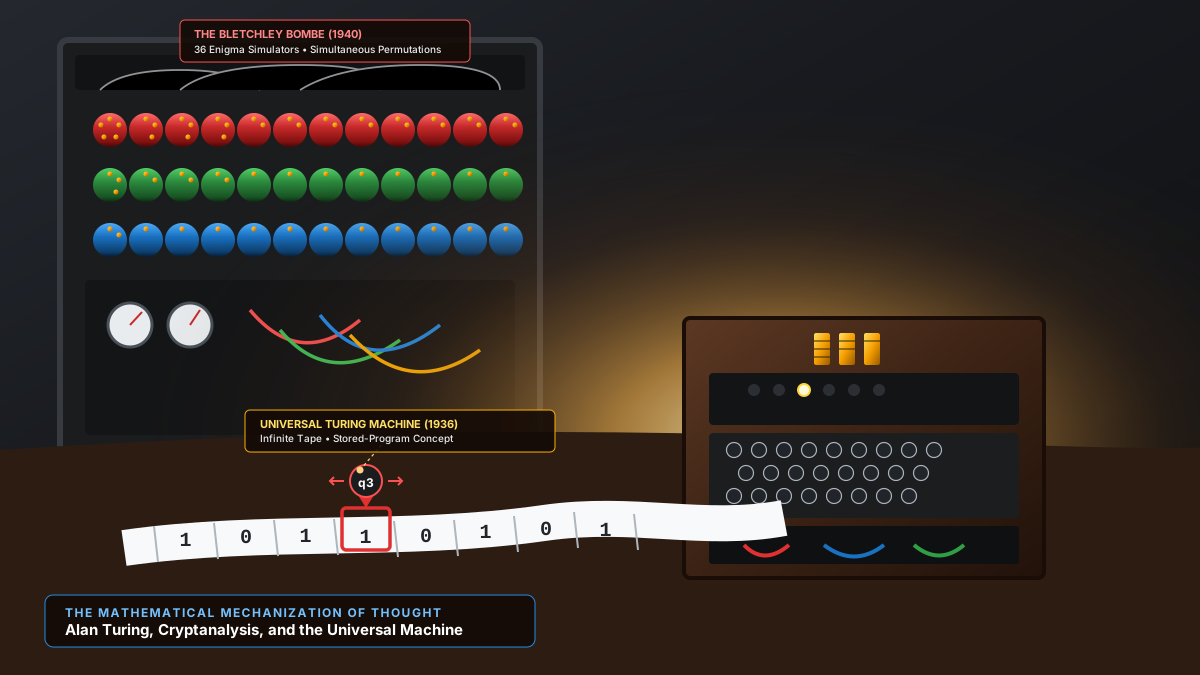
In his monumental paper, On Computable Numbers, with an Application to the Entscheidungsproblem, Turing conceptualized a theoretical computing automaton known today as the Universal Turing Machine (UTM):
- An infinite, one-dimensional paper tape divided into discrete square cells, each capable of storing a symbol from a finite alphabet (such as 0 or 1).
- A read/write scanning head capable of moving left or right by one cell, reading the current symbol, erasing it, and writing a new symbol.
- A finite state register that stores the machine’s internal state (q ∈ Q).
- A transition function ($$\delta: Q \times \Gamma \longrightarrow Q \times \Gamma \times \{L, R\}$$) dictating the machine\’s next action based on its current state and the symbol scanned.
Turing proved two monumental concepts:
- The Stored-Program Concept: A single Universal Turing Machine can simulate the behavior of any other dedicated algorithmic machine if the operational rules of that target machine are encoded as data on the input tape. Software and data are mathematically interchangeable.
- The Halting Problem: Turing proved that it is mathematically impossible to write a general algorithm that can determine whether an arbitrary program will ever halt or run forever, delivering a decisive negative answer to Hilbert\’s Entscheidungsproblem.
4. Claude Shannon and Information as Physical Entropy (1948 CE)
In 1937, while completing his master\’s thesis at MIT, Claude Shannon made the revolutionary connection between formal philosophy and electronic hardware: he demonstrated that George Boole\’s two-valued symbolic algebra (where TRUE = 1 and FALSE = 0) could be implemented physically using electromechanical relays and switches. Logic gates (AND, OR, NOT) could compute arithmetic.
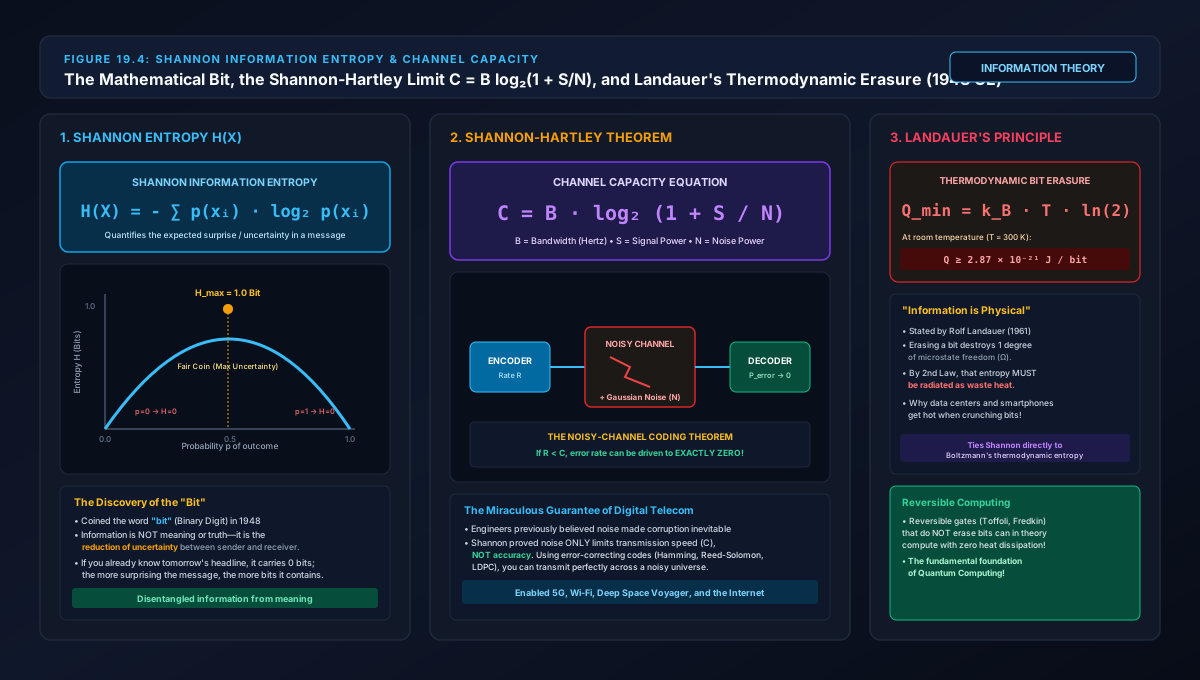
A decade later, working at Bell Telephone Laboratories in 1948, Shannon published A Mathematical Theory of Communication, founding the discipline of Information Theory. Shannon abstracted away semantic meaning, defining information strictly as the statistical resolution of probabilistic uncertainty. He coined the term bit (binary digit) as the fundamental atomic unit of information.
Shannon defined the information content (entropy) H of a discrete random variable X with probability distribution p(x) as:
$$H(X) = -\sum_{i=1}^n p(x_i) \log_2 p(x_i)$$Shannon’s formula was mathematically identical to Ludwig Boltzmann’s statistical thermodynamic entropy. Information was not an abstract ethereal concept; it was a physical property of the universe, bounded by physical signal-to-noise ratios and channel capacity:
$$C = B \log_2 \left(1 + \frac{S}{N}\right)$$5. The Solid-State Revolution: The Transistor (1947 CE)
Early electronic computers—such as the ENIAC built in 1945—relied on thermionic vacuum tubes to amplify signals and act as binary switches. But vacuum tubes were an engineering dead end: they were bulky, consumed immense electrical current to heat glowing cathodes, generated suffocating heat, and burned out at a rate of one tube every two days, limiting computers to roughly 18,000 components.
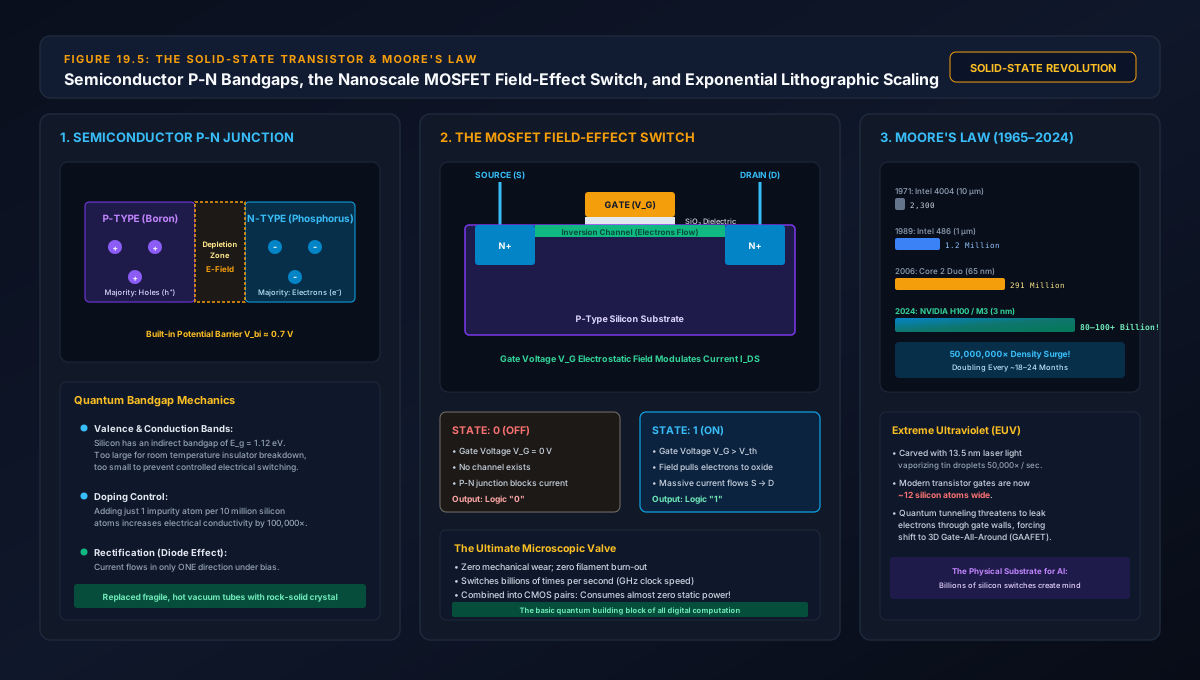
The definitive breakthrough occurred in December 1947 at Bell Labs, when physicists John Bardeen, Walter Brattain, and William Shockley invented the point-contact transistor, followed by the junction transistor. Rather than moving electrons through a fragile vacuum, transistors exploited the quantum mechanics of semiconductors.
| Transistor Technology | Year | Physical Principle | Impact |
|---|---|---|---|
| Point-Contact Transistor | 1947 | Gold foil contacts pressed against a crystal of germanium; minority carrier injection. | Proof of concept: solid-state electronic amplification without vacuum or filament heating. |
| Bipolar Junction (BJT) | 1951 | Three-layer sandwich of doped semiconductor (n-p-n or p-n-p); base current controls collector-emitter current. | High reliability; commercialization of portable transistor radios and early mainframe mainboards. |
| Planar Silicon MOSFET | 1959 / 1960 | Metal-Oxide-Semiconductor Field-Effect Transistor invented by Mohamed Atalla and Dawon Kahng; voltage applied to an insulated gate creates a conductive inversion channel. | Zero static gate current; scalable to microscopic dimensions; became the most widely manufactured object in human history. |
6. Photolithography and Moore’s Law: The Microprocessor Era (~1958 to Present)
In 1958 and 1959, Jack Kilby at Texas Instruments and Robert Noyce at Fairchild Semiconductor independently invented the Integrated Circuit (IC). Rather than soldering individual discrete transistors, resistors, and capacitors together with copper wire, Noyce pioneered the planar process: etching all electronic components and their metallic interconnects simultaneously onto a single flat wafer of monocrystalline silicon using photographic light projection (photolithography).
In 1965, Fairchild research director Gordon Moore made an empirical projection that would guide the technological trajectory of the next six decades: Moore’s Law. Moore observed that the number of transistors packed onto a single microchip doubled approximately every twelve to twenty-four months, while the manufacturing cost per transistor plummeted exponentially.
The Triumph of Dennard Scaling and Nanometer Geometry
In 1971, Intel released the 4004, the world\’s first single-chip commercial central processing unit (CPU). It contained 2,250 transistors fabricated at a feature size of 10 µm (10,000 nm). By 2024, modern microprocessors (such as Apple Silicon and NVIDIA Blackwell GPUs) pack over 208 billion transistors onto a piece of silicon the size of a postage stamp, utilizing extreme ultraviolet (EUV) photolithography (λ = 13.5 nm) to pattern silicon gates measuring just 3 nanometers across—a scale spanning a mere twelve silicon atoms.
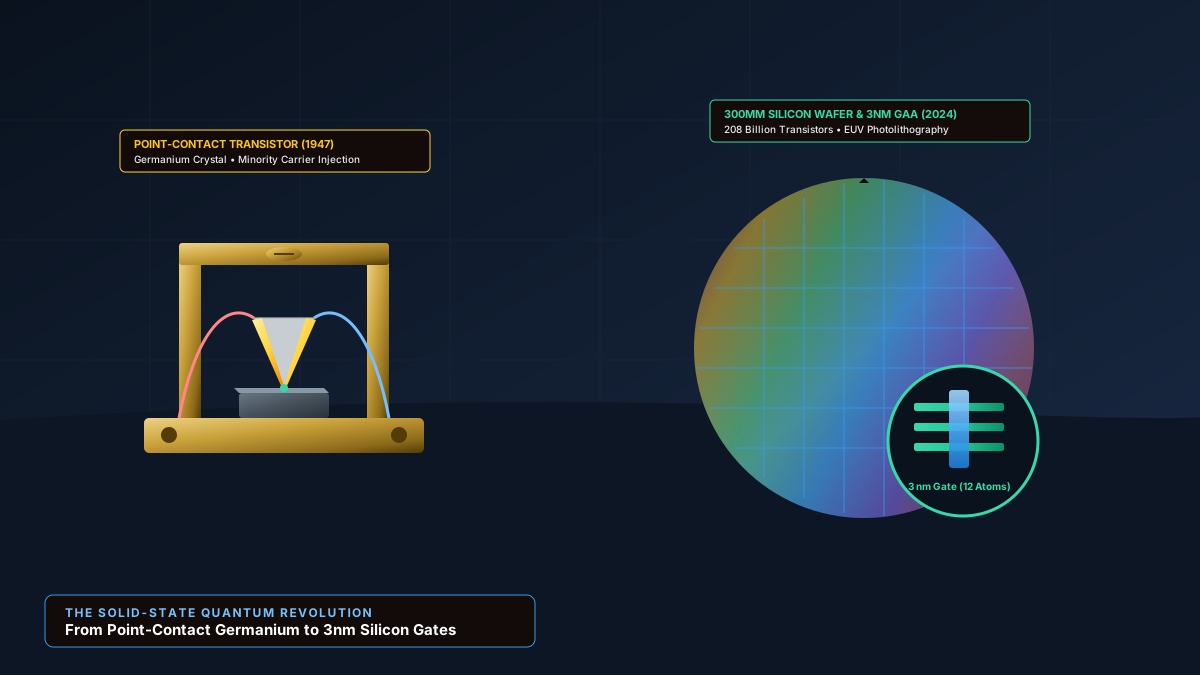
Through the mastery of solid-state quantum mechanics, humanity compressed the computational power of a room-sized supercomputer into a microscopic speck of sand costing fractions of a cent. Across a global network of billions of interconnected microprocessors, trillions of bits of information began pulsing through fiber-optic light conduits at relativistic speeds. The physical infrastructure was complete. The stage was set for software to awaken—for mathematical logic to transcend rigid deterministic rules and evolve into artificial neural networks capable of learning, perceiving, and understanding the universe.
Academic Citations & Historical References
- Turing, A. M. (1936). On computable numbers, with an application to the Entscheidungsproblem. Proceedings of the London Mathematical Society, 2(42), 230–265. doi:10.1112/plms/s2-42.1.230
- Shannon, C. E. (1948). A mathematical theory of communication. Bell System Technical Journal, 27(3), 379–423. doi:10.1002/j.1538-7305.1948.tb01338.x
- Bardeen, J., & Brattain, W. H. (1948). The transistor, a semi-conductor triode. Physical Review, 74(2), 230–231. doi:10.1103/PhysRev.74.230
- Maxwell, J. C. (1865). A dynamical theory of the electromagnetic field. Philosophical Transactions of the Royal Society of London, 155, 459–512. doi:10.1098/rstl.1865.0008
- Moore, G. E. (1965). Cramming more components onto integrated circuits. Electronics, 38(8), 114–117. doi:10.1109/jproc.1998.658762
- von Neumann, J. (1945). First Draft of a Report on the EDVAC. Contract No. W-670-ORD-4926, Moore School of Electrical Engineering, University of Pennsylvania.
- Kilby, J. S. (1976). Invention of the integrated circuit. IEEE Transactions on Electron Devices, 23(7), 648–654. doi:10.1109/T-ED.1976.18467