When buoyant continental landmasses collide, the low density of felsic crust ((
ho_c approx 2700 ext{ kg/m}^3)) resists subduction into the denser mantle. Unable to sink, the continental lithosphere accommodates colossal horizontal shortening through ductile thickening, folding, and crustal-scale thrust imbrication. The premier modern archetype of continent-continent collision is the Himalayan-Tibetan orogen, forged by the relentless northward trajectory of the Indian Plate into Eurasia.
1. The Critical Coulomb Taper Wedge Theory
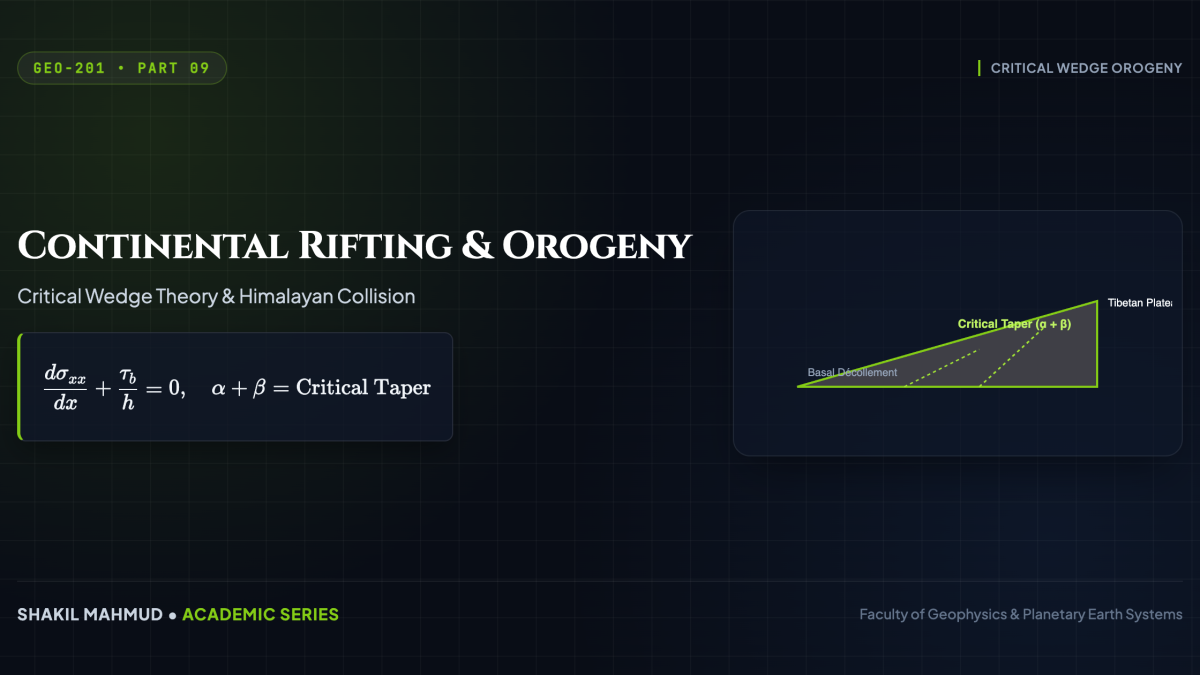
The macroscopic mechanics of fold-and-thrust belts and accretionary prisms are quantitatively modeled by the Critical Coulomb Taper Theory formulated by Dan Davis, John Suppe, and Frank Dahlen (1983). An orogenic thrust wedge pushes forward over a basal décollement fault until it achieves a self-similar critical taper angle (alpha + beta), analogous to sand bulldozed across a floor:
[
alpha + beta = rac{(1 – lambda_b) mu_b + rac{
ho_m –
ho_w}{
ho} beta}{(1 – lambda_f) left( rac{2sinphi}{1 – sinphi}
ight) + 1}
]
where (alpha) is surface topographic slope, (beta) is basal décollement dip angle, (mu_b) is basal friction coefficient, (phi) is internal angle of friction, and (lambda_b = P_{f,b} /
ho g h) is the basal pore fluid pressure ratio. If erosion flattens the surface ((alpha) decreases), the wedge becomes mechanically subcritical and internal thrust faulting reactivates to steepen the taper. Conversely, over-steepening induces extensional collapse along normal faults.
2. Structural Architecture of the Himalayan Orogen
Following the initial oceanic closure along the Indus-Yarlung Tsangpo Suture Zone (IYTSZ) at (sim 55 ext{–}50 ext{ Ma}), (sim 2500 ext{ km}) of continental convergence was absorbed along four major crustal-scale shear zones branching from the basal Main Himalayan Thrust (MHT):
- Main Frontal Thrust (MFT): The active, outermost emergent fault bounding the Indo-Gangetic molasse foreland basin (Siwaliks).
- Main Boundary Thrust (MBT): Separates unmetamorphosed Lesser Himalayan sedimentary strata from Sub-Himalayan units.
- Main Central Thrust (MCT): Monumental ductile shear zone placing high-grade crystalline metamorphic slabs over lower-grade greenschist metasediments.
- South Tibetan Detachment System (STDS): A synchronous, low-angle north-dipping normal fault system facilitating Miocene orogenic collapse and channel flow extrusion.
3. Inverted Metamorphism and Channel Flow Geodynamics
Classic Barrovian metamorphic sequences exhibit grade increasing with depth (chlorite ( o) biotite ( o) garnet ( o) staurolite ( o) kyanite ( o) sillimanite). However, in the Higher Himalayan Crystalline (HHC), the sequence is paradoxically inverted: metamorphic grade increases upward toward structural higher elevations.
This enigmatic architecture is explained by the channel flow and ductile extrusion model. High temperatures ((> 750^circ ext{C})) and partial melting (anatexis) generated a low-viscosity ductile layer within the mid-crust ((ta approx 10^{18} ext{–}10^{19} ext{ Pa}cdot ext{s})). Under the immense lithostatic overpressure of the 5-km-high Tibetan Plateau, this ductile channel was squeezed southward like toothpaste between two coeval bounding shears: thrusting at the base along the MCT and normal shearing at the top along the STDS.
4. Continental Escape Tectonics and Deep Mantle Anchors
Crustal thickening is bounded by the mechanical resistance of high topography. Once Tibet reached an average elevation of (sim 5 ext{ km}) and crustal thickness of (sim 70 ext{–}75 ext{ km}), gravitational potential energy ((Delta U = int
ho g z , dz)) balanced compressive tectonic forces. Continued convergence was accommodated by lateral extrusion (escape tectonics): major strike-slip faults (e.g., Altyn Tagh, Red River faults) extruding Indochina and southeastern China eastward toward the Pacific margin.