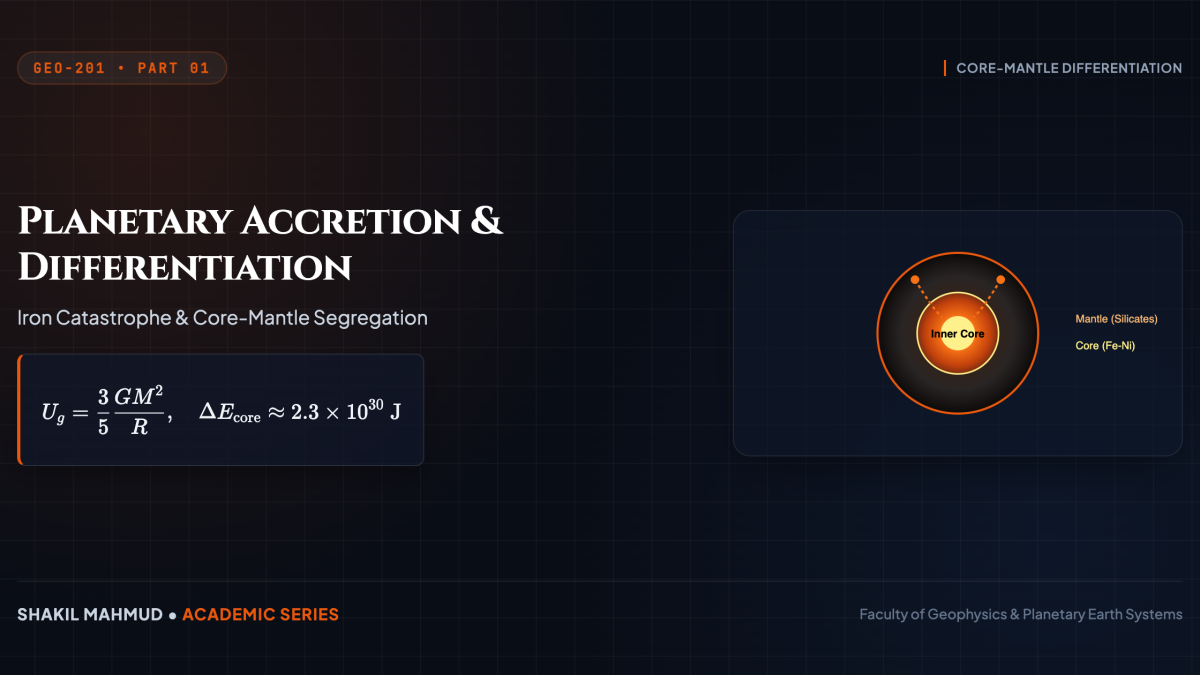
Approximately 4.567 billion years ago, the primordial solar nebula collapsed into a spinning protoplanetary disk. Within a narrow temporal window of roughly 30 to 50 million years, stochastic collisions among dust grains, chondritic planetesimals, and planetary embryos assembled the proto-Earth. This accretion culminated in the most catastrophic thermochemical reorganization in planetary history: the Iron Catastrophe, during which immiscible molten iron-nickel alloys segregated from silicate melts to build a dense metallic core.
1. Planetesimal Accretion and Energy Budgets
The total gravitational binding energy released during the accretion of a homogeneous sphere of mass (M_oplus) and radius (R_oplus) is obtained by integrating spherical shells of density (
ho):
[
U_g = int_0^{M_oplus} rac{G M(r)}{r} , dM = rac{3}{5}rac{G M_oplus^2}{R_oplus} approx 2.24 imes 10^{32} ext{ J}
]
Assuming complete retention of impact thermal kinetic energy with mean specific heat capacity (c_p approx 10^3 ext{ J}cdot ext{kg}^{-1}cdot ext{K}^{-1}), the average accretionary adiabatic temperature rise exceeds several thousand Kelvin:
[
Delta T_{ ext{acc}} = rac{U_g}{M_oplus c_p} approx 3.7 imes 10^4 ext{ K}
]
Even accounting for immediate surface radiative cooling via Stefan-Boltzmann blackbody radiation ((j^* = psilon sigma T^4)), late giant impacts—such as the Mars-sized impactor Theia that formed the Moon—deposited localized kinetic energies exceeding (10^{31} ext{ J}), inducing deep, global magma oceans extending down to the core-mantle boundary.
2. Radiogenic Heat Drivers: ({}^{26} ext{Al}) and ({}^{60} ext{Fe})
In addition to gravitational accretion, short-lived radionuclides synthesized in nearby core-collapse supernovae seeded the early nebula. The radioactive decay of ({}^{26} ext{Al}) ((t_{1/2} approx 0.717 ext{ Myr})) and ({}^{60} ext{Fe}) ((t_{1/2} approx 2.6 ext{ Myr})) injected colossal radiogenic heat fluxes:
[
Q_{ ext{rad}}(t) = sum_i C_i E_i lambda_i e^{-lambda_i t}
]
For planetesimals with radii (R > 20 ext{ km}) that accreted within the first 1.5 Myr of nebular history, internal thermal conduction was too slow to dissipate this heat, rapidly elevating central temperatures above the Fe-FeS eutectic melting temperature ((T_{ ext{eutectic}} approx 1260 ext{ K}) at low pressures).
3. The Mechanics of Molten Iron Segregation: Diapirism and Percolation
When metallic iron-nickel-sulfur phases liquefied within the silicate matrix, two distinct physical regimes governed their downward descent toward the planetary center:
A. Porous Flow and Percolation Thresholds
At partial melt fractions below total silicate liquefaction, molten metal migration through a crystalline silicate matrix depends strictly on the solid-liquid-liquid dihedral wetting angle ( heta). By Young’s interfacial energy balance:
[
gamma_{ss} = 2 gamma_{sl} cosleft(rac{ heta}{2}
ight)
]
When ( heta 60^circ) for olivine-iron systems, dynamic macroscopic shearing induces shear-assisted percolation, establishing connectivity and draining metal downward.
B. Rayleigh-Taylor Instabilities and Diapiric Descent
In fully molten magma oceans, dense iron droplets coalesce into continuous ponds atop denser crystalline silicate floors. As the metal layer exceeds a critical thickness (h_c), density inversion triggers a Rayleigh-Taylor instability. The characteristic wavelength (lambda_{ ext{RT}}) and growth rate (gamma_{ ext{RT}}) are parameterized by the density difference (Delta
ho =
ho_{ ext{iron}} –
ho_{ ext{silicate}} approx 4000 ext{ kg/m}^3):
[
lambda_{ ext{RT}} approx 2pi left( rac{mu_{ ext{eff}} gamma}{Delta
ho , g}
ight)^{1/3}
]
The resulting iron diapirs sink rapidly through the lower mantle at terminal Stokes velocities:
[
v_{ ext{Stokes}} = rac{2}{9} rac{Delta
ho , g , R_{ ext{diapir}}^2}{mu_{ ext{mantle}}}
]
4. Geochemical Consequences: Siderophile Element Partitioning
The gravitational segregation of (sim 1.9 imes 10^{24} ext{ kg}) of iron and nickel released an additional (Delta E_{ ext{core}} approx 1.5 imes 10^{30} ext{ J}) of potential energy, further superheating the planet. Elements partitioned between the metallic core and silicate mantle based on their metal-silicate partition coefficient (D_i^{ ext{met/sil}}):
[
D_i^{ ext{met/sil}} = rac{C_i^{ ext{metal}}}{C_i^{ ext{silicate}}}
]
Highly siderophile elements (HSEs: Os, Ir, Ru, Rh, Pt, Pd, Au) were quantitatively stripped into the core ((D_i > 10^4)). Their observed non-zero abundance in the upper mantle provides definitive evidence for a late veneer: an influx of chondritic impactors delivering (sim 0.5%) of Earth’s total mass after core separation had closed.