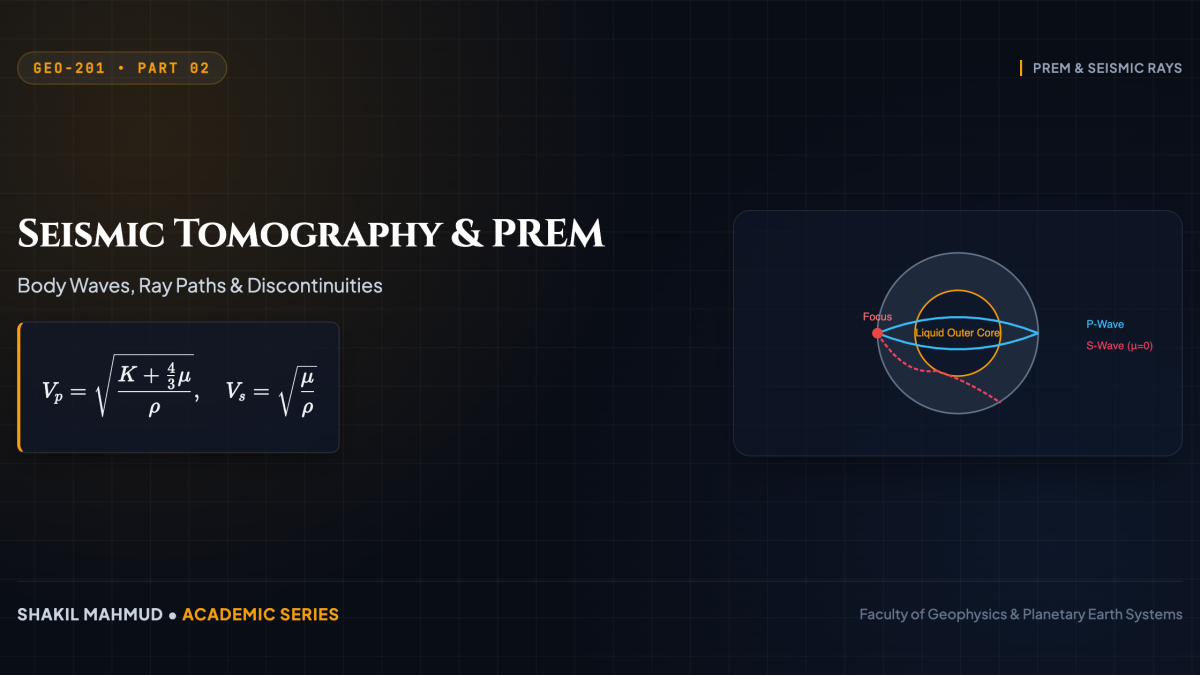
Because the deep interior of Earth is impervious to direct physical sampling—the deepest borehole, the Kola Superdeep, penetrates a mere 12.26 km into a 6,371 km radius sphere—our primary diagnostic window into the planet’s architecture is seismology. By recording the refraction, reflection, and dispersion of elastic stress waves generated by earthquakes, geophysicists mathematically reconstruct radial velocity profiles and three-dimensional tomographic structures.
1. The Navier-Cauchy Elastodynamic Wave Equations
In an isotropic, linearly elastic continuum, the balance between inertial forces and internal stress gradients is governed by the elastodynamic equation:
[
ho rac{partial^2 mathbf{u}}{partial t^2} = (lambda + mu)
abla(
abla cdot mathbf{u}) + mu
abla^2 mathbf{u}
]
where (lambda) and (mu) are the Lamé parameters ((mu) being the shear modulus or rigidity, and (lambda = K – rac{2}{3}mu), where (K) is the incompressibility or bulk modulus). By Helmholtz’s decomposition theorem, the displacement field (mathbf{u}) splits into an irrotational compressional scalar potential (phi) and a solenoidal equivoluminal vector potential (boldsymbol{psi}):
[
mathbf{u} =
abla phi +
abla imes boldsymbol{psi}, quad
abla cdot boldsymbol{psi} = 0
]
Substitution separates this into two uncoupled wave equations defining the propagation velocities of primary ((P)) and secondary ((S)) body waves:
[
V_p = sqrt{rac{lambda + 2mu}{
ho}} = sqrt{rac{K + rac{4}{3}mu}{
ho}}, qquad V_s = sqrt{rac{mu}{
ho}}
]
Because fluids possess zero resistance to shear deformation ((mu = 0)), shear waves cannot propagate through liquid media ((V_s = 0)), while compressional waves persist at reduced velocity (V_p = sqrt{K/
ho}).
2. Seismic Ray Tracing and Snell’s Law in a Spherical Earth
Seismic waves traversing a spherically symmetric velocity field (v(r)) obey Snell’s Law in spherical coordinates. The ray parameter (p) along any ray path is an invariant constant of motion:
[
p = rac{r sin i}{v(r)} = rac{dT}{dDelta}
]
where (r) is radial distance from Earth’s center, (i) is the angle of incidence with respect to the local vertical radius, (T) is travel time, and (Delta) is angular epicentral distance in radians. The total travel time (T(p)) and angular distance (Delta(p)) are evaluated via the Wiechert-Herglotz integrals:
[
Delta(p) = 2 int_{r_{ ext{turn}}}^{R_oplus} rac{p , dr}{r sqrt{left(rac{r}{v(r)}
ight)^2 – p^2}}, qquad T(p) = 2 int_{r_{ ext{turn}}}^{R_oplus} rac{r , dr}{v(r)^2 sqrt{left(rac{r}{v(r)}
ight)^2 – p^2}}
]
3. Major Discontinuities and Shadow Zones
Systematic mapping of ray arrivals revealed critical compositional and phase boundaries within Earth:
- The Mohorovičić Discontinuity (Moho) ((10 ext{–}70 ext{ km})): Marks the chemical interface between crustal felsic/mafic rocks ((V_p approx 6.0 ext{–}6.8 ext{ km/s})) and ultramafic peridotitic mantle ((V_p approx 8.0 ext{–}8.2 ext{ km/s})).
- The Mantle Transition Zone ((410 ext{–}660 ext{ km})): Sharp velocity jumps caused by high-pressure mineral phase transformations (olivine ( o) wadsleyite at 410 km; ringwoodite ( o) bridgmanite + ferropericlase at 660 km).
- The Gutenberg Discontinuity (Core-Mantle Boundary, CMB) ((2,891 ext{ km})): A monumental physical boundary where (V_p) drops precipitously from (13.7 ext{ km/s}) to (8.1 ext{ km/s}), and (V_s) plummets abruptly to zero. This refractive deceleration creates the P-wave shadow zone ((104^circ) to (140^circ)) and a complete S-wave shadow zone ((> 104^circ)), proving the outer core is liquid.
- The Lehmann Discontinuity ((5,150 ext{ km})): Inge Lehmann’s 1936 discovery of weak reflected and refracted P-waves ((PKiKP)) inside the shadow zone, establishing the existence of a solid inner core with (V_p approx 11.2 ext{ km/s}) and (V_s approx 3.6 ext{ km/s}).
4. The Preliminary Reference Earth Model (PREM)
Developed by Adam Dziewonski and Don Anderson in 1981, PREM establishes the standard spherically symmetric radial reference model for seismic velocities (V_p(r), V_s(r)), density (
ho(r)), elastic moduli (K(r), mu(r)), and attenuation (Q(r)). In PREM, density is constrained by the Adams-Williamson equation, which links seismic velocity to adiabatic self-compression:
[
rac{d
ho}{dr} = -rac{
ho(r) , g(r)}{Phi(r)}, quad Phi(r) = V_p^2 – rac{4}{3}V_s^2 = rac{K_S}{
ho}
]
where (Phi) is the seismic parameter and (g(r) = rac{G M(r)}{r^2}) is gravitational acceleration, integrating to match Earth’s total mass ((5.972 imes 10^{24} ext{ kg})) and moment of inertia factor ((I / M R^2 approx 0.3307)).