Across the solar system, hypervelocity impact cratering is the preeminent geomorphic process shaping solid planetary surfaces. When an asteroid or comet strikes a planet at cosmic speeds ((v > 11 ext{–}70 ext{ km/s})), its immense kinetic energy is partitioned into supersonic shock waves, excavating enormous craters and inducing extreme solid-state phase transitions in target rocks known as shock metamorphism. Sixty-six million years ago, one such impact terminated the Mesozoic Era, extinguishing non-avian dinosaurs and reshaping the biosphere.
1. Hypervelocity Impact Physics and Rankine-Hugoniot Equations
Because cosmic impact velocities vastly exceed the speed of sound in planetary rocks ((c_0 approx 5 ext{–}6 ext{ km/s})), energy transfer cannot proceed via elastic waves. Instead, discontinuous supersonic shock waves propagate through both impactor and target.
Across an infinitesimal shock front moving at shock velocity (U_s), conservation of mass, momentum, and energy yields the fundamental Rankine-Hugoniot jump equations:
[
ext{Mass: }
ho_0 U_s =
ho (U_s – u_p)
]
[
ext{Momentum: } P – P_0 =
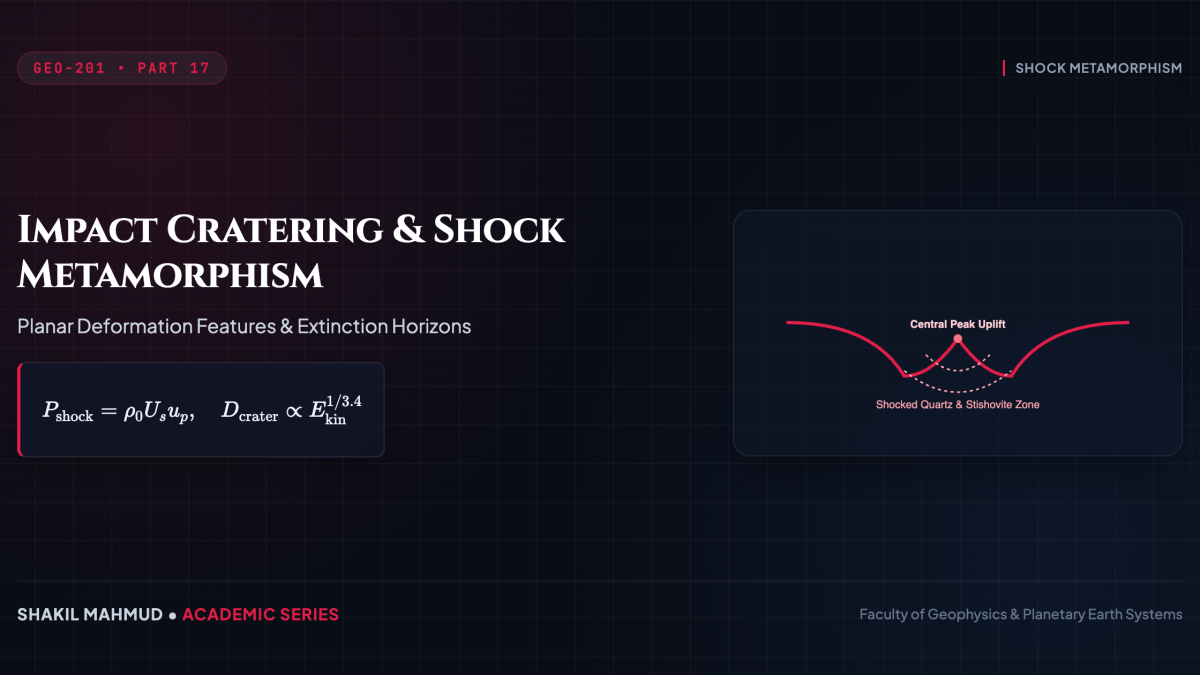
ho_0 U_s u_p
]
[
ext{Energy: } E – E_0 = rac{1}{2}(P + P_0)left( rac{1}{
ho_0} – rac{1}{
ho}
ight)
]
where (
ho_0) is unshocked target density, (u_p) is particle flow velocity, and (P) is peak shock pressure. Empirically, for most silicate minerals and metals, the shock velocity is linearly coupled to particle velocity:
[
U_s = c_0 + s u_p
]
For a chondritic asteroid striking granite at (20 ext{ km/s}), peak transient shock pressures exceed (P_{ ext{peak}} > 100 ext{–}500 ext{ GPa}), generating temperatures exceeding (10,000 ext{ K}) that instantaneously vaporize the impactor and adjacent crust.
2. The Three Stages of Impact Cratering
The morphology of an impact crater develops through three mechanically distinct phases:
- Contact and Compression Stage: Lasts mere fractions of a second. Shock waves compress target rock to hundreds of GPa; rarefaction (release) waves reflected from free surfaces trigger catastrophic decompression and explosive jetting of molten rock.
- Excavation Stage: Slower subsonic divergent particle flow opens a transient parabolic cavity. The diameter of the transient crater (D_{ ext{tc}}) scales with impactor kinetic energy (E_k = rac{1}{2}m v^2) via gravity-dominated scaling:
[
D_{ ext{tc}} propto left( rac{E_k}{
ho g}
ight)^{1/3.4}
] - Modification Stage: Gravity acts on the over-steepened, mechanically unstable transient cavity. Small craters form simple bowls. Large craters undergo immediate gravitational collapse: the crater floor rebounds elastically and dynamically, forming a central peak or concentric peak rings, while the crater rim collapses inward along listric faults to produce terraced walls (e.g., Chicxulub, Tycho, Copernicus).
3. Diagnostic Shock Metamorphism
Because transient shock pressures exceed standard crustal tectonic metamorphism ((P_{ ext{tectonic}} < 3 ext{ GPa})) by two orders of magnitude, hypervelocity impacts create unique, unambiguous diagnostic mineralogical markers:
- Planar Deformation Features (PDFs): Microscopic, straight, parallel lamellae of amorphous glass formed along specific crystallographic planes (e.g., ({10bar{1}3}) and ({10bar{1}2})) in shocked quartz and feldspar grains under pressures of (10 ext{–}35 ext{ GPa}).
- High-Pressure Silica Polymorphs: Shock conversion of quartz into ultra-dense minerals: coesite ((P > 2 ext{–}3 ext{ GPa})) and stishovite ((P > 10 ext{ GPa}), where silicon attains octahedral 6-fold coordination).
- Diaplectic Glasses (Maskelynite): Solid-state isotropic glass formed from plagioclase without melting ((30 ext{–}45 ext{ GPa})).
- Shatter Cones: Macroscopic striated conical fracture surfaces formed as high-pressure shock fronts refract around target rock inhomogeneities.
4. The Chicxulub Impact and The Cretaceous-Paleogene (K-Pg) Boundary
Sixty-six million years ago, a (sim 10 ext{-km}) carbonaceous chondrite struck the carbonate-sulfate platform of the Yucatán Peninsula, Mexico, forming the 180-km-wide Chicxulub crater. The impact released (sim 10^{24} ext{ J}) of kinetic energy ((sim 10^8 ext{ megatons}) TNT equivalent).
The geochemical signature of this catastrophe is preserved worldwide in a global millimeter-thick clay horizon at the K-Pg boundary. The layer is universally enriched in Iridium ((> 10 ext{–}50 ext{ ppb}), compared to crustal backgrounds of (< 0.1 ext{ ppb})), originating from the vaporized chondritic asteroid. The shock vaporization of thousands of cubic kilometers of Yucatán anhydrite (( ext{CaSO}_4)) injected (sim 325 ext{ Gt}) of sulfur and (sim 425 ext{ Gt}) of ( ext{CO}_2) into the stratosphere, inducing a decades-long impact winter, global acid rain, and catastrophic collapse of marine and terrestrial food webs.