Metamorphism represents the mineralogical, chemical, and structural adaptation of solid rocks to physical conditions of temperature, lithostatic pressure, differential stress, and fluid activity differing from those of their original formation. Because metamorphic transformations preserve residual chemical zoning within resistant porphyroblasts, metamorphic petrologists read these minerals as geological barometers and thermometers, mathematically reconstructing the pressure-temperature-time ((P ext{-}T ext{-}t)) trajectories of planetary crustal convergence and exhumation.
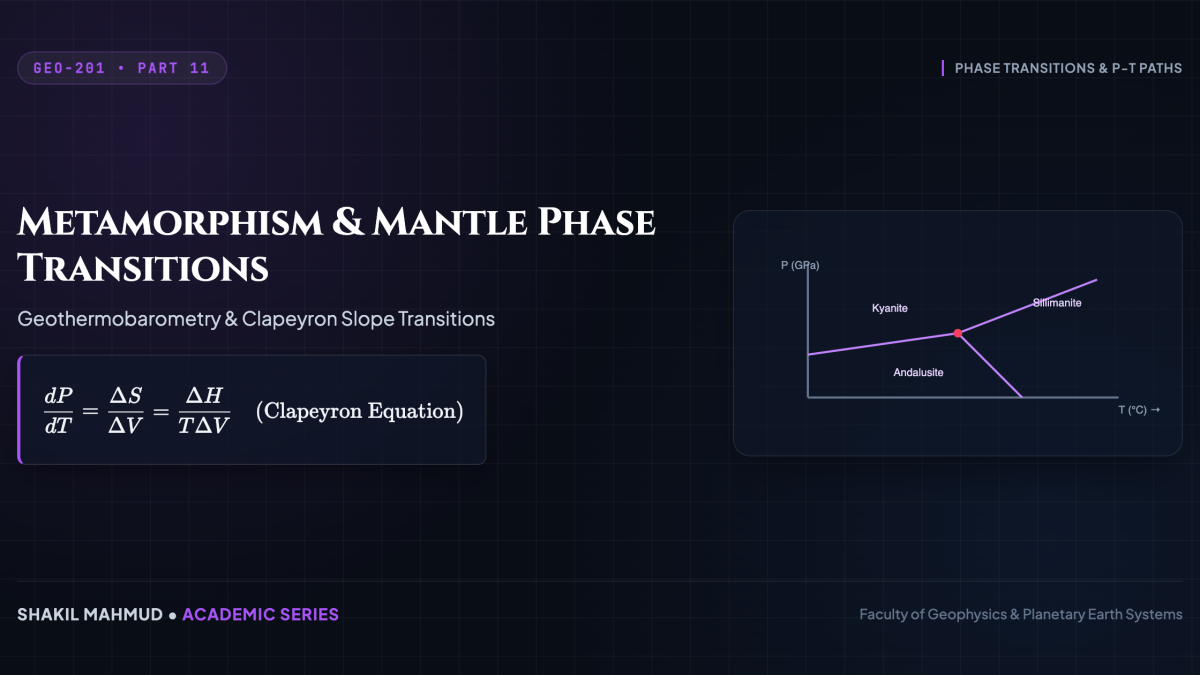
1. Thermodynamic Equilibrium and The Clapeyron Slope
A solid-state phase transformation (e.g., polymorph transitions such as andalusite (
ightleftharpoons) kyanite (
ightleftharpoons) sillimanite, or graphite (
ightleftharpoons) diamond) occurs along a phase boundary where the Gibbs free energy difference vanishes ((Delta G_r = 0)). Differentiating the fundamental thermodynamic relation (dG = -S dT + V dP) along the coexisting boundary yields the Clapeyron Equation:
[
rac{dP}{dT} = rac{Delta S_r}{Delta V_r} = rac{Delta H_r}{T Delta V_r}
]
where (Delta S_r) and (Delta V_r) are the entropy and molar volume changes of the reaction. Because solid-solid transformations typically have small volume changes (Delta V_r), their phase boundaries exhibit steep (dP/dT) slopes in (P ext{-}T) space, making them exceptionally sensitive geobarometers.
2. Geothermobarometry Formulations
Chemical equilibria between coexisting solid-solution mineral pairs provide continuous mathematical constraints on ambient pressure and temperature at the moment of chemical closure.
A. Cation Exchange Geothermometry (Garnet-Biotite)
The exchange of divalent iron and magnesium between garnet and biotite:
[
ext{Fe}_3 ext{Al}_2 ext{Si}_3 ext{O}_{12} ext{ (Almandine)} + ext{KMg}_3 ext{AlSi}_3 ext{O}_{10}( ext{OH})_2 ext{ (Phlogopite)}
ightleftharpoons ext{Mg}_3 ext{Al}_2 ext{Si}_3 ext{O}_{12} ext{ (Pyrope)} + ext{KFe}_3 ext{AlSi}_3 ext{O}_{10}( ext{OH})_2 ext{ (Annite)}
]
has a negligible volume change ((Delta V_r approx 0)), rendering its equilibrium constant (K_D) almost entirely dependent on temperature:
[
ln K_D = ln left( rac{( ext{Mg}/ ext{Fe})_{ ext{garnet}}}{( ext{Mg}/ ext{Fe})_{ ext{biotite}}}
ight) = -rac{Delta H_r^circ}{R T} + rac{Delta S_r^circ}{R}
]
Measuring the ( ext{Mg}/ ext{Fe}) ratios across rim interfaces using an electron microprobe yields equilibration temperatures accurate to within (pm 25^circ ext{C}).
B. Net-Transfer Geobarometry (GASP Barometer)
Net-transfer reactions involving significant molar volume changes serve as robust geobarometers. The celebrated GASP (Garnet-Aluminosilicate-Silica-Plagioclase) reaction:
[
3 ext{CaAl}_2 ext{Si}_2 ext{O}_8 ext{ (Anorthite)}
ightleftharpoons ext{Ca}_3 ext{Al}_2 ext{Si}_3 ext{O}_{12} ext{ (Grossular)} + 2 ext{Al}_2 ext{SiO}_5 ext{ (Kyanite)} + ext{SiO}_2 ext{ (Quartz)}
]
features a colossal volume reduction ((Delta V_r approx -66.1 ext{ cm}^3/ ext{mol})). The equilibrium pressure is calculated by balancing thermodynamic activities:
[
P = -rac{Delta G_r^circ + R T ln K_a}{Delta V_r}, quad K_a = rac{(a_{ ext{grossular}}^{ ext{garnet}})(a_{ ext{kyanite}})^2(a_{ ext{quartz}})}{(a_{ ext{anorthite}}^{ ext{plagioclase}})^3}
]
3. Metamorphic P-T-t Paths and Geodynamic Regimes
Metamorphism is intrinsically dynamic: rocks descend along geothermal gradients during tectonic burial and subsequently ascend during erosion and exhumation. Garnet crystals preserve concentric compositional zoning profiles from core to rim, recording the continuous trajectory:
A. Clockwise P-T-t Paths (Collisional Orogeny)
Characteristic of continent-continent collisions (e.g., the Alps, the Himalayas):
- Rapid Prograde Burial: Thrust stacking pushes rocks downward rapidly; pressure peaks before thermal conduction can heat the crust (yielding high-P, low-T blueschist or eclogite facies).
- Thermal Relaxation: As radioactive heat accumulates, temperature reaches its peak ((T_{ ext{max}})) while decompression begins (amphibolite/granulite facies).
- Exhumation and Retrograde Cooling: Continued rapid unroofing and erosional exhumation cools the rock back to the surface.
B. Counter-Clockwise P-T-t Paths (Magmatic Underplating)
Characteristic of continental rifts and back-arc basins where massive basaltic magmas underplate the lower crust. The rock experiences severe isobaric heating at near-constant pressure prior to slow conductive cooling.
4. Deep Mantle Discontinuities: The 410-km and 660-km Phase Transitions
Beneath the crust, the mantle transition zone is punctuated by two sharp seismic discontinuities governed by Clapeyron thermodynamics:
- The 410-km Discontinuity: Olivine ((alpha)) transforms to wadsleyite ((beta)-spinel) with a positive Clapeyron slope ((dP/dT approx +2.5 ext{ MPa/K})). In cold subducting slabs, lower temperatures cause this transition to occur at shallower depths, deflecting the boundary upward and exerting an additional downward pull.
- The 660-km Discontinuity: Ringwoodite ((gamma)-spinel) breaks down via post-spinel decomposition into bridgmanite + ferropericlase with a negative Clapeyron slope ((dP/dT approx -2.0 ext{ MPa/K})). In cold subducting slabs, the transition is delayed to greater depths, deflecting the boundary downward. This generates a buoyant upward resisting force that often causes subducting oceanic slabs to stagnate horizontally in the transition zone before puncturing into the lower mantle.