Subduction zones are the gravitational engines of planetary tectonics and the planet’s most active geochemical recycling factories. Where dense, cold oceanic lithosphere collides with an overriding plate, it plunges into the mantle along a dipping shear zone. This process drives catastrophic megathrust earthquakes, generates linear chains of explosive volcanic arcs, and recycles hydrated volatiles into the deep Earth.
1. The Primary Driving Force: Slab Pull Mechanics
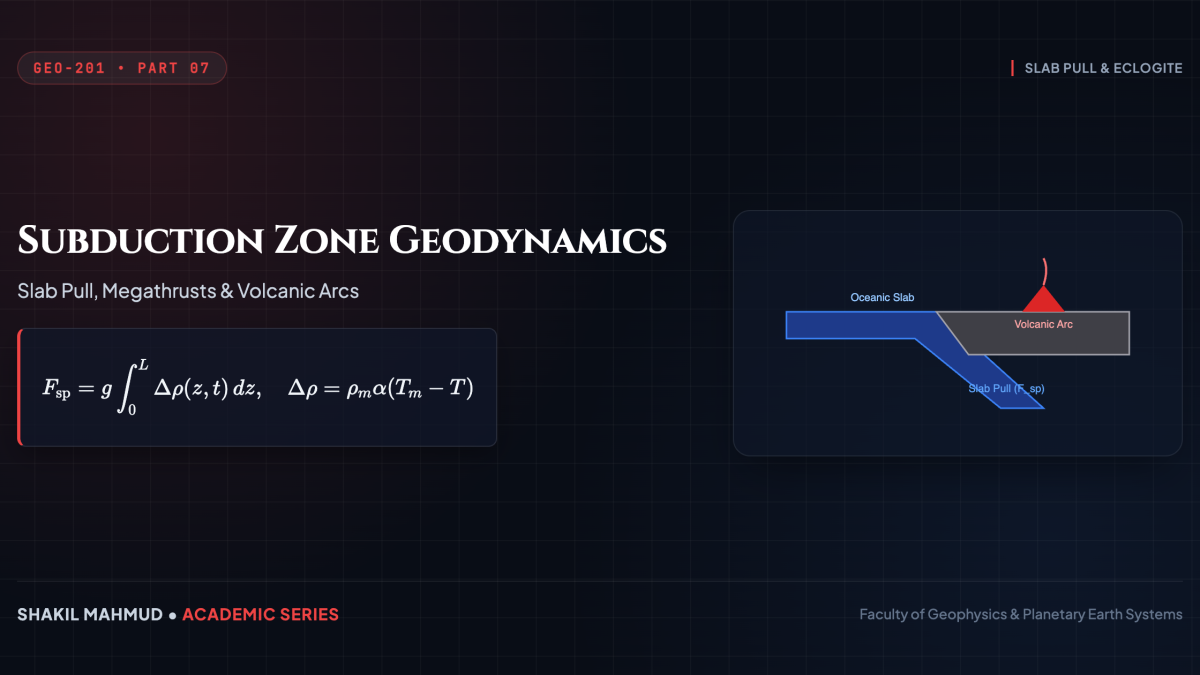
Geodynamic force-balance calculations reveal that slab pull ((F_{ ext{sp}})) provides (80 ext{–}90%) of the total driving torque of plate tectonics, vastly outstripping ridge push ((F_{ ext{rp}})) and basal mantle drag ((F_{ ext{drag}})). As oceanic lithosphere cools over tens of millions of years, it becomes thermally denser than the warm underlying asthenosphere. The integrated negative buoyancy force per unit trench length is:
[
F_{ ext{sp}} = g int_0^L int_0^{T_l} Delta
ho(z, t) , dz , dl
]
where (Delta
ho(z) =
ho_m alpha [T_m – T(z)]). Thermal contraction alone generates substantial negative buoyancy ((Delta
ho_{ ext{thermal}} approx 30 ext{–}50 ext{ kg/m}^3)).
The Eclogite Engine
As the slab descends through (40 ext{–}70 ext{ km}) depth ((P approx 1.5 ext{–}2.5 ext{ GPa})), hydrated basaltic oceanic crust and gabbros undergo metamorphic recrystallization into eclogite—a dense assemblage of garnet and omphacite pyroxene:
[
ext{Basalt / Gabbro } (
ho approx 2900 ext{–}3000 ext{ kg/m}^3) xrightarrow{Delta P} ext{Eclogite } (
ho approx 3500 ext{–}3600 ext{ kg/m}^3)
]
Because eclogite is denser than the ambient peridotitic mantle ((
ho_{ ext{mantle}} approx 3300 ext{ kg/m}^3)), this positive density contrast of (+200 ext{–}300 ext{ kg/m}^3) acts as a colossal gravitational anchor, relentlessly pulling the trailing oceanic plate downward.
2. Seismicity and The Wadati-Benioff Zone
Earthquakes within subducting slabs delineate a dipping planar seismic zone extending from the trench down to (670 ext{ km}), known as the Wadati-Benioff Zone. The dip angle ( heta_{ ext{dip}}) reflects the balance between slab sinking speed and hydrodynamic mantle suction, ranging from shallow flat-slab subduction ((sim 10^circ) in parts of the Andes) to vertical free-fall ((sim 90^circ) in the Mariana Trench).
Seismicity falls into three distinct mechanical depth regimes:
- Megathrust Interplate Seismicity ((0 ext{–}50 ext{ km})): Frictional stick-slip failure along the plate interface produces the planet’s largest earthquakes ((M_w > 9.0), such as the 1960 Chile, 2004 Sumatra, and 2011 Tohoku earthquakes) governed by rate-and-state friction:
[
au = sigma_n left[ mu_0 + a lnleft(rac{v}{v_0}
ight) + b lnleft(rac{v_0 heta_s}{d_c}
ight)
ight]
]
Velocity-weakening behavior ((a – b < 0)) enables unstable rupture propagation across thousands of square kilometers. - Intermediate-Depth Earthquakes ((50 ext{–}300 ext{ km})): At pressures where brittle fracture is theoretically suppressed by lithostatic confining stress, earthquakes occur via dehydration embrittlement: as hydrous minerals (serpentine, lawsonite, chlorite) breakdown, released pore water overpressures drastically reduce effective normal stress (sigma_n’ = sigma_n – P_f).
- Deep-Focus Earthquakes ((300 ext{–}670 ext{ km})): Occur in cold slab cores via transformational faulting (anticrack shear instability) during the metastable phase transformation of olivine into spinel (wadsleyite/ringwoodite). Seismicity abruptly halts at (670 ext{ km}) as bridgmanite transformations eliminate metastable pathways.
3. Subduction Arc Petrogenesis: Flux Melting
Volcanic arcs (e.g., the Pacific “Ring of Fire”) sit at a remarkably uniform vertical depth of (100 ext{–}120 ext{ km}) directly above the subducting slab. This volcanism is not caused by the slab melting directly, but by fluid-fluxed melting of the overriding mantle wedge.
As the slab descends, prograde metamorphism dehydrates sediments and altered oceanic basalts, liberating supercritical aqueous fluids enriched in fluid-mobile large-ion lithophile elements (LILE: Rb, Ba, Sr, Pb, U). These fluids ascend into the overlying hot peridotite mantle wedge ((T > 1000^circ ext{C})), drastically depressing the silicate solidus by hundreds of degrees:
[
T_{ ext{solidus}}( ext{peridotite} + ext{H}_2 ext{O}) ll T_{ ext{solidus}}( ext{dry peridotite})
]
Partial melting of the mantle wedge generates primitive hydrous, calc-alkaline basaltic melts. As these magmas ascend through the continental crust, fractional crystallization, crustal assimilation, and magma mixing (MASH processes) generate explosive intermediate-to-felsic andesites and dacites.