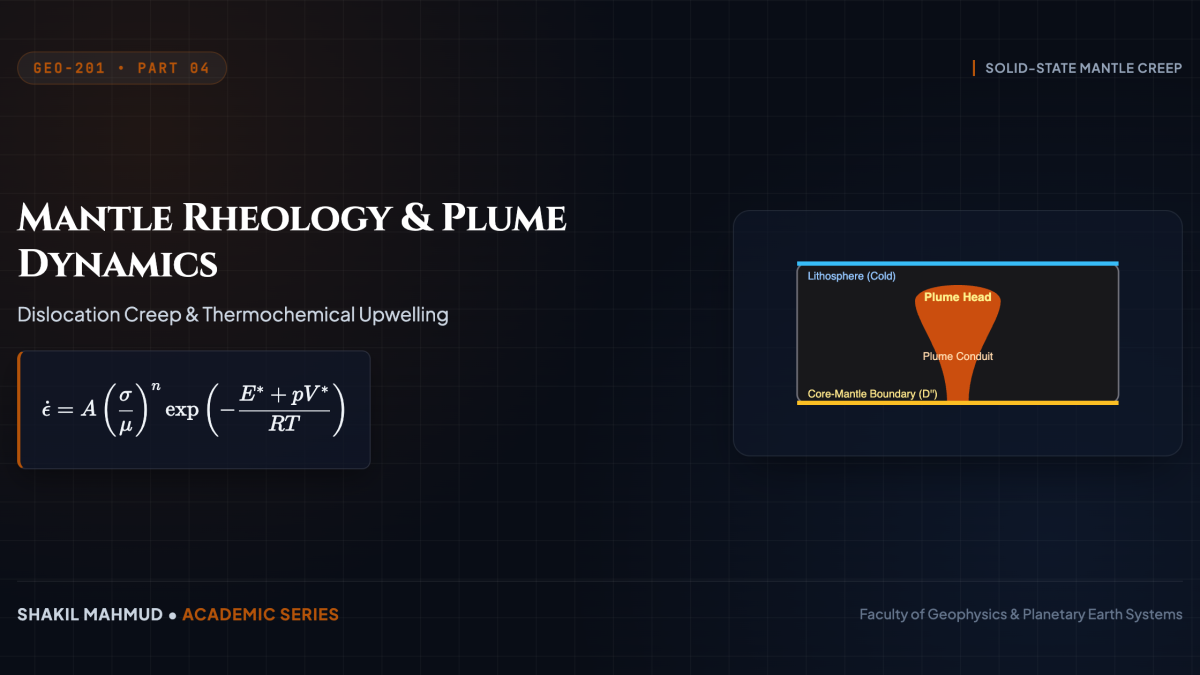
Although seismic shear wave propagation definitively proves that Earth’s 2,900-km-thick mantle is mechanically solid, on geological timescales of millions of years the mantle deforms and flows like an ultra-viscous fluid. Driven by radioactive decay heat and primordial cooling, solid-state mantle convection serves as the primary heat engine of the terrestrial system, dragging tectonic plates across the surface and driving the genesis of deep mantle plumes.
1. Solid-State Creep Rheology of Mantle Silicates
Mantle flow occurs via thermally activated plastic deformation within crystalline silicate minerals (predominantly olivine (( ext{Mg,Fe})_2 ext{SiO}_4) in the upper mantle, and bridgmanite (( ext{Mg,Fe}) ext{SiO}_3) in the lower mantle). The strain rate (dot{psilon}) is described by the Arrhenius constitutive flow law:
[
dot{psilon} = A left(rac{sigma}{mu}
ight)^n left(rac{b}{d}
ight)^m xpleft(-rac{E^* + p V^*}{R T}
ight)
]
where (sigma) is differential stress, (mu) is shear modulus, (d) is grain size, (E^*) is activation energy, (V^*) is activation volume, and (p) is lithostatic pressure. Two fundamental microphysical deformation mechanisms dominate:
A. Diffusion Creep ((n = 1), Newtonian Rheology)
At lower stresses and smaller grain sizes, vacancies migrate through mineral lattices (Nabarro-Herring creep, (m=2)) or along grain boundaries (Coble creep, (m=3)). Because (n = 1), the effective viscosity (ta = sigma / (2dot{psilon})) is independent of stress, behaving as a linear Newtonian fluid. Diffusion creep dominates the lower mantle and asthenosphere.
B. Dislocation Creep ((n approx 3 ext{–}3.5), Non-Newtonian Power-Law)
At higher deviatoric stresses, deformation proceeds via the glide and climb of crystal lattice dislocations. Because (n > 1), the viscosity is non-linear and stress-dependent (strain-rate weakening):
[
ta_{ ext{eff}} = rac{1}{2 A} sigma^{1-n} xpleft(rac{E^* + p V^*}{R T}
ight)
]
Dislocation creep induces crystal preferred orientation (CPO) of olivine grains, producing the measurable seismic anisotropy observed in the upper oceanic lithosphere and subduction zones.
2. Rayleigh-Bénard Convection and Boundary Layers
Mantle convection is governed by buoyant instability balancing thermal diffusion and viscous drag. The propensity for convection is parameterized by the dimensionless Rayleigh number (( ext{Ra})):
[
mathrm{Ra} = rac{
ho g alpha Delta T D^3}{kappa ta}
]
where (alpha approx 2 ext{–}3 imes 10^{-5} ext{ K}^{-1}) is thermal expansivity, (kappa approx 10^{-6} ext{ m}^2/ ext{s}) is thermal diffusivity, (D approx 2890 ext{ km}) is mantle depth, and (ta approx 10^{21} ext{ Pa}cdot ext{s}) is average mantle viscosity. For Earth’s mantle, ( ext{Ra} sim 10^7 ext{–}10^8), vastly exceeding the critical threshold ( ext{Ra}_{ ext{crit}} approx 10^3). Consequently, mantle convection is highly vigorous and unsteady.
Because heat is transported primarily by advection in the interior, thermal resistance is concentrated across two narrow, conducting thermal boundary layers:
- The Upper Boundary Layer (The Lithosphere): Cools conductively against space, becomes gravitationally unstable, and sinks into the mantle as subducting slabs.
- The Lower Boundary Layer (The (D”) Layer at the CMB): Absorbs core heat flux, destabilizes, and ascends as buoyant, narrow cylindrical mantle plumes.
3. Thermochemical Plumes and Large Igneous Provinces (LIPs)
When the lower thermal boundary layer destabilizes, it forms axisymmetric upwellings characterized by a broad spherical plume head ((500 ext{–}1000 ext{ km}) diameter) fed by a narrow, trailing plume conduit. As the plume head impacts the base of the lithosphere, decompression melting produces colossal volcanic outputs: Large Igneous Provinces (LIPs) such as the Siberian Traps ((252 ext{ Ma})) and the Deccan Traps ((66 ext{ Ma})), which coincide with global mass extinction events.
After the head dissipates, the stationary tail forms long-lived volcanic hotspot tracks as tectonic plates drift overhead, generating linear age-progressive island chains such as the Hawaiian-Emperor seamount chain.
4. The D” Layer and Large Low-Shear-Velocity Provinces (LLSVPs)
Modern seismic tomography reveals that the core-mantle boundary is not chemically uniform. Anchored directly atop the CMB beneath Africa and the Pacific Ocean lie two colossal antipodal structures known as LLSVPs (popularly termed “superplumes”). These structures rise hundreds of kilometers into the lower mantle, exhibiting a (1 ext{–}3%) reduction in shear wave velocity accompanied by elevated bulk sound speed and positive density anomalies ((Delta
ho /
ho sim +1 ext{–}2%)).
Geodynamic modeling demonstrates that LLSVPs are ancient, dense thermochemical piles enriched in iron-rich bridgmanite, likely remnants of early basal magma ocean differentiation or subducted oceanic crust accumulated over billions of years. Plume upwellings and surface kimberlitic diamond pipes are statistically correlated with the steep margins of these structures.