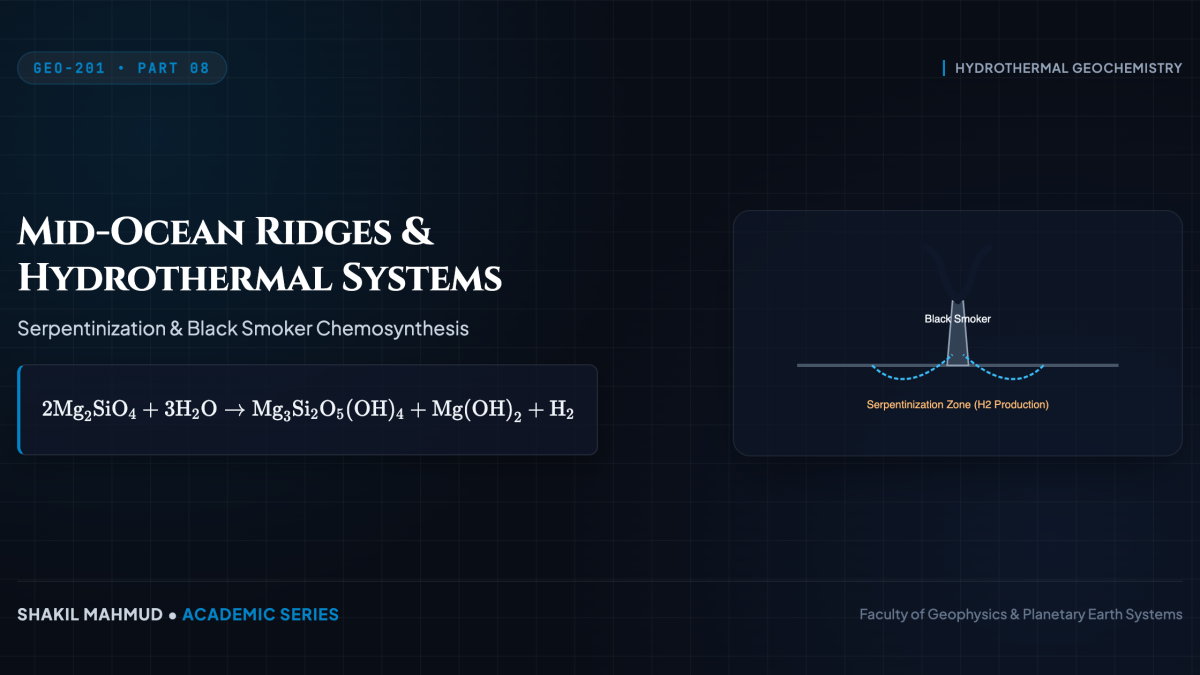
Spanning over 65,000 kilometers across the global abyssal plains, mid-ocean ridges (MORs) represent Earth’s continuous volcanic divergent boundary. At these underwater spreading axes, upwelling mantle partially melts to construct new oceanic crust, while fractured, permeable basalt drives colossal convective seawater circulation. The resulting hydrothermal vent fields (“black smokers” and alkaline serpentine vents) regulate the geochemical composition of the global ocean and host thriving chemosynthetic biospheres completely decoupled from sunlight.
1. Mid-Ocean Ridge Architecture and Spreading Rates
The morphology and crustal architecture of mid-ocean ridges are strictly dictated by the spreading rate, reflecting the thermal competition between magmatic heat advection and conductive hydrothermal cooling:
A. Fast-Spreading Ridges (Full Rate (> 80 ext{ mm/yr}))
Exemplified by the East Pacific Rise, these ridges are characterized by smooth, axial volcanic highs with steady-state magma chambers (axial melt lenses, AML) located at shallow crustal depths ((1 ext{–}2 ext{ km})). A steady supply of basaltic magma continuously forms the classic Penrose ophiolite stratigraphy: extrusive pillow basalts ( o) sheeted dike complexes ( o) isotropic and layered gabbros.
B. Slow and Ultra-Slow Spreading Ridges (Full Rate (< 40 ext{ mm/yr}))
Exemplified by the Mid-Atlantic Ridge and the Gakkel Ridge, these settings feature deep, faulted axial rift valleys ((1 ext{–}3 ext{ km}) deep). Magma supply is episodic or starved, and tectonic extension is accommodated along low-angle oceanic detachment faults. These faults excavate footwall rocks over millions of years, exhuming deep lower crust and ultramafic mantle peridotites directly onto the seafloor as oceanic core complexes (OCCs).
2. Hydrothermal Convection and Black Smoker Dynamics
Cold, dense, alkaline seawater ((T approx 2^circ ext{C}), ( ext{pH} approx 8.0)) percolates down through fractured oceanic basalt, driven by hydrostatic head. As it approaches the hot magmatic cracking front ((T > 400^circ ext{C})), intense chemical exchange transforms the fluid:
- Magnesium is quantitatively stripped from seawater via smectite and chlorite precipitation: ( ext{Mg}^{2+} + ext{silicates} + ext{H}_2 ext{O} o ext{chlorite} + 2 ext{H}^+), generating extreme acidity (( ext{pH} approx 2 ext{–}3)).
- Sulfate (( ext{SO}_4^{2-})) is reduced to hydrogen sulfide (( ext{H}_2 ext{S})).
- The hot, superheated, acidic fluid leaches transition metals (Fe, Cu, Zn, Mn, Au) from surrounding basalts.
As this buoyant, metal-laden hydrothermal fluid discharges violently back into the cold seafloor ocean at velocities of meters per second, abrupt quenching precipitates fine sulfide minerals:
[
ext{Fe}^{2+} + ext{H}_2 ext{S} o ext{FeS (Pyrrhotite/Pyrite)} + 2 ext{H}^+, qquad ext{Cu}^{2+} + ext{Fe}^{2+} + 2 ext{H}_2 ext{S} o ext{CuFeS}_2 ext{ (Chalcopyrite)} + 4 ext{H}^+
]
These mineral precipitants construct towering hollow chimneys (“black smokers”) reaching temperatures up to (410^circ ext{C}), avoiding boiling only due to the extreme hydrostatic pressure of the deep abyss ((P > 25 ext{ MPa})).
3. Serpentinization and Abiotic Hydrogen Production
At slow-spreading ridges and oceanic core complexes, tectonic faults expose ultramafic peridotite directly to seawater. The resulting low-to-moderate temperature ((150 ext{–}300^circ ext{C})) hydrothermal hydration of olivine is known as serpentinization:
[
6( ext{Mg}_{1.5} ext{Fe}_{0.5}) ext{SiO}_4 ext{ (Olivine)} + 7 ext{H}_2 ext{O} o 3 ext{Mg}_3 ext{Si}_2 ext{O}_5( ext{OH})_4 ext{ (Serpentine)} + ext{Fe}_3 ext{O}_4 ext{ (Magnetite)} + ext{H}_2 ext{ (aq)}
]
This reaction has several monumental geological and astrobiological consequences:
- Volume Expansion and Softening: The rock undergoes a (sim 30 ext{–}40%) volume expansion, reducing density from (3300 ext{ kg/m}^3) to (2600 ext{ kg/m}^3) and drastically lowering mechanical shear strength.
- Abiotic Molecular Hydrogen Generation: The oxidation of ferrous iron (( ext{Fe}^{2+})) to ferric iron (( ext{Fe}^{3+})) in magnetite reduces water protons to dissolved molecular hydrogen (( ext{H}_2)).
- Alkaline Vents and Fischer-Tropsch Synthesis: In serpentine systems like the Lost City Hydrothermal Field, warm ((40 ext{–}90^circ ext{C})), hyper-alkaline (( ext{pH } 9 ext{–}11)) effluent combines ( ext{H}_2) with dissolved carbon via Fischer-Tropsch-type abiotic catalysis:
[
ext{CO}_2 + 4 ext{H}_2 o ext{CH}_4 + 2 ext{H}_2 ext{O}
]
Precipitating calcium carbonate (aragonite/calcite) chimneys, these systems provided the energetic, proton-gradient micro-compartments widely hypothesized to have catalyzed the abiotic origin of life on Earth and potentially on icy ocean worlds like Enceladus and Europa.