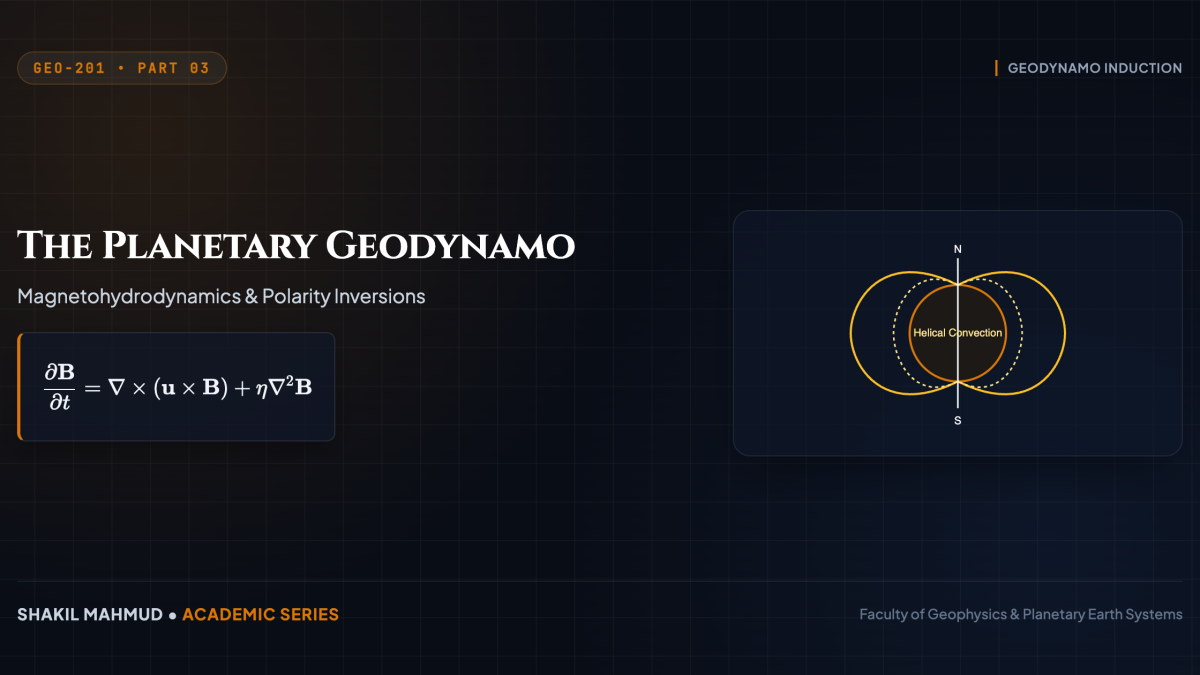
Earth’s global dipolar magnetic field is our planetary shield against solar wind plasma and galactic cosmic radiation. Because ferromagnetic minerals lose their spontaneous magnetization above their Curie temperatures ((T_C approx 580^circ ext{C}) for magnetite, reached within the upper 30 to 50 km of the crust), the geomagnetic field cannot be explained by permanent crustal magnetization. Instead, it is sustained by an active, self-exciting geodynamo operating within the rapidly convecting, electrically conductive liquid iron outer core.
1. Magnetohydrodynamic Induction and The Induction Equation
The coupling of Maxwell’s electrodynamics with the Navier-Stokes momentum equations governing an electrically conducting fluid (electrical conductivity (sigma approx 10^6 ext{ S/m}), magnetic diffusivity (ta = 1 / (mu_0 sigma) approx 1 ext{–}2 ext{ m}^2/ ext{s})) yields the fundamental magnetic induction equation:
[
rac{partial mathbf{B}}{partial t} =
abla imes (mathbf{u} imes mathbf{B}) + ta
abla^2 mathbf{B}
]
The dynamics are governed by the dimensionless magnetic Reynolds number (( ext{Rm})):
[
mathrm{Rm} = rac{U L}{ta}
]
When ( ext{Rm} ll 1), magnetic diffusion dominates and any initial field decays exponentially. For Earth’s outer core ((U sim 10^{-4} ext{ m/s}), (L sim 10^6 ext{ m})), ( ext{Rm} sim 100 ext{–}300). In this advective regime, magnetic field lines are effectively “frozen” into the fluid (Alfvén’s Theorem), allowing fluid flow to stretch, shear, and amplify magnetic flux against ohmic dissipation ((mathcal{D} = int mathbf{J}^2/sigma , dV)).
2. The (alpha)-(Omega) Dynamo Mechanism and Taylor Columns
A planar, purely toroidal fluid flow cannot sustain a self-exciting three-dimensional magnetic dipole (Cowling’s Anti-Dynamo Theorem). Self-generation requires a two-step cyclonic conversion known as the (alpha)-(Omega) effect:
A. The (Omega)-Effect (Toroidal Shearing)
Differential rotation within the outer core shears existing poloidal (meridional) magnetic field lines (mathbf{B}_{ ext{pol}}), wrapping them around Earth’s rotation axis into powerful azimuthal toroidal magnetic fields (mathbf{B}_{ ext{tor}}):
[
B_phi sim r sin heta , (mathbf{B}_{ ext{pol}} cdot
abla) Omega_{ ext{rot}}
]
B. The (alpha)-Effect (Helical Upwelling)
Buoyant fluid elements driven by thermal and compositional convection ascend toward the CMB. Because Earth rotates rapidly (( ext{Ekman number } ext{Ek} =
u / 2Omega L^2 sim 10^{-15})), the Coriolis force ((-2
ho boldsymbol{Omega} imes mathbf{u})) exerts a profound constraining influence, organizing convective flow into columnar, helical structures parallel to the rotation axis called Taylor-Proudman columns. Helical convection twists the toroidal magnetic loops back into the poloidal meridional plane:
[
mathcal{E} = langle mathbf{u}’ imes mathbf{B}’
angle = alpha mathbf{B}_0 – beta
abla imes mathbf{B}_0
]
This closed feedback loop sustains the planetary dipole indefinitely.
3. Core Energetics: Thermal vs. Compositional Buoyancy
What fuels outer core convection? Two distinct thermodynamic mechanisms drive the dynamo:
- Thermal Convection: Heat conducted across the CMB into the mantle must exceed the core’s adiabatic core heat flux ((Q_{ ext{ad}} approx 10 ext{–}15 ext{ TW})).
- Compositional Convection (The Inner Core Engine): As Earth slowly cools, the solid inner core crystallizes from the liquid outer core at a rate of (sim 1 ext{ mm/year}). Pure iron and nickel freeze into the inner core, expelling light alloying elements (silicon, oxygen, sulfur, and hydrogen) into the overlying liquid. This buoyancy flux ((sim 80%) of modern dynamo driving power) creates intense gravitational convection independent of thermal limits.
4. Secular Variation and Geomagnetic Polarity Reversals
Paleomagnetic measurements from volcanic basalts and marine sediments demonstrate that Earth’s dipole axis wanders (secular variation) and occasionally collapses and inverts polarity completely. The geomagnetic polarity timescale reveals stochastic reversals occurring on average every 200,000 to 300,000 years, separated by long periods of stability (chrons) and occasional superchrons (e.g., the Cretaceous Normal Superchron, lasting 40 Myr without a flip).
During a reversal, the dipole moment decays by (80 ext{–}90%) over several thousand years, revealing chaotic multipolar field geometries at the surface before re-establishing a dominant dipole in the opposite direction. Geodynamic numerical simulations demonstrate that reversals arise spontaneously from non-linear inertial-Lorentz force instabilities within turbulent convective plumes.