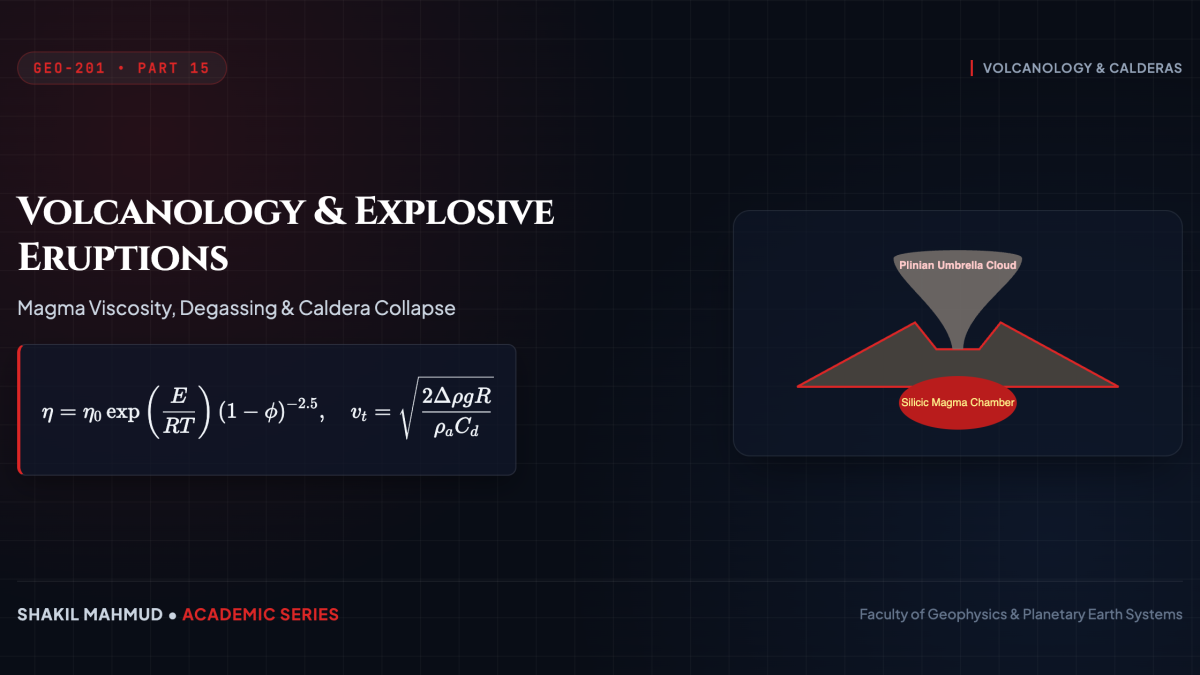
Volcanism is the primary thermal vent through which planetary interiors expel heat and juvenile volatiles into the exosphere. The physical spectrum of volcanic eruptions spans a continuum from benign Hawaiian effusive basaltic lava fountains to catastrophic Plinian and ultra-Plinian super-eruptions ejecting thousands of cubic kilometers of pyroclastic tephra. This dynamic is governed by melt rheology, dissolved volatile solubility, and hydrodynamic fragmentation within ascending magmatic conduits.
1. Silicate Melt Rheology: Polymerization and Viscosity
The primary control on eruption style is dynamic viscosity (ta), which spans over ten orders of magnitude: from fluid basalt ((ta approx 10^1 ext{–}10^2 ext{ Pa}cdot ext{s})) to viscous rhyolite ((ta approx 10^7 ext{–}10^{11} ext{ Pa}cdot ext{s})). Viscosity is parameterized by the ratio of non-bridging oxygens to tetrahedrally coordinated cations (( ext{NBO/T})):
[
rac{ ext{NBO}}{ ext{T}} = rac{2 ext{O} – 4 ext{T}}{ ext{T}}, quad ext{T} = ext{Si}^{4+} + ext{Al}^{3+} + ext{Ti}^{4+}
]
Basalts have high ( ext{NBO/T}) ((sim 0.6 ext{–}0.9)), forming short, depolymerized silicate units. Rhyolites have near-zero ( ext{NBO/T}), forming three-dimensionally connected, highly polymerized tetrahedral networks. Melt viscosity follows the non-Arrhenian temperature dependence modeled by Mauro et al. (MYEGA equation):
[
log_{10} ta(T) = log_{10} ta_infty + rac{12 + log_{10}(ta_0/ta_infty)}{T/T_g} xpleft[ left(rac{m}{12 + log_{10}(ta_0/ta_infty)} – 1
ight)left(rac{T_g}{T} – 1
ight)
ight]
]
where (T_g) is glass transition temperature and (m) is fragility.
2. Volatile Exsolution and Conduit Fragmentation Dynamics
Magmas ascending from depth carry dissolved volatiles (predominantly ( ext{H}_2 ext{O}) and ( ext{CO}_2)). Volatile solubility follows Henry’s Law at low pressures and square-root scaling at higher pressures (Burnham’s model):
[
C_{ ext{H}_2 ext{O}} = s sqrt{P}
]
As magma ascends, decompression forces dissolved water out of solution (first boiling). Bubbles nucleate, grow via volatile diffusion, and expand hydrodynamically. The gas volume fraction (porosity (phi)) increases rapidly along the volcanic conduit.
The Fragmentation Criterion
When bubble growth accelerates the ascending foam, the strain rate (dot{psilon}) within liquid silicate melt films exceeds the structural relaxation time ( au_r = ta / G_infty) (where (G_infty approx 10^{10} ext{ Pa}) is high-frequency shear modulus). When the Deborah number (( ext{De})) exceeds unity:
[
mathrm{De} = dot{psilon} au_r = rac{dot{psilon} ta}{G_infty} ge mathrm{De}_{ ext{crit}} approx 0.01 ext{–}0.1
]
the viscoelastic melt can no longer accommodate deformation by viscous flow; it undergoes brittle failure, catastrophically fragmenting into an explosive supersonic gas-particle suspension (tephra, ash, and pumice) shooting upward through the volcanic vent at velocities exceeding (300 ext{–}500 ext{ m/s}).
3. Pyroclastic Density Currents (PDCs) and Column Collapse
The buoyant ascent of an eruptive Plinian plume is governed by turbulent atmospheric entrainment. If the mass eruption rate (dot{M}) exceeds the carrying capacity of ambient air entrainment, or if conduit throat geometry widens, bulk plume density exceeds atmospheric density ((
ho_{ ext{plume}} >
ho_{ ext{air}})).
The eruptive column undergoes gravitational collapse, generating devastating Pyroclastic Density Currents (PDCs): ground-hugging avalanches of incandescent ash, pumice, and toxic gas traveling down volcanic flanks at velocities (v > 50 ext{–}150 ext{ m/s}) with temperatures (T > 400 ext{–}800^circ ext{C}). PDCs are governed by fluid-particle basal pore pressure equations, exhibiting near-zero friction due to fluidization.
4. Supervolcanoes and Resurgent Caldera Collapse
When immense silicic magma reservoirs ((V > 500 ext{–}1000 ext{ km}^3)) accumulate within the upper crust ((4 ext{–}10 ext{ km}) depth), roof overpressures trigger runaway ring-fracture faulting. The roof collapses gravitationally into the emptying chamber like a piston, producing a giant caldera collapse (e.g., Yellowstone, Toba, Long Valley, Santorini).
Post-eruption, continued magma replenishment and hydrothermal fluid circulation beneath the caldera floor initiate resurgence: structural doming and uplift of the central caldera block by hundreds of meters over tens of thousands of years, accompanied by intense fumarolic and geyser activity.