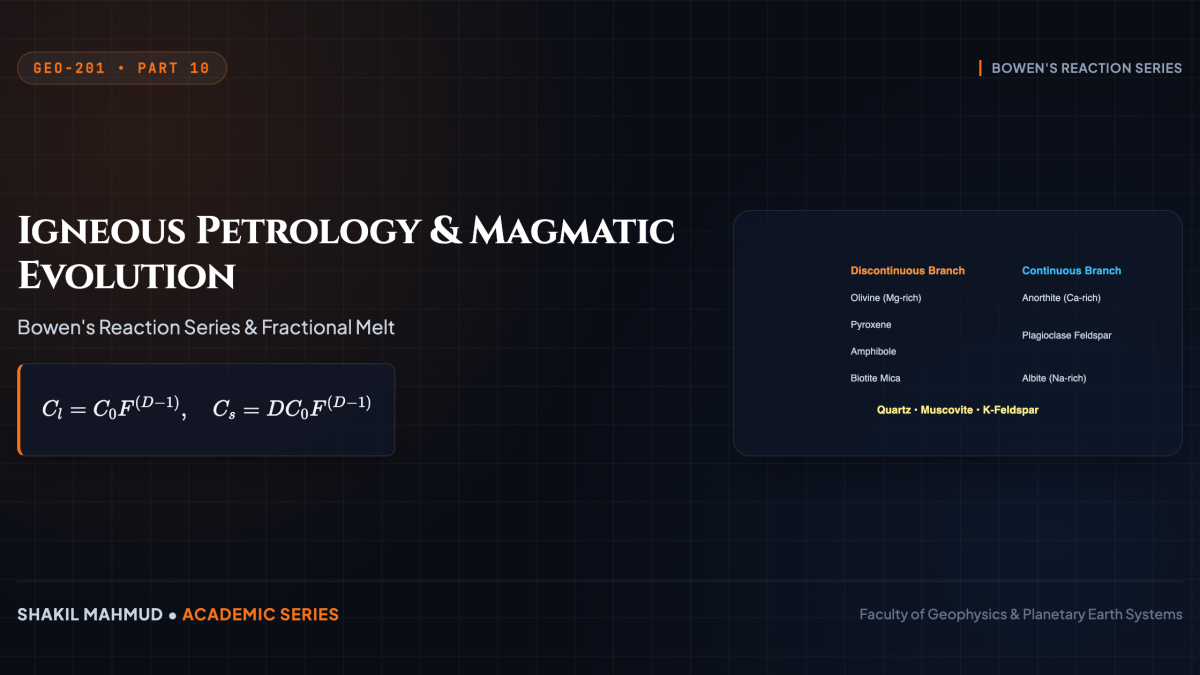
Igneous rocks represent the primary crustal building blocks of the terrestrial planets. When primitive, mantle-derived basaltic melts ascend into the crust, they pool in subsurface magma chambers. As these reservoirs cool and depressurize, chemical segregation governed by chemical thermodynamics transforms primitive ultramafic and mafic magmas into diverse intermediate and felsic differentiation suites (andesites, dacites, and granites), a thermodynamic sequence formalized in Bowen’s Reaction Series.
1. Thermodynamic Foundations and The Gibbs Phase Rule
The equilibrium state of a multi-component magma system containing (C) independent chemical components and (P) phases (crystals, liquid, vapor) is governed by Gibbs Phase Rule:
[
F = C – P + 2
]
where (F) denotes the degrees of thermodynamic freedom (independent intensive variables: temperature (T), pressure (P), and component mole fractions (X_i)). At isobaric conditions ((P = ext{const})):
[
F = C – P + 1
]
For a binary eutectic system (such as diopside-anorthite ( ext{CaMgSi}_2 ext{O}_6 – ext{CaAl}_2 ext{Si}_2 ext{O}_8)), when liquid and both crystalline phases coexist at the eutectic point ((P = 3)), degrees of freedom drop to zero ((F = 2 – 3 + 1 = 0)). The system is invariant: melt composition and temperature remain strictly fixed until the last drop of liquid crystallizes.
2. Bowen’s Reaction Series: Discontinuous and Continuous Branches
In 1928, Norman L. Bowen demonstrated through laboratory quench experiments that cooling silicate magmas undergo progressive chemical reactions with early-formed crystals. The series branches into two concurrent reaction paths:
A. The Discontinuous Reaction Branch (Fe-Mg Silicates)
In this branch, each early crystal reacts peritectically with the cooling melt at discrete reaction temperatures to form a completely distinct mineral structure with increasing silica polymerization:
- Forsteritic Olivine (( ext{Mg,Fe})_2 ext{SiO}_4) ((sim 1200 ext{–}1400^circ ext{C})): Isolated silica tetrahedra (([ ext{SiO}_4]^{4-}), nesosilicates).
- Pyroxene (( ext{Mg,Fe}) ext{SiO}_3) ((sim 1050 ext{–}1200^circ ext{C})): Single chain tetrahedra (([ ext{Si}_2 ext{O}_6]^{4-}), inosilicates).
- Amphibole (Hornblende) ((sim 900 ext{–}1050^circ ext{C})): Double chain tetrahedra (([ ext{Si}_8 ext{O}_{22}]^{12-})).
- Biotite Mica ((sim 750 ext{–}900^circ ext{C})): Continuous sheets (([ ext{Si}_4 ext{O}_{10}]^{4-}), phyllosilicates).
B. The Continuous Reaction Branch (Plagioclase Feldspars)
Here, the framework silicate structure remains intact while the crystal undergoes a continuous solid-solution cation exchange:
[
ext{Anorthite } ( ext{CaAl}_2 ext{Si}_2 ext{O}_8) xrightarrow{+ ext{Na}^+, ext{Si}^{4+} atop – ext{Ca}^{2+}, ext{Al}^{3+}} ext{Albite } ( ext{NaAlSi}_3 ext{O}_8)
]
Calcium-rich anorthite precipitates first at high temperatures; as the melt becomes enriched in sodium and silica, plagioclase crystals zone continuously toward sodic albite.
C. The Residual Eutectic System
Once both branches exhaust their respective reactants, the residual highly polymerized, water-saturated felsic melt crystallizes the lowest-temperature eutectic assemblage: Potassium Feldspar (Orthoclase) ( o) Muscovite Mica ( o) Quartz (( ext{SiO}_2)) ((sim 650 ext{–}750^circ ext{C})).
3. Mathematical Modeling of Fractional Crystallization: Rayleigh Distillation
When early-formed crystals settle out of the magma due to negative buoyancy (gravity settling) or flow segregation, they are physically removed from chemical equilibrium with the remaining liquid, preventing back-reaction. This irreversible process is governed by the Rayleigh Distillation Equation:
[
C_l = C_0 F^{(D – 1)}
]
where (C_0) is the initial concentration of a trace element, (C_l) is its concentration in the residual liquid, (F) is the fraction of melt remaining ((0 < F le 1)), and (D) is the bulk solid-liquid partition coefficient:
[
D = sum_i w_i K_{d,i}
]
where (w_i) is the mass fraction of mineral (i), and (K_{d,i} = C_{ ext{crystal}} / C_{ ext{melt}}). Trace elements behave according to their partition coefficient:
- Compatible Elements ((D gg 1), e.g., Ni, Cr in olivine/spinel): Rapidly depleted from the melt; (C_l o 0) as (F) decreases.
- Incompatible Elements ((D ll 1), e.g., Rb, Ba, Th, U, Rare Earth Elements): Excluded from early crystal lattices, concentrating inversely with melt fraction: (C_l approx C_0 / F).
4. Layered Mafic Intrusions: The Skaergaard and Bushveld Complexes
The planetary benchmark for in-situ fractional crystallization is the Skaergaard Intrusion of East Greenland (emplaced during the opening of the North Atlantic at (sim 55 ext{ Ma})). Within a closed magma chamber, convective crystal settling and boundary-layer crystallization produced rhythmic mineral layering: olivine and plagioclase cumulates exhibit extreme iron enrichment, progressing from magnesium-rich troctolites at the base to pure fayalite (( ext{Fe}_2 ext{SiO}_4)) and granophyre quartz at the sandwich horizon roof.