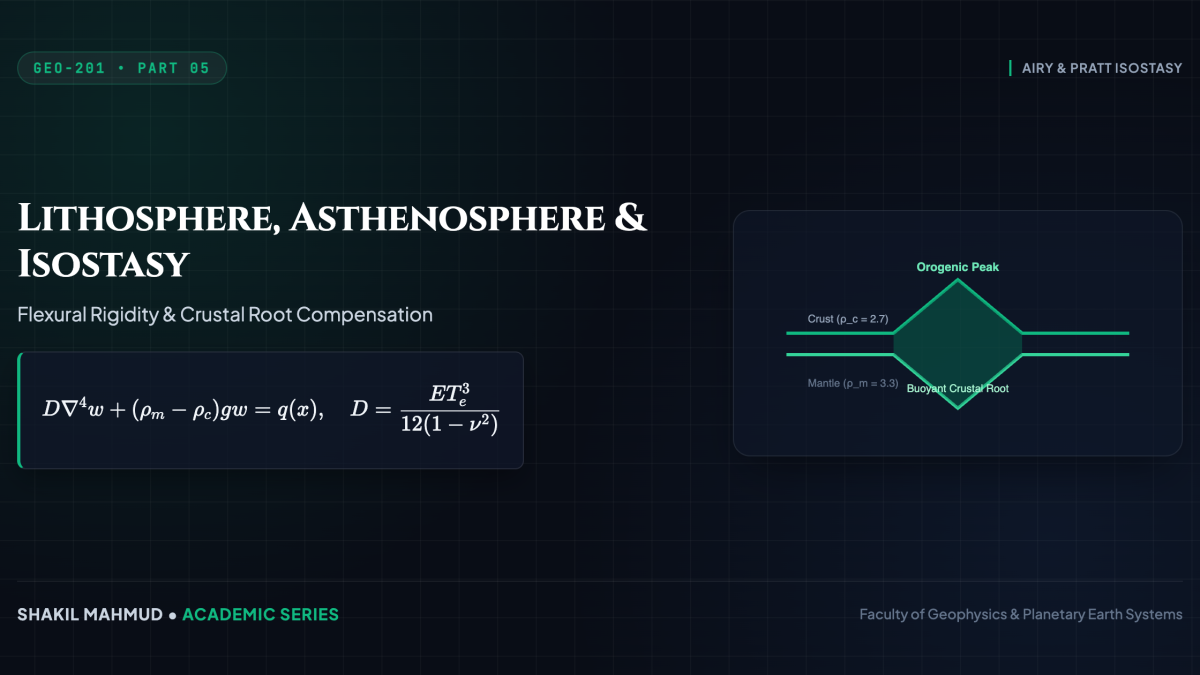
The outermost mechanical shell of the Earth—the lithosphere—behaves as a coherent, elastic-brittle lid that floats atop the underlying ductile, convective asthenosphere. When surface loads such as volcanic seamounts, ice sheets, or orogenic thrust wedges are emplaced upon the crust, the lithosphere bends elastically, distributing shear stresses and achieving gravitational hydrostatic equilibrium known as isostasy.
1. Classical Isostatic Models: Airy vs. Pratt
Isostasy describes the gravitational balance of topographic relief above an idealized depth of compensation ((z_c)), where hydrostatic pressure (int_0^{z_c}
ho(z) g , dz) is laterally uniform across all columns.
A. The Airy-Heiskanen Hypothesis (Variable Crustal Thickness)
Airy postulated that the crust has uniform density (
ho_c) and floats on a denser mantle (
ho_m). Surface topography of elevation (h) is supported by a deep crustal “root” of thickness (r):
[
ho_c (h + t_0 + r) =
ho_c t_0 +
ho_m r implies r = h left( rac{
ho_c}{
ho_m –
ho_c}
ight)
]
Taking typical densities (
ho_c approx 2700 ext{ kg/m}^3) and (
ho_m approx 3300 ext{ kg/m}^3), the root ratio is (r / h approx 4.5). An 8-km-high mountain range (such as the Himalayas) requires a crustal root extending (sim 36 ext{ km}) into the mantle, yielding total crustal thickness exceeding (70 ext{ km}), exactly matching deep seismic reflection surveys.
B. The Pratt-Hayford Hypothesis (Variable Crustal Density)
Pratt assumed a constant compensation depth (D), where variations in topography are balanced by lateral variations in crustal density (
ho(h)):
[
ho(h)(D + h) =
ho_0 D implies
ho(h) =
ho_0 left( rac{D}{D + h}
ight)
]
While Airy isostasy dominates continental orogens, Pratt-type density contrasts describe mid-ocean ridges, where hot, buoyant, low-density mantle upwelling supports elevated ocean floor topography.
2. Thin Elastic Plate Flexure Theory
In reality, the lithosphere possesses finite mechanical strength and flexural rigidity, supporting loads by elastic bending rather than purely localized hydrostatic flotation. Modeling the lithosphere as a thin elastic plate of thickness (T_e) under plane strain, the vertical deflection (w(x)) under vertical load (q(x)) is governed by the fourth-order biharmonic differential equation:
[
D rac{d^4 w}{dx^4} + P rac{d^2 w}{dx^2} + (
ho_m –
ho_{ ext{infill}}) g w(x) = q(x)
]
where (P) is horizontal tectonic in-plane force, (
ho_{ ext{infill}}) is the density of material filling the deflected trough (water or sediment), and (D) is the flexural rigidity:
[
D = rac{E T_e^3}{12(1 –
u^2)}
]
Here (E approx 10^{11} ext{ Pa}) is Young’s modulus, (
u approx 0.25) is Poisson’s ratio, and (T_e) is the effective elastic thickness. Defining the characteristic flexural parameter (alpha):
[
alpha = left( rac{4 D}{(
ho_m –
ho_{ ext{infill}}) g}
ight)^{1/4}
]
For a localized line load (V_0) at (x = 0) (such as an oceanic volcanic chain), the deflection takes the damped oscillatory form:
[
w(x) = w_0 e^{-x/alpha} left( cosrac{x}{alpha} + sinrac{x}{alpha}
ight)
]
This formulation naturally predicts the forebulge: a peripheral topographic uplift flanking the deflection moat, observed prominently around the Hawaiian Islands and seaward of oceanic trenches.
3. Effective Elastic Thickness ((T_e)) and Thermal Age
In oceanic plates, (T_e) scales rigorously with plate thermal age (t), tracking the depth to the (450 ext{–}600^circ ext{C}) cooling isotherm:
[
T_e approx C sqrt{t}
]
Young oceanic lithosphere near ridges has (T_e < 5 ext{ km}) (approaching pure Airy isostasy), whereas ancient Mesozoic seafloor exhibits (T_e approx 30 ext{–}40 ext{ km}). In ancient continental cratons, where cold, depleted lithospheric keels extend deeper than 200 km, (T_e) can exceed (100 ext{ km}), providing immense mechanical stability over billions of years.
4. Post-Glacial Rebound and Asthenospheric Viscosity
When the immense Quaternary ice sheets (such as the Laurentide and Fennoscandian sheets, thickness (> 3 ext{ km})) melted abruptly during the Holocene transition ((sim 12 ext{–}10 ext{ ka})), the depressed lithosphere began an ongoing isostatic uplift called post-glacial rebound. The exponential relaxation time ( au_r) of rebound directly constrains the kinematic viscosity of the underlying asthenosphere:
[
au_r = rac{2 ta_a k}{
ho_m g}
]
where (k = 2pi / lambda_{ ext{ice}}) is the wavenumber of the unloaded surface. Geodetic GPS and gravity satellite (GRACE) measurements establish an upper mantle asthenospheric viscosity of (ta_a approx 10^{20} ext{–}10^{21} ext{ Pa}cdot ext{s}).