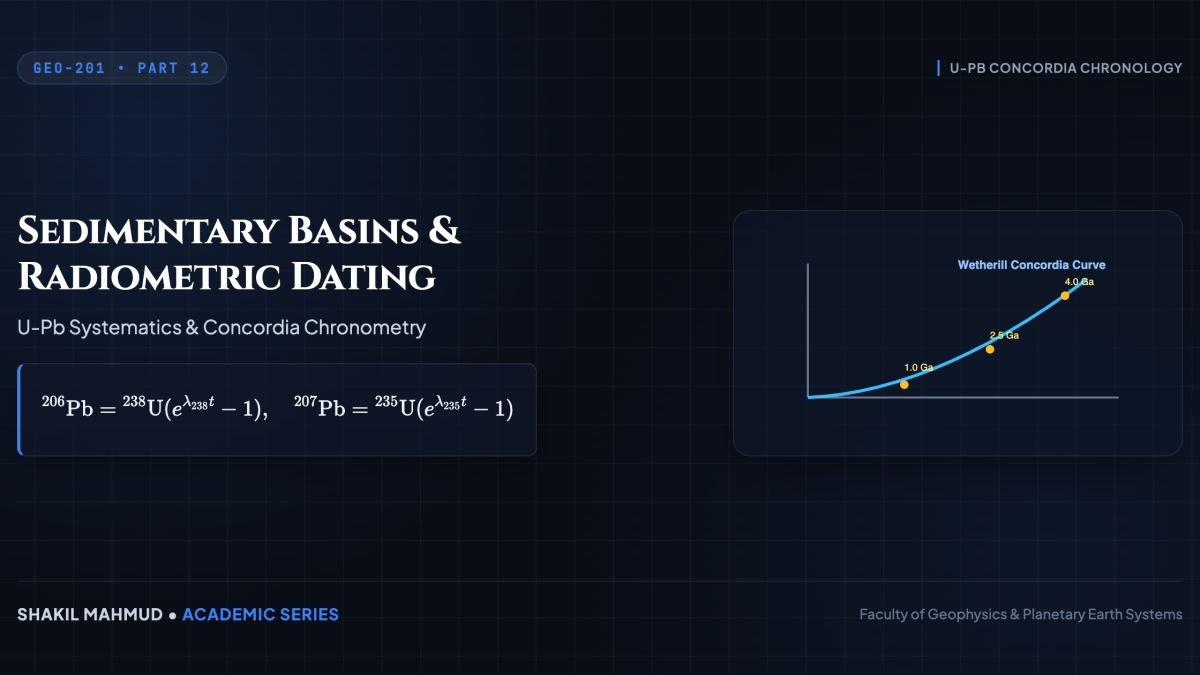
Sedimentary basins are the ultimate archives of planetary history, preserving continuous records of ocean chemistry, biological macroevolution, and paleoclimate across billions of years. To transform these physical rock strata into an absolute chronological framework, geologists combine sequence stratigraphy with the high-precision physics of radioactive isotope geochronology, unlocking the 4.56-billion-year continuum of deep geological time.
1. Sedimentary Basin Geodynamics and McKenzie Thermal Subsidence
Sedimentary basins develop when regional lithospheric subsidence creates accommodation space for sediments. In extensional rift basins, subsidence proceeds in two distinct thermodynamic stages modeled by Dan McKenzie (1978):
A. Initial Fault-Controlled Tectonic Subsidence ((S_i))
Instantaneous lithospheric thinning by a stretching factor (beta) causes isostatic readjustment:
[
S_i = rac{h_c left[ (1 – rac{alpha T_m}{2})rac{
ho_c}{
ho_m} – rac{h_c}{2 h_l}
ight] (1 – rac{1}{beta})}{rac{
ho_m –
ho_w}{
ho_m} (1 – alpha T_m)}
]
B. Thermal Subsidence ((S_t))
Following stretching, upwelled asthenospheric mantle cools conductively, contracting and causing exponential thermal subsidence over tens of millions of years:
[
S_t(t) = S_0 left( 1 – e^{-t/ au}
ight), quad au = rac{h_l^2}{pi^2 kappa} approx 62.8 ext{ Myr}
]
This prolonged thermal decay forms the expansive, stable post-rift sag basins hosting the planet’s vast hydrocarbon and groundwater reserves.
2. Radiometric Decay and The Age Equation
The spontaneous quantum decay of an unstable parent radioisotope (P) into a stable radiogenic daughter product (D) follows Poisson statistics governed by the constant decay rate (lambda):
[
rac{dP}{dt} = -lambda P implies P(t) = P_0 e^{-lambda t}
]
Because the number of daughter nuclei produced equals parent nuclei decayed ((D_{ ext{rad}} = P_0 – P = P(e^{lambda t} – 1))), the total daughter abundance accounting for initial non-radiogenic incorporation (D_0) is:
[
D = D_0 + P(e^{lambda t} – 1)
]
Normalizing against a stable, non-radiogenic reference isotope of the daughter element (D_{ ext{ref}}) yields the fundamental isochron equation:
[
rac{D}{D_{ ext{ref}}} = left(rac{D}{D_{ ext{ref}}}
ight)_0 + rac{P}{D_{ ext{ref}}} (e^{lambda t} – 1)
]
Plotting (D/D_{ ext{ref}}) versus (P/D_{ ext{ref}}) for cogenetic minerals yields a linear isochron whose slope (m = e^{lambda t} – 1) gives the unambiguous crystallization age (t = rac{1}{lambda}ln(1 + m)), independent of initial daughter concentration.
3. The U-Pb Concordia Geochronometer: The Gold Standard
The mineral zircon (( ext{ZrSiO}_4)) is the premier geochronological archive because its crystal lattice strongly incorporates uranium (( ext{U}^{4+})) while strictly excluding lead (( ext{Pb}^{2+})) during crystallization, and it boasts an exceptionally high closure temperature ((T_c > 900^circ ext{C})). Zircon contains two independent, coupled uranium decay schemes:
[
{}^{238} ext{U} o {}^{206} ext{Pb} quad (lambda_{238} = 1.55125 imes 10^{-10} ext{ yr}^{-1}, quad t_{1/2} = 4.468 ext{ Ga})
]
[
{}^{235} ext{U} o {}^{207} ext{Pb} quad (lambda_{235} = 9.8485 imes 10^{-10} ext{ yr}^{-1}, quad t_{1/2} = 0.704 ext{ Ga})
]
In a Wetherill Concordia Diagram, ({}^{206} ext{Pb}^*/{}^{238} ext{U}) is plotted against ({}^{207} ext{Pb}^*/{}^{235} ext{U}). The parametric locus of identical ages forms the curved Concordia line. If a zircon remains a closed system, its isotopic ratio plots precisely on the Concordia. If subsequent metamorphism induces lead loss, analyses fall along a straight discordia chord whose upper intercept dates the primary crystallization and lower intercept dates the metamorphic resetting event.
4. Dodson’s Closure Temperature Formulation
Radiometric clocks do not start immediately upon mineral formation; they initiate only when the mineral cools below a critical closure temperature ((T_c)), at which thermally activated volume diffusion of daughter isotopes becomes negligible over geological timescales. Martin Dodson (1973) formulated (T_c) as:
[
T_c = rac{E/R}{lnleft( -rac{A R T_c^2 (D_0 / a^2)}{E , (dT/dt)}
ight)}
]
where (E) is activation energy, (D_0) is diffusion pre-exponential factor, (a) is effective diffusion radius, (A) is a geometric shape factor, and (dT/dt) is the cooling rate. Utilizing multiple isotopic systems with varying closure temperatures (e.g., U-Pb in zircon: (> 900^circ ext{C}); Ar-Ar in hornblende: (sim 500^circ ext{C}); Ar-Ar in biotite: (sim 300^circ ext{C}); fission tracks in apatite: (sim 110^circ ext{C})) allows geochronologists to map complete, high-resolution cooling and exhumation trajectories through deep geological time.