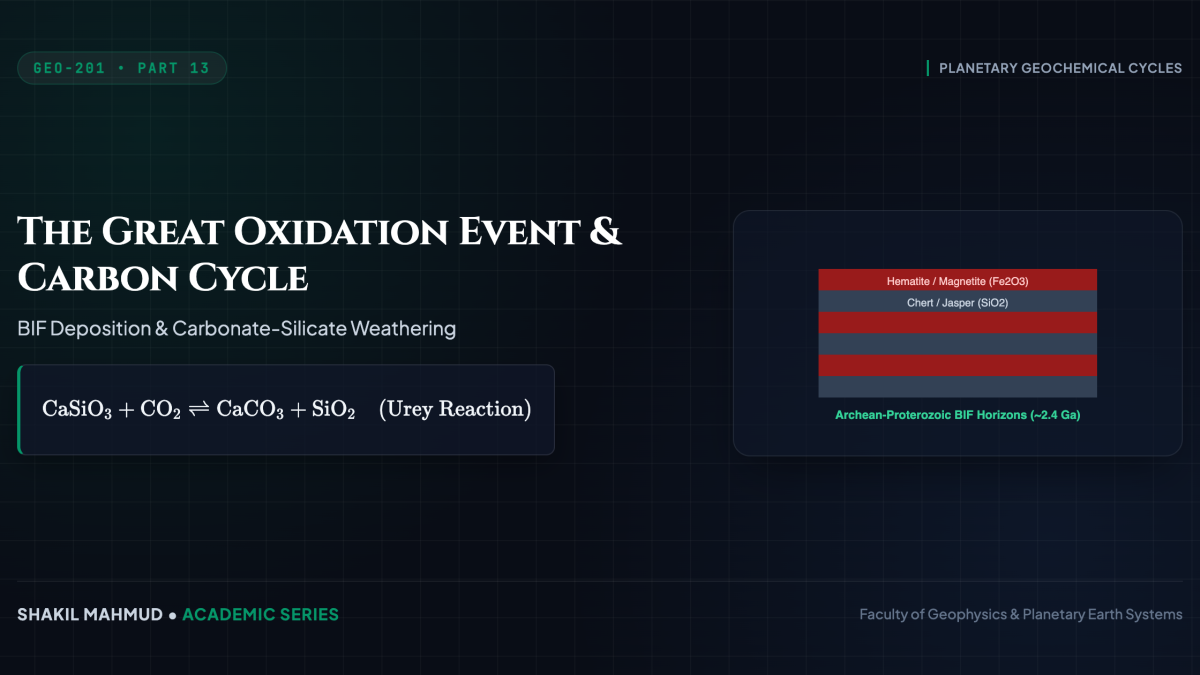
Planetary habitability over geological timescales is governed by coupled geochemical feedbacks operating between the solid Earth, oceans, biosphere, and atmosphere. Approximately 2.45 to 2.22 billion years ago, the rise of biogenic oxygen production triggered the Great Oxidation Event (GOE), permanently transforming planetary surface redox chemistry. Concurrently, the carbon-silicate weathering cycle established a self-regulating geological thermostat that has prevented runaway icehouse or greenhouse climates for four billion years.
1. The Archean Anoxic Earth and Banded Iron Formations (BIFs)
Throughout the Archean Eon ((4.0 ext{–}2.5 ext{ Ga})), Earth’s atmosphere was essentially anoxic ((p ext{O}_2 < 10^{-5}) of present atmospheric level, PAL). In this reducing ocean, dissolved iron existed in the soluble ferrous state (( ext{Fe}^{2+})). The emergence of oxygenic photosynthesis in cyanobacteria ((2 ext{H}_2 ext{O} + ext{CO}_2 + h
u o ext{CH}_2 ext{O} + ext{O}_2)) began generating free molecular oxygen.
Initially, dissolved ( ext{O}_2) was quantitatively scavenged by the ocean’s immense ferrous iron reservoir, oxidizing ( ext{Fe}^{2+}) to insoluble ferric iron (( ext{Fe}^{3+})):
[
4 ext{Fe}^{2+} + ext{O}_2 + 10 ext{H}_2 ext{O} o 4 ext{Fe(OH)}_3downarrow + 8 ext{H}^+ xrightarrow{Delta T, P} 2 ext{Fe}_2 ext{O}_3 ext{ (Hematite)} / ext{Fe}_3 ext{O}_4 ext{ (Magnetite)}
]
This rhythmic marine precipitation created the colossal Banded Iron Formations (BIFs)—alternating millimeter-to-centimeter laminations of iron oxides and chert (( ext{SiO}_2))—which constitute the planet’s vast commercial iron ore reserves (e.g., Hamersley Basin, Australia; Lake Superior, North America).
2. Geochemical Fingerprints of the GOE: Mass-Independent Fractionation
The transition from an anoxic to an oxygenated atmosphere is definitively recorded by sulfur isotope systematics. In an anoxic atmosphere lacking an ozone screen (( ext{O}_3)), deep ultraviolet photolysis ((lambda < 200 ext{ nm})) of volcanic sulfur dioxide (( ext{SO}_2)) produces mass-independent fractionation of sulfur isotopes (MIF-S), parameterized by non-zero (Delta^{33} ext{S}):
[
Delta^{33} ext{S} = delta^{33} ext{S} – left[ (1 + delta^{34} ext{S})^{0.515} – 1
ight]
e 0
]
At exactly (sim 2.45 ext{ Ga}), the large MIF-S anomalies that characterized the entire Archean rock record collapsed abruptly to (Delta^{33} ext{S} approx 0). The accumulation of atmospheric oxygen formed a protective stratospheric ozone layer, shielding lower tropospheric ( ext{SO}_2) from solar UV photolysis and providing incontrovertible geochemical proof that (p ext{O}_2) crossed the critical threshold of (10^{-5} ext{ PAL}).
3. The Carbon-Silicate Weathering Thermostat: The Urey Reaction
Volcanic degassing continuously injects ( ext{CO}_2) into the atmosphere at rates of (sim 0.1 ext{–}0.3 ext{ Gt C/yr}). Without a chemical sink, planetary surface temperatures would escalate catastrophically into a Venusian runaway greenhouse. The balancing sink is continental silicate weathering, formalized by Harold Urey (1952):
[
ext{CaSiO}_3 ext{ (Wollastonite)} + 2 ext{CO}_2 + ext{H}_2 ext{O} xrightarrow{ ext{Weathering}} ext{Ca}^{2+} + 2 ext{HCO}_3^- + ext{SiO}_2 ext{ (aq)}
]
Rivers transport dissolved calcium and bicarbonate ions to the ocean, where calcifying organisms precipitate solid marine limestone:
[
ext{Ca}^{2+} + 2 ext{HCO}_3^- xrightarrow{ ext{Oceanic Deposition}} ext{CaCO}_3downarrow ext{ (Calcite)} + ext{CO}_2 + ext{H}_2 ext{O}
]
Subtracting oceanic carbonate precipitation from continental weathering yields the net global drawdown reaction:
[
ext{CaSiO}_3 + ext{CO}_2
ightleftharpoons ext{CaCO}_3 + ext{SiO}_2
]
This reaction functions as a negative feedback loop: higher atmospheric ( ext{CO}_2) elevates global temperatures and intensifies the hydrological cycle, which accelerates chemical silicate weathering rates (governed by Arrhenius kinetics (k propto e^{-E_a/RT})). This strips excess ( ext{CO}_2) from the air, cooling the planet back toward equilibrium over characteristic response times of (sim 10^5 ext{–}10^6 ext{ years}).
4. The Faint Young Sun Paradox
Standard stellar evolution models dictate that during the Archean, solar luminosity was (sim 25 ext{–}30%) lower than today ((L_odot approx 0.70 ext{–}0.75 L_0)). Under modern greenhouse gas concentrations, the Archean Earth would have been permanently frozen solid. Yet sedimentological evidence proves abundant liquid oceans and active microbial life existed throughout the Archean.
The carbon-silicate thermostat resolves this paradox: slower weathering rates on the colder early planet allowed volcanic ( ext{CO}_2) and biogenic methane (( ext{CH}_4)) to accumulate to elevated partial pressures, providing sufficient greenhouse radiative forcing ((Delta F = 5.35 ln(C/C_0) ext{ W/m}^2)) to maintain liquid oceans under a faint sun.