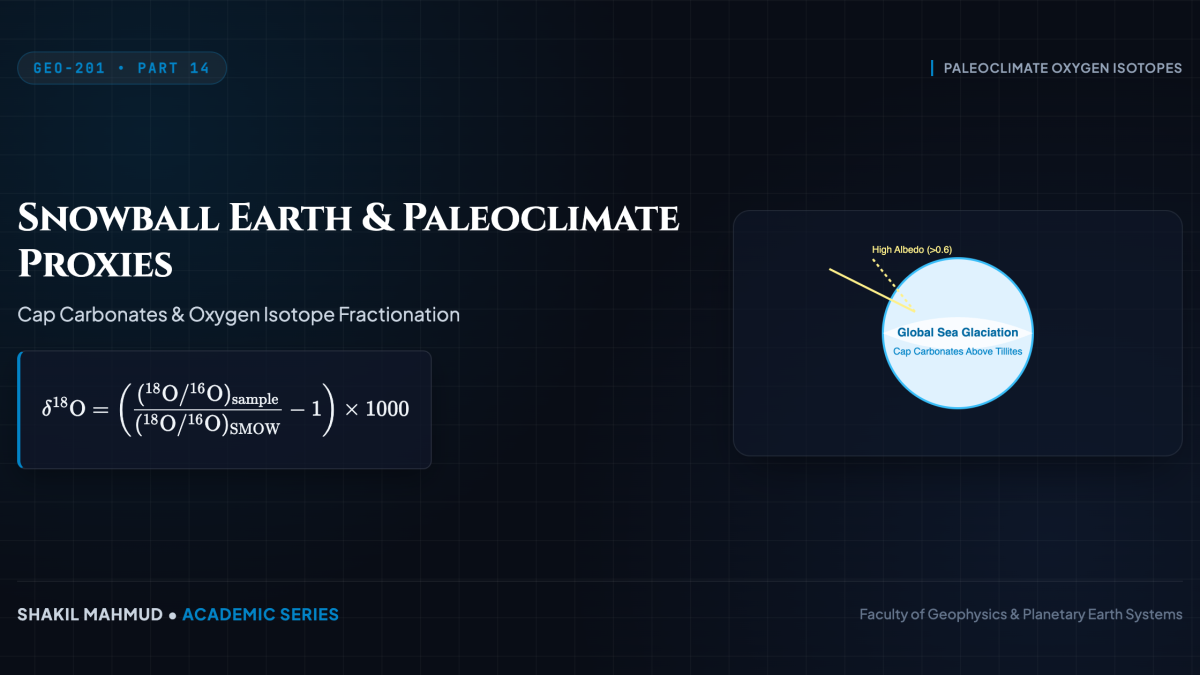
During the Neoproterozoic Era ((sim 720 ext{–}635 ext{ Ma})), Earth experienced the most severe climatic crises in its history: the Snowball Earth glaciations (the Sturtian and Marinoan episodes). Glacial ice sheets extended from the poles to the equator, encasing the global ocean beneath a continuous kilometer-thick shell of sea ice. Deciphering these extreme paleoclimate excursions relies on high-precision stable isotope geochemistry, notably the oxygen isotope paleothermometer ((delta^{18} ext{O})) and carbon isotope systematics ((delta^{13} ext{C})).
1. The Ice-Albedo Positive Feedback and The Budyko-Sellers Instability
The initiation of Snowball Earth is governed by the positive feedback between ice cover and planetary surface albedo ((alpha_p)). Open seawater has a very low albedo ((alpha_{ ext{water}} approx 0.06 ext{–}0.10)), absorbing (> 90%) of incoming solar insolation (S_0). In contrast, sea ice and fresh snow reflect most incident radiation ((alpha_{ ext{ice}} approx 0.60 ext{–}0.85)).
In one-dimensional energy balance climate models (Budyko, 1969; Sellers, 1969), planetary energy balance is formulated as:
[
rac{S_0}{4}(1 – alpha_p(phi_i)) = I(T) = A + B T
]
where (phi_i) is the latitude of the ice edge, and (I(T)) is outgoing longwave infrared radiation. As continental breakup positioned the supercontinent Rodinia in the tropics, elevated tropical rainfall and weathering stripped atmospheric ( ext{CO}_2), cooling the planet and advancing ice sheets equatorward. When the ice edge crossed a critical threshold latitude ((phi_{ ext{crit}} approx 30^circ)), the ice-albedo feedback became self-sustaining and unstable:
[
left. rac{d}{dphi_i} left[ rac{S_0}{4}(1 – alpha_p) – I(T)
ight]
ight|_{phi_{ ext{crit}}} > 0
]
Within less than a millennium, runaway glaciation plunged the entire globe into a frozen Snowball state with surface temperatures plunging below (-50^circ ext{C}).
2. Deglaciation Mechanics: Volcanic Super-Greenhouses and Cap Carbonates
How did Earth escape this frozen stasis? With the oceans sealed under ice, the hydrologic cycle collapsed, halting chemical silicate weathering (( ext{weathering rate} o 0)). However, deep-seated volcanic outgassing continued unabated through subaerial fissures and rift volcanoes.
Over 10 to 30 million years, volcanic ( ext{CO}_2) accumulated unhindered in the atmosphere, eventually reaching colossal partial pressures ((p ext{CO}_2 approx 0.1 ext{–}0.2 ext{ bar}), several hundred times modern levels). The resulting immense greenhouse radiative forcing finally overpowered the high ice albedo, triggering rapid, catastrophic deglaciation.
Global deglaciation exposed freshly ground, pulverized glacial till to tropical torrential rains and extreme heat ((T > 40^circ ext{C})). Hyper-intense chemical weathering transferred massive quantities of ( ext{Ca}^{2+}) and ( ext{HCO}_3^-) into the post-glacial oceans, depositing thick, continuous, laterally extensive Cap Carbonates (limestones and dolostones) directly atop glacial diamictites worldwide.
3. Carbon Isotope Systematics ((delta^{13} ext{C})) in Neoproterozoic Strata
Stable carbon isotope ratios (({}^{13} ext{C}/{}^{12} ext{C})) are expressed in per mil ((‰)) relative to the Vienna Pee Dee Belemnite (VPDB) standard:
[
delta^{13} ext{C} = left( rac{(^{13} ext{C}/^{12} ext{C})_{ ext{sample}}}{(^{13} ext{C}/^{12} ext{C})_{ ext{VPDB}}} – 1
ight) imes 1000
]
Photosynthetic carbon fixation (via the enzyme RuBisCO) preferentially incorporates the lighter ({}^{12} ext{C}) isotope, leaving marine dissolved inorganic carbon (DIC) enriched in ({}^{13} ext{C}) (typically (delta^{13} ext{C} approx +1 ext{–}+5‰)).
In cap carbonates overlying Snowball glacial deposits, (delta^{13} ext{C}) exhibits massive negative excursions, plunging to (-5‰) or lower. This isotopic collapse reflects two factors: (1) total biological collapse of the marine photosynthetic carbon pump during glaciation, and (2) rapid precipitation of carbonates derived from mantle volcanic ( ext{CO}_2) ((delta^{13} ext{C}_{ ext{mantle}} approx -6‰)) without biological fractionation.
4. Stable Oxygen Isotope Geothermometry ((delta^{18} ext{O})) and Ice Volume
The stable oxygen isotope ratio (({}^{18} ext{O}/{}^{16} ext{O})) recorded in ancient marine carbonates (calcite/aragonite) serves as the primary quantitative proxy for paleotemperature and global ice volume:
[
delta^{18} ext{O} = left( rac{(^{18} ext{O}/^{16} ext{O})_{ ext{sample}}}{(^{18} ext{O}/^{16} ext{O})_{ ext{V-SMOW}}} – 1
ight) imes 1000
]
During evaporation, water molecules containing the lighter ({}^{16} ext{O}) isotope evaporate preferentially due to higher vapor pressure (Rayleigh fractionation). As clouds precipitate while moving poleward, ({}^{18} ext{O}) is progressively rained out. Consequently, glacial ice sheets are severely depleted in ({}^{18} ext{O}) ((delta^{18} ext{O} approx -30 ext{–}-55‰)), leaving the global ocean enriched in heavy ({}^{18} ext{O}).
In carbonate precipitation, thermodynamic mineral-water isotope exchange is temperature-dependent:
[
T(^circ ext{C}) = 16.9 – 4.38(delta^{18} ext{O}_c – delta^{18} ext{O}_w) + 0.10(delta^{18} ext{O}_c – delta^{18} ext{O}_w)^2
]
Measuring (delta^{18} ext{O}) across benthic foraminifera tests across the Cenozoic reconstructs the 65-million-year climatic transition from the Paleocene-Eocene Thermal Maximum greenhouse to Quaternary orbital-scale glacial cycles (Milankovitch cyclicity).