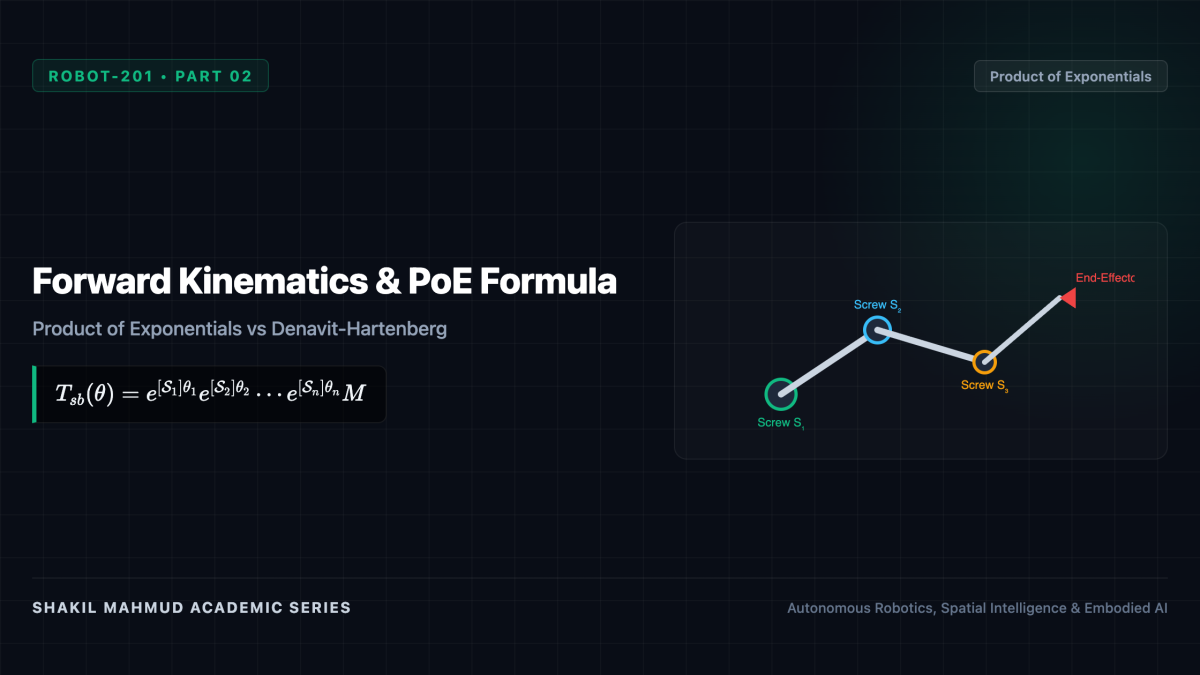
Forward kinematics answers the fundamental robot configuration problem: given the vector of joint angles ( heta = [ heta_1, heta_2, dots, heta_n]^T), what is the spatial pose (position and orientation) of the end-effector in the workspace? For decades, the classical Denavit-Hartenberg (DH) convention dominated textbook kinematics. However, modern roboticists increasingly rely on Brockett’s geometric Product of Exponentials (PoE) formula, which treats each joint as a spatial screw displacement defined in a single coordinate frame.
1. The Classical Denavit-Hartenberg (DH) Convention
Introduced in 1955, the DH convention assigns a local coordinate frame ({i}) to each link and parameterizes the transformation from link (i-1) to link (i) using four geometric parameters:
- Link length (a_{i-1}): Distance between (hat{z}_{i-1}) and (hat{z}_i) along (hat{x}_{i-1}).
- Link twist (alpha_{i-1}): Angle from (hat{z}_{i-1}) to (hat{z}_i) measured about (hat{x}_{i-1}).
- Joint offset (d_i): Distance between (hat{x}_{i-1}) and (hat{x}_i) along (hat{z}_i) (variable for prismatic joints).
- Joint angle ( heta_i): Angle from (hat{x}_{i-1}) to (hat{x}_i) measured about (hat{z}_i) (variable for revolute joints).
The homogeneous link transformation matrix is:
[
A_i( heta_i) = begin{bmatrix}
cos heta_i & -sin heta_i cosalpha_i & sin heta_i sinalpha_i & a_i cos heta_i
sin heta_i & cos heta_i cosalpha_i & -cos heta_i sinalpha_i & a_i sin heta_i
0 & sinalpha_i & cosalpha_i & d_i
0 & 0 & 0 & 1
nd{bmatrix}
]
The forward kinematics map is obtained by chained matrix products: (T_{0n}( heta) = A_1( heta_1) A_2( heta_2) cdots A_n( heta_n)).
2. Fundamental Pitfalls of the DH Convention
While compact, the DH approach suffers from severe practical liabilities in industrial and research robotics:
- Ambiguity in Frame Assignment: For parallel or intersecting joint axes, the common normal is undefined or arbitrary, forcing non-intuitive convention choices.
- Parametric Discontinuities: When two joint axes are nearly parallel (e.g., in robot calibration), tiny physical alignment errors cause discontinuous jumps in the link parameter values ((d_i o infty)), wrecking numerical optimization.
- Tedious Frame Layout: An (n)-DoF robot requires setting up and tracking (n+1) distinct coordinate systems.
3. Brockett’s Product of Exponentials (PoE) Formulation
Developed by Roger Brockett in 1984, the Product of Exponentials (PoE) formulation represents forward kinematics by viewing each joint motion as an exponential screw transformation:
[
T_{sb}( heta) = e^{[mathcal{S}_1] heta_1} e^{[mathcal{S}_2] heta_2} cdots e^{[mathcal{S}_n] heta_n} M
]
Where:
- (M in ext{SE}(3)): The initial “zero-reference” pose of the end-effector frame ({B}) relative to base frame ({S}) when all joint angles ( heta_i = 0).
- (mathcal{S}_i = [omega_i^T, v_i^T]^T in mathbb{R}^6): The screw axis of joint (i), defined entirely in the stationary base frame ({S}) when the robot is at its zero-reference pose.
For a revolute joint rotating about unit axis (hat{omega}_i) passing through point (q_i) on the axis:
[
omega_i = hat{omega}_i, quad v_i = -hat{omega}_i imes q_i
]
For a prismatic joint translating along unit direction (hat{v}_i):
[
omega_i = mathbf{0}, quad v_i = hat{v}_i
]
4. Mathematical and Computational Advantages of PoE
| Feature | Denavit-Hartenberg (DH) | Product of Exponentials (PoE) |
|---|---|---|
| Coordinate Frames | (n+1) individual link frames | Only 2 frames: Base ({S}) and End-Effector ({B}) |
| Parallel Axes | Singularities / discontinuous jumps | Smooth, continuous parametric representation |
| Differential Kinematics | Complex frame-by-frame derivation | Direct closed-form geometric Jacobian columns |
| Kinematic Calibration | Ill-conditioned for parallel joints | Well-conditioned, smooth gradients on Lie algebra |
The PoE formulation unifies forward kinematics, velocity Jacobians, and recursive dynamics under a clean coordinate-free geometric umbrella, serving as the standard foundation in modern robotic libraries (e.g., Pinocchio, Modern Robotics).