From the agile backflips of MIT Cheetah to the industrial inspections of Boston Dynamics Spot and ANYbotics ANYmal, four-legged robots represent a golden age of bio-inspired dynamic locomotion. Dynamic quadrupeds negotiate jagged boulders, ice sheets, and urban rubble at high velocities by continuously making and breaking foot contacts. Mastering this agility demands a hierarchical control architecture: Convex Whole-Body Model Predictive Control (WB-MPC) planning ground reaction forces over a multi-step horizon, paired with high-frequency Whole-Body Control (WBC) enforcing motor torque passivity.
1. Single Rigid-Body Dynamics (SRBD) for Quadrupeds
During dynamic trotting, the mass of the 4 legs constitutes less than (10%) of total robot mass. High-performance quadrupeds abstract the robot as a Single Rigid Body (SRBD) of mass (m) and rotational inertia tensor (I in mathbb{R}^{3 imes 3}) acted upon by contact forces (f_i in mathbb{R}^3) from feet currently in ground contact:
[
m ddot{p} = sum_{i=1}^4 f_i – m g mathbf{1}_z
]
[
rac{d}{dt} left( I omega
ight) = sum_{i=1}^4 left( r_i – p
ight) imes f_i
]
Where (p) is the base Center of Mass position and (r_i) is the spatial location of the (i)-th foot. Assuming small roll and pitch angles, the rotational dynamics linearize cleanly, converting the non-linear multi-body equations into a linear state-space system (dot{x} = A x + B u).
2. Unilateral Contact Physics: Coulomb Friction Cones
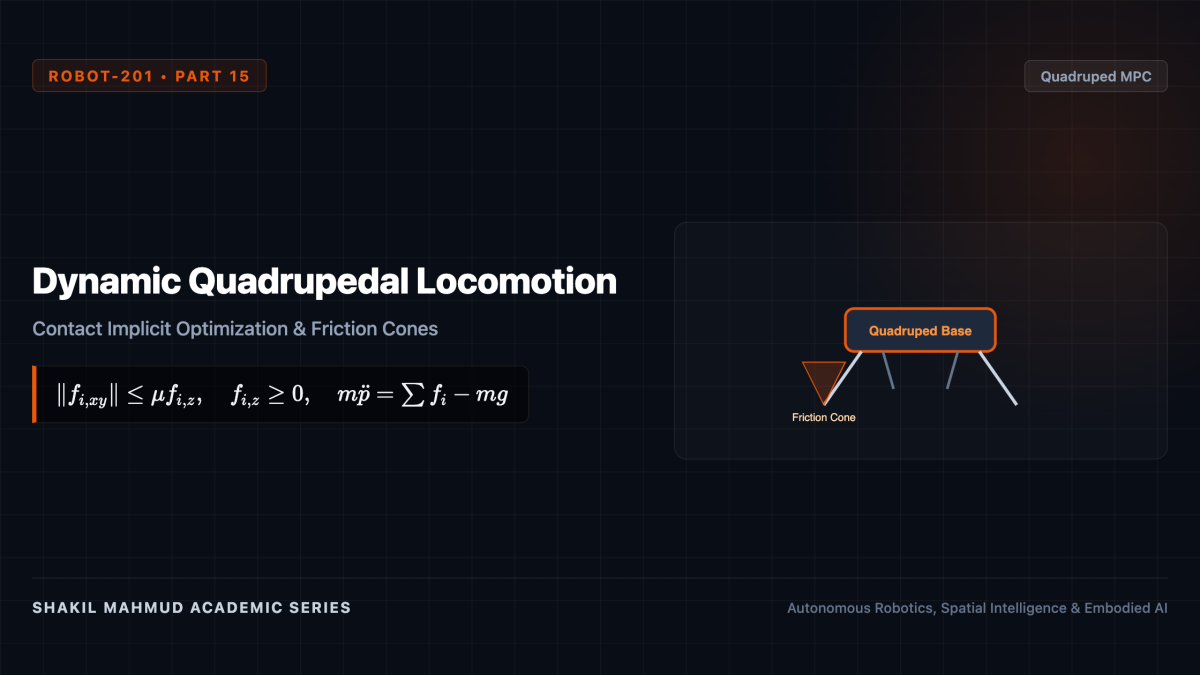
Unlike manipulation grippers, robot feet cannot pull or stick to the ground. The contact forces (f_i = [f_{i,x}, f_{i,y}, f_{i,z}]^T) must strictly obey physical boundary laws:
- Unilateral Contact: The ground can only push upward: (f_{i,z} ge f_{min} > 0) (during stance phase) and (f_{i,z} = 0) (during swing phase).
- Coulomb Friction Cone: Tangential traction forces cannot exceed maximum static friction without slipping:
[
|f_{i,xy}| = sqrt{f_{i,x}^2 + f_{i,y}^2} le mu f_{i,z}
]
To preserve convexity for real-time QP solvers, the circular friction cone is conservatively approximated as a 4-sided pyramid:
[
|f_{i,x}| le rac{mu}{sqrt{2}} f_{i,z}, quad |f_{i,y}| le rac{mu}{sqrt{2}} f_{i,z}
]
3. Hierarchical Control Architecture: MPC + Whole-Body Control (WBC)
Modern quadrupeds operate via a two-tier hierarchical control framework:
- High-Level Convex MPC ((30 ext{–}100 ext{ Hz})): Optimizes ground reaction forces (f_i^*) over a receding horizon of (0.5 ext{ seconds}) ((N approx 10 ext{–}15) steps) given a gait schedule (trot, pace, bound). The optimization ensures dynamic momentum tracking while respecting friction pyramids and foot clearance.
- Low-Level Whole-Body Control (WBC) ((1 ext{ kHz})): Solves a hierarchical quadratic program (HQP) across all 12 motor actuators in strict null-space priority order:
- Priority 1: Enforce contact holonomic constraints (stance feet must not move).
- Priority 2: Realize optimal ground reaction forces (f_i^*) commanded by MPC.
- Priority 3: Track swing foot Cartesian trajectories to step over obstacles.
- Priority 4: Regulate posture, joint damping, and singularity avoidance.
This decoupling provides extraordinary resilience: if a foot slips on black ice or bumps a step mid-swing, the 1 kHz WBC instantly adjusts motor torques to absorb the impact while the 100 Hz MPC re-plans the next footfall.