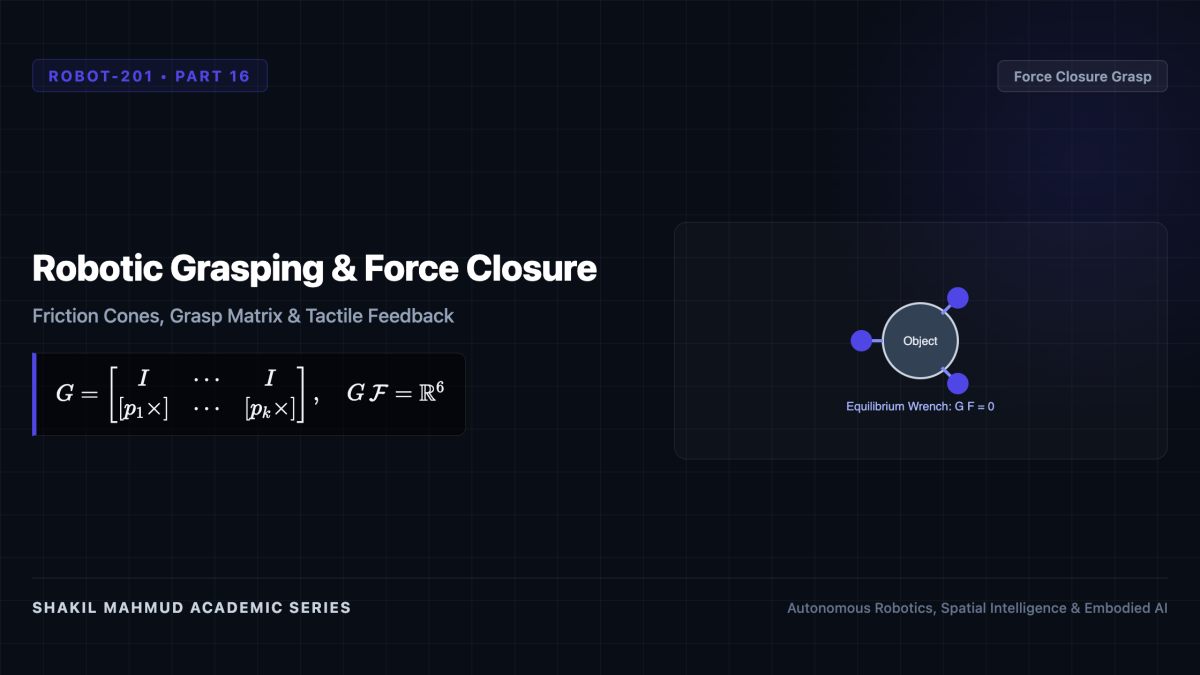
Locomotion empowers a robot to move through the physical world, but dexterous manipulation empowers a robot to transform it: picking up eggs without crushing them, inserting peg keys into locks, threading needles, and wielding hand tools. Operating multi-fingered anthropomorphic robotic hands requires mastering the mechanics of unilateral frictional contact, the algebraic structure of the Grasp Matrix, the topological concept of Force Closure, and real-time tactile feedback.
1. Contact Mechanics: From Point Contacts to Soft Fingers
When a robotic fingertip contacts an object, physical interaction is governed by the contact model:
- Point Contact with Friction (PCWF): Contact transmits a 3D force vector (f = [f_x, f_y, f_z]^T) through the contact point, but cannot transmit moments ((m = 0)). It obeys the Coulomb friction cone: (|f_t| le mu f_n).
- Soft-Finger Contact: Viscoelastic silicone fingertips deform over a finite patch, transmitting a 3D force and an additional torsional frictional spin moment (m_n) about the contact normal:
[
|f_t| le mu f_n, quad |m_n| le gamma f_n
]
Where (gamma) is the torsional friction coefficient. Soft fingers dramatically stabilize grasps with fewer contact points.
2. J. Kenneth Salisbury’s Grasp Matrix
Consider an object grasped by (k) contacts at spatial points (p_1, dots, p_k). The Grasp Matrix (G in mathbb{R}^{6 imes m}) maps individual contact wrenches (f_i) into the net resultant wrench (mathcal{F}_{ ext{ext}} in mathbb{R}^6) exerted on the object’s Center of Mass:
[
mathcal{F}_{ ext{ext}} = G f = begin{bmatrix} I_{3 imes 3} & cdots & I_{3 imes 3} [p_1 imes] & cdots & [p_k imes] nd{bmatrix} begin{bmatrix} f_1 dots f_k nd{bmatrix}
]
Where ([p_i imes]) is the skew-symmetric cross-product matrix. By duality, the transpose (G^T) maps object spatial velocity (mathcal{V}) directly to contact point velocities.
3. Form Closure vs. Force Closure
Robotic manipulation defines two gold standards of grasp stability:
- Form Closure (Reuleaux, 1875): Purely geometric restraint where frictionless contacts completely prevent any infinitesimal displacement of the object in all directions (( ext{rank}(G) = 6) and the origin lies strictly inside the convex hull of contact normals). Form closure requires at least 7 frictionless contacts for 3D objects.
- Force Closure (Nguyen, 1988): Frictional restraint where fingers can equilibrate any arbitrary external disturbance wrench (mathcal{F}_{ ext{ext}} in mathbb{R}^6) using only admissible compressive contact forces that strictly remain inside their local Coulomb friction cones (mathcal{C}_i):
[
G left( mathcal{C}_1 imes cdots imes mathcal{C}_k
ight) = mathbb{R}^6
]
Force closure can be achieved with as few as 2 soft fingers or 3 hard point contacts (e.g., pinching a coffee mug).
4. The Ferrari-Canny Grasp Quality Metric
To evaluate which grasp candidate is most stable against disturbances, Carlo Ferrari and John Canny (1992) defined the Grasp Wrench Space (GWS) as the convex hull of all achievable unit-force contact wrenches:
[
mathcal{Q}_{ ext{GWS}} = ext{ConvexHull}left( bigcup_{i=1}^k G_i mathcal{F}_{i, ext{unit}}
ight)
]
The Ferrari-Canny Metric (psilon) is the radius of the largest 6D ball centered at the origin that can fit completely inside the Grasp Wrench Space:
[
psilon = max left{ r ge 0 middle| mathcal{B}_r(mathbf{0}) subseteq mathcal{Q}_{ ext{GWS}}
ight}
]
A grasp with (psilon > 0) possesses force closure. The magnitude (psilon) directly represents the worst-case external disturbance wrench the robot can resist in any direction before dropping the object.
5. Optical Tactile Sensing: GelSight and DIGIT
Pure vision fails during manipulation because the robot’s own hand inevitably occludes the object. To close the manipulation feedback loop, modern robots employ Optical Tactile Sensors (e.g., GelSight, DIGIT):
- An elastomeric transparent silicone gel pad is covered with a reflective retro-reflective membrane.
- Internal multi-color LEDs illuminate the gel from different angles, and an internal microscopic camera captures the deformation pattern when pressed against an object.
- Using photometric stereo, the sensor reconstructs sub-millimeter 3D contact geometry, slip vectors, and distributed shear stress fields in real time.
Tactile feedback allows robots to detect incipient slip within milliseconds, dynamically tightening their grip to handle delicate glassware, slippery fruits, and mechanical tools with human-like dexterity.