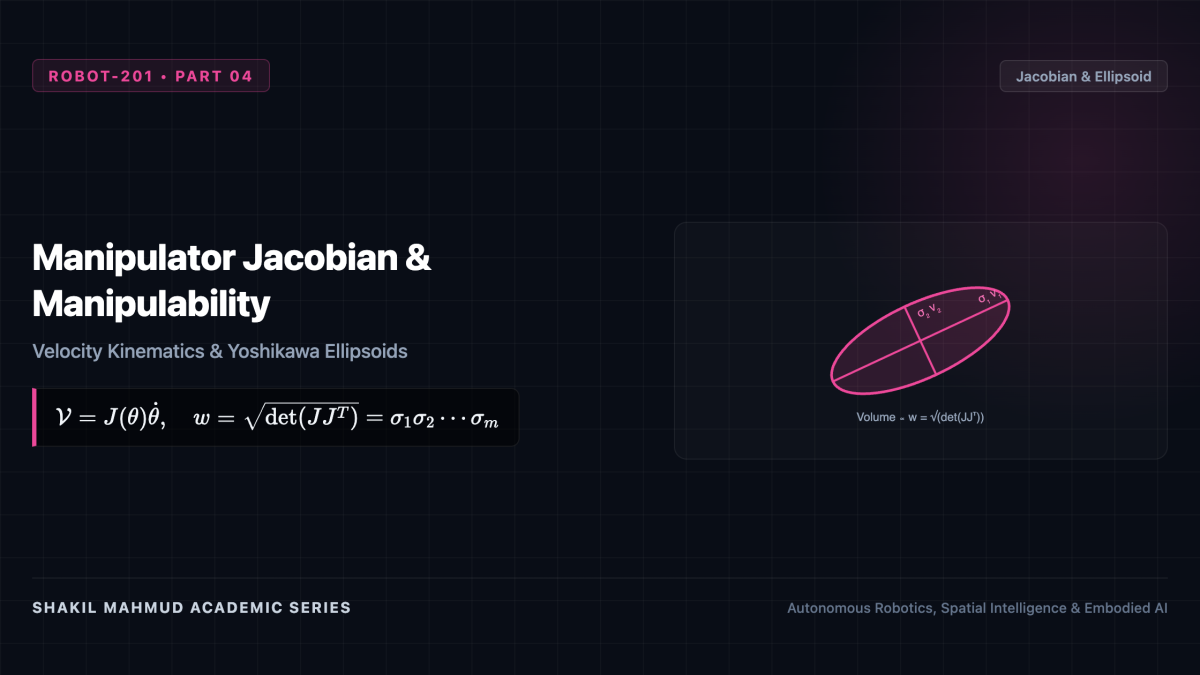
While kinematics maps joint coordinates to task-space positions, the Manipulator Differential Jacobian (J(q)) is the engine of robot motion control: it defines the linear mapping from joint velocities (dot{q} in mathbb{R}^n) to end-effector spatial velocities (twists) (mathcal{V} in mathbb{R}^6). By duality, the transpose Jacobian (J^T) maps task-space wrenches (forces and torques) to joint torques. Understanding the Jacobian reveals kinematic singularities where motion is lost and quantifies how dextrously a robot can maneuver in physical space.
1. Geometric vs. Analytical Jacobian
Robotics distinguishes between two formulations of the manipulator Jacobian:
- The Geometric Jacobian (J(q) in mathbb{R}^{6 imes n}): Relates joint velocities directly to the true physical spatial velocity (angular velocity (omega) and linear velocity (v)):
[
mathcal{V} = begin{bmatrix} omega v nd{bmatrix} = J(q) dot{q} = begin{bmatrix} J_omega(q) J_v(q) nd{bmatrix} dot{q}
]
Under the Product of Exponentials (PoE) framework, column (i) of the spatial Jacobian is simply the screw axis of joint (i) pushed forward by the preceding joint transformations:
[
J_{si}(q) = ext{Ad}_{e^{[mathcal{S}_1]q_1} cdots e^{[mathcal{S}_{i-1}]q_{i-1}}} (mathcal{S}_i)
] - The Analytical Jacobian (J_A(q)): Relates joint velocities to the time derivatives of a chosen task-space representation (such as Cartesian coordinates and Euler angles (dot{x} = [dot{p}^T, dot{phi}^T]^T)). The analytical Jacobian suffers from orientation representation singularities.
2. Kinematic Singularities: Rank Deficiency
A configuration (q) is a kinematic singularity if the Jacobian matrix loses rank:
[
ext{rank}(J(q)) < min(6, n) iff det(J(q) J^T(q)) = 0
]
At a singularity:
- The robot loses one or more degrees of freedom: there exist task-space directions in which the end-effector cannot move, regardless of joint velocity commands.
- Small desired velocities in the singular direction require infinite joint speeds ((dot{q} o infty)).
- By duality, the robot can resist infinite external forces in the singular direction without generating any motor torques (e.g., a locked human knee joint supporting body weight).
In standard 6-DoF articulated robots, singularities fall into three classes: boundary singularities (arm fully outstretched or folded), wrist singularities (axes 4 and 6 collinear), and shoulder/elbow singularities (wrist center intersecting the base axis).
3. Yoshikawa’s Manipulability Ellipsoid
To quantify a manipulator’s dexterity and proximity to singularities, Tsuneo Yoshikawa (1985) introduced the Manipulability Ellipsoid. Consider the set of all unit-norm joint velocities satisfying (|dot{q}|^2 = dot{q}^T dot{q} le 1). Mapping this hypersphere into task space via (dot{q} = J^+ mathcal{V}) yields:
[
mathcal{V}^T left( J J^T
ight)^{-1} mathcal{V} le 1
]
This defines an ellipsoid in task-space (mathbb{R}^6):
- The principal axes of the ellipsoid are aligned with the eigenvectors (u_i) of (J J^T), and their semi-axis lengths equal the singular values (sigma_i = sqrt{lambda_i}).
- The volume of the ellipsoid is proportional to Yoshikawa’s Manipulability Index (w):
[
w(q) = sqrt{det(J(q) J^T(q))} = sigma_1 sigma_2 cdots sigma_m
] - When (w(q) = 0), the ellipsoid flattens into a pancake of zero volume, indicating a singularity. Maximizing (w(q)) steers redundant robots into configurations with maximum agility.
4. Force/Velocity Duality and the Kinetostatic Wrench
By the principle of virtual work, the work done in joint space equals the work done in task space (( au^T dot{q} = mathcal{F}^T mathcal{V})). Substituting (mathcal{V} = J dot{q}) yields the fundamental Kinetostatic Duality:
[
au = J^T(q) mathcal{F}
]
Where (mathcal{F} = [m^T, f^T]^T) is the task-space wrench (moments and forces). While the velocity manipulability ellipsoid has axes along (sigma_i), the corresponding force manipulability ellipsoid has axes along (1/sigma_i). When an arm is stretched near a singularity, it cannot move quickly along that axis ((sigma_{min} o 0)), but it can exert immense mechanical forces along that same axis with minimal motor effort ((1/sigma_{min} o infty)).