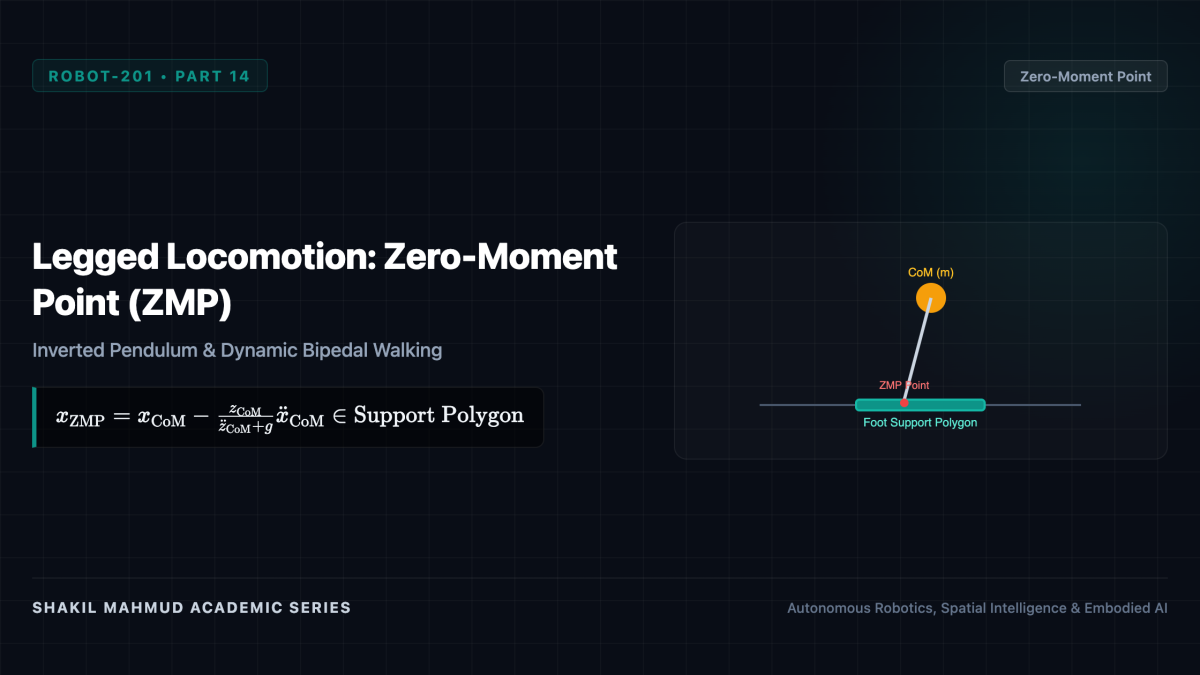
Wheeled rovers are confined to paved roads and flat terrain, whereas the biological world overwhelmingly relies on legged locomotion to negotiate staircases, rocky rubble, and unstructured environments. Unlike static multi-legged platforms that maintain stability by keeping their center of mass inside a support triangle, two-legged humanoids are continuously falling forward. Achieving dynamic bipedal walking requires Vukobratović’s foundational Zero-Moment Point (ZMP) theory and simplified Linear Inverted Pendulum Models (LIPM).
1. The Zero-Moment Point (ZMP) Criterion
Introduced in 1968 by Miomir Vukobratović, the Zero-Moment Point (ZMP) is defined as the unique point on the ground surface where the horizontal components of the tipping moment generated by gravity, inertia, and Coriolis forces identically vanish:
[
au_x(p_{ ext{ZMP}}) = 0, quad au_y(p_{ ext{ZMP}}) = 0
]
Writing the dynamic moment balance about the ground contact plane yields the analytical ZMP coordinates:
[
x_{ ext{ZMP}} = rac{sum m_i (ddot{z}_i + g) x_i – sum m_i ddot{x}_i z_i – sum I_{yy,i} dot{omega}_{y,i}}{sum m_i (ddot{z}_i + g)}
]
The Fundamental ZMP Stability Law:
A bipedal robot maintains dynamic balance without tipping over its foot edges if and only if the Zero-Moment Point remains strictly within the interior of the convex support polygon formed by the active foot contact area.
If the calculated ZMP reaches the boundary edge of the foot, unilateral ground reaction forces cannot generate an opposing restorative torque, causing the foot to rotate about the edge and the robot to topple.
2. The 3D Linear Inverted Pendulum Model (LIPM)
Simulating all 20+ joints of a humanoid is computationally unwieldy during fast walking. Shuuji Kajita (2001) simplified humanoid dynamics into the Linear Inverted Pendulum Model (LIPM) by constraining the robot’s Center of Mass (CoM) to move along a strictly horizontal plane at constant height (z_c):
[
ddot{x}_{ ext{CoM}} = rac{g}{z_c} left( x_{ ext{CoM}} – x_{ ext{ZMP}}
ight) = omega_0^2 left( x_{ ext{CoM}} – x_{ ext{ZMP}}
ight)
]
Where (omega_0 = sqrt{g / z_c}) is the natural pendulum eigenfrequency. Constraining the vertical height (ddot{z}_{ ext{CoM}} = 0) linearizes and completely uncouples the (x) and (y) motion dynamics! The solution is a hyperbolic trajectory: (x(t) = c_1 cosh(omega_0 t) + c_2 sinh(omega_0 t)).
3. Kajita’s Preview Control of ZMP
Because the LIPM has an unstable zero dynamics eigenvalue ((+omega_0)), instantaneous feedback control cannot stabilize walking. Future footstep intentions must be known in advance. Kajita formulated ZMP Preview Control:
[
u(t) = -K_I sum e_z(k) – K_x x(t) – sum_{j=1}^{N_p} F_j , p_{ ext{ZMP}}^{ ext{ref}}(t + j)
]
By previewing future ZMP reference steps (N_p) seconds ahead (typically (1.5 ext{ seconds})), the robot leans its upper body forward before initiating the swing leg step, seamlessly coordinating CoM momentum to keep the ZMP locked squarely within each alternating footstep.
4. The Capture Point and Capture Region
Jerry Pratt (2006) introduced the Capture Point (Instantaneous Capture Point, ICP): the exact ground point where a bipedal robot must place its swing foot to come to a complete, stable stop without falling:
[
x_{ ext{ICP}} = x_{ ext{CoM}} + rac{dot{x}_{ ext{CoM}}}{omega_0} = x_{ ext{CoM}} + sqrt{rac{z_c}{g}} dot{x}_{ ext{CoM}}
]
When pushed unexpectedly, modern humanoids evaluate their capture point in milliseconds: if the capture point flies outside the current foot support polygon, the robot immediately triggers an emergency recovery step directly onto the capture point, restoring upright equilibrium.