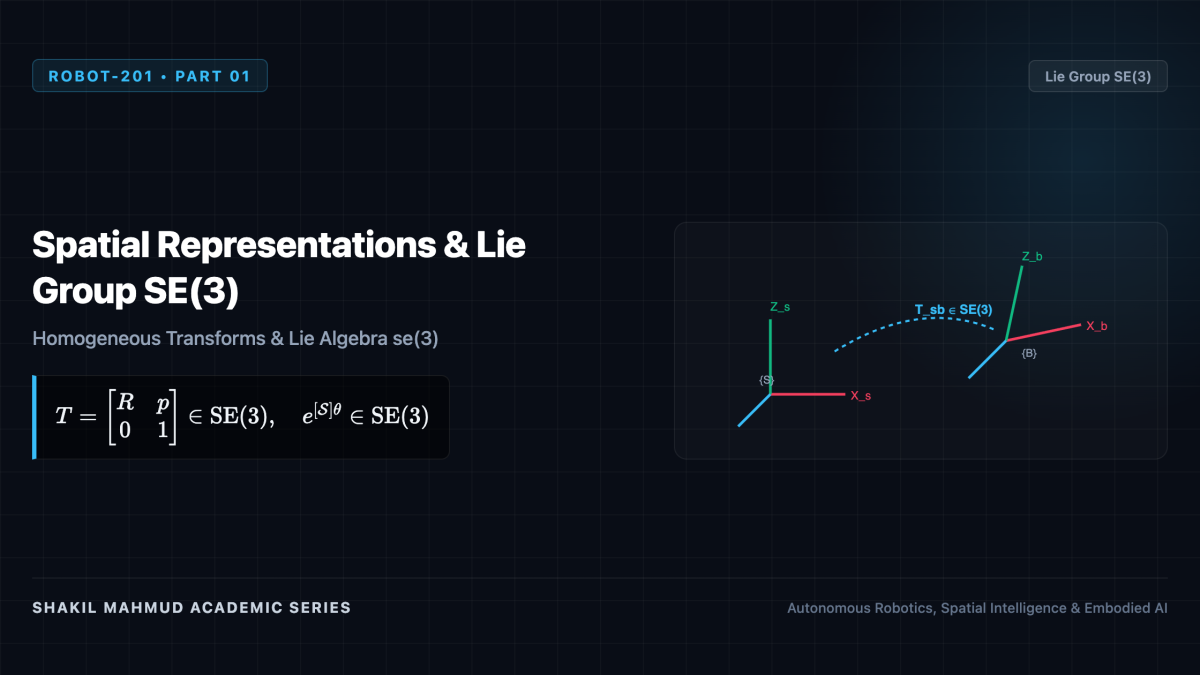
At the foundation of all autonomous robotics, mobile manipulation, and spatial intelligence lies the geometric problem of spatial representation: how to mathematically describe the position, orientation, and motion of rigid bodies in 3D Euclidean space. While naive parameterizations like Euler angles introduce artificial coordinate singularities (gimbal lock), modern robotics models spatial transformations through the elegant geometric framework of Lie groups and Lie algebras—specifically the Special Euclidean group ( ext{SE}(3)) and twist coordinates.
1. The Special Orthogonal Group SO(3) and Rotations
The orientation of a body frame ({B}) relative to a stationary spatial frame ({S}) is described by a (3 imes 3) rotation matrix (R in mathbb{R}^{3 imes 3}) belonging to the Special Orthogonal Group ( ext{SO}(3)):
[
ext{SO}(3) = left{ R in mathbb{R}^{3 imes 3} middle| R^T R = I, det(R) = +1
ight}
]
Properties of ( ext{SO}(3)) include:
- The columns of (R = [r_1, r_2, r_3]) form an orthonormal basis representing the unit axes of frame ({B}) expressed in frame ({S}).
- The inverse rotation equals its transpose: (R^{-1} = R^T).
- It preserves Euclidean lengths and angles: (|R p| = |p|) and ((R p) cdot (R q) = p cdot q).
2. Parameterizations: Euler Angles vs. Quaternions
While ( ext{SO}(3)) has 3 degrees of freedom, parameterizing it with 3 scalar numbers (such as (Z ext{-}Y ext{-}X) Tait-Bryan roll-pitch-yaw angles (alpha, beta, gamma)) inevitably encounters gimbal lock:
[
R_{ZYX}(alpha, beta, gamma) = R_z(alpha) R_y(beta) R_x(gamma)
]
When the pitch angle reaches (beta = pm pi/2) ((90^circ)), the roll and yaw rotation axes align, reducing the rank of the analytical Jacobian and causing angular velocities to diverge. To avoid singularities, robotics employs Unit Quaternions (q in mathbb{S}^3):
[
q = ta + psilon_1 mathbf{i} + psilon_2 mathbf{j} + psilon_3 mathbf{k} = left( cosrac{ heta}{2}, hat{omega} sinrac{ heta}{2}
ight), quad |q|^2 = ta^2 + |boldsymbol{psilon}|^2 = 1
]
Quaternions provide a smooth, double-cover of ( ext{SO}(3)) without coordinate singularities, enabling robust spherical linear interpolation (SLERP) for robot trajectory execution.
3. The Special Euclidean Group SE(3)
Combining 3D rotation (R in ext{SO}(3)) and 3D translation (p in mathbb{R}^3) into a single homogeneous transformation matrix yields the Special Euclidean Group ( ext{SE}(3)):
[
T = begin{bmatrix} R & p mathbf{0}_{1 imes 3} & 1 nd{bmatrix} in ext{SE}(3) subset mathbb{R}^{4 imes 4}
]
The inverse transformation is computed analytically without matrix inversion:
[
T^{-1} = begin{bmatrix} R^T & -R^T p mathbf{0}_{1 imes 3} & 1 nd{bmatrix}
]
Transformations follow the chaining rule: (T_{sb} = T_{s1} T_{12} cdots T_{(n-1)b}), allowing roboticists to map sensor observations, camera point clouds, and obstacle obstacles between world, base, wrist, and camera frames seamlessly.
4. The Lie Algebra se(3) and Twists
The tangent space of ( ext{SE}(3)) at the identity element is the Lie algebra (mathfrak{se}(3)), composed of (4 imes 4) matrices representing spatial velocities:
[
[mathcal{V}] = begin{bmatrix} [omega] & v mathbf{0} & 0 nd{bmatrix} in mathfrak{se}(3), quad ext{where } [omega] = begin{bmatrix} 0 & -omega_3 & omega_2 omega_3 & 0 & -omega_1 -omega_2 & omega_1 & 0 nd{bmatrix} in mathfrak{so}(3)
]
A Spatial Velocity (Twist) is represented as a 6-vector (mathcal{V} = [omega^T, v^T]^T in mathbb{R}^6), combining angular velocity (omega) and linear velocity (v). By Rodrigues’ formula and the matrix exponential, any rigid-body displacement can be realized as a screw motion along a spatial screw axis (mathcal{S}) through angle ( heta):
[
T = e^{[mathcal{S}] heta} = begin{bmatrix} e^{[omega] heta} & left( I heta + (1-cos heta)[omega] + ( heta-sin heta)[omega]^2
ight) v mathbf{0} & 1 nd{bmatrix}
]
This formulation forms the bedrock of the Product of Exponentials (PoE) method for manipulator kinematics.