Classical model-based control relies on precise analytical equations of motion. However, highly dynamic tasks—running across loose scree, catching spinning balls, or twisting a Rubik’s cube with a 24-joint anthropomorphic hand—involve complex contact friction, fluid aerodynamics, and motor saturation that defy exact mathematical modeling. Deep Reinforcement Learning (RL) enables robots to discover agile motor skills autonomously through trial and error. Overcoming the sample inefficiency of physical hardware demands massive parallel physics simulations bridged to reality via Domain Randomization and Teacher-Student Distillation.
1. The Continuous Robot Markov Decision Process (MDP)
Robot motor control is formalized as an infinite-horizon partially observable Markov decision process (POMDP) defined by the tuple (langle mathcal{S}, mathcal{A}, mathcal{P}, mathcal{R}, gamma
angle):
- State space (mathcal{S}): Proprioceptive joint positions, velocities, base orientation, and history buffers.
- Action space (mathcal{A}): Target joint positions commanded to low-level PD actuators.
- Reward function (mathcal{R}(s, a)): Composite scalar tracking task progress, penalizing excessive motor torque, joint accelerations, and feet slippage:
[
mathcal{R} = w_{ ext{vel}} (v_x – v_{ ext{target}}) – w_{ au} | au|^2 – w_{ ext{slip}} |v_{ ext{contact}}|^2 – w_{ ext{smooth}} |ddot{q}|^2
]
A policy neural network (pi_ heta(a mid s)) is optimized to maximize expected cumulative discounted return:
[
J( heta) = mathbb{E}_{ au sim pi_ heta} left[ sum_{t=0}^infty gamma^t mathcal{R}(s_t, a_t)
ight]
]
Modern robot RL universally adopts Proximal Policy Optimization (PPO), clipping probability ratio updates (r_t( heta) = rac{pi_ heta(a_t mid s_t)}{pi_{ heta_{ ext{old}}}(a_t mid s_t)}) to maintain monotonically improving, stable policy gradients without policy collapse.
2. The Reality Gap and GPU Simulation Farming
Training an agile walking policy requires billions of environment interaction steps—equivalent to decades of real-world trial and error that would shatter physical hardware. Massively parallel GPU-accelerated rigid-body physics engines (NVIDIA Isaac Gym, Isaac Lab, MuJoCo Warp) simulate 10,000 to 50,000 robot instances simultaneously, accumulating 10 years of walking experience in under 20 minutes of wall-clock GPU compute.
However, simulator simplifications (perfect contact physics, zero actuator latency, absence of cable flex) create the Reality Gap: a naive policy trained in simulation falls flat on its face when deployed on a real physical robot.
3. Dynamics Domain Randomization (DR)
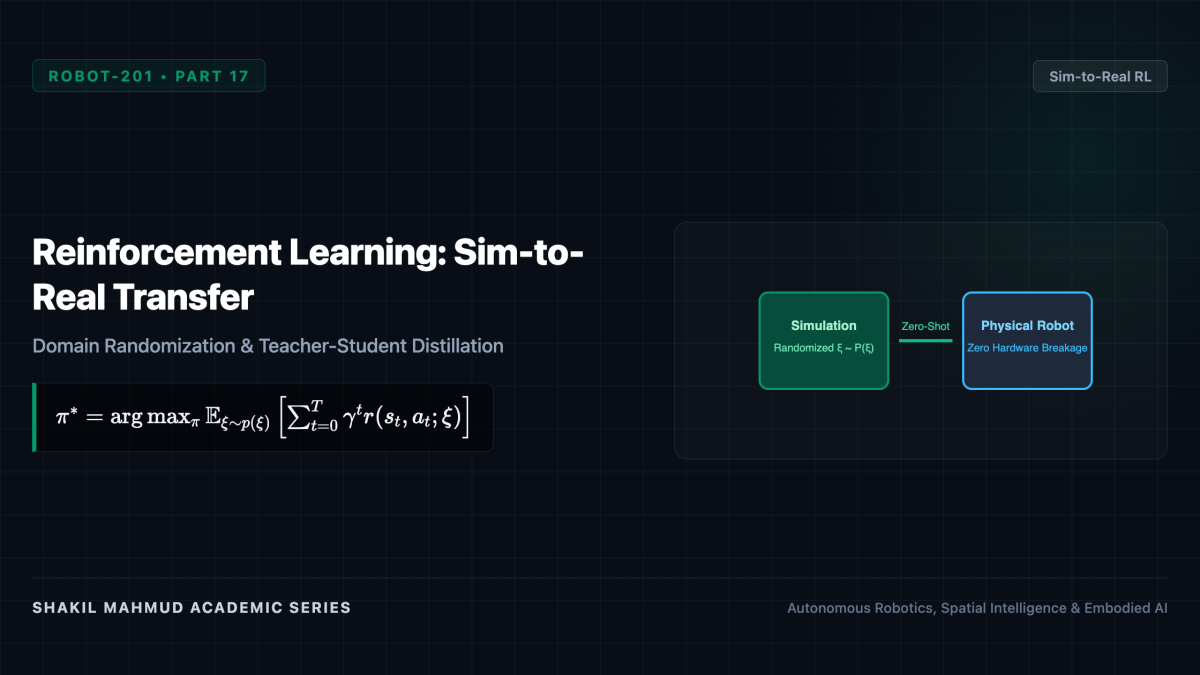
To cross the reality gap without collecting real-world failure data, roboticists employ Dynamics Domain Randomization. Across the tens of thousands of parallel simulation instances, physical environment parameters (xi in Xi) are randomized at every episode reset:
[
pi^* = argmax_ heta mathbb{E}_{xi sim P(Xi)} left[ mathbb{E}_{ au sim pi_ heta(xi)} left[ sum_{t=0}^infty gamma^t mathcal{R}(s_t, a_t; xi)
ight]
ight]
]
Randomized parameters include:
- Inertial Parameters: Link masses randomized by (pm 20%), center-of-mass locations perturbed by (pm 3 ext{ cm}).
- Contact Mechanics: Ground friction coefficient (mu sim mathcal{U}(0.2, 1.2)), contact restitution and surface stiffness.
- Actuator Dynamics: Joint damping, rotor inertia, motor torque limits, and PD gains.
- Sensor Latency & Noise: Observation delays randomly sampled between (5 ext{–}40 ext{ ms}), IMU biases, and encoder quantization noise.
By forcing the neural network policy to survive across thousands of contradictory simulated universes simultaneously, the real physical world appears to the policy as merely another random sample from its training distribution, enabling Zero-Shot Sim-to-Real Transfer.
4. Asymmetric Teacher-Student Distillation
During simulation training, the simulator provides access to privileged “god-mode” ground truth information: exact friction coefficients, obstacle distance fields, and terrain heightmaps under the feet. A Teacher Policy is trained with access to this privileged state.
Next, a Student Policy—equipped with an autoregressive temporal encoder (TCN, LSTM, or Transformer) that sees only realistic proprioceptive joint history—is trained via supervised imitation learning (distillation) to match the teacher’s action distribution:
[
mathcal{L}_{ ext{distill}}(phi) = mathbb{E} left[ mathcal{D}_{ ext{KL}}left( pi_{ ext{teacher}}(a mid s_{ ext{privileged}}) parallel pi_{ ext{student},phi}(a mid o_{ ext{proprioceptive}, 1:t})
ight)
ight]
]
Through temporal history, the student neural network implicitly infers the unobserved terrain friction and external payloads through proprioceptive feedback, achieving superhuman agility across mountains, stairs, and ice without requiring external cameras.