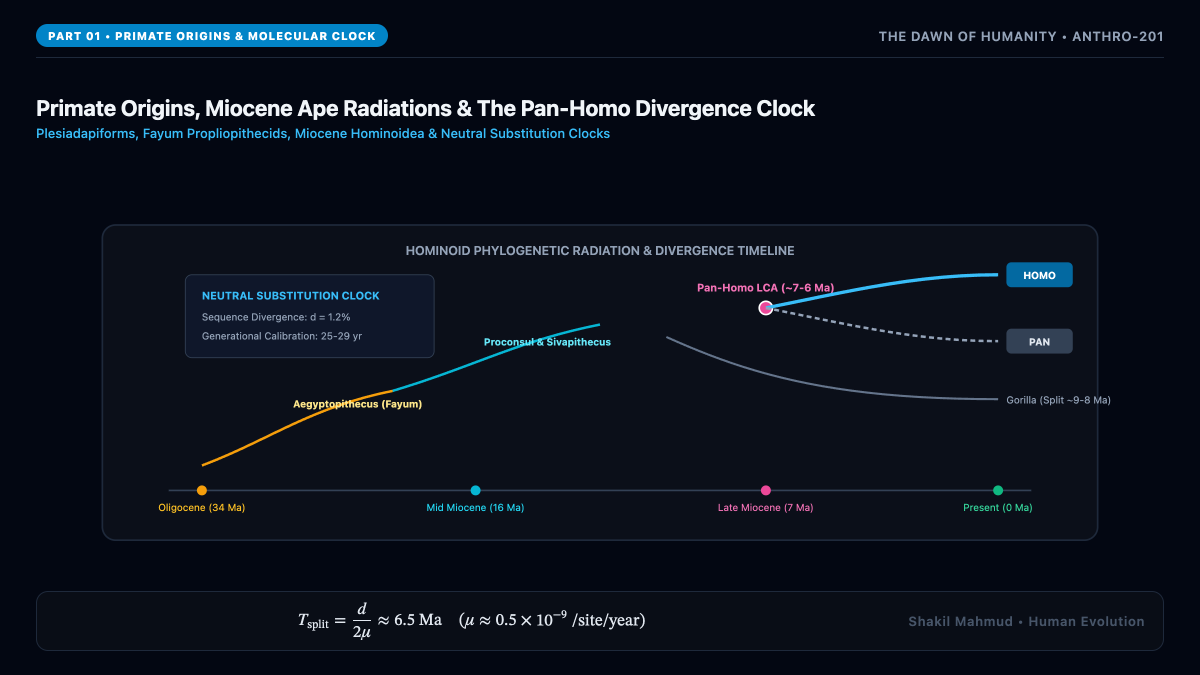
Seven million years ago, in the late Miocene woodlands of equatorial Africa, a biological event occurred whose consequences would fundamentally remake the geology, ecology, and climate of the Earth. A population of ancestral apes, morphologically continuous with the lush radiation of arboreal primates that had spanned Eurasia and Africa for twenty million years, underwent speciation. That lineage bifurcation gave rise on one branch to the ancestors of chimpanzees and bonobos (genus Pan), and on the other, to the hominins (subtribe Hominina)—the lineage of upright, bipedal primates that culminates in Homo sapiens.
1. Deep Cenozoic Origins: From Plesiadapiforms to the Fayum Anthropoids
To understand the anatomical architecture of the human lineage, we must reach back to the dawn of the Cenozoic Era. Following the Cretaceous-Paleogene (K-Pg) bolide impact $66.0text{ Ma}$ that eradicated non-avian dinosaurs, archaic stem primates—the Plesiadapiformes (such as Purgatorius)—colonized the expanding angiosperm forest canopies of the early Paleocene. By the early Eocene ($56text{ Ma}$), the first true primates of modern aspect (Euprimates) appeared synchronously across North America, Europe, and Asia, divided into two great clades:
- Adapiformes: Strepsirrhine-like primates possessing grasping digits, divergent halluces with flat nails instead of claws, and postorbital bars, ancestral to modern lemurs and lorises.
- Omomyiformes: Haplorrhine-like forms characterized by enlarged orbits indicating nocturnal predation and shortened rostra, phylogenetically allied with modern tarsiers and anthropoids.
The definitive establishment of higher primates (Anthropoidea) took place in the Afro-Arabian landmass during the Eocene-Oligocene transition ($34text{ Ma}$). The rich fluvio-lacustrine deposits of the Jebel Qatrani Formation in the Fayum Depression of Egypt preserve pivotal stem catarrhines:
- Aegyptopithecus zeuxis ($30text{ Ma}$): A catarrhine anthropoid possessing the definitive dental formula of Old World monkeys and hominoids:
$$text{Dental Formula: } 2.1.2.3 = frac{2text{ Incisors}, 1text{ Canine}, 2text{ Premolars}, 3text{ Molars}}{2text{ Incisors}, 1text{ Canine}, 2text{ Premolars}, 3text{ Molars}}$$
With a brain size of $sim 27text{ cm}^3$ and pronounced postorbital closure, Aegyptopithecus combined a primitive arboreal quadrupedal postcranium with derived catarrhine craniodental architecture.
2. The Miocene Golden Age of Hominoids: Dryopithecines to Sivapithecines
The early to middle Miocene ($23text{–}10text{ Ma}$) witnessed the adaptive radiation of the superfamily Hominoidea. In contrast to modern ecosystems where cercopithecoid monkeys vastly outnumber apes, the Miocene was an ape-dominated world featuring dozens of genera exhibiting diverse locomotor repertoires:
- Proconsul (East Africa, $20text{–}17text{ Ma}$): Lacked an external tail (a synapomorphy of hominoids) and possessed bunodont Y-5 lower molars, while retaining a generalized pronograde quadrupedal skeleton.
- Dryopithecus and Ouranopithecus (Europe, $12text{–}9text{ Ma}$): Displayed modern suspensory orthograde adaptations, including a broad thorax, dorsally placed scapulae, and mobile glenohumeral joints suited for below-branch arm hanging and brachiation.
- Sivapithecus (Siwalik Hills of Pakistan and India, $12text{–}8text{ Ma}$): Exhibited tall, oval orbital margins, a narrow interorbital distance, and concave facial profiles cladistically linking it directly to the ancestry of the modern orangutan (Pongo).
3. Calibrating the Molecular Clock: The Pan-Homo Lineage Divergence
Prior to the paleogenomic revolution, comparative anatomy placed humans in a unique family (Hominidae) separated from all great apes (Pongidae). In 1967, Vincent Sarich and Allan Wilson applied molecular immunology to serum albumin, demonstrating that humans, chimpanzees, and gorillas share an intensely recent common ancestry. Today, whole-genome sequencing confirms that Homo and Pan share $approx 98.8%$ nucleotide identity in alignable non-repetitive autosomal regions.
The divergence time between humans and chimpanzees is mathematically modeled under the neutral theory of molecular evolution formulated by Motoo Kimura. If neutral substitution mutations occur at a constant average genomic rate $mu$ per site per year, the total sequence divergence $d$ between two sister lineages separated from a common ancestor by time $T$ is governed by:
$$d = 2mu T + 2bar{theta}_{text{ancestral}}$$
Where $bar{theta}_{text{ancestral}} = 4N_emu$ reflects the ancestral genetic polymorphism present in the last common ancestor population with effective size $N_e$. Rearranging for the speciation time $T_{text{split}}$:
$$T_{text{split}} = frac{d – 2bar{theta}_{text{ancestral}}}{2mu}$$
Modern whole-genome pedigree sequencing directly calibrates the human de novo germline mutation rate at $mu approx 1.25 times 10^{-8}text{ per base pair per generation}$. With an estimated average generation interval of $g approx 26text{–}29text{ years}$, the yearly substitution rate resolves to:
$$mu_{text{year}} = frac{1.25 times 10^{-8}}{28} approx 4.5 times 10^{-10}text{ mutations/site/year}$$
When cross-calibrated against mammalian paleontological anchor points (e.g., the cercopithecoid-hominoid split anchored at $25text{–}30text{ Ma}$ by Kamoyapithecus), this molecular clock formula decisively places the Pan-Homo speciation split at:
$$T_{text{split}} approx 6.5 pm 0.8text{ million years ago}$$
4. The Mosaic Nature of the Last Common Ancestor (LCA)
What did the last common ancestor look like? For over a century, classical models assumed the LCA was an obligate knuckle-walking ape closely resembling modern Pan troglodytes. However, recent fossil discoveries—specifically Ardipithecus and Orrorin—have shattered this knuckle-walking paradigm. The Pan-Homo LCA was neither a knuckle-walker nor a human biped; it was a generalized, orthograde arboreal climber with high wrist flexibility, an un-specialized dietary regime, and an adaptable behavioral repertoire poised to venture across the thinning forest ecotones of late Miocene Africa.