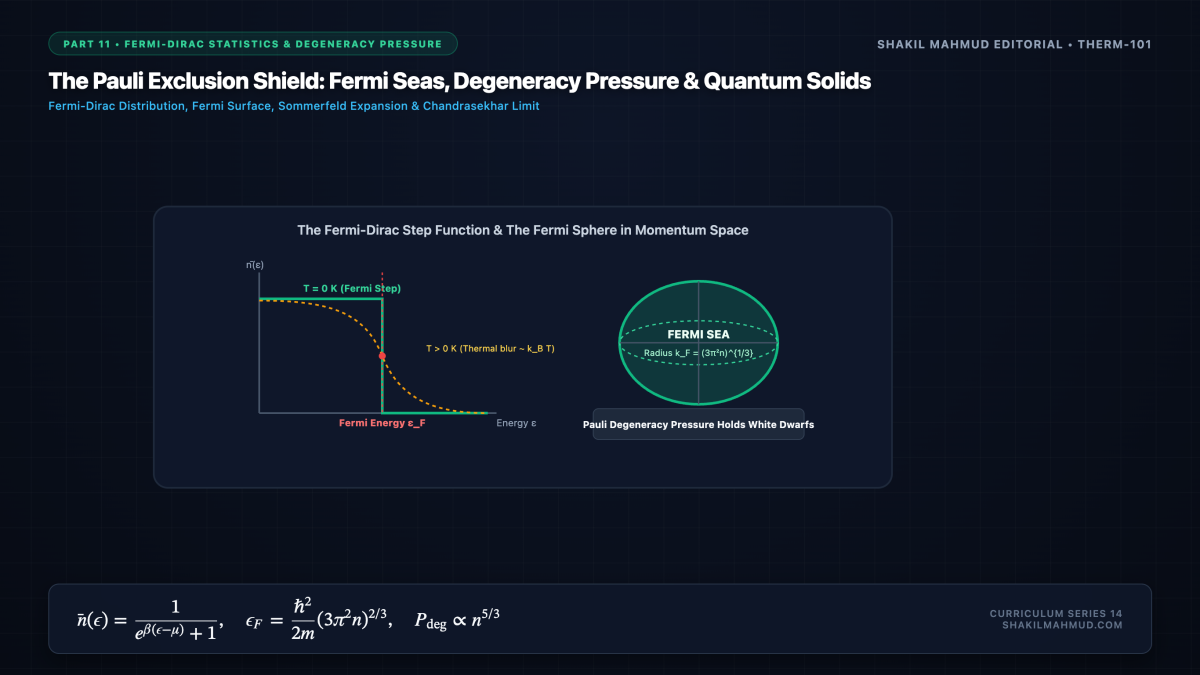
If bosons are the gregarious conformists of the quantum world, condensing gladly into a single collective ground state, fermions are the fierce individualists that build the solid architecture of reality. Electrons, protons, neutrons, and quarks—the constituents of all tangible matter—possess half-integer intrinsic spin ($S = 1/2, 3/2, dots$). In 1925, Austrian theoretical physicist Wolfgang Pauli announced his celebrated Exclusion Principle: no two electrons in an atom can occupy the identical quantum state. One year later, Enrico Fermi and Paul Dirac incorporated this anti-symmetry into statistical mechanics. The resulting distribution explains why metals conduct electricity, why matter resists collapse, and why dying stars are halted by a staggering cosmic pressure.
The Pauli Exclusion Principle & Fermi-Dirac Statistics
The total wavefunction of identical half-integer spin fermions must be completely anti-symmetric under the interchange of any two particles:
$$psi(dots, mathbf{r}_j, dots, mathbf{r}_k, dots) = -psi(dots, mathbf{r}_k, dots, mathbf{r}_j, dots)$$
If two fermions were to occupy the exact same quantum state ($mathbf{r}_j = mathbf{r}_k$), the wavefunction would satisfy $psi = -psi$, forcing $psi equiv 0$. The occupation number $n_k$ of any single-particle quantum state $k$ is therefore strictly binary:
$$n_k in {0, 1}$$
Evaluating the grand canonical partition function over these restricted binary occupations:
$$Xi_{text{Fermi}} = prod_{k} sum_{n_k=0}^{1} e^{-beta(epsilon_k – mu) n_k} = prod_{k} left[ 1 + e^{-beta(epsilon_k – mu)} right]$$
Taking the derivative of $ln Xi$ with respect to chemical potential $mu$ yields the Fermi-Dirac Distribution:
$$bar{n}(epsilon) = frac{1}{e^{beta(epsilon – mu)} + 1}$$
The Fermi Sea & Absolute Zero (T = 0 K)
At absolute zero temperature ($T to 0$, $beta to infty$), the Fermi-Dirac distribution exhibits a discontinuous, razor-sharp step function:
$$lim_{T to 0} bar{n}(epsilon) = begin{cases} 1 & text{for } epsilon epsilon_F end{cases}$$
Every single quantum level up to the Fermi Energy $epsilon_F$ is completely packed with exactly one fermion per spin state, while every level above $epsilon_F$ is completely vacant. In momentum space, this filled reservoir forms the Fermi Sea, bounded by a sharp spherical manifold called the Fermi Surface of radius $k_F$:
$$N = 2 frac{V}{(2pi)^3} left(frac{4}{3}pi k_F^3right) implies k_F = (3pi^2 n)^{1/3}$$
where $n = N/V$ is the spatial particle density and the prefactor 2 accounts for the two spin projections $s_z = pm 1/2$. The Fermi energy of a free electron gas is therefore:
$$epsilon_F = frac{hbar^2 k_F^2}{2m} = frac{hbar^2}{2m}(3pi^2 n)^{2/3}$$
In ordinary metals (like copper or silver), the electron density is so high that $epsilon_F approx 7 , text{eV}$, corresponding to a Fermi Temperature $T_F = epsilon_F / k_B approx 80,000 , text{Kelvin}$! Even at blazing red heat, the conduction electrons in a metal are effectively frozen at near absolute zero in their degenerate quantum distribution.
The Sommerfeld Low-Temperature Expansion
When an electron gas is heated from $T = 0$ to room temperature ($T ll T_F$), classical equipartition erroneously predicts that every electron should absorb $frac{3}{2} k_B T$, yielding a huge heat capacity $C_V = frac{3}{2} N k_B$ that is completely absent in experiments. Quantum statistics reveals the truth: an electron buried deep inside the Fermi sea cannot absorb thermal energy because all nearby states are already fully occupied! Only electrons residing within a narrow thermal crust of thickness $k_B T$ around the Fermi surface can be excited.
Applying the Sommerfeld Expansion to the density of states at the Fermi energy, the electronic heat capacity is found to be strictly linear in temperature:
$$C_V^{text{elec}} = frac{pi^2}{3} g(epsilon_F) k_B^2 T = left( frac{pi^2}{2} frac{k_B T}{epsilon_F} right) N k_B propto T$$
At room temperature, the factor $(k_B T / epsilon_F) approx 1/300$, explaining why electron heat capacity is suppressed by over two orders of magnitude.
Degeneracy Pressure & The Chandrasekhar Limit
Even at absolute zero, fermions cannot stop moving. Being compressed into tight spatial volumes forces them by Heisenberg uncertainty to occupy high-momentum quantum states in the Fermi sphere. Integrating this zero-point kinetic energy yields an intrinsic quantum mechanical pressure that exists independently of thermal motion: Degeneracy Pressure:
$$P_{text{deg}} = frac{2}{3}frac{langle E_{text{kin}} rangle}{V} = frac{(3pi^2)^{2/3} hbar^2}{5 m} n^{5/3}$$
When a star like our Sun exhausts its nuclear fuel, it collapses under gravity until its atoms are completely ionized into a plasma of nuclei and free electrons. It is the non-relativistic electron degeneracy pressure $P propto n^{5/3}$ that counteracts gravitational inward collapse, stabilizing the star as a White Dwarf.
In 1930, nineteen-year-old Indian astrophysicist Subrahmanyan Chandrasekhar calculated what happens when a collapsing star becomes so dense that the electrons reach relativistic speeds ($E approx p c$). In the ultra-relativistic limit, the degeneracy pressure softens to $P propto n^{4/3}$. Because gravity also scales as $n^{4/3}$, the star loses stability if its mass exceeds the Chandrasekhar Limit:
$$M_{text{Ch}} approx 1.44 , M_{odot}$$
Beyond this mass, electron degeneracy pressure fails, forcing the core to collapse into a neutron star (supported by neutron degeneracy pressure) or relentlessly past the event horizon into a black hole. The Pauli exclusion principle is literally the cosmic shield that preserves the structure of matter across the universe.




