For 170 years, the Second Law of Thermodynamics was codified in stone as an inescapable inequality: $langle W rangle ge Delta F$. If you drag a system from state $A$ to state $B$ in finite time, dissipative friction and irreversible turbulence guarantee that the average work performed always exceeds the reversible free energy difference. But what happens if the system is not a macroscopic steam engine containing $10^{23}$ atoms, but a single microscopic protein or a strand of RNA pulled with optical tweezers? At the nanoscale, thermal fluctuations are enormous: in some experimental runs, the system absorbs energy from the thermal bath, performing “impossible” trajectories where $W < Delta F$! In 1997, a young American theoretical physicist named Christopher Jarzynski made a discovery that transformed the Second Law from an imprecise inequality into an exact mathematical equality.
The Jarzynski Non-Equilibrium Work Equality (1997)
Consider a system in thermal contact with a heat bath at inverse temperature $beta = 1/k_B T$, initially in canonical equilibrium at parameter value $lambda(0) = lambda_A$. An external experimenter drives the parameter according to an arbitrary, violent, time-dependent protocol $lambda(t)$ over duration $tau$, ending at $lambda(tau) = lambda_B$. The process can be executed arbitrarily fast and arbitrarily far from equilibrium.
Because the microscopic initial conditions and thermal noise fluctuate from run to run, the work performed $W$ along each individual trajectory is a stochastic random variable governed by a non-equilibrium work distribution $P(W)$. In 1997, Christopher Jarzynski proved the exact identity:
$$leftlangle e^{-beta W} rightrangle = int_{-infty}^{infty} P(W) e^{-beta W} , dW = e^{-beta Delta F}$$
where $Delta F = F(lambda_B) – F(lambda_A)$ is the equilibrium Helmholtz free energy difference between the final and initial equilibrium states. Look closely at the profound majesty of this result: the left-hand side is an ensemble average over violently non-equilibrium, irreversible paths, yet the right-hand side depends solely on equilibrium state functions!
Jensen’s Inequality & Recovering the Second Law
How does Jarzynski’s equality reconcile with the traditional Second Law? The exponential function $f(x) = e^{-x}$ is strictly convex ($f”(x) > 0$). Applying Jensen’s Inequality for convex functions, $langle e^X rangle ge e^{langle X rangle}$:
$$leftlangle e^{-beta W} rightrangle ge e^{-beta langle W rangle}$$
Substituting Jarzynski’s equality into Jensen’s inequality:
$$e^{-beta Delta F} ge e^{-beta langle W rangle} implies -beta Delta F ge -beta langle W rangle implies langle W rangle ge Delta F$$
The classical Second Law of Thermodynamics is recovered in a single line of algebra! The Second Law is not an independent axiom; it is merely the Jensen-inequality shadow of Jarzynski’s deeper underlying equality. The dissipated work $W_{text{diss}} = langle W rangle – Delta F ge 0$ represents the thermodynamic price paid for driving the protocol in finite time.
The Crooks Fluctuation Theorem (1999)
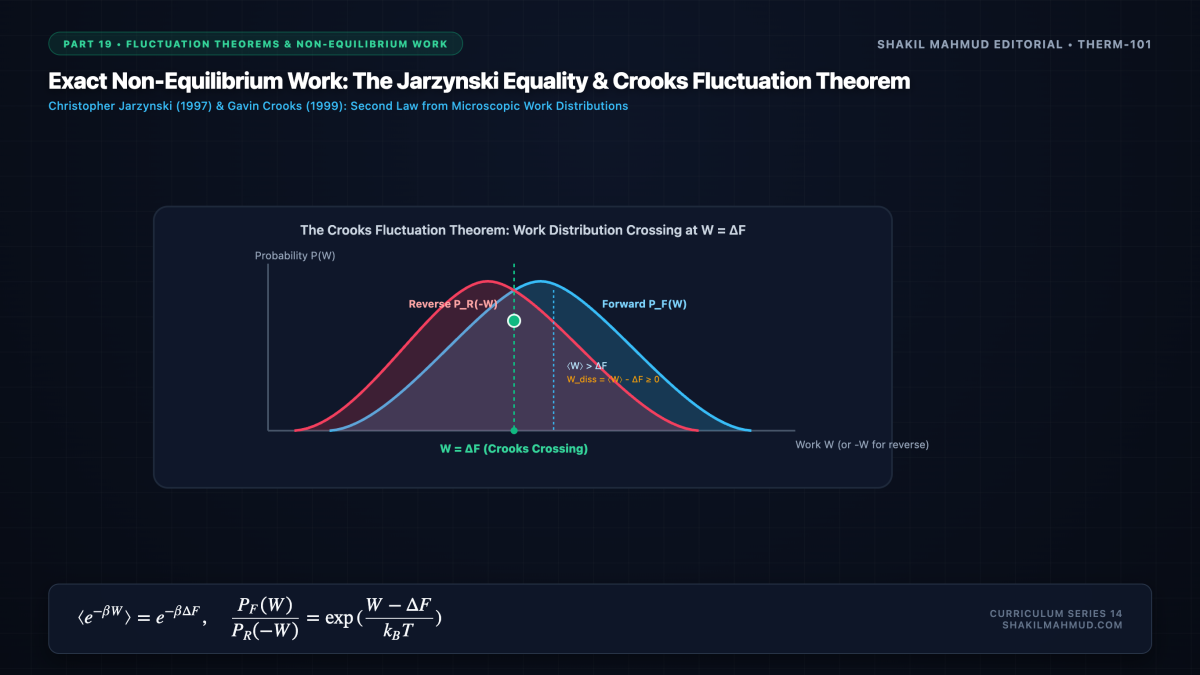
Two years later, Gavin Crooks discovered an even deeper symmetry connecting forward and time-reversed non-equilibrium processes. Let $P_F(W)$ be the probability distribution of work performed during the forward protocol $lambda(t)$, and let $P_R(-W)$ be the distribution of work performed when the system is driven along the time-reversed protocol $tilde{lambda}(t) = lambda(tau – t)$:
$$frac{P_F(W)}{P_R(-W)} = expleft( frac{W – Delta F}{k_B T} right)$$
This is the Crooks Fluctuation Theorem. It reveals a breathtaking geometric symmetry:
- The forward and reverse work distribution curves cross at precisely one point: where $W = Delta F$. At this intersection, $P_F(Delta F) = P_R(-Delta F)$. This provides an experimental technique to measure equilibrium free energy landscapes of single molecules by pulling them back and forth with optical tweezers.
- Multiplying by $P_R(-W) e^{-beta W}$ and integrating over all $W$ directly derives Jarzynski’s equality: $int P_F(W) e^{-beta W} dW = e^{-beta Delta F} int P_R(-W) dW = e^{-beta Delta F}$.
Stochastic Thermodynamics & Transient Violations of the Second Law
In 2005, Udo Seifert generalized these results to define entropy along individual microscopic trajectories: $s_{text{tot}}(t) = s_{text{system}}(t) + s_{text{bath}}(t)$. The total entropy production along a stochastic path satisfies the universal Integral Fluctuation Theorem:
$$leftlangle e^{-Delta s_{text{tot}} / k_B} rightrangle = 1$$
From this, the probability of observing a microscopic “Second Law violation”—a trajectory where total entropy decreases by $Delta s_{text{tot}} = -zeta < 0$—is governed by the detailed fluctuation theorem:
$$frac{P(Delta s_{text{tot}} = -zeta)}{P(Delta s_{text{tot}} = +zeta)} = e^{-zeta / k_B}$$
For a microscopic protein, observing an entropic dip of $Delta s approx -3 k_B$ occurs in roughly $e^{-3} approx 5%$ of trajectories. But for a macroscopic system where $zeta approx 10^{20} k_B$, the probability drops to $e^{-10^{20}}$—a number so incomprehensibly small that a violation will never occur in the lifetime of the universe. In the fluctuating nanoworld, the Second Law is not a prison wall; it is an exact statistical symmetry.




