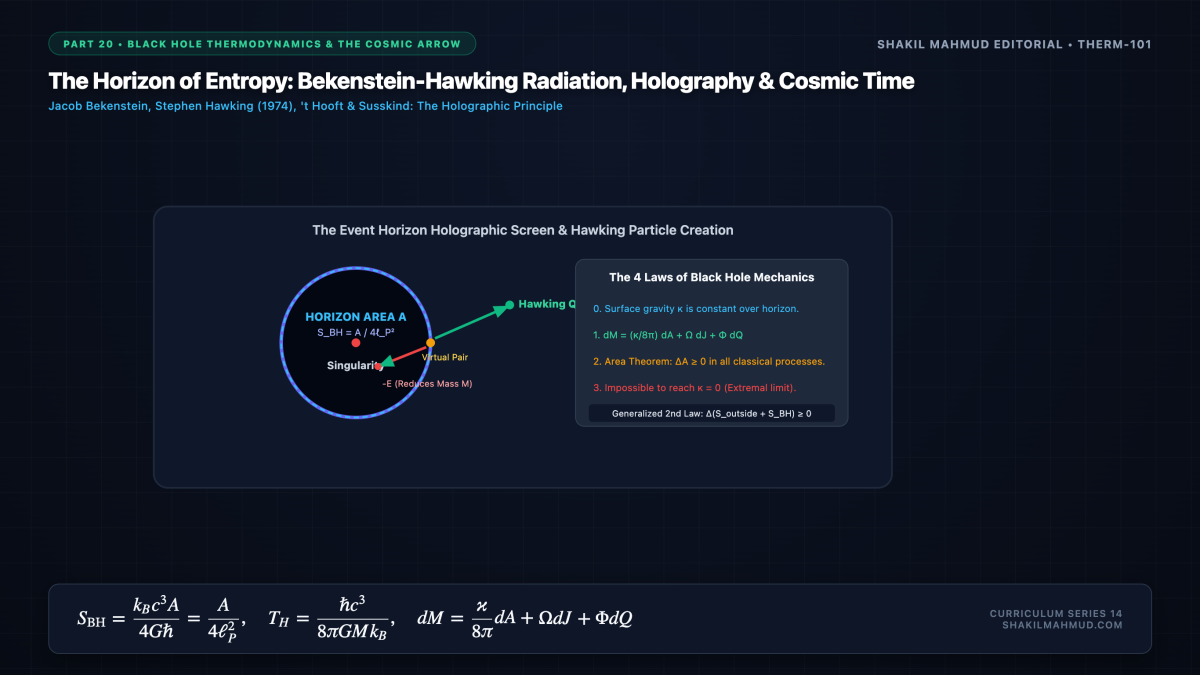
In the early 1970s, John Archibald Wheeler posed an innocent-sounding puzzle to his graduate student Jacob Bekenstein at Princeton University: If you pour a cup of hot tea into a black hole, the tea disappears forever behind the event horizon. Because the tea carries entropy, does this mean the total entropy of the universe has permanently decreased, violating the Second Law of Thermodynamics? Wheeler called it “entropy laundering.” Bekenstein’s daring response—and Stephen Hawking’s subsequent discovery of quantum black hole radiation—unleashed a conceptual earthquake that shook the foundations of physics, uniting thermodynamics, general relativity, and quantum mechanics into the crowning insight of modern fundamental physics: The Holographic Principle.
The Bekenstein Conjecture & Black Hole Area
Classical general relativity asserts that a stationary black hole is completely bald. According to the “no-hair theorem,” a black hole is characterized solely by three asymptotic numbers: mass $M$, angular momentum $J$, and electric charge $Q$. All microscopic details of the collapsed star—its chemical composition, quantum states, and entropy—are swallowed behind the null hypersurface of the Event Horizon.
In 1971, Stephen Hawking proved his classical Area Theorem: in any classical interaction, including the collision and coalescence of two black holes, the total surface area $A$ of the event horizon can never decrease:
$$Delta A ge 0$$
Bekenstein made a radical intellectual leap. The non-decreasing horizon area $Delta A ge 0$ was not a mere geometric coincidence; it was the Second Law of Thermodynamics in disguise! Bekenstein postulated that a black hole possesses a physical entropy proportional to its horizon area $A$:
$$S_{text{BH}} = eta frac{k_B c^3}{G hbar} A$$
where $hbar$ was required by dimensional analysis to ensure that entropy is a dimensionless scalar over $k_B$. To preserve the Second Law when matter falls into a hole, Bekenstein formulated the Generalized Second Law (GSL):
$$Delta S_{text{total}} = Delta S_{text{matter}} + Delta S_{text{BH}} ge 0$$
Hawking Radiation & The Exact Entropy Formula (1974)
Hawking initially rejected Bekenstein’s conjecture with fierce skepticism. If a black hole possesses thermodynamic entropy, classical thermodynamics mandates that it must also possess a non-zero thermodynamic temperature $T = (partial S / partial M)^{-1}$. But an object with finite temperature must radiate blackbody energy, whereas classical relativity dictates that nothing can escape an event horizon!
To disprove Bekenstein, Hawking performed a rigorous calculation using quantum field theory in curved spacetime near the horizon of a collapsing star. To his absolute astonishment, Hawking found that the event horizon does indeed radiate as a perfect blackbody. Virtual particle-antiparticle pairs continuously pop out of the quantum vacuum near the horizon. Occasionally, one particle with negative energy falls through the horizon, while its partner with positive energy escapes to infinity as real thermal radiation: Hawking Radiation.
Hawking calculated the exact temperature of a Schwarzschild black hole of mass $M$:
$$T_H = frac{hbar c^3}{8pi G M k_B}$$
Integrating the First Law of Black Hole Mechanics, $dM = T_H dS_{text{BH}}$, fixed Bekenstein’s unknown proportionality factor to precisely $eta = 1/4$, yielding the immortal Bekenstein-Hawking Entropy Formula:
$$S_{text{BH}} = frac{k_B c^3 A}{4 G hbar} = frac{k_B A}{4 ell_P^2}$$
where $ell_P = sqrt{frac{G hbar}{c^3}} approx 1.616 times 10^{-35} , text{meters}$ is the fundamental Planck length. Every Planck area $ell_P^2$ on the horizon surface encodes precisely one quarter of a bit of thermodynamic entropy!
The Four Laws of Black Hole Mechanics
The mathematical correspondence between thermodynamics and general relativity is exact and complete:
| Law | Classical Thermodynamics | Black Hole Mechanics (Bardeen, Carter, Hawking) |
|---|---|---|
| Zeroth | Temperature $T$ is constant throughout a system at equilibrium. | Surface gravity $kappa$ is constant over the event horizon of a stationary black hole. |
| First | $dE = T dS – P dV + mu dN$ | $dM = frac{kappa}{8pi} dA + Omega dJ + Phi dQ$ |
| Second | $Delta S ge 0$ in all isolated processes. | $Delta A ge 0$ in all classical interactions. |
| Third | Impossible to reach absolute zero ($T = 0$) in finite steps. | Impossible to achieve zero surface gravity ($kappa = 0$, extremal hole) in finite steps. |
The Holographic Principle & The Cosmic Arrow of Time
The Bekenstein-Hawking formula revealed the most shocking property of gravity: entropy scales with surface area, not volume. In ordinary statistical mechanics, entropy is extensive: doubling the volume of a gas doubles its microstates, $S propto V$. But if you try to pack too much information into a 3D volume, it gravitationally collapses into a black hole, whose maximum entropy is capped by its 2D boundary area: $S_{text{max}} = A / 4 ell_P^2$.
In 1993, Gerard ‘t Hooft and Leonard Susskind generalized this insight into the Holographic Principle: all physical phenomena occurring within a three-dimensional bulk volume can be completely, losslessly described by quantum degrees of freedom living on its two-dimensional boundary surface, codified mathematically in Juan Maldacena’s 1997 AdS/CFT correspondence.
From Carnot’s steam engines and Boltzmann’s kinetic collisions to quantum condensates, non-equilibrium dissipation, and black hole event horizons, statistical mechanics and thermodynamics have illuminated the grandest tapestry of reality. The laws that dictate why tea cools on a desk are the very laws that govern the evaporation of black holes and the cosmological arrow of cosmic time. Thermodynamics is not merely a chapter of physics; it is the universal grammar of nature itself.




