In the canonical ensemble, a system exchanges heat with its environment while keeping its chemical constituents sealed within fixed walls. Yet the vast majority of natural phenomena—from the diffusion of neurotransmitters across a synaptic cleft and the adsorption of oxygen onto hemoglobin, to phase equilibria between boiling liquid and vapor—involve open boundaries where both energy and matter flow freely. To conquer open systems, Josiah Willard Gibbs devised the grandest framework of classical statistical mechanics: the Grand Canonical Ensemble. Through the chemical potential and particle fluctuations, it reveals why matter condenses, reacts, and scatters light at critical thresholds.
The Grand Reservoir & The Chemical Potential
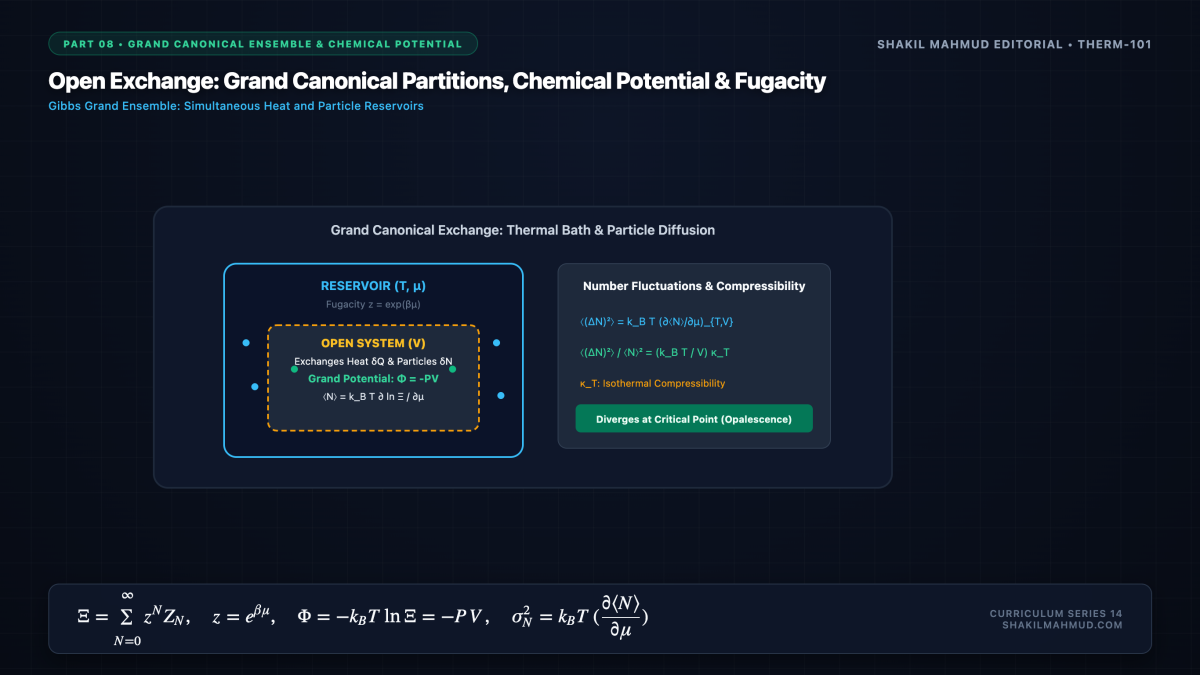
Consider a subsystem of fixed volume $V$ in simultaneous thermal and material contact with a gigantic reservoir characterized by temperature $T$ ($beta = 1/k_B T$) and chemical potential $mu$. The composite universe is isolated, with fixed total energy $E_{text{tot}} = E + E_R$ and fixed particle count $N_{text{tot}} = N + N_R$.
The probability $P_{N, i}$ of finding the subsystem containing exactly $N$ particles in microscopic quantum state $i$ (with energy $E_{N, i}$) is proportional to the multiplicity of the reservoir:
$$P_{N, i} propto Omega_R(E_{text{tot}} – E_{N, i}, N_{text{tot}} – N) = expleft( frac{S_R(E_{text{tot}} – E_{N, i}, N_{text{tot}} – N)}{k_B} right)$$
Expanding the reservoir’s entropy to first order in both energy and particle transfer:
$$S_R = S_R(E_{text{tot}}, N_{text{tot}}) – E_{N, i} left( frac{partial S_R}{partial E_R} right) – N left( frac{partial S_R}{partial N_R} right) + dots$$
Using the fundamental thermodynamic identity $dS = frac{1}{T} dE + frac{P}{T} dV – frac{mu}{T} dN$, we recognize $(partial S_R / partial N_R) = -mu / T$. Substituting these partial derivatives yields the grand canonical probability measure:
$$P_{N, i} propto expleft( -frac{E_{N, i} – mu N}{k_B T} right) = e^{-beta(E_{N, i} – mu N)} = z^N e^{-beta E_{N, i}}$$
Here, $z equiv e^{beta mu}$ is the fugacity—an absolute activity metric that quantifies the thermodynamic escaping tendency of particles from the reservoir.
The Grand Canonical Partition Function & The Grand Potential
Normalizing this joint distribution over all possible particle numbers $N in {0, 1, 2, dots, infty}$ and all quantum microstates $i$ yields the Grand Canonical Partition Function ($Xi$):
$$Xi(T, V, mu) = sum_{N=0}^{infty} sum_{i} e^{-beta(E_{N, i} – mu N)} = sum_{N=0}^{infty} z^N Z_N(T, V)$$
$Xi$ is a discrete Laplace-like transform of the canonical partition functions $Z_N$. Computing the Gibbs entropy of this distribution and connecting it with macroscopic thermodynamic potentials reveals the fundamental relationship:
$$Phi(T, V, mu) = -k_B T ln Xi = U – TS – mu N = F – mu N$$
$Phi$ is the Grand Potential (or Landau Free Energy). Because the fundamental equation of state dictates that $U – TS – mu N = -PV$, we uncover a relation of extraordinary elegance:
$$Phi = -PV implies PV = k_B T ln Xi$$
Macroscopic pressure times volume is directly the logarithm of the grand partition function!
Particle Number Fluctuations & Isothermal Compressibility
Taking logarithmic derivatives of $Xi$ with respect to chemical potential yields the average particle count and its variance:
$$langle N rangle = frac{1}{beta} left(frac{partial ln Xi}{partial mu}right)_{T, V}, quad sigma_N^2 = langle N^2 rangle – langle N rangle^2 = frac{1}{beta^2} left(frac{partial^2 ln Xi}{partial mu^2}right)_{T, V} = k_B T left(frac{partial langle N rangle}{partial mu}right)_{T, V}$$
Using thermodynamic Maxwell relations, the response derivative $(partial langle N rangle / partial mu)_{T, V}$ connects directly to the macroscopic isothermal compressibility $kappa_T = -frac{1}{V}(partial V / partial P)_T$:
$$frac{sigma_N^2}{langle N rangle^2} = frac{k_B T}{V} kappa_T$$
This result is profound. It demonstrates that microscopic particle number fluctuations are physically manifested in macroscopic mechanical compressibility. In ordinary dense liquids, $kappa_T$ is tiny, ensuring that density fluctuations are virtually imperceptible. But near a liquid-gas critical point, the compressibility diverges to infinity ($kappa_T to infty$).
At that critical threshold, particle number fluctuations $sigma_N$ explode across macroscopic spatial scales, growing comparable to the wavelength of visible light. The fluid scatters photons in every direction, turning milk-white and opaque: the mesmerizing spectacle of critical opalescence. Through Gibbs’ grand canonical ensemble, statistical mechanics unites microscopic particle exchanges with the macroscopic phase transitions of our universe.