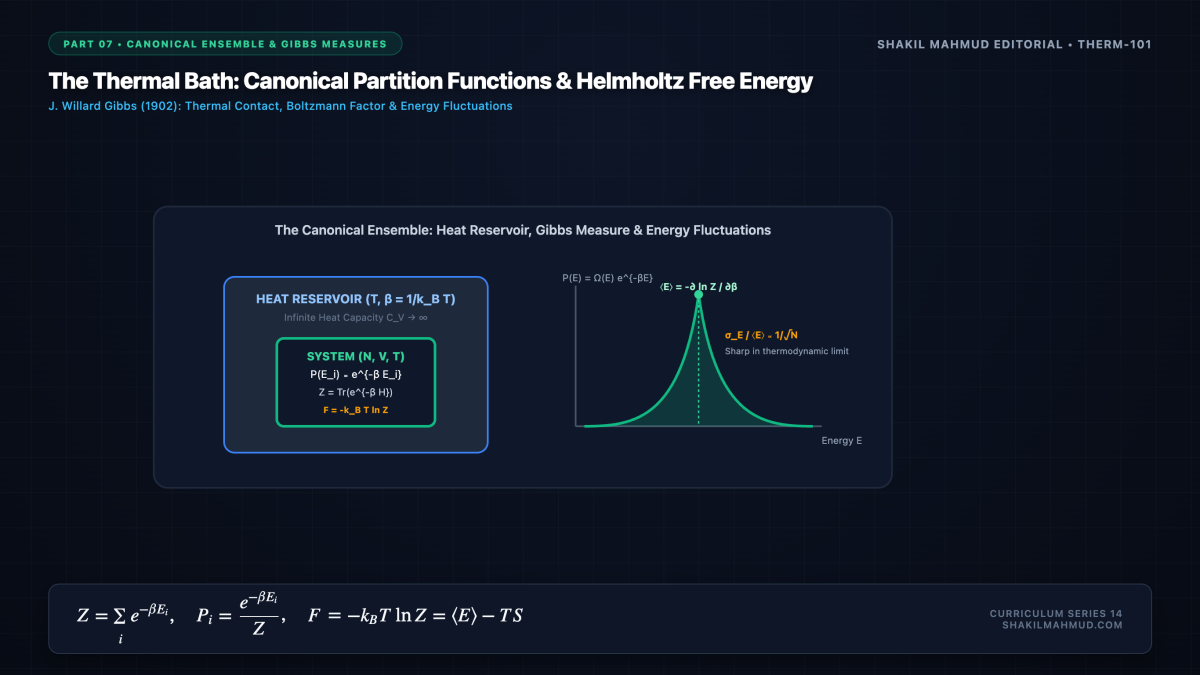
In the microcanonical ensemble of Ludwig Boltzmann, a system is locked inside a rigid, completely adiabatic vault. Its energy is an invariant constant. But almost nothing in the physical universe is truly isolated. A cup of coffee rests on an office desk, continuously exchanging thermal energy with the surrounding atmosphere. A strand of DNA inside a living cell is bombarded by water molecules maintained at a constant body temperature of 310 Kelvin. To describe systems in thermal equilibrium with an external reservoir, American mathematical physicist Josiah Willard Gibbs conceived the Canonical Ensemble. At its heart lies the partition function: the mathematical engine that powers modern theoretical physics.
Derivation of the Boltzmann Factor & Canonical Measure
Consider a small subsystem $S$ in thermal contact with a massive heat reservoir $R$. The composite system $S + R$ is completely isolated, with fixed total energy $E_{text{tot}} = E_i + E_R$, where $E_i$ is the energy of a specific microscopic quantum state of subsystem $S$. Because the heat reservoir is macroscopic ($E_R gg E_i$), its degrees of freedom vastly outnumber those of the subsystem.
According to the fundamental postulate of statistical mechanics, the probability $P_i$ of finding the subsystem in state $i$ is proportional to the number of microstates accessible to the reservoir, $Omega_R(E_{text{tot}} – E_i)$:
$$P_i propto Omega_R(E_{text{tot}} – E_i) = expleft( frac{S_R(E_{text{tot}} – E_i)}{k_B} right)$$
Since $E_i ll E_{text{tot}}$, we perform a Taylor expansion of the reservoir’s entropy around $E_{text{tot}}$:
$$S_R(E_{text{tot}} – E_i) = S_R(E_{text{tot}}) – E_i left( frac{partial S_R}{partial E_R} right) + frac{1}{2} E_i^2 left( frac{partial^2 S_R}{partial E_R^2} right) + dots$$
Recalling that $(partial S_R / partial E_R) equiv 1/T$, and that the second derivative scales inversely with the infinite heat capacity of the reservoir ($C_R to infty$), higher-order terms vanish identically. Thus:
$$P_i propto expleft( frac{S_R(E_{text{tot}})}{k_B} right) expleft( -frac{E_i}{k_B T} right) propto e^{-beta E_i}$$
where $beta equiv frac{1}{k_B T}$ is the thermodynamic inverse temperature. The universal exponential weighting $e^{-beta E_i}$ is the celebrated Boltzmann Factor.
The Canonical Partition Function: The Master Key
To normalize the probability distribution such that $sum_i P_i = 1$, we define the sum over all accessible microstates, named by Max Planck and Gibbs as the Zustandssumme or Canonical Partition Function ($Z$):
$$Z = sum_{i} e^{-beta E_i}$$
The partition function is not merely a normalization constant; it is the master generating function of the entire thermodynamic universe. Every macroscopic observable emerges cleanly through simple logarithmic derivatives of $Z$:
- Mean Internal Energy $langle E rangle$:
$$langle E rangle = sum_i E_i P_i = frac{1}{Z} sum_i E_i e^{-beta E_i} = -frac{partial ln Z}{partial beta}$$ - Energy Variance & Heat Capacity:
$$sigma_E^2 = langle E^2 rangle – langle E rangle^2 = frac{partial^2 ln Z}{partial beta^2} = -frac{partial langle E rangle}{partial beta} = k_B T^2 C_V$$
Connecting Z to Helmholtz Free Energy
What is the fundamental connection between the microscopic sum $Z$ and macroscopic thermodynamics? We calculate the Gibbs entropy of the canonical probability distribution $P_i = e^{-beta E_i} / Z$:
$$S = -k_B sum_{i} P_i ln P_i = -k_B sum_i P_i (-beta E_i – ln Z) = k_B beta langle E rangle + k_B ln Z$$
Substituting $beta = 1/k_B T$ and multiplying by $T$:
$$T S = langle E rangle + k_B T ln Z implies -k_B T ln Z = langle E rangle – T S$$
Comparing this with the definition of the Helmholtz Free Energy $F = U – TS$, we obtain the profound bridge between microscopic statistical mechanics and macroscopic thermodynamics:
$$F = -k_B T ln Z$$
The Sharpness of Thermodynamic Reality
In the canonical ensemble, the system’s energy is not strictly fixed; it fluctuates as it trades thermal quanta with the bath. Why, then, does a glass of water on a table possess a rock-solid, invariant internal energy? We examine the relative energy fluctuation:
$$frac{sigma_E}{langle E rangle} = frac{sqrt{k_B T^2 C_V}}{langle E rangle}$$
Because internal energy and heat capacity are extensive quantities, $langle E rangle propto N$ and $C_V propto N$. Therefore:
$$frac{sigma_E}{langle E rangle} propto frac{sqrt{N}}{N} = frac{1}{sqrt{N}}$$
For a macroscopic system where $N approx 10^{23}$, the relative fluctuation is on the order of $10^{-11.5}$—utterly invisible to any physical measurement! In the thermodynamic limit ($N to infty$), the canonical distribution becomes a delta function centered precisely at the microcanonical energy. The ensembles become mathematically equivalent, demonstrating why thermodynamics operates with the certainty of an immutable physical law.




