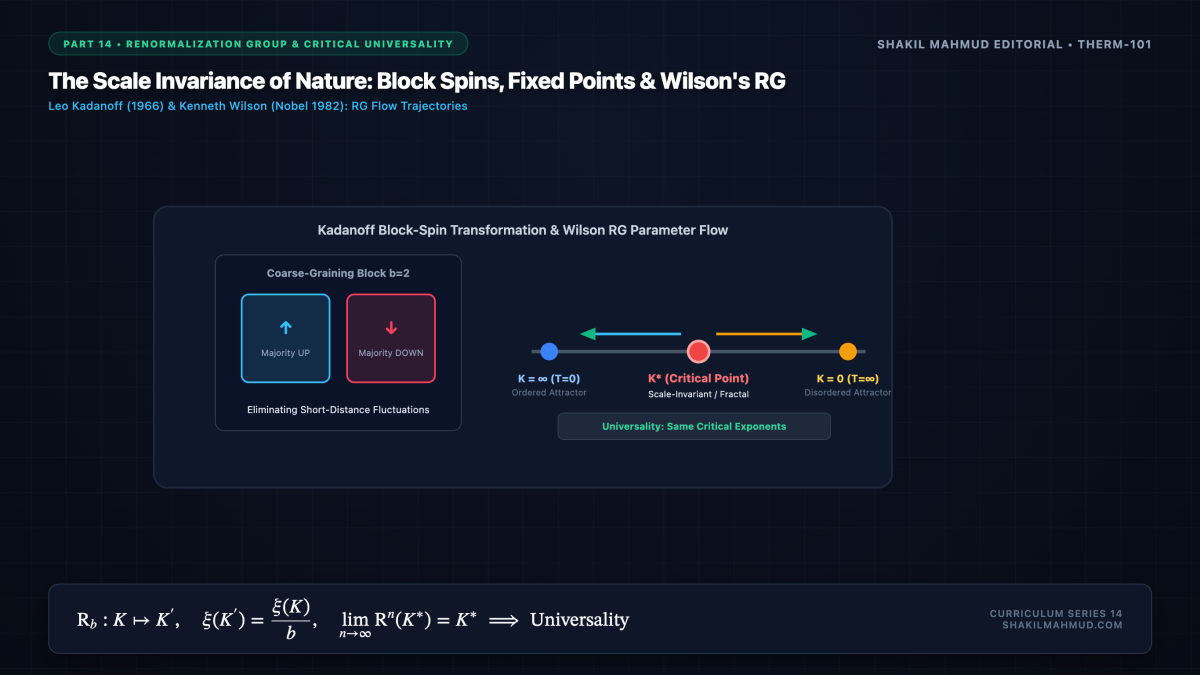
In the 1960s, theoretical physics confronted a profound crisis of scales. Near a continuous phase transition, whether in a boiling fluid, a ferromagnet, or an alloy, the correlation length $xi$ diverges toward infinity ($xi to infty$). At that critical threshold, microscopic fluctuations at atomic scales ($10^{-10}$ meters) couple hierarchically with macroscopic fluctuations across centimeters, rendering ordinary perturbative mathematics completely impotent. How could systems with completely different microscopic interactions—a simple liquid of van der Waals molecules and a solid iron crystal—share precisely identical critical exponents? In 1971, American physicist Kenneth Wilson solved this riddle by formulating the Renormalization Group (RG), an intellectual framework that transformed not only statistical mechanics, but quantum field theory and the philosophy of physics itself.
The Kadanoff Block-Spin Transformation
In 1966, Leo Kadanoff proposed an intuitive coarse-graining procedure. Consider an Ising lattice with lattice spacing $a$ and interaction coupling $K = J / k_B T$. Kadanoff suggested grouping spins into square blocks of size $b times b$ (so that the new effective lattice spacing is $a’ = b a$). Each block is assigned a single effective spin $s’_I = pm 1$ using a majority-vote rule:
$$s’_I = operatorname{sign}left( sum_{i in text{Block } I} s_i right)$$
By integrating out the short-wavelength fluctuations within each block, the system is mapped onto a new Ising model with an effective renormalized coupling constant $K’$:
$$K’ = mathcal{R}_b(K)$$
Because distances are rescaled by factor $b$, the correlation length $xi$ must transform according to:
$$xi(K’) = frac{xi(K)}{b}$$
At a critical temperature $T_c$, the correlation length is infinite ($xi = infty$). Dividing infinity by $b$ yields infinity: $xi(K^*) / b = infty = xi(K^*)$. Therefore, the critical point corresponds mathematically to a Fixed Point of the renormalization group transformation:
$$K^* = mathcal{R}_b(K^*)$$
The Wilson Flow in Hamiltonian Parameter Space
Kenneth Wilson elevated Kadanoff’s heuristic idea into a rigorous mathematical theory. Instead of tracking a single coupling constant, Wilson viewed the renormalization transformation as a dynamical flow in an infinite-dimensional space of all possible Hamiltonians $mathcal{H} = sum g_alpha mathcal{O}_alpha$:
$$mathcal{H}’ = mathcal{R}_b[mathcal{H}]$$
Linearizing the RG transformation around a critical fixed point $mathcal{H}^*$:
$$mathcal{R}_b[mathcal{H}^* + delta mathcal{H}] approx mathcal{H}^* + mathbf{L}_b cdot delta mathcal{H}$$
The eigenvectors of the linear operator $mathbf{L}_b$ are the scaling operators $mathcal{O}_i$ with eigenvalues $b^{y_i}$ ($g’_i = b^{y_i} g_i$). This classifies all possible microscopic physical interactions into three profound categories:
- Relevant Operators ($y_i > 0$): The perturbation grows under coarse-graining ($g’_i to infty$). These operators drive the system away from the critical fixed point. In a ferromagnet, the reduced temperature $t = (T – T_c)/T_c$ ($y_t = 1/nu$) and external magnetic field $h$ ($y_h$) are the only two relevant parameters.
- Irrelevant Operators ($y_i < 0$): The perturbation shrinks and vanishes under coarse-graining ($g’_i to 0$). All the microscopically messy details of the system—lattice geometry, atomic potentials, next-nearest-neighbor couplings—are swept away to zero!
- Marginal Operators ($y_i = 0$): The coupling remains invariant to first order, requiring higher-order nonlinear analysis.
The Mathematical Miracle of Universality
Wilson’s flow diagram explains the phenomenon of Universality. Because irrelevant operators vanish under coarse-graining, an infinite variety of different microscopic Hamiltonians are all swept by the RG flow into the basin of attraction of the exact same critical fixed point $mathcal{H}^*$.
Near the fixed point, the singular part of the free energy satisfies the scaling relation:
$$f_s(t, h) = b^{-d} f_s(b^{y_t} t, b^{y_h} h)$$
Setting the arbitrary rescaling factor $b = t^{-1/y_t}$ yields the universal scaling law:
$$f_s(t, h) = t^{d / y_t} Phileft( frac{h}{t^{y_h / y_t}} right)$$
Differentiating $f_s$ reveals that all critical exponents depend exclusively on two numbers: the spatial dimension $d$ and the symmetry of the order parameter $n$ (the $O(n)$ universality class):
$$alpha = 2 – frac{d}{y_t}, quad beta = frac{d – y_h}{y_t}, quad gamma = frac{2 y_h – d}{y_t}, quad nu = frac{1}{y_t}$$
Whether you examine carbon dioxide at its liquid-gas critical point or a uniaxial magnet in a crystal of iron, both systems share $d = 3$ and a scalar order parameter ($n = 1$). Consequently, nature forces them to exhibit identical critical exponents ($beta approx 0.326, gamma approx 1.237, nu approx 0.630$). Wilson won the 1982 Nobel Prize in Physics for revealing that at critical thresholds, nature sheds its microscopic baggage and acts as an immortal scale-invariant fractal.




