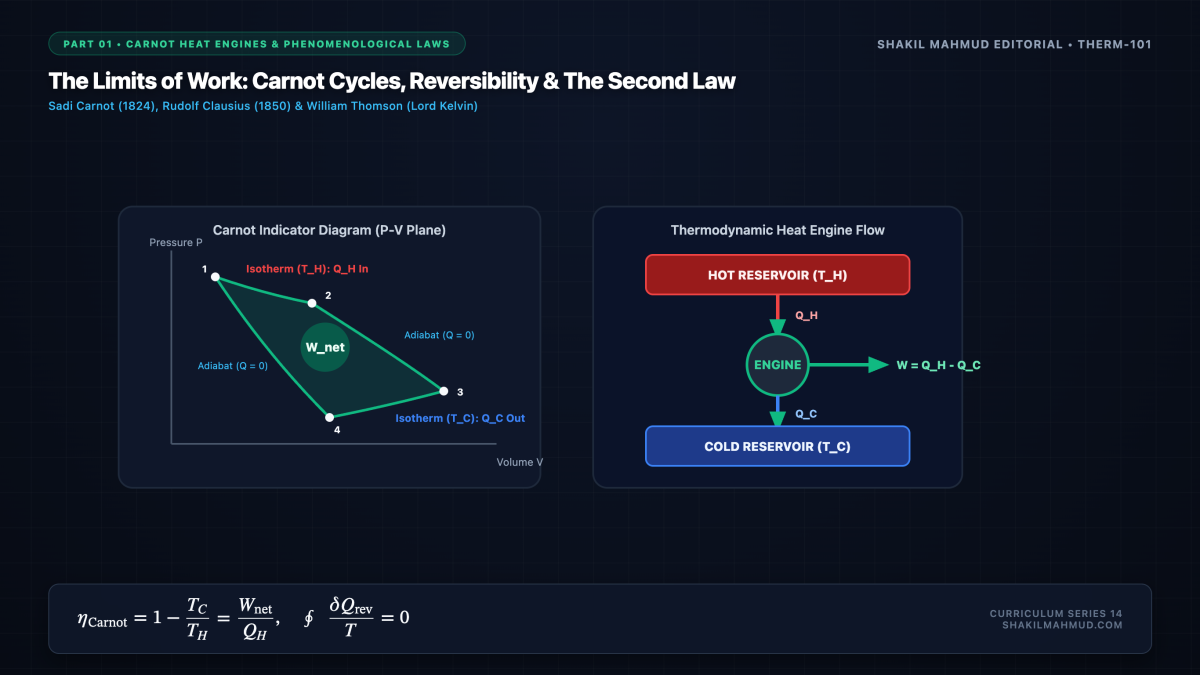
In 1824, a twenty-eight-year-old French military engineer named Nicolas Léonard Sadi Carnot published a modest sixty-five-page treatise titled Réflexions sur la puissance motrice du feu (“Reflections on the Motive Power of Fire”). At the dawn of the Industrial Revolution, steam engines were noisy, smoky iron behemoths devouring coal with startling inefficiency. Engineers believed that work was created by the consumption of a weightless fluid called “caloric.” Carnot pierced through this material illusion. He recognized that work is generated not by the destruction of heat, but by its transport down an imperial thermal cascade—from a furnace of high caloric potential to a condenser of low potential, precisely analogous to water turning a mill wheel as it plunges over a cataract.
The Ideal Engine & Thermodynamic Reversibility
Carnot asked a foundational question that transcended the metallurgy and engineering of his era: What is the theoretical upper bound on the mechanical work that can be extracted from a given quantity of heat? To answer this, he abstracted away friction, turbulence, and unintended conductive losses, conceiving an idealized, closed thermodynamic cycle executing across four frictionless, quasi-static transformations of an ideal working substance:
- Reversible Isothermal Expansion ($1 to 2$): The cylinder is placed in diathermal contact with a hot reservoir at absolute temperature $T_H$. As the gas expands from volume $V_1$ to $V_2$, it absorbs heat $Q_H$ while maintaining an invariant temperature. The work performed equals $W_{12} = int_{V_1}^{V_2} P , dV = n R T_H ln(V_2 / V_1) = Q_H$.
- Reversible Adiabatic Expansion ($2 to 3$): Thermally insulated from its surroundings ($dQ = 0$), the working gas continues expanding against the piston, cooling internally from $T_H$ to the cold reservoir temperature $T_C$. The internal energy drops by $Delta U = -W_{23} = n C_v (T_C – T_H)$.
- Reversible Isothermal Compression ($3 to 4$): The cylinder is placed in contact with the cold sink at $T_C$. External work compresses the gas from $V_3$ to $V_4$, expelling heat $Q_C$ into the sink: $|Q_C| = n R T_C ln(V_3 / V_4)$.
- Reversible Adiabatic Compression ($4 to 1$): Thermally isolated once more, the gas is compressed back to its initial state $(P_1, V_1, T_H)$, raising its internal energy and temperature back to $T_H$.
Carnot’s Theorem & The Universal Efficiency Bound
Because each step in this ideal cycle is strictly reversible, the entire engine can be operated in reverse as an ideal heat pump or refrigerator, requiring an external input of work $W$ to extract heat $Q_C$ from the cold reservoir and deliver $Q_H$ to the hot reservoir. By invoking the logical impossibility of perpetual motion of the second kind—that no cyclic process can exist whose sole result is the spontaneous, uncompensated extraction of heat from a single reservoir to produce work (the Kelvin-Planck statement)—Carnot proved his celebrated theorem:
Carnot’s Theorem: No heat engine operating between two fixed thermal reservoirs can be more efficient than a reversible engine operating between the same reservoirs, and all reversible engines operating between these reservoirs possess identical efficiency, irrespective of the working substance.
For an ideal gas, the adiabatic trajectories satisfy $T_H V_2^{gamma – 1} = T_C V_3^{gamma – 1}$ and $T_H V_1^{gamma – 1} = T_C V_4^{gamma – 1}$, which immediately yields the expansion ratio equality $V_2 / V_1 = V_3 / V_4$. Consequently, the ratio of heat exchanged is dictated solely by temperature:
$$frac{Q_C}{Q_H} = frac{T_C}{T_H}$$
The maximum theoretical thermodynamic efficiency $eta$ is therefore an inviolable geometric constant of the temperature difference:
$$eta_{text{Carnot}} = frac{W_{text{net}}}{Q_H} = frac{Q_H – Q_C}{Q_H} = 1 – frac{T_C}{T_H}$$
Clausius, The Integral of Dissipation, and Entropy
Decades after Carnot’s tragic death from cholera at age thirty-six, German theoretical physicist Rudolf Clausius revisited this thermal ratio. Rewriting $frac{Q_C}{Q_H} = frac{T_C}{T_H}$ in signed convention where heat absorbed is positive and heat ejected is negative, the relation becomes:
$$frac{Q_H}{T_H} + frac{Q_C}{T_C} = 0$$
Clausius recognized that any arbitrary reversible cyclic process in the $Ptext{–}V$ plane can be decomposed into an infinite dense mesh of infinitesimal Carnot cycles. Integrating the differential heat transfer $delta Q_{text{rev}}$ around any closed path yields zero:
$$oint frac{delta Q_{text{rev}}}{T} = 0$$
This closed contour integral signifies that the quantity $dS = frac{delta Q_{text{rev}}}{T}$ is an exact differential of a state function. Clausius named this state function entropy ($S$), derived from the Greek word $tau rho o pi acute{eta}$ (transformation). For any irreversible, real-world cycle, uncompensated dissipation ensures that:
$$oint frac{delta Q}{T} le 0 implies Delta S ge int frac{delta Q}{T}$$
In an isolated system ($delta Q = 0$), entropy can never decrease: $dS ge 0$. The Second Law of Thermodynamics was born: while energy is universally conserved (First Law), the quality and work-potential of energy monotonically degrades throughout the cosmos.




