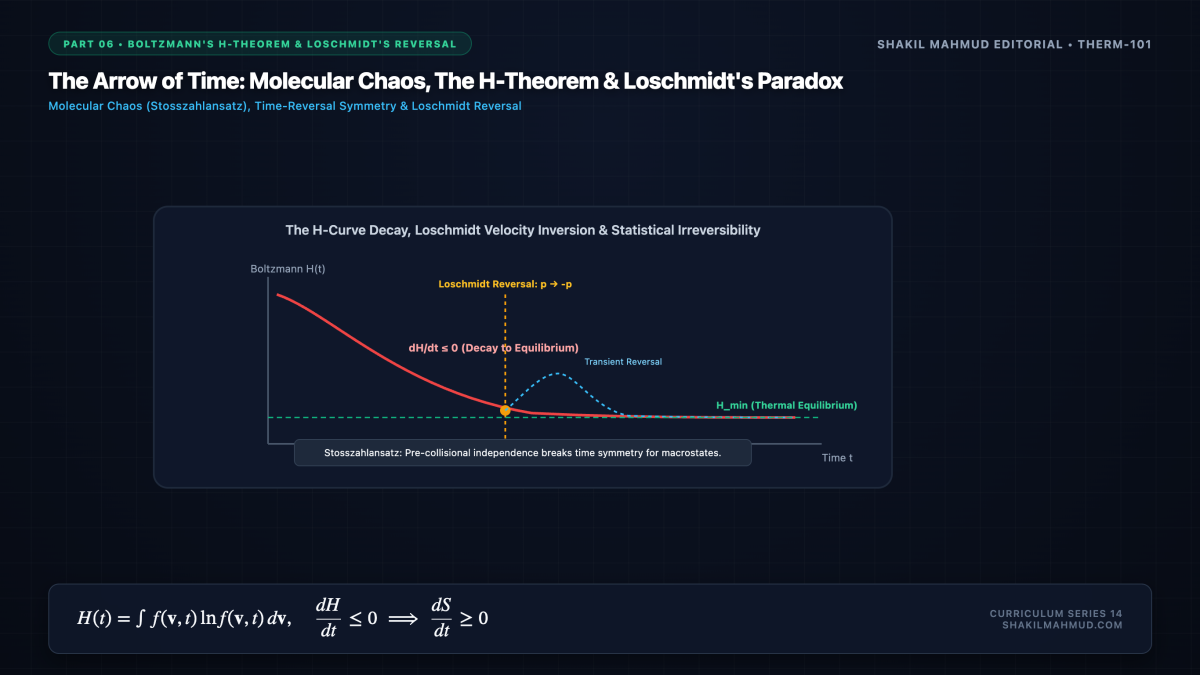
Newton’s laws of motion possess an exquisite mathematical symmetry: they are completely invariant under time reversal ($t to -t$). If you film the elastic collision of two billiard balls and run the projector in reverse, the reversed motion violates no law of mechanics. Why, then, in the real macroscopic world, does a dropped coffee mug shatter upon the floor while shards never spontaneously recombine and leap back into your hand? Why does an egg scramble, but never unscramble? In 1872, Ludwig Boltzmann formulated the H-Theorem in an attempt to prove mechanically why entropy must always increase. In doing so, he ignited one of the deepest debates in the history of science: the origin of the Arrow of Time.
The Boltzmann Transport Equation & The H-Functional
To follow the time evolution of a non-equilibrium gas, Boltzmann introduced the single-particle distribution function $f(mathbf{r}, mathbf{v}, t)$, where $f , d^3r , d^3v$ represents the expected number of particles in a phase space volume element around $(mathbf{r}, mathbf{v})$. In the absence of collisions, Liouville’s theorem dictates that $df/dt = 0$. Accounting for binary collisions between particles, Boltzmann constructed his famous transport equation:
$$frac{partial f}{partial t} + mathbf{v} cdot nabla_{mathbf{r}} f + frac{mathbf{F}}{m} cdot nabla_{mathbf{v}} f = left( frac{partial f}{partial t} right)_{text{coll}}$$
To evaluate the collision integral, Boltzmann introduced the Stosszahlansatz (the hypothesis of molecular chaos): he assumed that two colliding particles are statistically uncorrelated immediately prior to impact, so that the two-particle distribution factors as $f_2(mathbf{v}_1, mathbf{v}_2) = f(mathbf{v}_1) f(mathbf{v}_2)$. Under this assumption, Boltzmann defined the mathematical functional $H(t)$:
$$H(t) = int f(mathbf{v}, t) ln f(mathbf{v}, t) , d^3v$$
Notice that because $f ln f$ is the negative of the entropy density, $H(t)$ is directly proportional to negative thermodynamic entropy: $S(t) = -k_B H(t)$. Differentiating $H(t)$ with respect to time and inserting the collision integral derived from the Stosszahlansatz, Boltzmann proved his monumental result:
$$frac{dH}{dt} le 0 iff frac{dS}{dt} ge 0$$
The equality holds if and only if $f(mathbf{v})$ reaches the Maxwell-Boltzmann distribution. Boltzmann believed he had achieved the ultimate triumph: deriving the irreversible Second Law of Thermodynamics directly from the reversible laws of Newtonian collisions.
Loschmidt’s Paradox: The Reversibility Objection
Boltzmann’s Vienna colleague, Josef Loschmidt, immediately spotted a glaring paradox (the Umkehreinwand). Loschmidt argued:
For any dynamical trajectory of $N$ particles that leads from an initial ordered state $A$ to a disordered state $B$ (where $H$ decreases), there exists an exact microstate where every particle’s momentum is instantaneously reversed: $mathbf{p}_i to -mathbf{p}_i$. Under time-reversible Hamiltonian dynamics, this reversed state will retrace its trajectory backward with mechanical perfection, returning to state $A$ and causing $H$ to increase! Therefore, mechanical laws cannot possibly mandate that $dH/dt le 0$.
Loschmidt’s objection struck at the core of physics. How could time-asymmetry emerge from perfectly time-symmetric mechanics?
Molecular Chaos & The Statistical Resolution
Boltzmann realized that the asymmetry entered through the back door: specifically, inside his Stosszahlansatz. By assuming particles are uncorrelated before collision, he imposed an arrow of time upon the calculation. In reality, after two particles collide, their outgoing velocities are strongly correlated. If one reverses all momenta ($mathbf{p} to -mathbf{p}$), the particles now possess delicate post-collisional correlations that violate the molecular chaos hypothesis! Such backwards-evolving microstates do indeed exist, but their measure in phase space is astronomically infinitesimal.
The increase of entropy is not a deterministic mechanical absolute; it is an overwhelming statistical typicality. Out of $10^{10^{23}}$ possible microstates of an energy shell, the equilibrium macrostate occupies virtually $99.99999dots%$ of the phase volume. Any initial non-equilibrium state will inevitably wander into the overwhelmingly vast equilibrium region, simply because there are vastly more ways to be disordered than ordered.
The Past Hypothesis: Why Was the Early Universe Ordered?
This statistical resolution raised an even deeper cosmological enigma: If high entropy is overwhelmingly typical, why is our universe not in thermal equilibrium today? Why do stars burn, engines run, and living organisms exist?
As modern physicists like Richard Feynman and Roger Penrose have emphasized, the Second Law of Thermodynamics operates only because the universe was born roughly 13.8 billion years ago in an extraordinarily, inexplicably low-entropy state (the Past Hypothesis). At the Big Bang, matter was distributed with breathtaking gravitational smoothness, creating a colossal reservoir of gravitational negative entropy. Every increase of entropy on Earth today—from the burning of coal to the firing of a neuron—is the slow, inexorable unwinding of that primordial cosmic clock.




