Throughout the eighteenth and nineteenth centuries, classical thermodynamics reigned as a phenomenological masterpiece. It dictated how steam expanded, how pistons moved, and how chemical equilibriums shifted—yet it maintained a resolute silence regarding the microscopic constitution of matter. What, physically, is pressure? What is temperature? In 1859, a twenty-eight-year-old Scottish mathematical physicist named James Clerk Maxwell took a daring leap into the unseen. Treating a volume of gas not as a continuous fluid, but as an astronomical swarm of billions of hard, elastic spherical atoms colliding under Newton’s laws of motion, Maxwell deduced the first statistical law of physics: the molecular velocity distribution.
The Statistical Formulation of Kinetic Pressure
Consider a cubical box of volume $V = L^3$ containing $N$ identical particles of mass $m$. When a particle with velocity $mathbf{v} = (v_x, v_y, v_z)$ undergoes an elastic collision with a boundary wall perpendicular to the $x$-axis, its perpendicular momentum changes by $Delta p_x = 2 m v_x$. The time between successive round-trip collisions with this wall is $Delta t = 2L / v_x$. According to Newton’s Second Law, the average force exerted on the wall by this single particle is:
$$F_x = frac{Delta p_x}{Delta t} = frac{2 m v_x}{2L / v_x} = frac{m v_x^2}{L}$$
Summing over all $N$ particles and dividing by the wall surface area $A = L^2$, the macroscopic pressure emerges as:
$$P = frac{1}{L^2} sum_{i=1}^N frac{m v_{x, i}^2}{L} = frac{N m}{V} langle v_x^2 rangle$$
Because spatial directions in an isotropic gas are completely symmetric, the mean-square velocity is evenly partitioned across all three spatial dimensions: $langle v^2 rangle = langle v_x^2 rangle + langle v_y^2 rangle + langle v_z^2 rangle = 3 langle v_x^2 rangle$. Substituting $langle v_x^2 rangle = frac{1}{3} langle v^2 rangle$ yields the foundational equation of kinetic theory:
$$P V = frac{1}{3} N m langle v^2 rangle = frac{2}{3} N left(frac{1}{2} m langle v^2 rangleright) = frac{2}{3} E_{text{kin}}$$
Comparing this statistical derivation with the empirical ideal gas law $P V = N k_B T$ reveals the profound microscopic meaning of temperature:
$$leftlangle frac{1}{2} m v^2 rightrangle = frac{3}{2} k_B T$$
Temperature is not an ethereal fluid. It is nothing more and nothing less than the direct measure of the average translational kinetic energy of microscopic constituents.
Maxwell’s Velocity Derivation & Isotropy
Maxwell recognized that while individual molecular collisions are violently erratic, the statistical distribution of velocities in thermal equilibrium must be stationary and isotropic. He postulated that the three orthogonal velocity components $(v_x, v_y, v_z)$ are statistically independent, so that the joint probability density factors as:
$$f(mathbf{v}) = f(v_x, v_y, v_z) = phi(v_x) phi(v_y) phi(v_z)$$
Furthermore, because the gas possesses no preferred direction in space, the probability density can depend solely on the magnitude of the velocity squared, $v^2 = v_x^2 + v_y^2 + v_z^2$. The only functional equation satisfying $phi(v_x)phi(v_y)phi(v_z) = psi(v_x^2 + v_y^2 + v_z^2)$ is the exponential:
$$phi(v_x) = left(frac{m}{2pi k_B T}right)^{1/2} expleft(-frac{m v_x^2}{2 k_B T}right)$$
To find the distribution of speeds $v = |mathbf{v}|$, we integrate the three-dimensional velocity density over a spherical shell of radius $v$ and thickness $dv$ in velocity space ($d^3mathbf{v} = 4pi v^2 dv$). This produces the famous Maxwell-Boltzmann Speed Distribution:
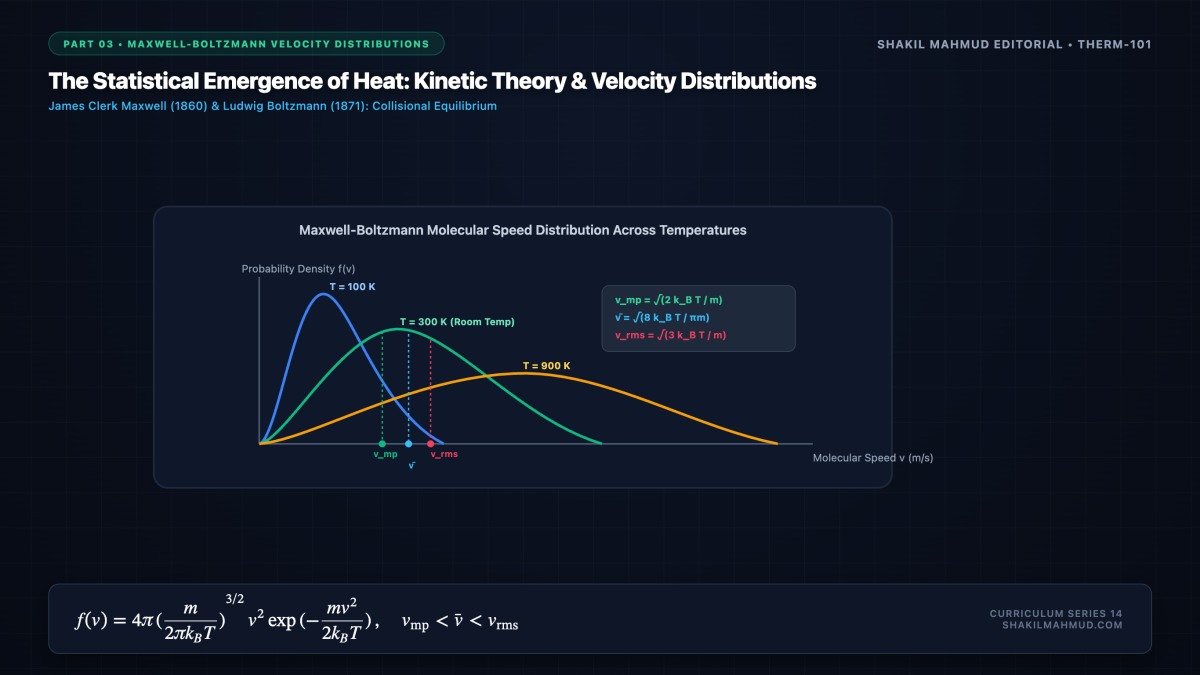
$$f(v) , dv = 4pi left(frac{m}{2pi k_B T}right)^{3/2} v^2 expleft(-frac{m v^2}{2 k_B T}right) dv$$
Three Characteristic Velocities & The Equipartition Theorem
Because the Maxwell distribution is asymmetric—characterized by a parabolic rise $v^2$ at low speeds and an exponential Gaussian tail $e^{-m v^2 / 2k_B T}$ at high speeds—it yields three distinct characteristic velocities:
- Most Probable Speed ($v_{text{mp}}$): Found by maximizing $f(v)$ ($frac{df}{dv} = 0$):
$$v_{text{mp}} = sqrt{frac{2 k_B T}{m}} approx 1.414 sqrt{frac{k_B T}{m}}$$ - Mean Arithmetic Speed ($bar{v}$): The first moment $int_0^infty v f(v) , dv$:
$$bar{v} = sqrt{frac{8 k_B T}{pi m}} approx 1.596 sqrt{frac{k_B T}{m}}$$ - Root-Mean-Square Speed ($v_{text{rms}}$): The square root of the second moment $sqrt{int_0^infty v^2 f(v) , dv}$:
$$v_{text{rms}} = sqrt{frac{3 k_B T}{m}} approx 1.732 sqrt{frac{k_B T}{m}}$$
This hierarchy $v_{text{mp}} < bar{v} < v_{text{rms}}$ is a universal signature of thermal equilibrium. Ludwig Boltzmann later generalized this result into the Equipartition Theorem: for any classical system in thermal equilibrium governed by quadratic degrees of freedom in the Hamiltonian ($H = sum a_i q_i^2 + sum b_i p_i^2$), each independent translational, rotational, or vibrational degree of freedom stores precisely $frac{1}{2} k_B T$ of thermal energy. Heat had finally been demystified: it was the chaotic, harmonious dance of trillions of unseen particles.