Classical thermodynamics is, strictly speaking, a misnomer: it is a science of thermo-statics. Its classical equations describe quiescent systems that have ceased to change, pinned motionless in equilibrium. Yet our living biosphere and technological civilization operate entirely through flow: currents of heat, fluxes of electric charge, diffusion of chemical reactants, and transport of momentum. In 1931, a twenty-eight-year-old Norwegian-born physical chemist named Lars Onsager published two seminal papers in the Physical Review that extended thermodynamics into the realm of irreversible flows. Onsager discovered that when multiple transport processes couple together, nature enforces an astonishing mathematical reciprocity: the matrix of cross-transport coefficients is perfectly symmetric.
Thermodynamic Forces, Fluxes, and Entropy Production
To analyze a non-equilibrium system in the linear regime, we partition it into local volume elements where local thermodynamic equilibrium holds. When gradients exist across the system, they generate continuous thermodynamic currents or fluxes $J_i$ (such as heat current $mathbf{J}_q$, electric current $mathbf{J}_e$, or matter flux $mathbf{J}_k$). Each flux is driven by a conjugate thermodynamic force (or affinity) $X_i$, defined as the gradient of an intensive state variable:
- For heat conduction: $X_q = nablaleft(frac{1}{T}right) = -frac{nabla T}{T^2}$
- For electric conduction: $X_e = -frac{nabla V}{T}$
- For chemical diffusion: $X_k = -nablaleft(frac{mu_k}{T}right)$
According to the Second Law, irreversible transport processes continuously generate entropy. The local rate of entropy production $sigma$ (entropy generated per unit volume per unit time) is an invariant bilinear sum of fluxes and conjugate forces:
$$sigma = sum_{i} J_i X_i ge 0$$
The inequality $sigma ge 0$ is the local manifestation of the Second Law: entropy must be produced, never destroyed.
Linear Phenomenological Relations & Coupled Transport
Close to equilibrium, the thermodynamic forces are weak, allowing us to approximate each flux as a linear Taylor expansion in all driving forces:
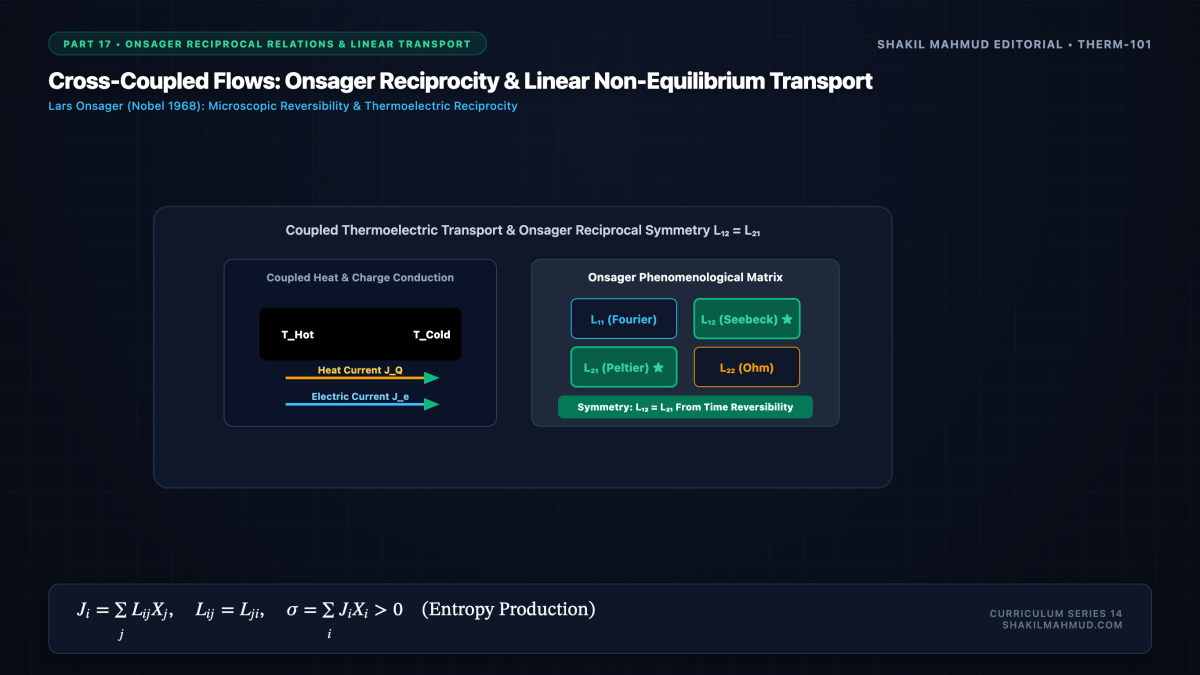
$$J_i = sum_{j} L_{ij} X_j$$
Here, $L_{ij}$ are the phenomenological transport coefficients:
- The diagonal coefficients $L_{ii}$ represent direct classical transport laws: $L_{qq}$ yields Fourier’s law of heat conduction ($J_q = -kappa nabla T$), while $L_{ee}$ yields Ohm’s law of electrical conduction ($J_e = -sigma_{text{elec}} nabla V$).
- The off-diagonal coefficients $L_{ij}$ ($i ne j$) represent cross-coupling effects, where a gradient in one physical quantity directly drives the flux of an entirely different quantity!
The prime example is thermoelectricity: a temperature gradient $nabla T$ not only conducts heat, but pushes mobile electrons, driving an electric current (the Seebeck Effect, $L_{eq}$). Conversely, passing an electric current through a junction drives a concurrent heat flux, heating or cooling the interface (the Peltier Effect, $L_{qe}$).
Onsager’s Reciprocal Theorem & Microscopic Reversibility
For nearly a century, engineers and physicists treated the Seebeck and Peltier coefficients as independent material constants. In 1931, Onsager demonstrated that they are mathematically identical. By analyzing the spontaneous Gaussian thermal fluctuations of state variables $alpha_i$ around equilibrium and invoking the microscopic time-reversibility of Hamiltonian mechanics ($langle alpha_i(0) alpha_j(t) rangle = langle alpha_i(t) alpha_j(0) rangle$), Onsager proved his celebrated theorem:
Onsager Reciprocal Relations: Provided the thermodynamic forces $X_i$ and fluxes $J_i$ are chosen such that the entropy production rate is $sigma = sum_i J_i X_i$, the matrix of phenomenological coefficients is strictly symmetric:
$$L_{ij} = L_{ji}$$
If the system is placed in an external magnetic field $mathbf{B}$ or rotates with angular velocity $boldsymbol{Omega}$ (which break time-reversal invariance by inverting under $t to -t$), Hendrik Casimir generalized the relation:
$$L_{ij}(mathbf{B}) = L_{ji}(-mathbf{B})$$
The Fourth Law of Thermodynamics
Onsager’s reciprocity is so fundamental that many physicists refer to it as the “Fourth Law of Thermodynamics.” It reduces the number of independent transport coefficients from $n^2$ to $frac{1}{2}n(n+1)$, proving that cross-effects in nature are locked in perfect mutual harmony: the efficiency with which a temperature gradient produces an electric voltage is identical to the efficiency with which an electric voltage produces thermal pumping.
In 1968, thirty-seven years after his paper was published, Lars Onsager was awarded the Nobel Prize in Chemistry for discovering the reciprocal relations that laid the mathematical foundations of modern non-equilibrium thermodynamics.