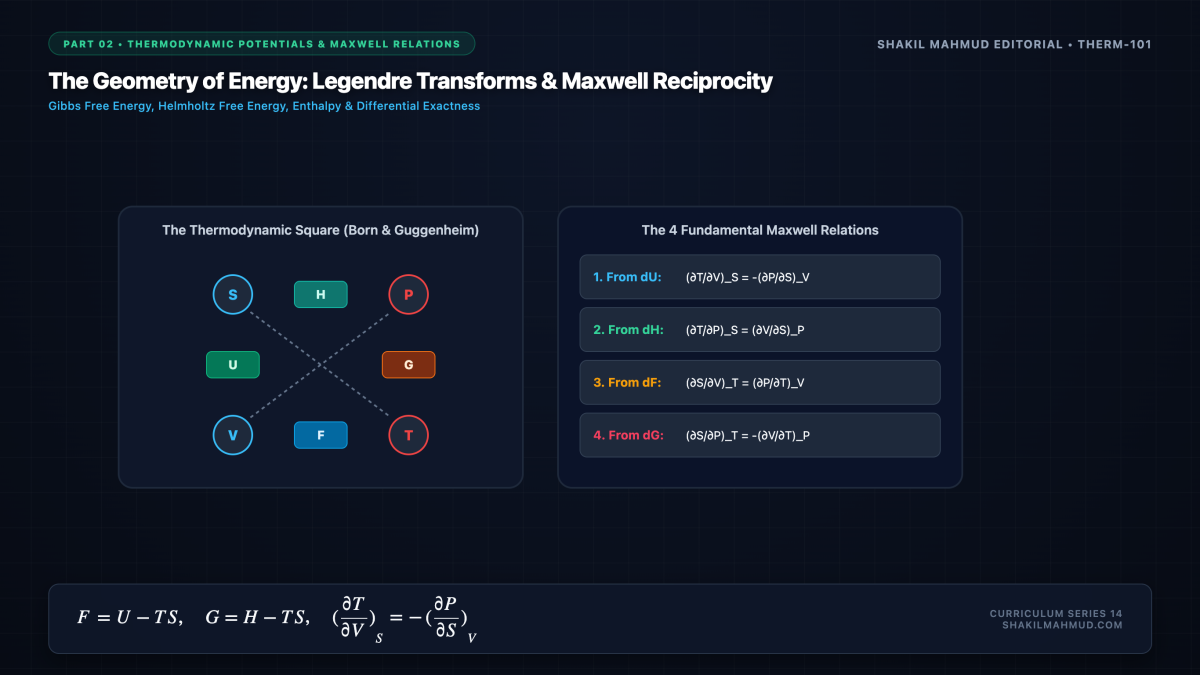
In classical mechanics, a dynamical system is fully governed by an energy function—the Lagrangian or Hamiltonian. In macroscopic thermodynamics, however, energy is not a monolith. When a chemical reaction unfolds at atmospheric pressure, or a protein folds inside an isothermal intracellular bath, the fundamental quantity that dictates equilibrium and spontaneous change is not simply the total internal energy $U$, but a specialized energy potential molded by the external constraints of the environment. Through the elegant mathematical machinery of Legendre transformations, thermodynamics constructs four fundamental potentials, revealing a breathtaking geometric symmetry codified in the Maxwell reciprocity relations.
The Fundamental Thermodynamic Relation & Internal Energy
The First and Second Laws combine to define the fundamental differential identity for a simple compressible substance undergoing an internally reversible process:
$$dU = T dS – P dV + sum_{i} mu_i dN_i$$
Here, the internal energy $U = U(S, V, {N_i})$ is expressed in terms of its canonical, extensive natural variables: entropy $S$, volume $V$, and mole numbers $N_i$. The intensive conjugate variables emerge as partial derivatives:
$$T = left(frac{partial U}{partial S}right)_{V, N}, quad P = -left(frac{partial U}{partial V}right)_{S, N}, quad mu_i = left(frac{partial U}{partial N_i}right)_{S, V, N_{j ne i}}$$
While theoretically pure, $U(S, V, N)$ is experimentally inconvenient. Controlling entropy in a laboratory requires perfect adiabatic shields, whereas measuring and tuning temperature $T$ or pressure $P$ is effortless. We need a mathematical bridge to swap extensive variables with their intensive conjugates without losing any physical information.
Legendre Transforms: The Duality of Convex Geometries
Consider a smooth, strictly convex function $f(x)$. The curve can be parameterized either by the collection of points $(x, f(x))$ or, dualistically, by the envelope of its tangent lines characterized by their slopes $p = f'(x)$ and their vertical intercepts $-g(p)$. The Legendre transform defines this dual function $g(p)$:
$$g(p) = sup_{x} [p x – f(x)] implies g(p) = p x(p) – f(x(p))$$
Applying this duality to thermodynamics replaces independent variables while preserving the complete informational content of the fundamental equation of state:
- Helmholtz Free Energy $F(T, V, N)$: Swapping entropy $S$ for temperature $T$ via $F = U – TS$. Taking the exterior derivative:
$$dF = dU – T dS – S dT = -S dT – P dV + mu dN$$
Under constant temperature and volume ($dT = 0, dV = 0$), spontaneous processes minimize $F$. $F$ represents the maximum “free” isothermal work extractable from the system: $W_{text{max}} = -Delta F$. - Enthalpy $H(S, P, N)$: Swapping volume $V$ for pressure $P$ via $H = U + PV$:
$$dH = dU + P dV + V dP = T dS + V dP + mu dN$$
Under isobaric conditions ($dP = 0$), the heat exchanged during a process is identically the change in enthalpy: $dQ_P = dH$. - Gibbs Free Energy $G(T, P, N)$: Simultaneously swapping $(S to T)$ and $(V to P)$ via $G = U – TS + PV = H – TS$:
$$dG = -S dT + V dP + mu dN$$
Because most benchtop experiments, chemical syntheses, and biological cellular processes occur at ambient room temperature and atmospheric pressure ($dT = 0, dP = 0$), the Gibbs free energy is the supreme thermodynamic potential of chemistry: spontaneous change occurs if and only if $dG le 0$.
The Maxwell Reciprocity Relations & Thermodynamic Squares
Because thermodynamic potentials are state functions, their mixed second partial derivatives must commute (Schwarz’s theorem on symmetry of second derivatives). For any twice continuously differentiable function $Phi(x, y)$, $frac{partial^2 Phi}{partial x partial y} = frac{partial^2 Phi}{partial y partial x}$. Applying this mathematical inevitability to the four potentials yields the celebrated Maxwell Relations:
- From $dU = T dS – P dV$:
$$left(frac{partial T}{partial V}right)_S = -left(frac{partial P}{partial S}right)_V$$ - From $dH = T dS + V dP$:
$$left(frac{partial T}{partial P}right)_S = left(frac{partial V}{partial S}right)_P$$ - From $dF = -S dT – P dV$:
$$left(frac{partial S}{partial V}right)_T = left(frac{partial P}{partial T}right)_V$$ - From $dG = -S dT + V dP$:
$$left(frac{partial S}{partial P}right)_T = -left(frac{partial V}{partial T}right)_P$$
The practical consequence of these relations is staggering. Quantities that seem impossible to measure directly—such as the change in entropy of a solid as it is compressed isothermally, $(partial S / partial P)_T$—are converted into easily measurable macroscopic properties: the volumetric thermal expansion coefficient $alpha = frac{1}{V}(partial V / partial T)_P$. Through Legendre duality, thermodynamics weaves an unbreakable mathematical tapestry binding mechanical, thermal, and chemical measurements into a single unified architecture.




