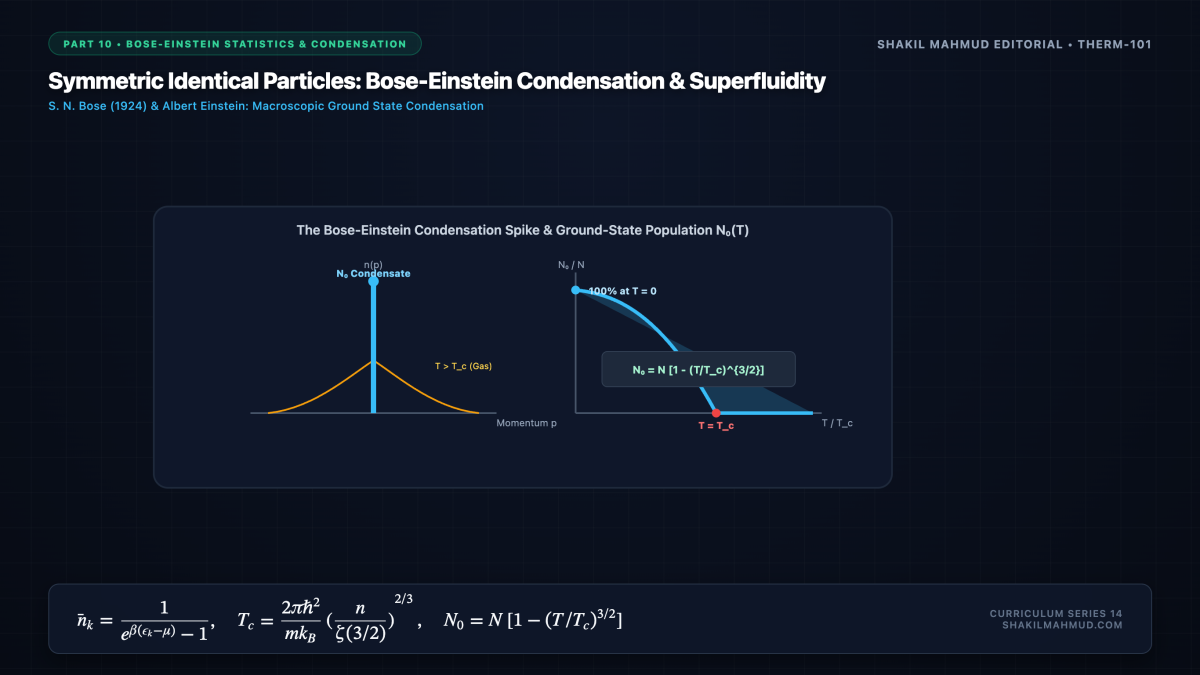
In June 1924, an obscure Indian theoretical physicist at the University of Dacca named Satyendra Nath Bose mailed a handwritten manuscript directly to Albert Einstein in Berlin. Bose had derived Planck’s blackbody radiation law without invoking classical electrodynamics, treating light as a gas of massless, completely indistinguishable particles that obeyed a novel counting statistic. Einstein recognized the revolutionary brilliance of the paper immediately. He personally translated it into German for publication in the Zeitschrift für Physik and extended Bose’s statistical method from photons to non-relativistic massive atoms. In doing so, Einstein uncovered a breathtaking prediction: at ultra-cold temperatures, quantum particles would spontaneously lose their individual identities and merge into a single macroscopic giant wave—the Bose-Einstein Condensate.
Quantum Indistinguishability & Bose Statistics
In classical physics, identical particles can always be tracked along their individual continuous trajectories. In quantum mechanics, however, the Heisenberg uncertainty principle blurs trajectories, making identical particles fundamentally indistinguishable. For a system of particles with integer spin ($S = 0, 1, 2, dots$), known as bosons, the many-body wavefunction must be completely symmetric under particle exchange:
$$psi(mathbf{r}_1, dots, mathbf{r}_j, dots, mathbf{r}_k, dots, mathbf{r}_N) = +psi(mathbf{r}_1, dots, mathbf{r}_k, dots, mathbf{r}_j, dots, mathbf{r}_N)$$
Because there is no restriction on how many bosons can occupy a single quantum state, the grand partition function factorizes over independent single-particle energy levels $epsilon_k$:
$$Xi_{text{Bose}} = prod_{k} sum_{n_k=0}^{infty} e^{-beta(epsilon_k – mu) n_k} = prod_{k} frac{1}{1 – e^{-beta(epsilon_k – mu)}}$$
For the geometric series to converge, the argument must satisfy $e^{-beta(epsilon_k – mu)} < 1$, which imposes an absolute thermodynamic ceiling on the chemical potential: $mu le epsilon_0$. Setting the ground state energy to zero ($epsilon_0 = 0$), the chemical potential of a Bose gas is strictly non-positive: $mu le 0$. Taking the derivative with respect to $mu$ yields the Bose-Einstein Distribution:
$$bar{n}_k = frac{1}{e^{beta(epsilon_k – mu)} – 1}$$
The Condensation Phenomenon & Critical Temperature
To determine the total particle number $N$, we separate the ground state population $N_0$ from the excited states and convert the sum over excited states into an integral using the 3D density of states $g(epsilon) = frac{V m^{3/2}}{sqrt{2}pi^2 hbar^3} epsilon^{1/2}$:
$$N = N_0 + int_0^infty frac{g(epsilon)}{e^{beta(epsilon – mu)} – 1} , depsilon = N_0 + V left(frac{m k_B T}{2pi hbar^2}right)^{3/2} g_{3/2}(z)$$
where $g_{3/2}(z) = sum_{j=1}^infty frac{z^j}{j^{3/2}}$ is the Polylogarithm function of fugacity $z = e^{beta mu}$. As the temperature drops at fixed particle density $n = N/V$, the fugacity increases toward its maximum theoretical bound $z to 1$ ($mu to 0^-$), where the polylogarithm reaches the Riemann zeta function $zeta(3/2) approx 2.612$.
At this threshold, the excited states become completely saturated: they can hold no more particles! The critical temperature at which saturation occurs is:
$$T_c = frac{2pi hbar^2}{m k_B} left( frac{N / V}{zeta(3/2)} right)^{2/3} approx 3.31 frac{hbar^2 n^{2/3}}{m k_B}$$
Expressed in terms of the thermal de Broglie wavelength $lambda_{text{th}} = sqrt{frac{2pi hbar^2}{m k_B T}}$, condensation occurs precisely when the wavepackets of neighboring atoms overlap in space: $n lambda_{text{th}}^3 ge 2.612$.
Macroscopic Quantum Coherence Below Tc
For any temperature below $T_c$, any excess particles beyond the capacity of the excited states are forced by pure quantum statistics to collapse directly into the zero-momentum ground state ($epsilon_0 = 0$):
$$frac{N_0(T)}{N} = 1 – left(frac{T}{T_c}right)^{3/2}$$
This is a phase transition driven entirely by quantum statistics, with zero interparticle forces required! In the condensate, billions of independent atoms coordinate their quantum phases into a single macroscopic wavefunction $Psi(mathbf{r}) = sqrt{n_0} e^{itheta}$, exhibiting zero viscosity, macroscopic quantum vortices, and superfluidity.
In 1995—seventy years after Einstein’s theoretical paper—Eric Cornell and Carl Wieman at JILA/NIST cooled rubidium-87 vapor down to 170 nanokelvin using laser cooling and magnetic evaporative traps, producing the first pristine laboratory Bose-Einstein condensate and winning the 2001 Nobel Prize in Physics. Bose and Einstein’s vision had become living physical reality.




