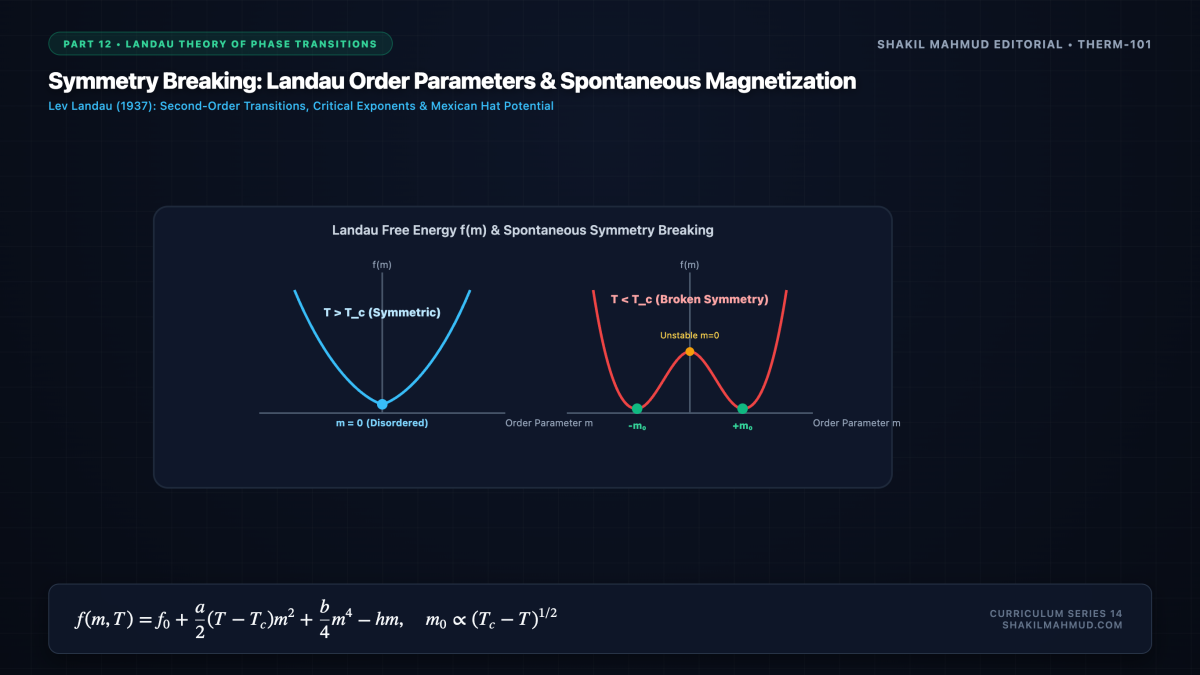
Water boiling into steam, molten iron freezing into a ferromagnet, a ceramic oxide losing all electrical resistance to become a superconductor—these sudden, dramatic metamorphoses of matter are known as phase transitions. To microscopic physics, they present a profound mathematical puzzle: the microscopic Hamiltonian of atoms is perfectly smooth and analytic, yet macroscopic phase transitions exhibit sharp discontinuities and infinities. In 1937, Soviet theoretical physicist Lev Davidovich Landau revolutionized our understanding of critical phenomena by introducing a universal conceptual framework rooted in the geometry of symmetry: Landau Mean Field Theory.
The Ehrenfest Classification of Phase Transitions
In classical thermodynamics, Paul Ehrenfest classified phase transitions based on the lowest derivative of the free energy that exhibits a mathematical discontinuity:
- First-Order Transitions: The first derivatives of the Gibbs free energy $G(T, P)$ are discontinuous. Because $(partial G / partial T)_P = -S$ and $(partial G / partial P)_T = V$, these transitions involve a discontinuous jump in entropy (requiring a latent heat $L = T Delta S$) and volume (density discontinuity). Ice melting and water boiling are classic first-order transitions with phase coexistence.
- Continuous (Second-Order) Transitions: The first derivatives are continuous (no latent heat, $Delta S = 0$), but the second derivatives diverge or jump discontinuously: heat capacity $C_P = -T(partial^2 G / partial T^2)_P$, isothermal compressibility $kappa_T$, and magnetic susceptibility $chi$. Ferromagnetic Curie points and superfluid transitions are continuous.
The Order Parameter & Spontaneous Symmetry Breaking
Landau recognized that continuous transitions cannot be understood merely by thermodynamic derivatives; they represent a fundamental change in the symmetry of the system. Above a critical temperature $T_c$, a ferromagnet is completely disordered: magnetic moments point randomly in all directions, invariant under continuous spatial rotations $SO(3)$. Below $T_c$, the spins align collectively along a single spontaneous axis: the rotational symmetry of the Hamiltonian is spontaneously broken.
To quantify this broken symmetry, Landau introduced the concept of the Order Parameter ($m$): a macroscopic variable that is identically zero in the high-temperature symmetric phase and acquires a non-zero value in the low-temperature ordered phase:
$$m = begin{cases} 0 & text{for } T > T_c \ pm m_0(T) ne 0 & text{for } T < T_c end{cases}$$
The Landau Free Energy Expansion
Near the critical point, the order parameter is small ($m ll 1$). Landau postulated that the free energy density $f(m, T)$ can be expanded as a Taylor series in powers of $m$. By spatial inversion symmetry ($m to -m$), all odd powers must vanish in the absence of an external field $h$:
$$f(m, T) = f_0(T) + frac{a(T)}{2} m^2 + frac{b(T)}{4} m^4 – h m$$
To ensure thermodynamic stability (that free energy is bounded from below as $m to infty$), the quartic coefficient must be strictly positive: $b > 0$. The quadratic coefficient $a(T)$ must change sign across the critical point, parameterised to first order as:
$$a(T) = a_0 (T – T_c), quad a_0 > 0$$
Examining the geometry of this potential reveals the mechanism of spontaneous symmetry breaking:
- For $T > T_c$ ($a > 0$): The potential $f(m)$ is a single convex parabola with a unique global minimum at $m^* = 0$. The disordered, symmetric phase is stable.
- For $T < T_c$ ($a < 0$): The origin $m = 0$ becomes an unstable local maximum. The potential develops a double-well (the “Mexican hat” profile in 2D), with two degenerate minima at:
$$frac{partial f}{partial m} = a_0 (T – T_c) m + b m^3 = 0 implies m_0(T) = pm sqrt{frac{a_0}{b}} (T_c – T)^{1/2}$$
The system must arbitrarily choose one minimum, spontaneously breaking the $pm m$ reflection symmetry!
Universal Mean Field Critical Exponents
Landau’s framework predicts universal power laws for macroscopic observables near the critical point $|t| = |T – T_c| / T_c to 0$:
- Order Parameter Exponent ($beta$): $m_0 propto (-t)^beta implies beta = 1/2$.
- Susceptibility Exponent ($gamma$): Differentiating with respect to external field $h$ at $m=0$:
$$chi = left(frac{partial m}{partial h}right)_{h=0} = frac{1}{a_0 |T – T_c|} propto |t|^{-gamma} implies gamma = 1$$ - Specific Heat Discontinuity ($alpha$): Evaluating the free energy minimum yields a finite jump in heat capacity at $T_c$: $Delta C = frac{a_0^2 T_c}{2b}$, so $alpha = 0$.
The Ginzburg Criterion: The Limit of Mean Field Theory
Landau mean field theory assumes that the order parameter is spatially uniform, ignoring local statistical fluctuations. Vitaly Ginzburg formulated the criterion to test when spatial fluctuations destroy Landau’s predictions. The Ginzburg Criterion states that mean field theory is valid only when fluctuations over a correlation volume $xi^d$ are negligible compared to the mean value:
$$frac{langle (delta m)^2 rangle_{xi}}{m_0^2} ll 1 implies d > d_u = 4$$
In spatial dimensions $d < 4$, fluctuations diverge near $T_c$, causing Landau's classical exponents ($beta = 1/2, gamma = 1$) to fail. To capture the true physics of critical phase transitions in our 3D world, physics had to invent a radically new mathematical weapon: the Renormalization Group.




